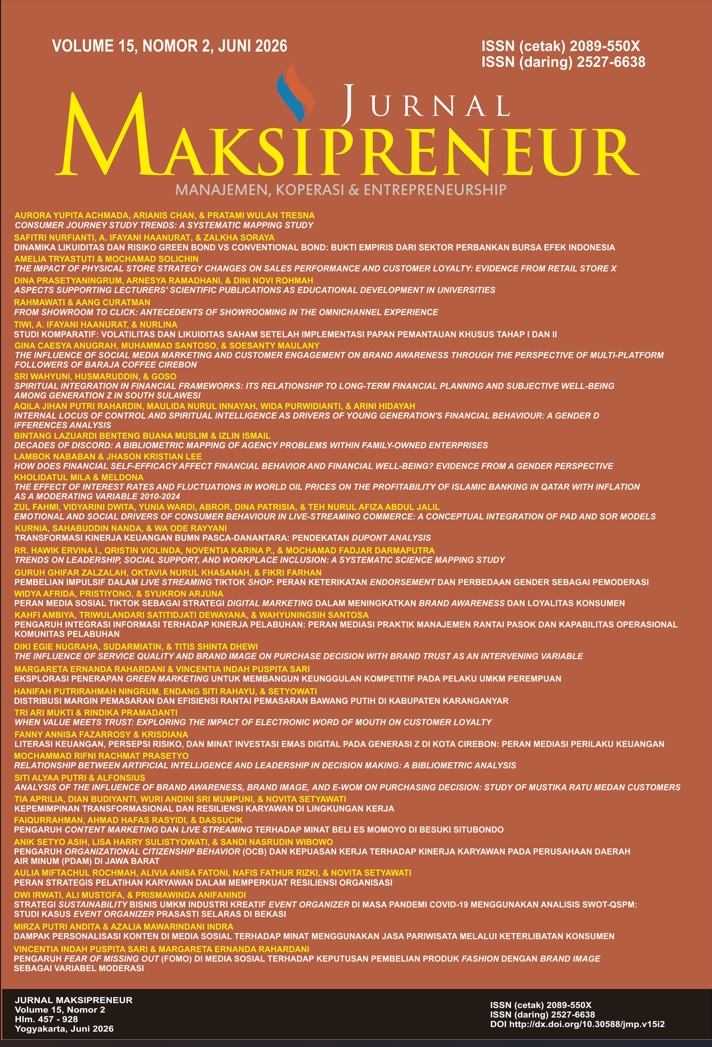
Spiritual Integration in Financial Frameworks: Its Relationship to Long-Term Financial Planning and Subjective Well-Being Among Generation Z in South Sulawesi
DOI:
https://doi.org/10.30588/jmp.v15i2.2632Keywords:
Life Awareness, Money Management, Psychological Meaning, Financial Behavior, Spiritual IntelligenceAbstract
Generation Z in South Sulawesi faces challenges in managing their finances carefully amid a consumerist lifestyle and modernization pressures. This study examines the influence of spiritual integration on long-term financial planning and subjective well-being. A quantitative approach is used, employing the survey method. The carefully prepared questionnaire was administered to 100 respondents from Generation Z, aged 15 to 29, all from South Sulawesi. These respondents were selected using the purposive sampling method. The collected data were then analyzed using the Partial Least Squares Structural Equation Modeling technique, or PLS-SEM for short. The results of the analysis show that spirituality plays a major role in fostering a more responsible financial attitude, improving long-term financial planning, and strengthening people's subjective well-being. In addition, long-term financial planning partially mediates the relationship between spiritual integration and subjective well-being. These findings confirm that a financial approach that incorporates spiritual values can be an effective strategy to improve the quality of life among young people. They highlight the importance of integrating the spiritual dimension into financial education programs.
References
Ahamed, A. F. M. J. (2024). The Pursuit of Subjective Well-Being Through Financial Well-Being, Relationship Quality, and Spiritual Well-Being: A Configuration Approach with Fuzzy-Set Qualitative Comparative Analysis (fsQCA). Journal of Family and Economic Issues, 46, 784–801. https://doi.org/10.1007/s10834-024-09968-6
Ajzen, I. (1991). The Theory of Planned Behavior. Disability, CBR and Inclusive Development, 50(2), 179–211. https://doi.org/10.1016/0749-5978(91)90020-T
Bado, B., Hasan, M., Tahir, T., & Hasbiah, S. (2023). How do Financial Literacy, Financial Management Learning, Financial Attitudes, and Financial Education in Families Affect Personal Financial Management in Generation Z? International Journal of Professional Business Review, 8(5), 2001. https://doi.org/10.26668/businessreview/2023.v8i5.2001
Captari, L. E., Sandage, S. J., & Vandiver, R. A. (2022). Spiritually integrated psychotherapies in real-world clinical practice: Synthesizing the literature to identify best practices and future research directions. Psychotherapy, 59(3), 307–320. https://doi.org/10.1037/pst0000407
Diah, A. I. G. A. A., & Henny, R. (2021). The Influence of Financial Literacy, Self–Control, Spiritual Quotient, and Financial Behavior Towards Financial Wellbeing: A Case Study of Civil Servant in Kantor Regional X BKN Denpasar. Eurasia: Economics & Business, 8(50), 41–50. https://doi.org/10.18551/econeurasia.2021-08
Diener, E. (1984). Subjective Well-Being. Psychological Bulletin, 95(3), 542–575. https://doi.org/10.1037/0033-2909.95.3.542
Emmons, R. A. (2000). Is Spirituality an Intelligence? Motivation, Cognition, and the Psychology of Ultimate Concern. International Journal of Phytoremediation, 10(1), 3–26.
Enete, S., & McDowell, S. (2024). Way of life: A future research agenda for how worldviews impact financial attitudes and behaviors. Financial Planning Review, 7(1), 1–15. https://doi.org/10.1002/cfp2.1177
Goi, M. T., Palil, M. R., Zain, N. H. M., & Mamat, N. H. (2024). Self-Efficacy, Religiosity, Financial Behavior, and Financial Well-Being. Proceedings of the 9th International Conference on Marketing and Retailing (INCOMaR 2023), March 1-2, 2023, Sabah, Malaysia, 133, 421–431. https://doi.org/10.15405/epsbs.2024.05.35
Jangid, J., Bhardwaj, B., & Sharma, D. (2024). The nexus between spirituality and personal financial behavior: a study of students with entrepreneurial intentions. LBS Journal of Management & Research, 22(2), 190–199. https://doi.org/10.1108/lbsjmr-03-2024-0011
Lone, U. M., & Bhat, S. A. (2022). Impact of financial literacy on financial well-being: a mediational role of financial self-efficacy. Journal of Financial Services Marketing, 29(1), 122–137. https://doi.org/10.1057/s41264-022-00183-8
Maobe, A. (2020). The overlay between demographic characteristics, spirituality and retirement planning, Kenya expose. Cogent Social Sciences, 6(1), 1–18. https://doi.org/10.1080/23311886.2020.1831147
Mappadang, A., Hendryadi, H., Yoewono, H., Elizabeth, E., & Fitriawati, R. (2025). The God locus of financial control, impulsive use of buy-now-pay-later service, and subjective financial well-being among accounting students: The role of social comparison tendencies. Cogent Social Sciences, 11(1), 1–19. https://doi.org/10.1080/23311886.2025.2474192
Mulyadi, M., Oktrivina, A., Hendryadi, H., & Hendratni, T. W. (2023). The Islamic Religiosity and Financial Well-Being: A Moderated Mediation Model of Financial Behavior and Literacy. Jurnal Reviu Akuntansi dan Keuangan, 13(2), 249–268. https://doi.org/10.22219/jrak.v13i2.26790
Palimbong, S. M., Agnes, L., & Pali, E. (2022). The Influence of Hedonism Style, Spiritual Intelligence, and Financial Literacy on Student Personal Finance Management (Case study on students of the Faculty of Economics, Indonesian Christian University Toraja). Proceedings of The International Conference on Economics and Business, 1(2), 24–36. https://doi.org/10.55606/iceb.v1i2.109
Pong, H. K. (2022). Money Attitude and Spiritual Well-Being. Journal of Risk and Financial Management, 15(10), 1–16. https://doi.org/10.3390/jrfm15100483
Radiman, R., Wahyuni, S. F., Putri, L. P., Damaiyanti, A., & Anugrahwati P, D. (2025). Lecturers’ financial well-being: The role of religiosity, financial literacy, financial behavior, and financial stress with gender as a moderating variable. Investment Management and Financial Innovations, 22(2), 14–25. https://doi.org/10.21511/imfi.22(2).2025.02
Rahmawati, I. Y., Cahyaningsih, A., & Wiarsih, C. (2023). Pengaruh Kecerdasan Spiritual dan Literasi Keuangan Terhadap Manajemen Keuangan Pribadi. E-Journal Ekonomi Bisnis dan Akuntansi. https://jurnal.unej.ac.id/index.php/e-JEBAUJ/article/view/38289
Rahmayanti, D. (2023). The Effect of Internal Locus of Control and Spiritual Intelligence on Personal Financial Management Behavior. Integrated Journal of Business and Economics, 7(1), 340. https://doi.org/10.33019/ijbe.v7i1.596
Rosciano, M., & Starita, M. G. (2025). Relevant Topics in the Financial Well-Being Literature. Journal of Financial Management, Markets and Institutions, 13(1), 2430002. https://doi.org/10.1142/S2282717X24300022
Ryff, C. D. (2021). Spirituality and well-being: Theory, science, and the nature connection. Religions, 12(11), 914. https://doi.org/10.3390/rel12110914
Wijaya, H. R., Hati, S. R. H., Ekaputra, I. A., & Kassim, S. (2024). The impact of religiosity and financial literacy on financial management behavior and well-being among Indonesian Muslims. Humanities and Social Sciences Communications, 11(1), 1–13. https://doi.org/10.1057/s41599-024-03309-6
Wijayanti, K. L., & Ompusunggu, H. (2024). Pengaruh Literasi Keuangan, Kemudahan dan Kemanfaatan terhadap Minat Penggunaan E-Money pada Mahasiswa Akuntansi di Kota Batam. ECo-Buss: Economy and Business, 6(3), 1235–1249. https://doi.org/10.32877/eb.v6i3.1105
Downloads
Published
How to Cite
Issue
Section
License
Copyright (c) 2026 Sri Wahyuni, Husmaruddin Husmaruddin, Goso Goso

This work is licensed under a Creative Commons Attribution 4.0 International License.
Authors who publish with Jurnal Maksipreneur agree to the following terms:
Authors retain copyright and grant the Jurnal Maksipreneur right of first publication with the work simultaneously licensed under a Creative Commons Attribution 4.0 International License that allows others to share (copy and redistribute the material in any medium or format) and adapt (remix, transform, and build upon the material) the work for any purpose, even commercially with an acknowledgment of the work's authorship and initial publication in Jurnal Maksipreneur.
Authors are able to enter into separate, additional contractual arrangements for the non-exclusive distribution of the journal's published version of the work (e.g., post it to an institutional repository or publish it in a book), with an acknowledgment of its initial publication in Jurnal Maksipreneur. Authors are permitted and encouraged to post their work online (e.g., in institutional repositories or on their website) prior to and during the submission process, as it can lead to productive exchanges, as well as earlier and greater citation of published work (See The Effect of Open Access).