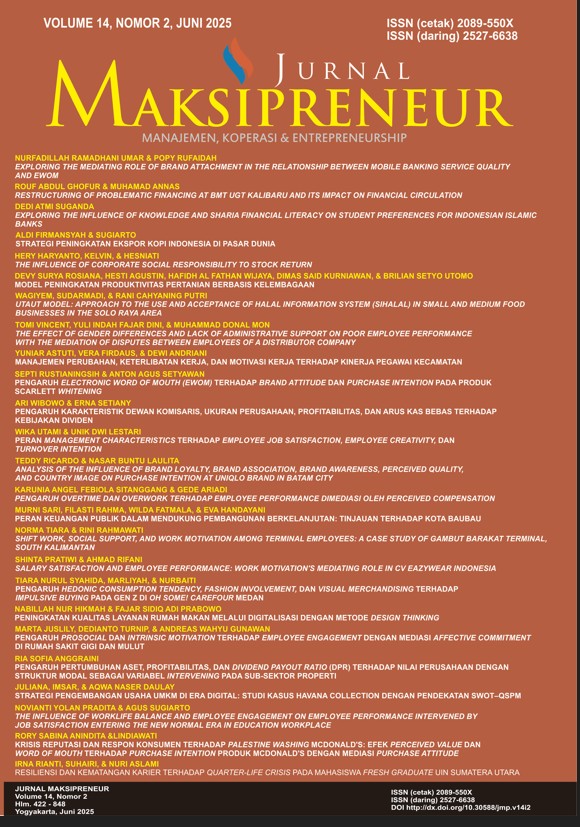
Exploring the Influence of Knowledge and Sharia Financial Literacy on Student Preferences for Indonesian Islamic Banks
DOI:
https://doi.org/10.30588/jmp.v14i2.2101Keywords:
Knowledge, Literacy, Islamic finance, Decision MakingAbstract
The low level of Islamic financial literacy in Indonesia, including among university students, is a major challenge in increasing Islamic financial inclusion in Indonesia. Although the Islamic finance industry is growing, students' understanding of Sharia-based principles and services, such as Bank Syariah Indonesia (BSI), is still limited. This study analyzes the influence of Islamic financial knowledge and literacy on the decision of UIN Raden Fatah Palembang students to utilize BSI services. The method used is mixed with sequential explanatory design, combining multiple linear regression, in-depth interviews, and systematic review. The results showed that Islamic financial knowledge and literacy have a significant effect on student decisions. Factors such as the Fiqh Muamalah and Islamic Economics curricula, as well as the supportive attitude of the lecturers, contribute to improving students' understanding. Active learning, such as flipped classrooms, is also effective in strengthening understanding. Social media and technology play an important role in improving Islamic financial literacy, with the utilization of films, advertisements, and character actors and influencers being very influential in introducing Islamic financial products and improving corporate image and public trust. KKN students can contribute by conducting workshops and training for community education. Supportive policies and an adaptive organizational culture are needed for wider access to digital financial services and more effective teaching.
References
Ajzen, I. (1991). The theory of planned behavior. Organizational Behavior and Human Decision Processes, 50(2), 179–211. https://doi.org/10.1016/0749-5978(91)90020-T
Al Kurdi, B., & Alshurideh, M. T. (2023). The effect of social media influencer traits on consumer purchasing decisions for keto products: examining the moderating influence of advertising repetition. Journal of Marketing Communications. https://doi.org/10.1080/13527266.2023.2246043
Al-Awlaqi, M. A., & Aamer, A. M. (2023). Islamic financial literacy and Islamic banks selection: an exploratory study using multiple correspondence analysis on banks’ small business customers. International Journal of Emerging Markets, 18(12), 6285–6299. https://doi.org/10.1108/IJOEM-09-2021-1354/FULL/XML
Angel, B. F., Duffey, M., & Belyea, M. (2000). An evidence-based project for evaluating strategies to improve knowledge acquisition and critical-thinking performance in nursing students. Journal of Nursing Education, 39(5), 219–228. https://doi.org/10.3928/0148-4834-20000501-07
Antara, P. M., Musa, R., & Hassan, F. (2016). Bridging Islamic Financial Literacy and Halal Literacy: The Way Forward in Halal Ecosystem. Procedia Economics and Finance, 37, 196–202. https://doi.org/10.1016/S2212-5671(16)30113-7
Arens, A. K., Morin, A. J. S., & Watermann, R. (2015). Relations between classroom disciplinary problems and student motivation: Achievement as a potential mediator? Learning and Instruction, 39, 184–193. https://doi.org/10.1016/J.LEARNINSTRUC.2015.07.001
Arikunto, S. (1998). Prosedur penelitian : suatu pendekatan praktek / Suharsimi Arikunto | Perpustakaan Universitas Islam Negeri Sultan Syarif Kasim Riau (Ed. revisi 4, Cet.11). Rineka Cipta. https://inlislite.uin-suska.ac.id/opac/detail-opac?id=19640
Armstrong, R., Waters, E., Dobbins, M., Anderson, L., Moore, L., Petticrew, M., Clark, R., Pettman, T. L., Burns, C., Moodie, M., Conning, R., & Swinburn, B. (2013). Knowledge translation strategies to improve the use of evidence in public health decision making in local government: Intervention design and implementation plan. Implementation Science, 8(1), 1–10. https://doi.org/10.1186/1748-5908-8-121/FIGURES/2
Asaad, C. T. (2015). Financial literacy and financial behavior: Assessing knowledge and confidence. Financial Services Review, 24, 101–117.
Becheikh, N., Ziam, S., Idrissi, O., Castonguay, Y., & Landry, R. (2010). How to improve knowledge transfer strategies and practices in education? Answers from a systematic literature review. Research in Higher Education Journal. https://core.ac.uk/outputs/35146539/?utm_source=pdf&utm_medium=banner&utm_campaign=pdf-decoration-v1
Carlson, J. R., Hanson, S., Pancras, J., Ross, W. T., & Rousseau-Anderson, J. (2022). Social media advertising: How online motivations and congruency influence perceptions of trust. Journal of Consumer Behaviour, 21(2), 197–213. https://doi.org/10.1002/CB.1989
Creswell, J. W., & Cresswel, D. (2018). Research design: Qualitative, quantitative, and mixed methods approaches. SAGE Publications, Inc. (US) (5th ed.).
Dinc, Y., Çetin, M., Bulut, M., & Jahangir, R. (2021). Islamic financial literacy scale: An amendment in the sphere of contemporary financial literacy. ISRA International Journal of Islamic Finance, 13(2), 251–263. https://doi.org/10.1108/IJIF-07-2020-0156/FULL/PDF
Dos Santos, P. H., Neves, S. M., Sant’Anna, D. O., Oliveira, C. H. de, & Carvalho, H. D. (2019). The analytic hierarchy process supporting decision making for sustainable development: An overview of applications. Journal of Cleaner Production, 212, 119–138. https://doi.org/10.1016/J.JCLEPRO.2018.11.270
Ekaptiningrum, K. (2024). Inklusi Keuangan Syariah Indonesia Masih Rendah - FEB UGM. UGM, 23 September. https://feb.ugm.ac.id/en/news/4848-indonesia-s-islamic-financial-inclusion-still-low
Elwyn, G., Durand, M. A., Song, J., Aarts, J., Barr, P. J., Berger, Z., Cochran, N., Frosch, D., Galasiski, D., Gulbrandsen, P., Han, P. K. J., Härter, M., Kinnersley, P., Lloyd, A., Mishra, M., Perestelo-Perez, L., Scholl, I., Tomori, K., Trevena, L., … Van Der Weijden, T. (2017). A three-talk model for shared decision making: Multistage consultation process. BMJ, 359, 4891. https://doi.org/10.1136/BMJ.J4891
Faye, A. S. (2000). Critical thinking in South Dakota public schools grades 3, 4, and 5: The influence of teachers’ behaviors, perceptions, and attitudes [University of South Dakota]. https://www.proquest.com/openview/debdfe4f6c60a05b0daa5cddbf9ef2c3/1?pq-origsite=gscholar&cbl=18750&diss=y
Firdausi, M. R. A., & Kasri, R. A. (2022). Islamic Financial Literacy Amongst Muslim Students in Indonesia: A Multidimensional Approach. Al-Muzara’ah, 77–94. https://doi.org/10.29244/JAM.SPECIALISSUE2022.77-94
Fitri, I., Dan, H., & Utama, S. (2017). Analisis Tingkat Literasi Keuangan Syariah Mahasiswa serta Pengaruhnya terhadap Minat Mahasiswa Menjadi Nasabah pada Lembaga Keuangan Syariah (Studi Kasus pada Mahasiswa Non Ekonomi Universitas Muhammadiyah Yogyakarta). Repository Universitas Muhammadiyah Yogyakarta. https://repository.umy.ac.id/bitstream/handle/123456789/17056/12.JURNAL%20PUBLIKASI.pdf?sequence=12&isAllowed=y
Freund, Y., & Schapire, R. E. (1997). A Decision-Theoretic Generalization of On-Line Learning and an Application to Boosting. Journal of Computer and System Sciences, 55(1), 119–139. https://doi.org/10.1006/JCSS.1997.1504
Gazmararian, J. A., Williams, M. V., Peel, J., & Baker, D. W. (2003). Health literacy and knowledge of chronic disease. Patient Education and Counseling, 51(3), 267–275. https://doi.org/10.1016/S0738-3991(02)00239-2
Hair, J. F., Risher, J. J., Sarstedt, M., & Ringle, C. M. (2019). When to use and how to report the results of PLS-SEM. European Business Review, 31(1), 2–24. https://doi.org/10.1108/EBR-11-2018-0203
Hassan, M. K., Aliyu, S., Huda, M., & Rashid, M. (2019). A survey on Islamic Finance and accounting standards. Borsa Istanbul Review, 19, S1–S13. https://doi.org/10.1016/J.BIR.2019.07.006
Hayes, J. L., Brinson, N. H., Bott, G. J., & Moeller, C. M. (2022). The Influence of Consumer–Brand Relationship on the Personalized Advertising Privacy Calculus in Social Media. Journal of Interactive Marketing, 55(1), 16–30. https://doi.org/10.1016/J.INTMAR.2021.01.001
Heller, L. J., Skinner, C. S., Tomiyama, A. J., Epel, E. S., Hall, P. A., Allan, J., LaCaille, L., Randall, A. K., Bodenmann, G., Li-Tsang, C. W. P., Sinclair, K., Creek, J., Baumann, L. C., Karel, A., Andersson, G., Hanewinkel, R., Morgenstern, M., Puska, P., Bucks, R. S., … Sularz. (2013). Theory of Reasoned Action. Encyclopedia of Behavioral Medicine, 1964–1967. https://doi.org/10.1007/978-1-4419-1005-9_1619
Hikmah, N., Najah, S. S., & Subagyo, S. (2024). Pengaruh Sikap Positif Guru terhadap Keberhasilan dan Minat Belajar Siswa. Jurnal Pengembangan dan Penelitian Pendidikan, 6(3). https://journalpedia.com/1/index.php/jppp/article/view/2777
Ji, C., Mieiro, S., & Huang, G. (2022). How social media advertising features influence consumption and sharing intentions: The mediation of customer engagement. Journal of Research in Interactive Marketing, 16(1), 137–153. https://doi.org/10.1108/JRIM-04-2020-0067/FULL/XML
Ji, S., Pan, S., Cambria, E., Marttinen, P., & Yu, P. S. (2022). A Survey on Knowledge Graphs: Representation, Acquisition, and Applications. IEEE Transactions on Neural Networks and Learning Systems, 33(2), 494–514. https://doi.org/10.1109/TNNLS.2021.3070843
Jung, A. R. (2017). The influence of perceived ad relevance on social media advertising: An empirical examination of a mediating role of privacy concern. Computers in Human Behavior, 70, 303–309. https://doi.org/10.1016/J.CHB.2017.01.008
Keynes, J. M. (2018). The general theory of employment, interest, and money. The General Theory of Employment, Interest, and Money, 1–404. https://doi.org/10.1007/978-3-319-70344-2/COVER
Kim, E., Duffy, M., & Thorson, E. (2021). Under the Influence: Social Media Influencers’ Impact on Response to Corporate Reputation Advertising. Journal of Advertising, 50(2), 119–138. https://doi.org/10.1080/00913367.2020.1868026
König, J., Hanke, P., Glutsch, N., Jäger-Biela, D., Pohl, T., Becker-Mrotzek, M., Schabmann, A., & Waschewski, T. (2022). Teachers’ professional knowledge for teaching early literacy: Conceptualization, measurement, and validation. Educational Assessment, Evaluation and Accountability, 34(4), 483–507. https://doi.org/10.1007/s11092-022-09393-z
Kumar, P., Pillai, R., Kumar, N., & Tabash, M. I. (2023). The interplay of skills, digital financial literacy, capability, and autonomy in financial decision making and well-being. Borsa Istanbul Review, 23(1), 169–183. https://doi.org/10.1016/J.BIR.2022.09.012
Laras, A. (2024). Klasemen Bank Syariah di Indonesia: BSI Terbesar, Siapa Pesaing Paling Dekat? Bisnis Financial, March 29. https://finansial.bisnis.com/read/20240329/231/1753718/klasemen-bank-syariah-di-indonesia-bsi-terbesar-siapa-pesaing-paling-dekat#:~:text=%28BRIS%29%20alias%20BSI%20menjadi%20pengelola%20aset%20bank%20syariah,aset%20Rp353%2C62%20triliun%20atau%20naik%2015%2C7%25%20secara%20tahunan.
Lăzăroiu, G., Neguriţă, O., Grecu, I., Grecu, G., & Mitran, P. C. (2020). Consumers’ Decision-Making Process on Social Commerce Platforms: Online Trust, Perceived Risk, and Purchase Intentions. Frontiers in Psychology, 11, 478039. https://doi.org/10.3389/FPSYG.2020.00890/BIBTEX
Lea, M. R., & Street, B. V. (2006). The “academic literacies” model: Theory and applications. Theory into Practice, 45(4), 368–377. https://doi.org/10.1207/s15430421tip4504_11
Liang, K., Meng, L., Liu, M., Liu, Y., Tu, W., Wang, S., Zhou, S., Liu, X., Sun, F., & He, K. (2024). A Survey of Knowledge Graph Reasoning on Graph Types: Static, Dynamic, and Multi-Modal. IEEE Transactions on Pattern Analysis and Machine Intelligence. https://doi.org/10.1109/TPAMI.2024.3417451
Lima, G. T., & Setterfield, M. (2010). Pricing behaviour and the cost-push channel of monetary policy. Review of Political Economy, 22(1), 19–40. https://doi.org/10.1080/09538250903391863
Lusardi, A., & Mitchell, O. S. (2013). The Economic Importance of Financial Literacy: Theory and Evidence. Journal of Economic Literature. https://doi.org/10.2139/SSRN.2243635
Mahatthanhothai, L. (2024). Development of Internet Finance and Its Impact on Traditional Financial Models. OALib, 11(06), 1–6. https://doi.org/10.4236/OALIB.1111657
Maramis, A. A., Mege, R. A., Paus, J. R., & Mantiri, J. (2019). Effectiveness of Realia Media: A Case Study in SMP Negeri 1 Likupang Barat as a Partner in KKN-PPM Program. Journal of Physics: Conference Series, 1387(1), 012070. https://doi.org/10.1088/1742-6596/1387/1/012070
Maxwell, K. L., & Wright, V. H. (2016). Evaluating the effectiveness of two teaching strategies to improve nursing students’ knowledge, skills, and attitudes about quality improvement and patient safety. Nursing Education Perspectives, 37(5), 291–292. https://doi.org/10.1097/01.NEP.0000000000000043
Mercusuar. (2024). Literasi dan Inklusi Keuangan Syariah pada Gen Z 2024. Harian Mercusuar, 2 November. https://mercusuar.web.id/opini/literasi-dan-inklusi-keuangan-syariah-pada-gen-z-2024/
Mindra, R., Bananuka, J., Kaawaase, T., Namaganda, R., & Teko, J. (2022). Attitude and Islamic banking adoption: Moderating effects of pricing of conventional bank products and social influence. Journal of Islamic Accounting and Business Research, 13(3), 534–567. https://doi.org/10.1108/JIABR-02-2021-0068/FULL/XML
Mustofa, M. (2021). Literasi Keuangan Syariah dan Perilaku Menabung Mahasiswa. Jurnal Ekonomi dan Pendidikan, 18(2), 183–191. https://doi.org/10.21831/JEP.V18I2.49299
Nastiti, N., Hartono, A., & Ulfah, I. F. (2020). Pengaruh Religiusitas, Pengetahuan Perbankan, Pengetahuan Produk Perbankan, Pengetahuan Pelayanan Perbankan, dan Pengetahuan Bagi Hasil terhadap Preferensi Menggunakan Jasa Perbankan Syariah. ASSET: Jurnal Manajemen dan Bisnis, 1(1). https://doi.org/10.24269/ASSET.V1I1.2554
OJK & BPS. (2024). SP OJK dan BPS Umumkan Hasil Survei Nasional Literasi dan Inklusi Keuangan Tahun 2024. https://www.ojk.go.id/id/berita-dan-kegiatan/siaran-pers/Documents/Pages/OJK-dan-BPS-Umumkan-Hasil-Survei-Nasional-Literasi-dan-Inklusi-Keuangan-Tahun-2024/SP%20OJK%20dan%20BPS%20Umumkan%20Hasil%20Survei%20Nasional%20Literasi%20dan%20Inklusi%20Keuangan%20Tahun%202024.pdf
Ostrom, E. (1998). A Behavioral Approach to the Rational Choice Theory of Collective Action: Presidential Address, American Political Science Association, 1997. American Political Science Review, 92(1), 1–22. https://doi.org/10.2307/2585925
Palley, T. I. (2010). The Relative Permanent Income Theory of Consumption: A Synthetic Keynes–Duesenberry–Friedman Model. Review of Political Economy, 22(1), 41–56. https://doi.org/10.1080/09538250903391954
Pasaribu, L. O. (2023). Pengaruh Literasi Keuangan terhadap Perilaku keuangan Mahasiswa Program Studi Pendidikan Ekonomi Angkatan 2020 [Universitas Sriwijaya]. https://repository.unsri.ac.id/105054/3/RAMA_87203_06031381924038_0022086402_01_front_ref.pdf
Potrich, A. C. G., Vieira, K. M., & Mendes-Da-Silva, W. (2016). Development of a financial literacy model for university students. Management Research Review, 39(3), 356–376. https://doi.org/10.1108/MRR-06-2014-0143
Prabadevi, M. N., Auxilia, P. A. M., Subramanian, K. P., & Rengarajan, V. (2024). Strategies for Leveraging Digital Libraries to Improve Financial Literacy among Rural Entrepreneurial Women. Indian Journal of Information Sources and Services, 14(2), 28–33. https://doi.org/10.51983/IJISS-2024.14.2.05
Pritchard, D. (2015). What is this thing called philosophy? In What is this thing Called Philosophy? Taylor and Francis. https://doi.org/10.4324/9780203771006
Robbins, S. P., & Judge, T. (2019). Organizational Behavior. 736. https://books.google.com/books/about/Organizational_Behavior.html?id=yonBswEACAAJ
Safitri, A. I. (2022). Pengaruh Literasi Keuangan, Gaya Hidup, dan Sikap Keuangan terhadap Perilaku Keuangan Mahasiswa Universitas Semarang [Universitas Semarang]. https://repository.uir.ac.id/6056/1/Ade%20Noviani.pdf
Sagayadevan, V., & Jeyaraj, S. (2012). The role of emotional engagement in lecturer-student interaction and the impact on academic outcomes of student achievement and learning. Journal of the Scholarship of Teaching and Learning, 12(3), 1–30.
Showkat, M., Nagina, R., Baba, M. A., & Yahya, A. T. (2025). The impact of financial literacy on women’s economic empowerment: Exploring the mediating role of digital financial services. Cogent Economics & Finance, 13(1). https://doi.org/10.1080/23322039.2024.2440444
Skinner, E., Furrer, C., Marchand, G., & Kindermann, T. (2008). Engagement and Disaffection in the Classroom: Part of a Larger Motivational Dynamic? Journal of Educational Psychology, 100(4), 765–781. https://doi.org/10.1037/A0012840
Skwara, F. (2023). Effects of mental accounting on purchase decision processes: A systematic review and research agenda. Journal of Consumer Behaviour, 22(5), 1265–1281. https://doi.org/10.1002/CB.2193
Sugiarto, S. (2001). Teknik Sampling. Gramedia Pustaka Utama.
Sugiharti, H., & Maula, K. A. (2019). Pengaruh Literasi Keuangan terhadap Perilaku Pengelolaan Keuangan Mahasiswa. Accounthink: Journal of Accounting and Finance, 4(02).
Takona, J. P. (2024). Research design: Qualitative, quantitative, and mixed methods approaches, Sixth edition. Quality and Quantity, 58(1), 1011–1013. https://doi.org/10.1007/S11135-023-01798-2/METRICS
Torralba, K. D., & Doo, L. (2020). Active Learning Strategies to Improve Progression from Knowledge to Action. Rheumatic Disease Clinics of North America, 46(1), 1–19. https://doi.org/10.1016/J.RDC.2019.09.001/ASSET/D54D0C37-84C9-4BA9-9368-A94C3843D182/MAIN.ASSETS/GR3.SML
Wijekumar, K., Meyer, B. J., Lei, P., Beerwinkle, A. L., & Joshi, M. (2020). Supplementing teacher knowledge using web-based Intelligent Tutoring System for the Text Structure Strategy to improve content area reading comprehension with fourth- and fifth-grade struggling readers. Dyslexia, 26(2), 120–136. https://doi.org/10.1002/DYS.1634
World Population Review. (2024a). Indonesia Population 2024 (Live). World Population Review. https://worldpopulationreview.com/countries/indonesia
World Population Review. (2024b). Muslim Population by Country 2024. World Population Review. https://worldpopulationreview.com/country-rankings/muslim-population-by-country
Wulandari, D., & Subagio, A. (2015). Consumer Decision Making in Conventional Banks and Islamic Bank based on Quality of Service Perception. Procedia - Social and Behavioral Sciences, 211, 471–475. https://doi.org/10.1016/J.SBSPRO.2015.11.062
Yang, S., Lin, S., Carlson, J. R., & Ross, W. T. (2016). Brand engagement on social media: will firms’ social media efforts influence search engine advertising effectiveness? Journal of Marketing Management, 32(5–6), 526–557. https://doi.org/10.1080/0267257X.2016.1143863
Downloads
Published
How to Cite
Issue
Section
License
Copyright (c) 2025 Dedi Atmi Suganda

This work is licensed under a Creative Commons Attribution 4.0 International License.
Authors who publish with Jurnal Maksipreneur agree to the following terms:
Authors retain copyright and grant the Jurnal Maksipreneur right of first publication with the work simultaneously licensed under a Creative Commons Attribution 4.0 International License that allows others to share (copy and redistribute the material in any medium or format) and adapt (remix, transform, and build upon the material) the work for any purpose, even commercially with an acknowledgment of the work's authorship and initial publication in Jurnal Maksipreneur.
Authors are able to enter into separate, additional contractual arrangements for the non-exclusive distribution of the journal's published version of the work (e.g., post it to an institutional repository or publish it in a book), with an acknowledgment of its initial publication in Jurnal Maksipreneur. Authors are permitted and encouraged to post their work online (e.g., in institutional repositories or on their website) prior to and during the submission process, as it can lead to productive exchanges, as well as earlier and greater citation of published work (See The Effect of Open Access).