













English version
Indonesian version


The aim of Jurnal Maksipreneur (JMP) publication is to disseminate the research results that have been achieved in the areas of management, cooperatives, and entrepreneurship.
The JMP particularly focuses on the main problems in the development of the sciences of management, cooperatives, entrepreneurship, and relevant issues as follows:
The script of the articles submitted to the JMP will be minimally reviewed by two peer-reviewers who have the same or relevant scientific domain as the script. The accepted script will be available online following the journal blind-peer-reviewing process. Articles published in this journal can use Indonesian or English version.
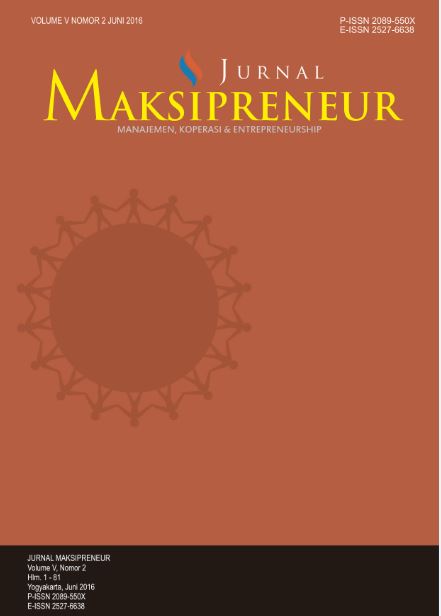
Jurnal Maksipreneur (JMP) is a periodical, scientific, and peer-reviewed journal published by Universitas Proklamasi 45 Yogyakarta, Indonesia (UP 45), twice a year (biannually) in December and June.
This journal provides immediate open access to its content on the principle that making research freely available to the public supports a greater global exchange of knowledge.
This journal is an open-access journal which means that all content is freely available without charge to users or / institutions. Users are allowed to read, download, copy, distribute, print, search, or link to full-text articles in this journal without asking prior permission from the publisher or author. This is following the Budapest Open Access Initiative
An old tradition and a new technology have converged to make possible an unprecedented public good. The old tradition is the willingness of scientists and scholars to publish the fruits of their research in scholarly journals without payment, for the sake of inquiry and knowledge. The new technology is the internet. The public good they make possible is the world-wide electronic distribution of the peer-reviewed journal literature and completely free and unrestricted access to it by all scientists, scholars, teachers, students, and other curious minds. Removing access barriers to this literature will accelerate research, enrich education, share the learning of the rich with the poor and the poor with the rich, make this literature as useful as it can be, and lay the foundation for uniting humanity in a common intellectual conversation and quest for knowledge.
For various reasons, this kind of free and unrestricted online availability, which we will call open access, has so far been limited to small portions of the journal literature. But even in these limited collections, many different initiatives have shown that open access is economically feasible, that it gives readers extraordinary power to find and make use of relevant literature, and that it gives authors and their works vast and measurable new visibility, readership, and impact. To secure these benefits for all, we call on all interested institutions and individuals to help open up access to the rest of this literature and remove the barriers, especially the price barriers, that stand in the way. The more who join the effort to advance this cause, the sooner we will all enjoy the benefits of open access.
The literature that should be freely accessible online is that which scholars give to the world without expectation of payment. Primarily, this category encompasses their peer-reviewed journal articles, but it also includes any unreviewed preprints that they might wish to put online for comment or to alert colleagues to important research findings. There are many degrees and kinds of wider and easier access to this literature. By "open access" to this literature, we mean its free availability on the public internet, permitting any users to read, download, copy, distribute, print, search, or link to the full texts of these articles, crawl them for indexing, pass them as data to software, or use them for any other lawful purpose, without financial, legal, or technical barriers other than those inseparable from gaining access to the internet itself. The only constraint on reproduction and distribution, and the only role for copyright in this domain, should be to give authors control over the integrity of their work and the right to be properly acknowledged and cited.
While the peer-reviewed journal literature should be accessible online without cost to readers, it is not costless to produce. However, experiments show that the overall costs of providing open access to this literature are far lower than the costs of traditional forms of dissemination. With such an opportunity to save money and expand the scope of dissemination at the same time, there is today a strong incentive for professional associations, universities, libraries, foundations, and others to embrace open access as a means of advancing their missions. Achieving open access will require new cost recovery models and financing mechanisms, but the significantly lower overall cost of dissemination is a reason to be confident that the goal is attainable and not merely preferable or utopian.
To achieve open access to scholarly journal literature, we recommend two complementary strategies.
Open access to peer-reviewed journal literature is the goal. Self-archiving (I.) and a new generation of open-access journals (II.) are the ways to attain this goal. They are not only direct and effective means to this end, but they are also within the reach of scholars themselves, immediately, and need not wait on changes brought about by markets or legislation. While we endorse the two strategies just outlined, we also encourage experimentation with further ways to make the transition from the present methods of dissemination to open access. Flexibility, experimentation, and adaptation to local circumstances are the best ways to assure that progress in diverse settings will be rapid, secure, and long-lived.
The Open Society Institute, the foundation network founded by philanthropist George Soros, is committed to providing initial help and funding to realize this goal. It will use its resources and influence to extend and promote institutional self-archiving, to launch new open-access journals, and to help an open-access journal system become economically self-sustaining. While the Open Society Institute's commitment and resources are substantial, this initiative is very much in need of other organizations to lend their effort and resources.
We invite governments, universities, libraries, journal editors, publishers, foundations, learned societies, professional associations, and individual scholars who share our vision to join us in the task of removing the barriers to open access and building a future in which research and education in every part of the world are that much freer to flourish.
February 14, 2002
Budapest, Hungary
Leslie Chan: Bioline International
Darius Cuplinskas: Director, Information Program, Open Society Institute
Michael Eisen: Public Library of Science
Fred Friend: Director of Scholarly Communication, University College London
Yana Genova: Next Page Foundation
Jean-Claude Guédon: University of Montreal
Melissa Hagemann: Program Officer, Information Program, Open Society Institute
Stevan Harnad: Professor of Cognitive Science, University of Southampton, Universite du Quebec a Montreal
Rick Johnson: Director, Scholarly Publishing and Academic Resources Coalition (SPARC)
Rima Kupryte: Open Society Institute
Manfredi La Manna: Electronic Society for Social Scientists
István Rév: Open Society Institute, Open Society Archives
Monika Segbert: eIFL Project consultant
Sidnei de Souza: Informatics Director at CRIA, Bioline International
Peter Suber: Professor of Philosophy, Earlham College & The Free Online Scholarship Newsletter
Jan Velterop: Publisher, BioMed Central
Publication Ethics and Misconduct
Jurnal Maksipreneur: Manajemen, Koperasi dan Entrepreneurship (JMP) is a peer-reviewed journal. This statement explains the ethical behavior of all parties involved in the act of publishing articles in this journal as well as alleged research violations, including the authors, editor-in-chief, Editorial Board, peer-reviewers, and the publisher of Universitas Proklamasi 45. This statement is based on the COPE Best Practice Guidelines for Journal Editors.
Guidelines for Journal Publication Ethics
Articles in Jurnal Maksipreneur: Manajemen, Koperasi dan Entrepreneurship (JMP) is an important building block in the development of a coherent and respected knowledge network. This is a direct reflection of the quality of the work of the authors and the institutions that support them. Peer-reviewed articles support and embody the scientific method. Therefore, it is important to agree on the standards of ethical behavior expected of all parties involved in the act of publishing: authors, journal editors, peer reviewers, publisher, and the public.
Universitas Proklamasi 45 as the publisher of Jurnal Maksipreneur: Manajemen, Koperasi dan Entrepreneurship (JMP) takes the duty of guardianship over all stages of publishing very seriously, and we are aware of our ethical and other responsibilities. We are committed to ensuring that advertising, reprint or other commercial revenue has no impact or influence on editorial decisions.
Alleged Research Infringement Research
The error means falsification, manipulation of citations, or plagiarism in producing, conducting, or reviewing research and writing articles by authors, or in reporting research results. When authors are found to be involved in research violations or other serious irregularities involving articles that have already been published in a scientific journal, the Editor has a responsibility to ensure the accuracy and integrity of the scientific record.
In cases of suspected violations, the Editors and the Editorial Board will use COPE best practices to help them resolve complaints and deal fairly with violations. This will include an investigation into the allegations by the Editor. Submissions found to contain these errors will be rejected. In cases where the published paper is found to contain such errors, a retraction may be issued and will be linked to the original article.
The first step involves determining the validity of the allegation and assessing whether the allegations are consistent with the definition of research misconduct. This initial step also involves determining whether the individual committing the offense has a relevant conflict of interest.
If a scientific error or the presence of other substantial research irregularities is a possibility, the allegations are shared with the appropriate authors, who, on behalf of all co-authors, are asked to provide detailed responses. Once responses are received and evaluated, additional review and involvement of experts (such as statistical reviewers) can be obtained. For cases where infringement is unlikely, clarification, additional analysis, or both, published as a letter to the editor, and often including notification of corrections and corrections to the published article is sufficient.
Institutions are expected to carry out proper and thorough investigations into suspected scientific misconduct. Ultimately, authors, journals, and institutions have an important obligation to ensure the accuracy of scientific records. By responding appropriately to concerns about scientific errors, and taking the necessary actions based on the evaluation of these issues, such as corrections, retractions with replacements, and retractions, the journal of coaching and sports science will continue to fulfill its responsibility to ensure the validity and integrity of the scientific record.
Publication Decisions
Editor is responsible for deciding which articles submitted to the journal should be published. Editors may be guided by the discretion of the journal's editorial board and limited by legal requirements such as those that would apply regarding defamation, copyright infringement, and plagiarism. The editor may confer with other editors or reviewers in making this decision.
Complaints and Appeals
Jurnal Maksipreneur: Manajemen, Koperasi dan Entrepreneurship (JMP) will have a clear procedure for handling complaints against the journal, Editorial Staff, Editorial Board, or Publisher. Complaints will be clarified to a respected person regarding the complaint case. The scope of the complaint includes everything related to the journal's business processes, i.e., editorial processes, manipulation of found citations, unfair editors/reviewers, peer-review manipulation, etc. Complaint cases will be processed according to COPE guidelines.
Post-publication
Discussion permits the publication of debate posts either on its website, by letter to the editor, or on a moderated external site.
Fair play
An editor evaluates manuscripts at all times for their intellectual content regardless of the race, gender, sexual orientation, religious beliefs, ethnic origin, nationality, or political philosophy of the authors.
Confidentiality
Editors and any editorial staff may not disclose any information about submitted manuscripts to anyone other than the respective authors, reviewers, prospective reviewers, other editorial advisors, and the publisher, as appropriate.
Disclosure and conflicts of interest
Unpublished material disclosed in submitted manuscripts may not be used in the editor's own research without the written consent of the author.
Data Sharing Policy
Jurnal Maksipreneur: Manajemen, Koperasi dan Entrepreneurship (JMP) is committed to a more open research landscape, facilitating faster and more effective research discovery by enabling reproducibility and verification of data, methodologies, and reporting standards. We encourage authors of articles published in our journal to share their research data including, but not limited to: raw data, processed data, software, algorithms, protocols, methods, and materials.
Duties of Reviewers
Contribute to Editorial Decisions
Peer reviews assist editors in making editorial decisions and editorial communication with authors can also assist authors in improving papers.
Appropriateness
Any selected referee who feels unqualified to review the research reported in a manuscript or knows that immediate review is not possible, must notify the editor and withdraw from the review process.
Confidentiality
Any manuscript received for review must be treated as a confidential document. They may not be shown or discussed with others except as permitted by the editor.
Review Standards Objectivity reviews
must be conducted objectively. Personal criticism of the author is inappropriate. Referees must express their views clearly with supporting arguments.
Acknowledgment of Sources
Reviewers must identify relevant published work that has not been cited by the authors. Any statement that an observation, derivation, or argument has been previously reported must be accompanied by a relevant citation. Reviewers should also call the editor's attention to any substantial similarities or overlaps between the manuscript under consideration and other published papers of which they have personal knowledge.
Disclosure and Conflicts of Interest
Information or privileged ideas obtained through peer review must be kept confidential and not used for personal gain. Reviewers should not consider manuscripts in which they have a conflict of interest resulting from a competitive, collaborative, or other relationship or connection with the author, company, or any institution with which the paper is related.
Author's Duties
Reporting Standards
Authors of original research reports must present an accurate account of the work performed as well as an objective discussion of its significance. The underlying data must be represented accurately on paper. A paper must contain sufficient detail and references to allow others to replicate the work. Deceptive or intentionally inaccurate statements are unethical and unacceptable behavior.
Originality and Plagiarism
Authors must ensure that they have written an entirely original work, and if the author has used the work and/or words of others, then this has been properly cited or cited.
Multiple, Redundant, or Concurrent Publications
An author may not, in general, publish a manuscript describing essentially the same research in more than one journal or major publication. Submitting the same manuscript to more than one journal at the same time constitutes unethical publishing behavior and is unacceptable.
Acknowledgment of Sources
Proper acknowledgment of the work of others should always be given. Authors should cite publications that were influential in determining the nature of the reported work.
Authorship
Authorship should be limited to those who have made a significant contribution to the conception, design, conduct, or interpretation of the reported study. All persons who have made significant contributions must be listed as co-authors. Where there are others who have participated in certain substantive aspects of the research project, they must be recognized or listed as contributors.
Correspondence authors must ensure that all appropriate co-authors and no inappropriate co-authors are included in the paper and that all co-authors have seen and approved the final version of the paper and have approved its submission for publication.
Disclosure and Conflicts of Interest
All authors must disclose in their manuscript any financial or other substantive conflicts of interest that may be construed to influence the results or interpretation of their manuscript. All sources of financial support for the project must be disclosed.
Fundamental errors in published work
When an author discovers significant errors or inaccuracies in his published work, it is the author's obligation to promptly notify the journal or publisher's editor and cooperate with the editor to retract or correct the paper.
Ethical Oversight
If research work involves chemicals, humans, animals, procedures, or equipment that have unusual hazards inherent in their use, authors must clearly identify these in the manuscript to comply with the ethical conduct of research using both animal and human subjects. If required, Authors must provide legal and ethical permission from legal associations or organizations.
If the research involves confidential data and business/marketing practices, the author must clearly justify whether the data or information will be securely hidden or not.
Manuscript submitted to Jurnal Maksipreneur: Manajemen, Koperasi dan Entrepreneurship (JMP) will be screened using iThenticate similarity detection tool. Jurnal Maksipreneur: Manajemen, Koperasi dan Entrepreneurship (JMP) will immediately reject papers leading to plagiarism or self-plagiarism.
JMP wants to ensure that all authors are careful and comply with international standards for academic integrity, particularly on the issue of plagiarism.
Plagiarism occurs when an author takes ideas, information, or words from another source without proper credit to the source. Even when it occurs unintentionally, plagiarism is still a serious academic violation and unacceptable in international academic publications.
When the author learns specific information (a name, date, place, statistical number, or other detailed information) from a specific source, a citation is required (This is only forgiven in cases of general knowledge, where the data is readily available in more than five sources or is common knowledge, e.g., the fact that Indonesia is the most populous Muslim country in the world.)
When the author takes an idea from another author, a citation is required even if the author then develops the idea further. This might be an idea about how to interpret the data, either what methodology to use or what conclusion to draw. It might be an idea about broad developments in a field or general information. Regardless of the idea, authors should cite their sources. In cases where the author develops the idea further, it is still necessary to cite the original source of the idea, and then in a subsequent sentence, the author can explain her or his more developed idea.
When the author takes words from another author, citation and quotation marks are required. Whenever four or more consecutive words are identical to a source that the author has read, the author must use quotation marks to denote the use of another author's original words; just a citation is no longer enough.
Jurnal Maksipreneur: Manajemen, Koperasi dan Entrepreneurship (JMP) takes academic integrity very seriously, and the editors reserve the right to withdraw acceptance from a paper found to violate any of the standards set out above. For further information, potential authors can contact the editorial office at email to editor
Papers submitted to JMP will be screened and checked for plagiarism by using plagiarism detection tools (iThenticate), but an author should check it too before submitted.
Institute for Research and Community Services
JMP with the registration number ISSN 2089-550X (printed version), first published in printed form starting Volume 1 Number 1 in December 2011. Since then, JMP has routinely published twice yearly, i.e. December for edition/number/issue No. 1 and June for edition/number/issue No. 2.
Since the beginning of the publication, a mistake was made in writing the registration number, namely ISSN 2089-5501. The mistake has been corrected along with the issuance of an electronic version of JMP with registration number ISSN 2527-6638 (online version). Since using OJS (online journal system) platform in 2016, JMP has made many improvements on an ongoing basis according to the rules of good governance of online scientific journals.
From the beginning until the fifth volume and the edition of December 2015, the number of articles in each edition of the JMP still varied and ranged from 6-11 articles per edition. However, since 2016 the number of articles published by JMP has consistently amounted to 7 articles for each issue. JMP in printed and online versions began to be published simultaneously starting in Volume 5 Number 2 of the June 2016 edition.
JMP began implementing DOI (Digital Object Identifier) to improve publication quality standards starting in December 2017. At the same time, the application of DOI was also carried out for all articles and issues of the previous edition of JMP (back issues), so that all editions and articles published by JMP already had active DOIs. The implementation of DOI has a big impact on the dissemination of JMP publications and articles. One of the real impacts of the power of dissemination is recognition in the form of indexation by some indexers of international scientific journals so that the JMP is increasingly known and the number of citations is increasing.
Since the beginning of the publication, the page numbering system of JMP is issue-based or numbered each time it is published. Since the publication of Volume 7 Number 1 in December 2017, JMP has begun implementing a volume-based page numbering system. That is, page number 1 starts again at each volume change.
Starting in the edition of December 2018, the JMP manager began to improve the system and administration process for accepting manuscripts via online submission, applying a similarity check with iThenticate from Crossref, a blind peer-review process involving more than one reviewer, editing, copyediting, proofreading, and layout editing. From its initial issue until 2018, JMP used only the Indonesian language for writing articles published in full. Since the edition of December 2018, JMP began accepting manuscripts in two languages, namely Indonesian language, and English. Gradually, JMP will turn to the use of English as a whole to position itself as one of the internationally recognized scientific journals.
JMP has increased the number of articles for each issue starting from Volume 10 Number 1 (December 2020) from 7 articles to 9 articles in response to the enthusiasm of the authors or researchers who will publish their scientific works. Again, the Editor responds to the author's extraordinary enthusiasm by increasing the number of articles to 15 articles per issue starting from Vol 12 Issue 1 2022.
The milestones of JMP developments:

Jurnal Maksipreneur: Manajemen, Koperasi, dan Entrepreneurship is licensed under a Creative Commons Attribution 4.0 International License. Based on a work at https://ejournal.up45.ac.id/index.php/maksipreneur
Published by Universitas Proklamasi 45, Sleman, Yogyakarta Special Region, Indonesia
Email: [email protected]
e-ISSN: 2527-6638 p-ISSN: 2089-550X