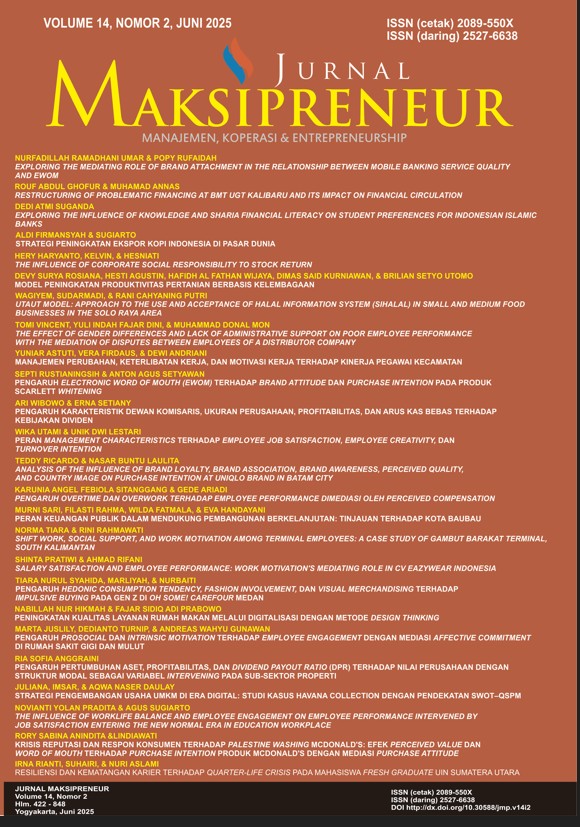
The Influence of Worklife Balance and Employee Engagement on Employee Performance Intervened by Job Satisfaction Entering the New Normal Era in Education Workplace
DOI:
https://doi.org/10.30588/jmp.v14i2.1822Keywords:
Work Life Balance, Employee Engagement, Job Satisfaction, Employee Performance, Education WorkplaceAbstract
The Covid-19 outbreak is a poignant reminder of how fragile and unpredictable our lives can be in unusual circumstances. Work-life balance and Employee Engagement are two key factors in determining employee performance in the New Normal Era after Covid-19. The intervention of Job Satisfaction can affect assessing the Employee Performance. This research presents each dimension of the variables: Work Life Balance, Work Interference with Personal Life (WIPL), Personal Life Interference with Work (PLIW), Personal Life Enhancement of Work (PLEW), and Work Enhancement of Personal Life (WEPL). The job satisfaction has six dimensions, which are: Salary and Welfare, Work Itself, Leader Behavior, Interpersonal Relationships, Job Competency, and Personal Growth. Employee performance with dimensions which are: Task Performance, Adaptive Performance, and Contextual Performance. Using descriptive analysis, this quantitative research was conducted on 100 employees in Dharma Mulya Christian School. The interesting finding is found during the research whereby in Dharma Mulya Christian School, as an educational workplace, Work Life Balance and Employee Engagement have a significant effect on Job Satisfaction with a positive coefficient direction; nevertheless, Job Satisfaction does not mediate the influence of Work Life Balance and Employee Engagement on Employee Performance.
References
Ackert, L. F., & Deaves, R. (2010). Behavioral Finance Psychology, Decision-Making, and Markets. South-Western Cengage Learning.
Alegre, I., Mas-Machuca, M., & Berbegal-Mirabent, J. (2016). Antecedents of employee job satisfaction: Do they matter?
Ali, R., & Ahmed, M. S. (2009). The impact of reward and recognition programs on employee’s motivation and satisfaction: An empirical study. International Review of Business Research Papers, 5(4), 270–279.
Amabile, T. M., Hill, K. G., Hennessey, B. A., & Tighe, E. M. (1994). The Work Preference Inventory: Assessing intrinsic and extrinsic motivational orientations. Journal of Personality and Social Psychology, 66, 950 –967.
Anitha, J. (2014). Determinants of employee engagement and their impact on employee performance. International Journal of Productivity and Performance Management, 63(3), 308–323.
Armstrong, M. (2007). Performance Management: Key Strategies and Practical Guidelines. Kogan Page, 3, 216.
Aziri, B. (2011). Job satisfaction: A literature review. Management Research and Practice, 3(4), 77–86.
Bailyn, L. D., Robert, R., & Kochan, T. A. (2001). Integrating Work Family Life: Holistic Approach. Sloan Work-Family Policy Network Advisory Board, 1, 66.
Baral, R., & Bhargava, S. (2010). Work-family enrichment as a mediator between organizational interventions for work-life balance and job outcomes. Jounal of Managerial Psychology, 25(3), 274–300.
Bella, D. C. W., & Widjaja, D. C. (2018). Pengaruh Employee Engegament terhadap Kinerja Karyawan dengan Kepuasan Kerja Sebagai Variabel Intervening di Hotel Ibis Styles Surabaya. Jurnal Hospitality dan Manajemen Jasa, 6(2).
Berg, K. A. and H. A. van den. (2016). Antecedents, Consequences and the Context of Employee Engagement in Nonprofit Organizations. Review of Public Personnel Aministrator, 39(1).
Chang, A., Gudmundsson, A., & Sawang, S. (2012). The role of life friendly policies on employees’ work-life balance. https://doi.org/10.5172/jmo.2012.18.1.53
Cheng, T., Zhang, P., Wen, Y., & Wang, L. (2020). Social media use and employee innovative performance: Work engagement as a mediator. Social Behavior and Personality: An International Journal, 48(1), 1–9.
Creswell, J. W. (2009). Research Design: Qualitative, quantitative, and mixed methods approaches (3rd ed.). SAGE Publications, Ltd.
Dewi, M. P. (2022). Pengaruh Work-Life Balance dan Budaya Organisasi terhadap Kinerja Pegawai Melalui Kepuasan Kerja Sebagai Variabel Intervening (Studi pada Pegawai ATR/BPN Kantor Pertanahan Kabupaten Kulon Progo). Universitas Muhammadiyah Yogyakarta.
Dissanayaka, N. M. N. P., & Ali, M. A. M. H. (2013). Impact of worklife balance on employees performance: An empirical study on seven apparel organizations in Sri Lanka. Proceedings of the Third International Symposium, SEUSL South Eastern University of Sri Lanka: 6-7 July 2013, Oluvil, Sri Lanka.
Fisher, G. G., Bulger, C. A., & Smith, C. S. (2009). Beyond Work and Family: A Measure of Work/Nonwork Interference and Enhancement. Journal of Occupational Health Psychology, 14(4), 441–456. https://doi.org/10.1037/a0016737
Higgins, C., Duxbury, L., & Lyons, S. (2001). Reducing Work–Life Conflict: What Works ? What Doesn’t? National Work–Life Conflict Study, 5, 1–243. https://doi.org/10.1371/journal.pone.0097769
Kembuan, D., Koleangan, R. A. M., Kembuan, D., Koleangan, R. A. M., & Ogi, I., (2021). Pengaruh Work Life Balance dan Lingkungan Kerja terhadap Kinerja Karyawan pada PT Bank Sulutgo Cabang Utama di Manado Effect of Work Life Balance and Work Environment on Employee Performance at PT Bank Sulutgo Main Branch in Manado. Jurnal EMBA, 9(3), 1257–1266.
Kim-Soon. (2015). Employee Engagement and Job Satisfaction. Retrieved January, 14, 2017.
Klehe, U. C. (2004). Choosing how to choose: Institutional pressures affecting the adoption of personnel selection procedures. International Journal of Selection and Assessment, 12(4), 327–342.
Macey, W. H., Schneider, B., Barbera, K. M., & Young, S. A. (2009). Employee engagement: Tools for analysis, practice, and competitive advantage. Wiley & Blackwell.
Mathis, R., & Jackson, J. (2000). Job analysis and the changing nature of jobs. Human Resource Management. South-Western College Publishing.
Mendis, M. D. V. S., & Weerakkody, W. A. S. (2017). The impact of work life balance on employee performance with reference to telecommunication industry in Sri Lanka: A mediation model. Kelaniya Journal of Human Resource Management, 12(1), 72.
Mutiara, A. D. S. (2019). A Magical Augmented Reality Book Berbasis Mobile. Sipora.
Maslichah, N. I., & Hidayat, K. (2017). Pengaruh Work-Life Balance dan Lingkungan Kerja terhadap Kepuasan Kerja Karyawan (Studi pada Perawat RS Lavalette Malang Tahun 2016). Jurnal Administrasi Bisnis, 49(1).
Muliawan, Y., Perizade, B., & Cahyadi, A. (2018). Pengaruh Keterikatan Karyawan (Employee Engagement) terhadap Kinerja Karyawan di PT Badja Baru Palembang. Jembatan Jurnal Ilmiah Manajemen, 14, 69–78.
Noviyanthi, D. A. (2016). Studi New World of Work Tunjukkan Pentingnya Transformasi Tempat Kerja bagi Peningkatan Produktivitas dan Daya Saing Bisnis di Indonesia. Microsoft Indonesia News Center.
Paparang, N. C. P., Areros, W. A., & Tatimu, V. (2021). Pengaruh Kepuasan Kerja terhadap Kinerja Pegawai Kantor PT Post Indonesia di Manado. In Productivity 2(2).
Peeters, M. C. W., Montgomery, A. J., Bakker, A. B., & Schaufeli, W. B. (2005). Balancing work and home: How job and home demands are related to burnout. International Journal of Stress Management, 12(1), 43–61. https://doi.org/10.1037/1072-5245.12.1.43
Pradhan, R. K., & Jena, L. J. (2017). Employee Performance at Workplace: Conceptual Model and Empirical Validation. Business Perspectives and Research, 69–85.
Qodrizana, D. L. (2018). Pengaruh Work-Life Balance terhadap Kepuasan Kerja (Studi pada Karyawan Perempuan Yayasan Insan Permata Tunggulwulung Kota Malang). Jurnal Administrasi Bisnis, 60(1).
Rondonuwu, F., Rumawas, W., & Asaloei, S. (2018). Pengaruh Work-life Balance Terhadap Kepuasan Kerja Karyawan Pada Hotel Sintesa Peninsula Manado. Jurnal Administrasi Bisnis, 7(2), 30–39. https://doi.org/10.35797/jab.v7.i2.30-39
Rowden, R. W. (2002). The relationship between workplace learning and job satisfaction in U.S. small to midsize businesses. Human Resource Development Quarterly. 13(4), 407–425.
Rue, L., & Byars, L. (2003). Management: Skills & Application. McGraw-Hill Higher Education.
Saina, I. V., Pio, R. J., & Rumawas, W. (2016). Pengaruh Worklife Balance Dan Kompensasi Terhadap Kinerja Karyawan Pada Pt Pln (Persero) Wilayah Suluttenggo Area Manado. Jurnal Administrasi Bisnis, 4(3).
Schaufeli, W. B., Salanova, M., Gonzalez-Rom, V., & Bakker, A. B. (2002). The measurement of engagement and burnout: A two sample confirmatory factor analytic approach. Journal of Happiness Studies, 3, 71–92.
Schiemann, W. A. (2011). Alignment Capability Engagement. PPM.
Sidik, R. (2019). Pengaruh Kemampuan, Work Life Balance, Kepuasan Kerja Terhadap Kinerja Karyawan pada Karyawan BMT Permata Jawa Timur. Yos Soedarso Economics Journal, 1(1).
Simanjuntak, T., & Sitio, V. S. S. (2020). Pengaruh Knowledge Sharing dan Employee Engagement terhadap Kepuasan Kerja Karyawan Narma Toserba, Narogong Bogor. JIMEN Innovative Journal of Management Students, 2, 42–54.
Siswanti, Y., & Pratiwi, K. W. (2020). Analisis Dukungan Organisasional Persepsian dan Employee Engagement terhadap Kinerja Karyawan: Kepuasan Kerja sebagai Pemediasi. Jurnal Manajemen dan Keuangan, 9(3), 286–304.
Sparrow, P. (2013). Strategic HRM and employee engagement. Employee engagement in theory and practice. Routledge, 99–115.
Squires, J. E., Hoben, M., Linklater, S., Carleton, H. L., Graham, N., & Estabrooks, C. A. (2015). Job Satisfaction among Care Aides in Residential Long-Term Care: A Systematic Review of Contributing Factors, both Individual and Organizational. Nursing Research and Practice, 5(5).
Sucahyowati, H., Hendrawan, A., & Nusantara, A. M. (2020). Pengaruh Employee Engagement terhadap Kinerja Karyawan pada PT MK Semarang. In Jurnal Sains Teknologi Transportasi Maritim, 2(2).
Suhery, S., Ravelby, T. A., Sutiyem, S., Linda, M. R., & Nurofik, A. (2020). Pengaruh Self-Efficacy dan Employee Engagement terhadap Kepuasan Kerja Karyawan Perbankan di Padang. Padang Scientific Development Media Journal, 15, 4239–4248.
Sukur, M. I. S., & Susanty, A. (2022). Pengaruh Work Life Balance terhadap Kepuasan Kerja Karyawan PT MNC Investama, Tbk (Studi pada Divisi Sosial Media dan Media Manajemen). E-Proceeding of Management, 9(3), 1604–1610.
Sutopo, S. (2002). Penelitian Jumlah Sampel dalam Penelitian. STIE Dharmaputra Semarang, 1(3), 2–6.
Turangan, S. E., Tatimu, V., & Mukuan, D. D. S. (2022). Pengaruh Worklife Balance dan Kepuasan Kerja terhadap Kinerja Karyawan PLN Gardu Induk Kawangkoan. Productivity, 3(4), 343–348.
Ummah, W. (2018). Work life balance ditinjau dari modal psikologis pekerja di perusahaan garmen Yogyakarta. Skripsi, Universitas Islam Indonesia, 1, 124.
Wenno, W. (2018). Hubungan Antara Work Life Balance dan Kepuasan Kerja pada Karyawan di PT PLN Persero Area Ambon. Jurnal Maneksi, 7(1), 47–54.
Wijayanti, T. (2018). Pelaksanaan Pemberian Kredit Berbasis Tehnologi Informasi Oleh Fintech kepada Pelaku UKM (Study Pengawasan Ojk Surakarta). Doctoral dissertation, Universitas Muhammadiyah Surakarta.
Wulandari, S., Sari, D. P., Sari, S. Y., & Candra, Y. (2022). Pengaruh Pelatihan Kerja dan Employee Engagement terhadap Kinerja Karyawan dengan Kepuasan Kerja Sebagai Variabel Intervening. Jurnal Ekonomi dan Bisnis Dharma Andalas 24(2).
Zaini, A., & Nilufar, S. A. S. (2009). The effect of human resource management practices on business performance among private companies in Malaysia. International Journal of Business and Management, 4(6), 65–72.
Zhang, S. J., & Liao, J. Q. (2007). An empirical study on the influences of dimensions of employee job satisfaction on total job satisfaction. Science of Science and Management of S & T, 8, 184–188. https://doi.org/10.3969/j.issn.1002-0241.2007.08.03.
Downloads
Published
How to Cite
Issue
Section
License
Copyright (c) 2025 Novianti Yolan Pradita, Agus Sugiarto

This work is licensed under a Creative Commons Attribution 4.0 International License.
Authors who publish with Jurnal Maksipreneur agree to the following terms:
Authors retain copyright and grant the Jurnal Maksipreneur right of first publication with the work simultaneously licensed under a Creative Commons Attribution 4.0 International License that allows others to share (copy and redistribute the material in any medium or format) and adapt (remix, transform, and build upon the material) the work for any purpose, even commercially with an acknowledgment of the work's authorship and initial publication in Jurnal Maksipreneur.
Authors are able to enter into separate, additional contractual arrangements for the non-exclusive distribution of the journal's published version of the work (e.g., post it to an institutional repository or publish it in a book), with an acknowledgment of its initial publication in Jurnal Maksipreneur. Authors are permitted and encouraged to post their work online (e.g., in institutional repositories or on their website) prior to and during the submission process, as it can lead to productive exchanges, as well as earlier and greater citation of published work (See The Effect of Open Access).