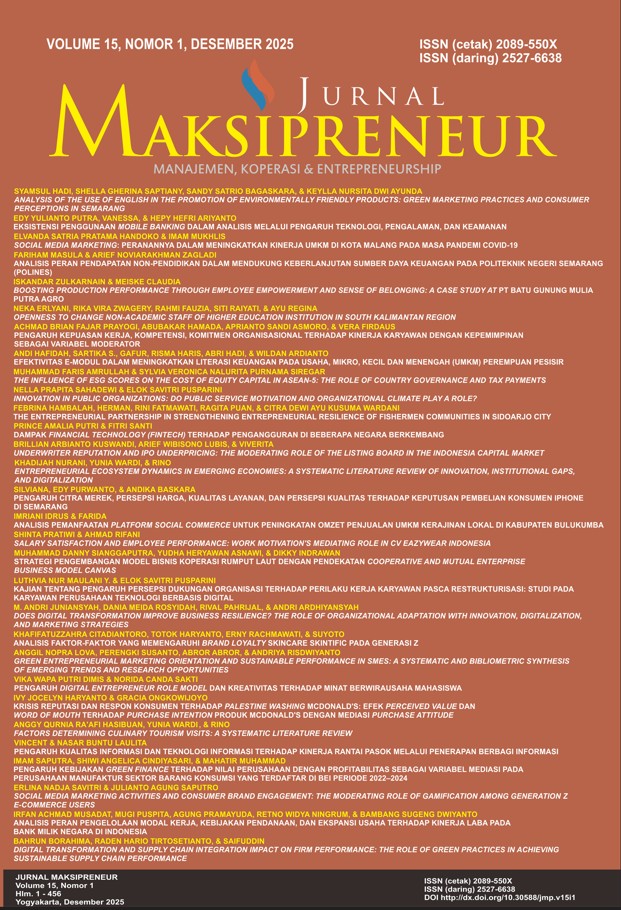
Green Entrepreneurial Marketing Orientation and Sustainable Performance in SMEs: A Systematic and Bibliometric Synthesis of Emerging Trends and Research Opportunities
DOI:
https://doi.org/10.30588/jmp.v15i1.2523Keywords:
GEMO, GEO, GMO, Green Innovation, Organizational Resilience, Sustainable PerformanceAbstract
This study systematically examines the evolution and integration of the Entrepreneurial Marketing Orientation (EMO) concept into the Green Entrepreneurial Marketing Orientation (GEMO) framework, as well as its role in enhancing sustainable performance within the small and medium-sized enterprise (SME) sector. Employing a Systematic Literature Review (SLR) and bibliometric analysis using VOSviewer, this research maps the intellectual structure and emerging trends in GEMO studies during the 2020-2025 period. The findings reveal that GEMO represents an integrated capability rooted in Entrepreneurial Marketing Orientation, grounded in the Resource-Based View (RBV) and Dynamic Capabilities View (DCV) frameworks, where resilience and sustainability serve as the foundations of long-term competitive advantage. The integration of Green Entrepreneurial Orientation (GEO), Green Marketing Orientation (GMO), and Green Innovation (GI) creates an adaptive system that enhances organizational resilience against environmental, digital, and regulatory pressures. Furthermore, this study recommends the development of the Green Digital Entrepreneurial Marketing Orientation (GDEMO) concept to strengthen green innovation and organizational resilience in the era of Green Economy 5.0.
References
Adiguzel, Z., & Cakir, F. S. (2025). Empowering sustainability: Green entrepreneurial orientation, innovative strategies, culture and operational performance. Management Decision, 63(11), 3934–3966. https://doi.org/10.1108/MD-07-2024-1700
Afum, E., Agyabeng-Mensah, Y., Baah, C., Asamoah, G., & Kusi, L. Y. (2023). Green market orientation, green value-based innovation, green reputation and enterprise social performance of Ghanaian SMEs: The role of lean management. Journal of Business & Industrial Marketing, 38(10), 2151–2169. https://doi.org/10.1108/JBIM-03-2021-0169
Afum, E., Agyabeng-Mensah, Y., Sun, Z., Frimpong, B., Kusi, L. Y., & Acquah, I. S. K. (2021). Exploring the link between green manufacturing, operational competitiveness, firm reputation and sustainable performance dimensions: A mediated approach. Journal of Manufacturing Technology Management, 31(7), 1417–1438. https://doi.org/10.1108/JMTM-02-2020-0036
Agustini, M., Baloran, A., Bagano, A., Tan, A., Athanasius, S., & Retnawati, B. (2021) Green marketing practices and issues: A comparative study of selected firms in Indonesia and Philippines. Journal of Asia-Pacific Business, 22(3), 164-181. https://doi.org/10.1080/10599231.2021.1943807
Alfandi, A. M. T., & Bataineh, M. S. E. (2023). The impact of green entrepreneurship orientation on sustainable performance: The mediating effect of knowledge management. International Journal of Academic Reserach in Economics and Management Sciences, 12(1), 388–404. https://doi.org/10.6007/IJAREMS/v12-i1/16422
Alhijris, A., & Alnasser, A. (2025). The mediating role of green innovation in the relationship between strategic green marketing orientation and marketing performance. American Journal of Business Science Philosophy (AJBSP), 2(1), 48–58. https://doi.org/10.70122/ajbsp.v2i1.26
Alwakid, W. N., & Dahri, N. A. (2025). Harnessing AI Capabilities and Green Entrepreneurial Orientation for Sustainable SME Performance using SEM Analysis Approach. Technology in Society, 83, 103007. https://doi.org/10.1016/j.techsoc.2025.103007
Ameer, F., & Khan, N. R. (2023). Green entrepreneurial orientation and corporate environmental performance: A systematic literature review. European Management Journal, 41(5), 755–778. https://doi.org/10.1016/j.emj.2022.04.003
Appiah, M. K., Sam, A., Twum, E., & Godslove, E. (2023). Modelling the influencing of green entrepreneurship orientation on sustainable firm performance: A moderated mediation model. Economic research-Ekonomska istraživanja, 36(2). https://doi.org/10.1080/1331677X.2023.2179094
Asad, M., Majali, T. E., Aledeinat, M., Abdelkarim Almajali, D., & Akhorshaideh, A. H. O. (2023). Green entrepreneurial orientation for enhancing SMEs financial and environmental performance: Synergetic moderation of green technology dynamism and knowledge transfer and integration. Cogent Business & Management, 10(3), 2278842. https://doi.org/10.1080/23311975.2023.2278842
Baquero, A. (2025). Optimizing green knowledge acquisition through entrepreneurial orientation and resource orchestration for sustainable business performance. Marketing Intelligence & Planning, 43(2), 241–271. https://doi.org/10.1108/MIP-07-2023-0330
Bhardwaj, S., Nair, K., Tariq, M. U., Ahmad, A., & Chitnis, A. (2023). The state of research in green marketing: A bibliometric review from 2005 to 2022. Sustainability, 15(4), 2988. https://doi.org/10.3390/su15042988
Braik, A., Saleh, Y., & Jaaron, A. A. (2024). Green marketing practices and organizational sustainable performance in developing countries context: An empirical study. Journal of Foodservice Business Research, 27(6), 769–809. https://doi.org/10.1080/15378020.2023.2205337
Coelho, A., Ferreira, J., & Proença, C. (2024). The impact of green entrepreneurial orientation on sustainability performance through the effects of green product and process innovation: The moderating role of ambidexterity. Business Strategy and the Environment, 33(4), 3184–3202. https://doi.org/10.1002/bse.3648
Crespo, J. D. O., Domínguez, J. M. F., & Guzmán, D. M. C. (2025). An analytical study of structural equation modeling on organizational resilience and financial performance in Ecuadorian SMEs. Decision Analytics Journal, 15, 100575. https://doi.org/10.1016/j.dajour.2025.100575
Ezeh, P. C., & Dube, K. (2025). Trends and development in green and sustainability marketing: A bibliometrics analysis using VOSviewer. Discover Sustainability, 6, 324. https://doi.org/10.1007/s43621-025-01159-z
Guo, Y., Wang, L., & Chen, Y. (2020). Green entrepreneurial orientation and green innovation: The mediating effect of supply chain learning. Sage Open, 10(1). https://doi.org/10.1177/2158244019898798
Habib, M. A., Bao, Y., & Ilmudeen, A. (2020). The impact of green entrepreneurial orientation, market orientation and green supply chain management practices on sustainable firm performance. Cogent Business & Management, 7(1), 1743616. https://doi.org/10.1080/23311975.2020.1743616
Hanaysha, J. R., Abusharbeh, M., Dwikat, S. Y., Shubita, M. F., Sharif, M. N., & Alshdaifat, S. M. (2025). Impact of Corporate Social Responsibility, Technological Capability, and Green Entrepreneurial Orientation on Green Innovation and Sustainable Performance. World Development Sustainability, 7, 100233. https://doi.org/10.1016/j.wds.2025.100233
Henion, K. E. (1981). Energy usage and the conserver society: Review of the 1979 AMA conference on ecological marketing. Journal of Consumer Research, 8(3), 339–342.
Hossain, M. A., Tat, H. H., & Rahman, A. A. (2025). The Impacts of Environmental Orientation, Social Media, Innovation Capabilities, and Marketing Management on Innovation Performance of Manufacturing SMEs in Bangladesh: A Mediated Moderation Model. Journal of International Business and Management, 8(4), 01–30. http://dx.doi.org/10.2139/ssrn.5129622
Hu, W., & Tresirichod, T. (2024). Impact of Green Entrepreneurial Orientation on Sustainable Performance: The Mediating Role of Green Intellectual Capital and Green Supply Chain Management. Asian Administration & Management Review, 7(1), 159–175. https://doi.org/10.14456/aamr.2024.15
Issa, A., Khadem, A., Alzubi, A., & Berberoğlu, A. (2024). The path from green innovation to supply chain resilience: Do structural and dynamic supply chain complexity matter? Sustainability, 16(9), 3762. https://doi.org/10.3390/su16093762
Jamil, K., Ahmad, Z., & Sheikh, A. A. (2025). The Role of Green Strategies and Blockchain Technology in SME’s Sustainability. Pakistan Journal of Social Sciences, 45(1), 55–76.
Jones, R., & Rowley, J. (2011). Entrepreneurial marketing in small businesses: A conceptual exploration. International Small Business Journal: Researching Entrepreneurship, 29(1), 25–36. https://doi.org/10.1177/0266242610369743
Jung, J., Kim, S. J., & Kim, K. H. (2021). Sustainable marketing activities of traditional fashion market and brand loyalty. Journal of Business Research, 120, 294–301. https://doi.org/10.1016/j.jbusres.2020.04.019
Kanan, M., Taha, B., Saleh, Y., Alsayed, M., Assaf, R., Hassen, M. B., Alshaibani, E., Bakir, A., & Tunsi, W. (2023). Green innovation as a mediator between green human resource management practices and sustainable performance in Palestinian manufacturing industries. Sustainability, 15(2), 1077. https://doi.org/10.3390/su15021077
Keskin, H., Tatoglu, E., Akgün, A. E., & Balak, D. (2025). Unveiling the nexus of organizational intelligence, resilience capacity and financial performance. Management Decision. https://doi.org/10.1108/MD-12-2023-2284
Khan, F. A., Sheikh, A. A., & Zainab, F. (2024). The Impact of SMEs Capability for Service Innovation and Its Tactical Green Marketing on Sustainable Business Performance. Journal of Small Business Strategy, 34(2), 95–108. https://doi.org/10.53703/001c.117659
Khan, N. R., Ameer, F., Bouncken, R. B., & Covin, J. G. (2023). Corporate sustainability entrepreneurship: The role of green entrepreneurial orientation and organizational resilience capacity for green innovation. Journal of Business Research, 169, 114296. https://doi.org/10.1016/j.jbusres.2023.114296
Kotler, P., Keller, K. L., & Chernev, A. (2021). Marketing Management (16th ed.). Pearson.
Kyrdoda, Y., Balzano, M., & Marzi, G. (2023). Learn to survive crises: The role of firm resilience, innovation capabilities and environmental dynamism. Technology in Society, 74, 102285. https://doi.org/10.1016/j.techsoc.2023.102285
Liang, H., Hussain, M., & Iqbal, A. (2025). The Dynamic Role of Green Innovation Adoption and Green Technology Adoption in the Digital Economy: The Mediating and Moderating Effects of Creative Enterprise and Financial Capability. Sustainability, 17(7), 3176. https://doi.org/10.3390/su17073176
Liu, N., Hu, H., & Wang, Z. (2022). The relationship between institutional pressure, green entrepreneurial orientation, and entrepreneurial performance The moderating effect of network centrality. Sustainability, 14(19), 12055. https://doi.org/10.3390/su141912055
Mahjoob, M., Fazeli, S. S., Milanlouei, S., Mohammadzadeh, A. K., Tavassoli, L. S., & Noble, J. S. (2021). Green supply chain network design with emphasis on inventory decisions. Sustainable Operations and Computers, 2, 214–229. https://doi.org/10.1016/j.susoc.2021.07.006
Muangmee, C., Dacko-Pikiewicz, Z., Meekaewkunchorn, N., Kassakorn, N., & Khalid, B. (2021). Green entrepreneurial orientation and green innovation in small and medium-sized enterprises (SMEs). Social Sciences, 10(4), 136. https://doi.org/10.3390/socsci10040136
Mubeen, A., Nisar, Q. A., Patwary, A. K., Rehman, S., & Ahmad, W. (2024). Greening your business: Nexus of green dynamic capabilities, green innovation and sustainable performance. Environment, Development and Sustainability, 26, 22747–22773. https://doi.org/10.1007/s10668-023-03574-6
Mufti, N., Sajid, M., ul Ain, Q., & Abrar, R. (2024). Strategic, Tactical, internal green marketing orientation impact on sustainability performance-A mediation mechanism of stakeholders’ engagement. Journal of Applied Research and Multidisciplinary Studies, 5(1), 43–62. https://doi.org/10.32350/jarms.51.04
Mukonza, C., & Swarts, I. (2021). The influence of green marketing strategies on business performance and corporate image in the retail sector. Business strategy and the Environment, 29(3), 838–845. https://doi.org/10.1002/bse.2401
Nasir, A., Zakaria, N., Do, N., & Velasquez, S. (2024). The impact of knowledge management on sustainable performance with mediation effect of green innovation in Malaysian SMEs. VINE Journal of Information and Knowledge Management Systems. https://doi.org/10.1108/VJIKMS-02-2024-0066
Nguyen-Viet, B. (2023). The impact of green marketing mix elements on green customer based brand equity in an emerging market. Asia-Pacific Journal of Business Administration, 15(1), 96–116. https://doi.org/10.1108/APJBA-08-2021-0398
Niazi, U. I., Nisar, Q. A., Nasir, N., Naz, S., Haider, S., & Khan, W. (2023). Green HRM, green innovation and environmental performance: The role of green transformational leadership and green corporate social responsibility. Environmental Science and Pollution Research, 30(15), 45353–45368. https://doi.org/10.1007/s11356-023-25442-6
Nsefumu, D. A. M. O., Jihong, S., & Wiredu, J. (2024). Green Marketing Orientation and Sustainable Performance of Hospitality Firms in the Malabo Capital of Equatorial Guinea. International Journal of Development Research, 14. 66409-66419. https://doi.org/10.37118/ijdr.28619.08.2024
Nuryakin, N., & Maryati, T. (2022). Do green innovation and green competitive advantage mediate the effect of green marketing orientation on SMEs’ green marketing performance? Cogent Business & Management, 9(1), 2065948. https://doi.org/10.1080/23311975.2022.2065948
Papadas, K. A., Piha, L., Davvetas, V., & Leonidou, C. N. (2024). Strategizing green marketing in times of uncertainty: Does it pay off? European Journal of Marketing, 58(10), 2169-2198. https://doi.org/10.1108/EJM-07-2023-0534
Persakis, A., Nikolopoulos, T., Negkakis, I. C., & Pavlopoulos, A. (2025). Greenwashing in marketing: A systematic literature review and bibliometric analysis. International Review on Public and Nonprofit Marketing, 22, 957–992. https://doi.org/10.1007/s12208-025-00452-x
Saleem, F., Khattak, A., Ur Rehman, S., & Ashiq, M. (2021). Bibliometric analysis of green marketing research from 1977 to 2020. Publications, 9(1), 1. https://doi.org/10.3390/publications9010001
Shabbir, M. S., & Wisdom, O. (2021). The relationship between corporate social responsibility, environmental investments and financial performance: evidence from manufacturing companies. Environmental Science and Pollution Research, 27(32), 39946–39957. https://doi.org/10.1007/s11356-020-10217-0
Shahzad, M., Qu, Y., Zafar, A. U., Rehman, S. U., & Islam, T. (2020). Exploring the influence of knowledge management process on corporate sustainable performance through green innovation. Journal of knowledge management, 24(9), 2079–2106. https://doi.org/10.1108/JKM-11-2019-0624
Sharma, A. P. (2021). Consumers’ purchase behaviour and green marketing: a synthesis, review and agenda. International Journal of Consumer Studies, 45(6), 1217–1238, https://doi.org/10.1111/ijcs.12722
Sheykhan, S., Boozary, P., GhorbanTanhaei, H., Behzadi, S., Rahmani, F., & Rabiee, M. (2024). Creating a fuzzy DEMATEL-ISM-MICMAC-fuzzy BWM model for the organization's sustainable competitive advantage, incorporating green marketing, social responsibility, brand equity and green brand image. Sustainable Futures, 8, 100280. https://doi.org/10.1016/j.sftr.2024.100280
Singh, S. K., Giudice, M. D., Chierici, R., & Graziano, D. (2021). Green innovation and environmental performance: The role of green transformational leadership and green human resource management. Technological Forecasting and Social Change, 150, 119762. https://doi.org/10.1016/j.techfore.2019.119762
Song, Y., & Wang, Z. (2024). Green entrepreneurial orientation, green marketing orientation, SMEs resilience amidst COVID-19: The moderation role of network ties. Current Psychology, 1–20. https://doi.org/10.1007/s12144-024-06353-2
Sulaiman, M. A. B. A. (2025). Green Product Innovation as a Mediator Between Green Market Orientation and Sustainable Performance of SMEs. Sustainability, 17(4), 1628. https://doi.org/10.3390/su17041628
Tan, Q. L., Hashim, S. B., Abdullah, N. L., Zaki, H. O., & Zheng, Z. (2025). Bibliometric insights into the impact of values on consumer sustainable environmental behavior: Current trends and future directions. Sustainable Futures, 9, 100582. https://doi.org/10.1016/j.sftr.2025.100582
Trang, P. N. T., Hanh Le, A. N., Tan, L. P., & Sung Cheng, J. M. (2023). Sustainable marketing management: Using bibliographic coupling to review the state-of-the-art and identify future research prospects. Journal of Business-to-Business Marketing, 30(1), 63–85. https://doi.org/10.1080/1051712X.2023.2188134
Vallet‐Bellmunt, T., Del‐Corte‐Lora, V., & Martínez‐Fernández, M. T. (2024). Do we have to choose between economic or environmental performance? The case of the ceramic industry cluster. Corporate Social Responsibility and Environmental Management, 31(6), 5815–5836. https://doi.org/10.1002/csr.2890
Waqar, M., Aamir, S., Zahid, B., Zhonghua, C., Muhammad, A., & Mehak, G. (2025). Fintech Revolution and Sustainability: Unveiling the impact on SMEs through Circular Economy and Green Innovation Practices. Sustainable Futures, 9, 100714. https://doi.org/10.1016/j.sftr.2025.100714
Watto, W. A., Abubakar, M., Kouser, R., Quddus, A., & Fayaz, M. (2025). Green supply chain management practices and sustainable firm performance via green dynamic capacity and green entrepreneurial orientation (GEO) mediation of green innovation. International Journal of Innovation Science. https://doi.org/10.1108/IJIS-08-2024-0247
Zhang, X. E., Li, Y., & Teng, X. (2024). How does green entrepreneurial orientation improve enterprises' sustainable performance? Evidence from agricultural sector in China. Business Ethics, the Environment & Responsibility, 34(4), 1255–1277. https://doi.org/10.1111/beer.12706
Downloads
Published
How to Cite
Issue
Section
License
Copyright (c) 2025 Anggil Nopra Lova, Perengki Susanto, Abror Abror, Andriya Risdwiyanto

This work is licensed under a Creative Commons Attribution 4.0 International License.
Authors who publish with Jurnal Maksipreneur agree to the following terms:
Authors retain copyright and grant the Jurnal Maksipreneur right of first publication with the work simultaneously licensed under a Creative Commons Attribution 4.0 International License that allows others to share (copy and redistribute the material in any medium or format) and adapt (remix, transform, and build upon the material) the work for any purpose, even commercially with an acknowledgment of the work's authorship and initial publication in Jurnal Maksipreneur.
Authors are able to enter into separate, additional contractual arrangements for the non-exclusive distribution of the journal's published version of the work (e.g., post it to an institutional repository or publish it in a book), with an acknowledgment of its initial publication in Jurnal Maksipreneur. Authors are permitted and encouraged to post their work online (e.g., in institutional repositories or on their website) prior to and during the submission process, as it can lead to productive exchanges, as well as earlier and greater citation of published work (See The Effect of Open Access).