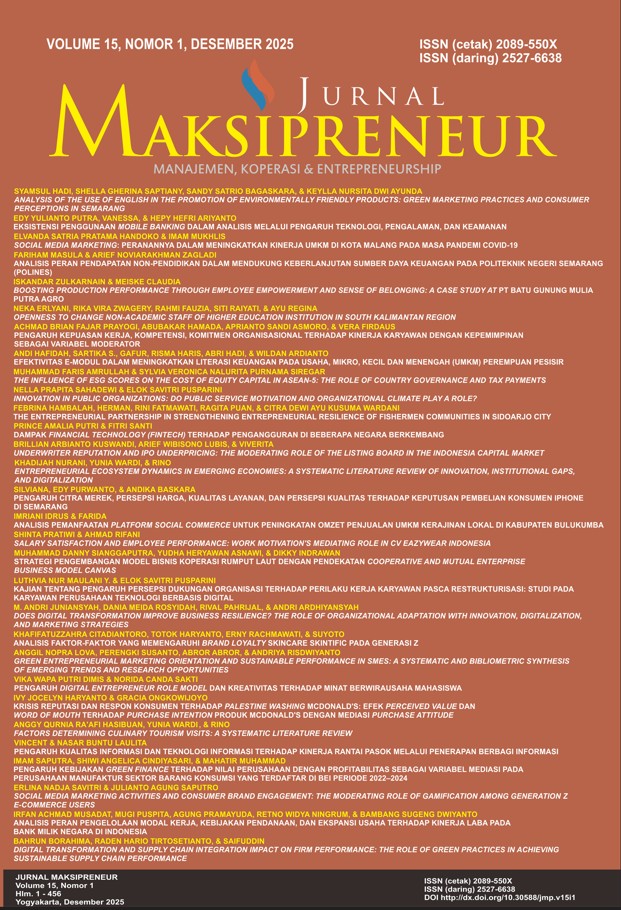
Entrepreneurial Ecosystem Dynamics in Emerging Economies: A Systematic Literature Review of Innovation, Institutional Gaps, and Digitalization
DOI:
https://doi.org/10.30588/jmp.v15i1.2497Keywords:
Entrepreneurial Ecosystem, Emerging Economies, Innovation, Institutional Gap, DigitalizationAbstract
The entrepreneurial ecosystem is a crucial framework for understanding how the interplay of innovation, institutions, and digitalization drives economic growth, especially in emerging economies. However, many developing countries still face structural challenges such as limited access to financing, weak regulatory capacity, and technological gaps that hinder the dynamics of the entrepreneurial ecosystem. These conditions create institutional gaps that impact innovative capabilities and the digital transformation process of entrepreneurship. This study aims to conduct a Systematic Literature Review of various recent empirical and conceptual studies to analyze how innovation, institutional gaps, and digitalization interact in shaping the competitiveness, resilience, and sustainability of the entrepreneurial ecosystem in developing countries. The study's results indicate that the dynamics of the entrepreneurial ecosystem in developing countries are significantly influenced by the strong interactions among innovation, institutions, and digitization. Innovation, especially green and digital innovation, acts as the main driver of value creation and entrepreneurial competitiveness. Institutions serve as the foundation of governance, but still face obstacles in the form of bureaucratic rigidity and policy fragmentation. Meanwhile, digitalization acts as an integrative catalyst that bridges institutional weaknesses, accelerates the flow of information, and strengthens cross-sector collaboration.
References
Afolabi, B. (2021). Entrepreneurship in Nigeria: Challenges and opportunities. Journal of African Business, 22(3), 45–62.
Aimonino, G., Pesce, D., Appio, F., & Franzè, C. (2025). The new era of traceability: A case study on digital product passport. Digital Transformation Research Series.
Aldrich, H., & Fiol, C. (2020). Digital innovation and institutional change in emerging economies. Academy of Management Perspectives, 34(4), 567–584.
Sedeh, A., Pezeshkan, A., & Caiazza, R. (2022). Innovative entrepreneurship in emerging and developing economies: The effects of entrepreneurial competencies and institutional voids. The Journal of Technology Transfer, 47(4), 1198–1223. https://doi.org/10.1007/s10961-021-09874-1
Antenozio, L., Marques, P., & Bikfalvi, A. (2025). The dynamic role of digital orientation in shaping SME performance. ResearchGate.
Autio, E., Kenney, M., Mustar, P., Siegel, D., & Wright, M. (2021). Entrepreneurial ecosystems and innovation: A cross-national synthesis. Research Policy, 50(4), 104233.
Brown, R., & Mason, C. (2017). Looking inside the entrepreneurial ecosystem. Small Business Economics, 49(1), 11–30.
Čabrilo, S., Užienė, L., & Kianto, A. (2025). Rethinking the future of intellectual capital: Emerging perspectives in IC theory and practice. ECKM 2025 Proceedings, Kaunas University of Technology.
Christogeorgou, K. (2025). Exploring the nexus among institutions, innovation and entrepreneurship. University of Athens Press.
Global Entrepreneurship Monitor (GEM). (2022). Global Report. GEM Consortium.
Guo, H., Tang, J., Su, Z., & Katz, J. A. (2023). Digital innovation and firm performance: The mediating role of dynamic capabilities. Journal of Business Research, 158, 113680. https://doi.org/10.1016/j.jbusres.2023.113680
Jiang, L., Zhang, M., & Hu, S. (2025). Digital economy, green innovation and regional resource allocation efficiency: evidence from 257 cities in China. Frontiers in Environmental Science, 13, https://doi.org/10.3389/fenvs.2025.1529946
Jack, W., & Suri, T. (2014). Risk sharing and transaction costs: Evidence from Kenya’s mobile money revolution. American Economic Review, 104(1), 183–223.
Kshetri, N. (2021). Digital transformation in developing economies. Technological Forecasting and Social Change, 168, 120780.
Le, P. B., & Lei, H. (2021). Determinants of innovation capability: The roles of transformational leadership and knowledge sharing. Journal of Innovation & Knowledge, 6(3), 178–190. https://doi.org/10.1016/j.jik.2020.02.002
Leal, A. N., Fernandes, R. P., & Costa, M. L. (2025). Innovation-driven entrepreneurial ecosystems in emerging economies. Journal of Entrepreneurship and Innovation Research, 12(1), 45–60.
Liu, X., Zhang, W., Liu, M., & Han, J. (2025). Green finance and carbon neutrality: Strategies and policies for a sustainable future. Frontiers in Environmental Science, 13. https://doi.org/10.3389/fenvs.2025.1560927
Marchio, G. (2025). La digitalizzazione come strumento a supporto dell'internazionalizzazione delle PMI: Potenzialità, sfide ed applicazioni. Ph.D Thesis, University of Cassino and Southern Lazio.
Min, X., Jiang, W., & Yang, Y. (2025). Platform enterprise internationalization: Theoretical framework and research prospects. Nankai Business Review International, 16(1), 33–52.
Organisation for Economic Co-operation and Development (OECD). (2022). Innovation in emerging economies. OECD Publishing.
Osei, A., & Asare, C. (2025). Driving circular business strategies for sustainability transitions through green innovation, strategic environmental orientation, and digital transformation. Business Strategy & Development, 8(2), 145–162. https://doi.org/10.1002/bsd2.70246
Osei, A., & Asare, C. (2025). Driving circular business strategies for sustainability transitions through green innovation, strategic environmental orientation, and digital transformation. Business Strategy & Development, 8(2), 145–162. https://doi.org/10.1002/bsd2.70246
Oturu, D. (2025). Venture capital ecosystem for fintechs in Africa: Connecting the dots of a rapidly emerging ecosystem. In Entrepreneurship and Digitalization in Emerging Markets (pp. 211–230).
Rama, R., & Zulaika, S. (2025). A comparative study of entrepreneurship in developed and developing countries: A systematic literature review. Bussman Journal: Indonesian Journal of Business and Management, 4(1), 25–39.
Rao-Nicholson, R., & Svystunova, L. (2022). Bridging the void: How institutional entrepreneurship can overcome institutional voids in Indian public organisations. International Journal of Indian Culture and Business Management, 27(1), 51–76. https://doi.org/10.1504/IJICBM.2022.125598
Sari, N. M. A., & Pratiwi, N. M. F. (2025). Transforming economic education: Building sustainable and digital entrepreneurs. Proceedings of the International Conference on Teaching Economics and Management Studies (TEAMS). Universitas Pendidikan Ganesha.
Storz, C., ten Brink, T., & Zou, N. (2022). Innovation in emerging economies: How do university–industry linkages and public procurement matter for small businesses? Asia Pacific Journal of Management, 39(4), 1439–1480. https://doi.org/10.1007/s10490-021-09763
Todaro, M. P., & Smith, S. C. (2020). Economic development (13th ed.). Pearson.
Transparency International. (2022). Corruption perceptions index. Transparency International.
United Nations Conference on Trade and Development (UNCTAD). (2022). Digital economy report 2022. United Nations.
Vărzaru, A. A. (2024). Digital transformation and innovation: The influence of digitalization on innovation management. Systems, 12(9), 359. https://doi.org/10.3390/systems12090359
Verhoef, P. C., Broekhuizen, T., Bart, Y., Bhattacharya, A., Dong, J. Q., Fabian, N., & Haenlein, M. (2021). Digital transformation: A multidisciplinary reflection and research agenda. Journal of Business Research, 122, 889–901.
Windsperger, J., Cliquet, G., & Galak, O. (2025). Managing networks in the digital economy: Alliances, cooperatives, franchise chains, platforms, and digitalization. In Entrepreneurship and Digitalization in Emerging Markets (pp. 1–21). Springer. https://doi.org/10.1007/978-3-031-81233-0_1
World Economic Forum (WEF). (2023). Global competitiveness report. World Economic Forum.
Wurth, B. (2023). Entrepreneurship ecosystem dynamics: Foundations and contemporary perspectives. Routledge.
Yorgancıoğlu, C. (2025). Extending institutional isomorphism: Adaptive and dynamic dimensions in green policy strategies in knowledge management. Proceedings of the 25th European Conference on Knowledge Management. Academic Conferences International.
Zheng, S., Wang, H., & An, Y. (2025). Ecosystem-based digitalization and the hub firm's innovation performance: A system dynamics approach from the modular architecture perspective. Journal of the Knowledge Economy. https://doi.org/10.1007/s13132-024-02534-3
Zhifeng, Y., Jinchii, H., & Zhaofeng, G. (2025). Digital transformation and innovation of private enterprises in China. Modern Economic Studies, 12(3), 115–128.
Downloads
Published
How to Cite
Issue
Section
License
Copyright (c) 2025 Khadijah Nurani, Yunia Wardi, Rino Rino

This work is licensed under a Creative Commons Attribution 4.0 International License.
Authors who publish with Jurnal Maksipreneur agree to the following terms:
Authors retain copyright and grant the Jurnal Maksipreneur right of first publication with the work simultaneously licensed under a Creative Commons Attribution 4.0 International License that allows others to share (copy and redistribute the material in any medium or format) and adapt (remix, transform, and build upon the material) the work for any purpose, even commercially with an acknowledgment of the work's authorship and initial publication in Jurnal Maksipreneur.
Authors are able to enter into separate, additional contractual arrangements for the non-exclusive distribution of the journal's published version of the work (e.g., post it to an institutional repository or publish it in a book), with an acknowledgment of its initial publication in Jurnal Maksipreneur. Authors are permitted and encouraged to post their work online (e.g., in institutional repositories or on their website) prior to and during the submission process, as it can lead to productive exchanges, as well as earlier and greater citation of published work (See The Effect of Open Access).