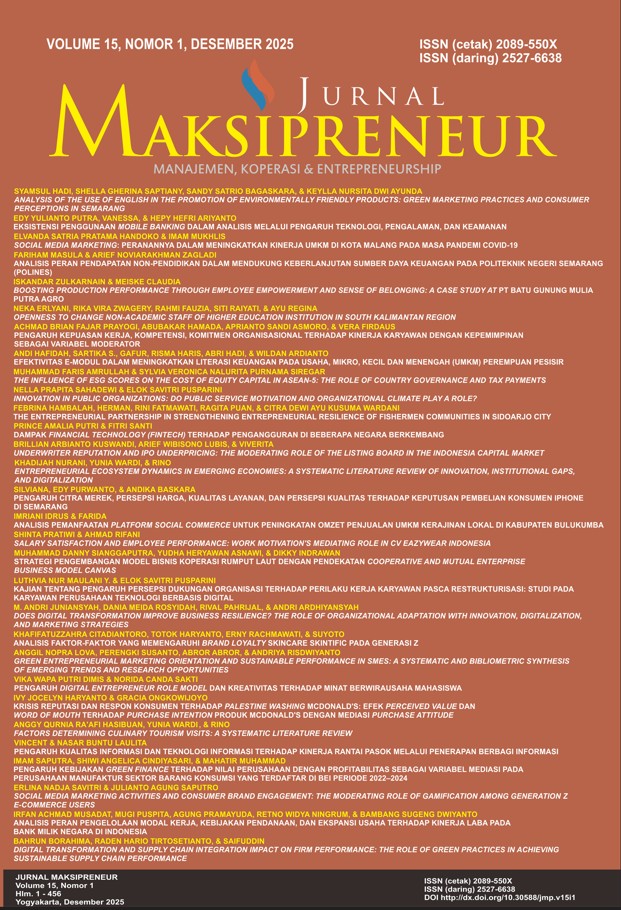
Factors Determining Culinary Tourism Visits: A Systematic Literature Review
DOI:
https://doi.org/10.30588/jmp.v15i1.2543Keywords:
Ambidextrous Leadership, Entrepreneurial Orientation, Gastronomy Tourism, Digital Promotion, Local WisdomAbstract
This article conducts a Systematic Literature Review (SLR) to identify key factors determining visit and revisit intentions in culinary tourism. Guided by PRISMA 2020, Scopus is used to select Q1 journal articles (2020–2025) that examine culinary/gastronomy tourism, ambidextrous leadership (AL), entrepreneurial orientation (EO), digital promotion, and virtual reality/virtual tours (VR/VT). Ten eligible studies are synthesized into three clusters: (1) AL and EO as internal strategic capabilities, (2) VR/VT and digital promotion as experiential and technological drivers, and (3) culinary experiences and local wisdom as core cultural assets. The review presents a comprehensive framework incorporating managerial capabilities and digital experiences.
References
Adeyinka-Ojo, S. (2021). PRISMA statement and thematic analysis framework in hospitality and tourism research. Advances in Global Services and Retail Management, 2, 1–23.
Anggraini, F., Yunilma, Y., Desiyanti, R., & Hakim, L. (2023). The impacts of intellectual capital and entrepreneurship orientation on business performance. Jurnal Ekonomi dan Bisnis, 26(2), 313–330. https://doi.org/10.24914/jeb.v26i2.6366
Armanu, A., Aryati, A. S., Makhmut, K. D. I., & Mail, G. B. (2024). Examining Entrepreneurial Leadership on Tourism Performance: Mediating Role Entrepreneurial Orientation and Moderating Government Support. Jurnal Aplikasi Manajemen, 22(4), 1219–1235. http://dx.doi.org/10.21776/ub.jam.2024.022.04.18
Dedeoğlu, B. B., Çalışkan, C., & Sabbağ, Ç. (2021). Local food consumption during travel: Interaction of ıncentive-disincentive factors, togetherness, and hedonic value. International Journal of Tourism Research, 23(2), 206–219. https://doi.org/10.1002/jtr.2394
Gajić, T., Veljović, S. P., Petrović, M. D., Blešić, I., Radovanović, M. M., Milićević, M. S., Pešić, A. M., Issakov, Y., & Khamitova, D. M. (2025). The Use of Local Ingredients in Shaping Tourist Experience: The Case of Allium ursinum and Revisit Intention in Rural Destinations of Serbia. Foods, 14(9), 1–25. https://doi.org/10.3390/foods14091527
García-Pérez, L. E., & Castillo-Ortiz, I. (2024). Memorable gastro-tourism experiences: A systematic literature review. Annals of Tourism Research Empirical Insights, 5(2), 100158. https://doi.org/10.1016/j.annale.2024.100158
Jonson, A. P., & Masa, J. R. (2023). Gastronomicscape: Determinants of Gastronomic Tourism Experience and Loyalty. African Journal of Hospitality, Tourism and Leisure, 12(3), 1127–1144. https://doi.org/10.46222/ajhtl.19770720.421
Juniarta, P. P., & Suta, P. W. P. (2025). Gastronomic Tourism as an Innovative Strategy to Increase the Attractiveness of Tourist Destinations. Jurnal Informatika Ekonomi Bisnis, 7, 545–550. https://doi.org/10.37034/infeb.v7i3.1240
Kieanwatana, K., & Vongvit, R. (2024). Virtual reality in tourism: The impact of virtual experiences and destination image on the travel intention. Results in Engineering, 24(December), 103650. https://doi.org/10.1016/j.rineng.2024.103650
Maraña, E. C., Cabusay, B. M. M., Torre, C. O. D., Rodriguez, A. P., Ruzol, L. M., De Leon, T. G. R., & Barrion, S. A. M. (2024). Influence of food tourism on tourist satisfaction and revisit intention in laguna. GSC Advanced Research and Reviews, 19(3), 045–057. https://doi.org/10.30574/gscarr.2024.19.3.0191
Maosul, A., Barliana, M. S., Ana, A., Karpin, K., Suwandi, A., & Lestari, N. (2025). Gastrodiplomacy and Culinary Tourism: A Syestematic Literature Review on Small and Medium Enterprise Skills Development in the Tourism Industry. Mimbar Pendidikan: Jurnal Indonesia untuk Kajian Pendidikan, 10(3), 250–266. https://doi.org/10.17509/mimbardik.v10i3.88028
Naderi, N., Naderi, N., Boo, H. C., Lee, K. H., & Chen, P. -J. (2024). Editorial: Food tourism: Culture, technology, and sustainability. Frontiers in Nutrition, 11 01–02. https://doi.org/10.3389/fnut.2024.1390676
Pertusa-Ortega, E. M., Tarí, J. J., Pereira-Moliner, J., Molina-Azorín, J. F., & López-Gamero, M. D. (2021). Developing ambidexterity through quality management and their effects on performance. International Journal of Hospitality Management, 92(October), 102720. https://doi.org/10.1016/j.ijhm.2020.102720
Pusparini, H.I.G.A.P., Indirawati, D.M., Adi, I.K.Y., & Azhari, A. (2024). The Significance of Entrepreneurial Orientation on Firm Performance Through Innovation Capability. Jurnal Ilmiah Manajemen dan Bisnis, 9(2), 118-132. https://doi.org/10.38043/jimb.v9i2.5492
Putra, R. R., Perwitasari, I. D., Rangkuty, D. M., Tasril, V., Handayani, S., & Dewi, A. S. (2025). From Virtual to Reality: How Metaverse and VR Technologies Influence Travel Decisions. Journal of Applied Engineering and Technological Science (JAETS), 6(2), 862–873. https://doi.org/10.37385/jaets.v6i2.6314
Recuero-Virto, N., & Arróspide, C. V. (2024). Culinary destination enchantment: The strategic interplay of local gastronomy in regional tourism development. International Journal of Gastronomy and Food Science, 36(February), 100931. https://doi.org/10.1016/j.ijgfs.2024.100931
Rousta, A., & Jamshidi, D. (2020). Food tourism value: Investigating the factors that influence tourists to revisit. Journal of Vacation Marketing, 26(1), 73–95. https://doi.org/10.1177/1356766719858649
Skard, S., Knudsen, E. S., Sjåstad, H., & Thorbjørnsen, H. (2021). How virtual reality influences travel intentions: The role of mental imagery and happiness forecasting. Tourism Management, 87(February), 104360. https://doi.org/10.1016/j.tourman.2021.104360
Sofiana, M., Langelo, J. S., Supriyadi, E., Maulina, A., & Wahyuni, R. (2022). Case Study of Digital-Based Service Innovation for Old Age Insurance (JHT) Claims by BPJS Employment (BPJAMSOSTEK) Pekalongan Branch Office Central Java. Ilomata International Journal of Management, 3(1), 327–342. https://doi.org/10.52728/ijjm.v3i1.302
Suder, M., Kusa, R., Kallmuenzer, A., Dryglas, D., Gamage, T. C., & Tajeddini, K. (2026). Entrepreneurial orientation and firm performance in tourism and hospitality firms: A configurational approach across different market conditions. International Journal of Hospitality Management, 132(February), 104387. https://doi.org/10.1016/j.ijhm.2025.104387
Usman, M., Ogbonnaya, C., Roodbari, H., Yusuf, R., & Hirekhan, M. (2024). Servant leadership as a catalyst for middle managers’ learning ambidexterity: A resource‐based perspective. British Journal of Management, 35(3), 1336–1347. https://doi.org/10.1111/1467-8551.12761
Utami, M. P., Priyambodo, T. K., & Reksoatmodjo, W. (2022). The Effects of Virtual Reality Use on Millenials’ on Intention to Visit Travel Destination. Indonesian Journal of Tourism and Leisure, 3(2), 58–70. https://doi.org/10.36256/ijtl.v3i2.268
Zhou, L., Zhou, H., Cui, X., & Zhao, J. (2025). Virtual Reality Tourism: Connecting Immersive Experiences to Future Travel Choices. HighTech and Innovation Journal, 6(3), 831–845. https://doi.org/10.28991/HIJ-2025-06-03-06
Zhu, Y., Zhu, L., & Weng, L. (2024). How Do Tourists’ Value Perceptions of Food Experiences Influence Their Perceived Destination Image and Revisit Intention? A Moderated Mediation Model. Foods, 13(3), 412. https://doi.org/10.3390/foods13030412
Downloads
Published
How to Cite
Issue
Section
License
Copyright (c) 2025 Anggy Qurnia Ra’afi Hasibuan, Yunia Wardi, Rino Rino

This work is licensed under a Creative Commons Attribution 4.0 International License.
Authors who publish with Jurnal Maksipreneur agree to the following terms:
Authors retain copyright and grant the Jurnal Maksipreneur right of first publication with the work simultaneously licensed under a Creative Commons Attribution 4.0 International License that allows others to share (copy and redistribute the material in any medium or format) and adapt (remix, transform, and build upon the material) the work for any purpose, even commercially with an acknowledgment of the work's authorship and initial publication in Jurnal Maksipreneur.
Authors are able to enter into separate, additional contractual arrangements for the non-exclusive distribution of the journal's published version of the work (e.g., post it to an institutional repository or publish it in a book), with an acknowledgment of its initial publication in Jurnal Maksipreneur. Authors are permitted and encouraged to post their work online (e.g., in institutional repositories or on their website) prior to and during the submission process, as it can lead to productive exchanges, as well as earlier and greater citation of published work (See The Effect of Open Access).