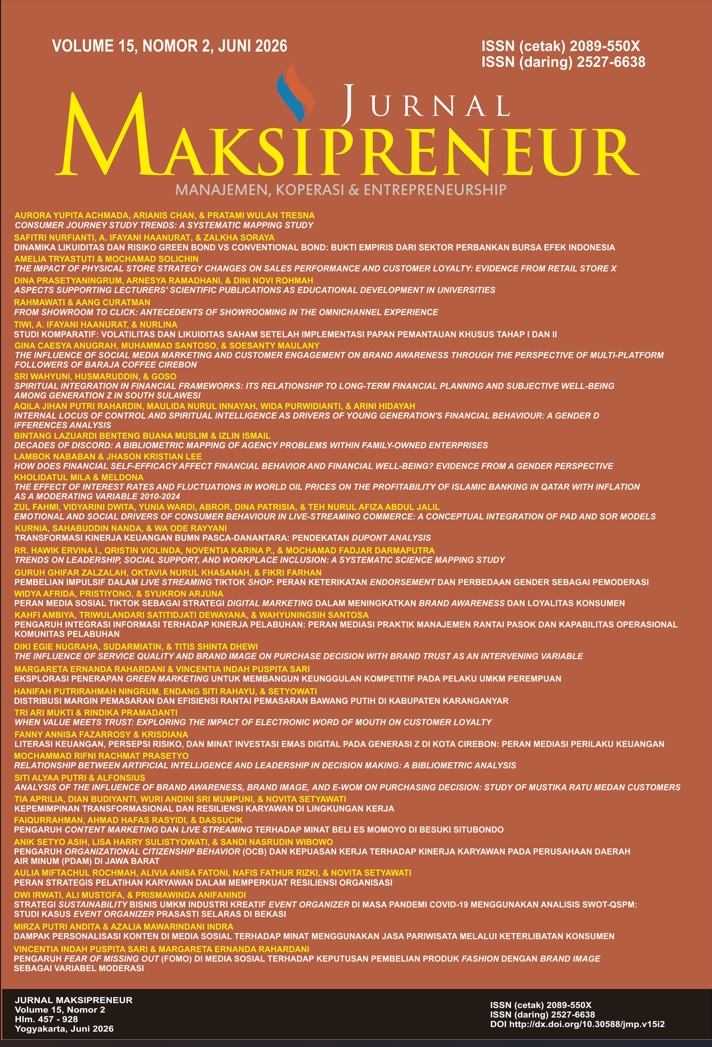
From Showroom to Click: Antecedents of Showrooming in the Omnichannel Experience
DOI:
https://doi.org/10.30588/jmp.v15i2.2643Keywords:
Cosmetic Retail, Omnichannel Experience Satisfaction, Online Seller Trust, Price Sensitivity, Showrooming BehaviorAbstract
This study examines how price sensitivity and trust in online sellers influence showrooming behavior, with omnichannel experience satisfaction serving as a mediator. Data were collected using a quantitative, associative design; questionnaires were administered to 165 cosmetic consumers in Cirebon, selected through purposive sampling. The data were analyzed in SmartPLS version four. The results show that price sensitivity has a positive and significant effect on showrooming behavior, whereas trust in online sellers has no significant direct effect. However, both independent variables significantly affect omnichannel experience satisfaction. Omnichannel experience satisfaction plays a significant mediating role in the relationships between trust in online sellers and price sensitivity, and showrooming behavior. These findings confirm that integrating a satisfying shopping experience is key to encouraging consumer showrooming behavior in the cosmetics retail industry. Traditional retailers should view showrooming as an opportunity for conversion by implementing integration strategies that combine the convenience of online and physical stores and ensure channel consistency.
References
Agung, D. A., Wibowo, R. S., & Supriharyanti, E. (2024). Pengaruh persepsi manfaat, showrooming, dan webrooming terhadap niat menggunakan omnichannel: Peran moderasi persepsi risiko. Jurnal Manajemen Bisnis dan Kewirausahaan, 8(5), 1207–1219.
Alesanco-Llorente, M., Reinares-Lara, E., Pelegrín-Borondo, J., & Olarte-Pascual, C. (2025). Assessing the key variables of mobile-assisted showroomers’ behavior to enhance their shopping experience. Journal of Global Fashion Marketing, 16(1), 109–129. https://doi.org/10.1080/20932685.2024.2420621
Amarullah, D., Handriana, T., & Maharudin, A. (2022). Ewom credibility, trust, perceived risk, and purchase intention in the context of e-commerce: Moderating role of online shopping experience. Jurnal Ekonomi Bisnis dan Kewirausahaan (JEBIK) 2022, 11(1), 61–83. https://doi.org/10.26418/jebik.v11i1.50594
Baines, P., Rosengren, S., & Antonetti, P. (2022). Marketing. Oxford University Press.
Brubakken, J., Fagerstrøm, A., Pawar, S., Sigurdsson, V., & Arntzen, E. (2024). Exploring the Use of Shopper-Facing Technology to Reduce Showrooming. Procedia Computer Science, 239, 1713–1720. https://doi.org/10.1016/j.procs.2024.06.349
Fiestas, J. C., & Tuzovic, S. (2021). Mobile-assisted showroomers: Understanding their purchase journey and personalities. Journal of Retailing and Consumer Services, 58. https://doi.org/10.1016/j.jretconser.2020.102280
Frasquet, M., Miquel-Romero, M. J., & Mollá-Descals, A. (2023). When showrooming is not a threat: Uncovering opportunities for showroomer retention. Electronic Commerce Research and Applications, 60. https://doi.org/10.1016/j.elerap.2023.101287
Fu, J. (2023). The Influence and Mitigation of Consumers’ Price Sensitivity on the Pricing of Luxury Brands & Two Case Studies. Business, Economics, and Management FEIM (Vol. 2023).
Goraya, M. A. S., Zhu, J., Akram, M. S., Shareef, M. A., Malik, A., & Bhatti, Z. A. (2022). The impact of channel integration on consumers’ channel preferences: Do showrooming and webrooming behaviors matter? Journal of Retailing and Consumer Services, 65, 102130. https://doi.org/10.1016/j.jretconser.2020.102130
Gunawan, A., Sumarwan, U., Yuliati, L. N., & Jahroh, S. (2022). Cross-Channel Behavior in Indonesia: Are Omnichannel Shoppers More Loyal than Multichannel Shoppers? Binus Business Review, 13(3), 285–292. https://doi.org/10.21512/bbr.v13i3.8526
Hair Jr, J. F., Hult, G. T. M., Ringle, C. M., & Sarstedt, M. (2017). A Primer on Partial Least Squares Structural Equation Modeling (PLS-SEM). Second Edition. SAGE Publications, Inc.
Helmi, A., Komaladewi, R., Sarasi, V., & Yolanda, L. (2023). Characterizing Young Consumer Online Shopping Style: Indonesian Evidence. Sustainability (Switzerland), 15(5), 1–12. https://doi.org/10.3390/su15053988
Holkkola, M., Tyrväinen, O., Makkonen, M., Karjaluoto, H., Kemppainen, T., Kaleton, T., & Frank, L. (2024). The Drivers of Showrooming Behavior: A Meta-Analysis. 37th Bled eConference Proceedings – Resilience Through Digital Innovation: Enabling the Twin Transition, June 9–12, Bled, Slovenia. https://doi.org/10.18690/um.fov.4.2024.35
Kalaivani, M., Murugan, P. S. B., Selvaraj, V., & Anitha, L. (2025). Analyzing economic determinants of consumer preferences in the digital market using the theory of consumer behavior. International Journal of Accounting and Economics Studies, 12(sI-1), 318–323. https://doi.org/10.14419/mw3cf566
Khan, S. K., Hassan, N. U., & Ali, W. (2023). The determinants of consumers’ online shopping behaviour: An empirical assessment. Gomal University Journal of Research, 39(01), 47–54. https://doi.org/10.51380/gujr-39-01-05
Khoo, W. Y. C., Hong, M., & Chan, T. H. (2023). Click-and-drive e-tailing service: consumers’ perceived convenience and cost. International Journal of Business and Society, 24(6), 629–650. https://doi.org/10.33736/ijbs.5949.2023
Kiew, C. C., Abu Hasan, Z. R., & Abu Hasan, N. (2021). Factors influencing consumers in using Shopee for online purchase intention in East Coast Malaysia. Universiti Malaysia Terengganu Journal of Undergraduate Research, 3(1), 45–56. https://doi.org/10.46754/umtjur.2021.01.006
Lahtinen, J. (2025). Showroomers-who are they? Forms of showrooming behavior in omni-channel retail. Thesis, Master's Programme in Marketing, Aalto University.
Latan, H., & Ghozali, I. (2015). Partial Least Squares: Konsep, Teknik, dan Aplikasi Menggunakan Program SmartPLS 3.0. BP Undip.
Ma’ruf, J. J. (2025). Manajemen Pemasaran Perspektif Indonesia. USK Press.
Mayer, R. C., Davis, J. H., & David Schoorman, F. (1995). An Integrative Model of Organizational Trust. The Academy of Management Review, 20(3), 709–734. https://doi.org/10.2307/258792
Nagle, T. T., Muller, G., & Gruyaert, E. (2024). The Strategy and Tactics of Pricing: A Guide to Growing More Profitably (7th ed.). Taylor & Francis. https://doi.org/10.4324/9781003179566
Othman, A. K. (2021). The Mediating Role of Customer Trust in Affecting the Relationship between Online Shopping Factors and Customer Purchase Decision. Journal of Information Technology Management, 13(3), 141–159. https://doi.org/10.22059/JITM.2021.83234
Paliszkiewicz, J., Chen, K., & Launer, M. (2022). Trust and Digital Business. Routledge. https://doi.org/10.4324/9781003266525
Quach, S., Barari, M., Moudrý, D. V., & Quach, K. (2022). Service integration in omnichannel retailing and its impact on customer experience. Journal of Retailing and Consumer Services, 65, 102267. https://doi.org/10.1016/j.jretconser.2020.102267
Rahman, S. M., Carlson, J., Gudergan, S. P., Wetzels, M., & Grewal, D. (2025). How do omnichannel customer experiences affect customer engagement? Theory and empirical validation. Journal of Business Research, 189, 115196. https://doi.org/10.1016/j.jbusres.2025.115196
Sahu, K. C., Naved Khan, M., & Gupta, K. Das. (2021). Determinants of webrooming and showrooming behavior: A systematic literature review. Journal of Internet Commerce, 20(2), 137–166. https://doi.org/10.1080/15332861.2020.1863041
Schneider, P. J., & Zielke, S. (2021). Price versus service: Can retailers beat showrooming with competence? Journal of Retailing and Consumer Services, 61, 102592. https://doi.org/10.1016/j.jretconser.2021.102592
Sen, S. S., Alexandrov, A., Jha, S., McDowell, W. C., & Babakus, E. (2023). Convenient = competitive? How brick-and-mortar retailers can cope with online competition. Review of Managerial Science, 17(5), 1615–1643. https://doi.org/10.1007/s11846-022-00566-0
Sharma, N., & Fatima, J. K. (2025). Omnichannel usage influence on webrooming-showrooming: the moderating influence of consumer segment and product price. Journal of Consumer Marketing, 42(6), 731–742. https://doi.org/10.1108/JCM-05-2024-6891
Shi, S., Wang, Y., Chen, X., & Zhang, Q. (2020). Conceptualization of omnichannel customer experience and its impact on shopping intention: A mixed-method approach. International Journal of Information Management, 50, 325–336. https://doi.org/10.1016/j.ijinfomgt.2019.09.001
Sugiyono, S., & Lestari, P. (2021). Metode penelitian komunikasi (Kuantitatif, kualitatif, dan cara mudah menulis artikel pada jurnal internasional). Alfabeta.
Wang, S., Luo, T., & Chang, D. (2021). Pricing Strategies of Multichannel Apparel Supply Chain Based on Showrooming and Information Sharing. Mathematical Problems in Engineering, 6659200. https://doi.org/10.1155/2021/6659200
Wang, Z. (2024). A Literature Review of Showrooming Phenomenon: Causes and Implications. Advances in Economics, Management and Political Sciences, 92(1), 39–45. https://doi.org/10.54254/2754-1169/92/20231366
Wei, J., Chang, M., & Zhao, J. (2023). Price matching and product differentiation strategies considering showrooming. Journal of Retailing and Consumer Services, 75, 103473. https://doi.org/10.1016/j.jretconser.2023.103473
Wibowo, A. (2022). Transformasi Ekonomi Digital. Yayasan Prima Agus Teknik.
Downloads
Published
How to Cite
Issue
Section
License
Copyright (c) 2026 Rahmawati Rahmawati, Aang Curatman

This work is licensed under a Creative Commons Attribution 4.0 International License.
Authors who publish with Jurnal Maksipreneur agree to the following terms:
Authors retain copyright and grant the Jurnal Maksipreneur right of first publication with the work simultaneously licensed under a Creative Commons Attribution 4.0 International License that allows others to share (copy and redistribute the material in any medium or format) and adapt (remix, transform, and build upon the material) the work for any purpose, even commercially with an acknowledgment of the work's authorship and initial publication in Jurnal Maksipreneur.
Authors are able to enter into separate, additional contractual arrangements for the non-exclusive distribution of the journal's published version of the work (e.g., post it to an institutional repository or publish it in a book), with an acknowledgment of its initial publication in Jurnal Maksipreneur. Authors are permitted and encouraged to post their work online (e.g., in institutional repositories or on their website) prior to and during the submission process, as it can lead to productive exchanges, as well as earlier and greater citation of published work (See The Effect of Open Access).