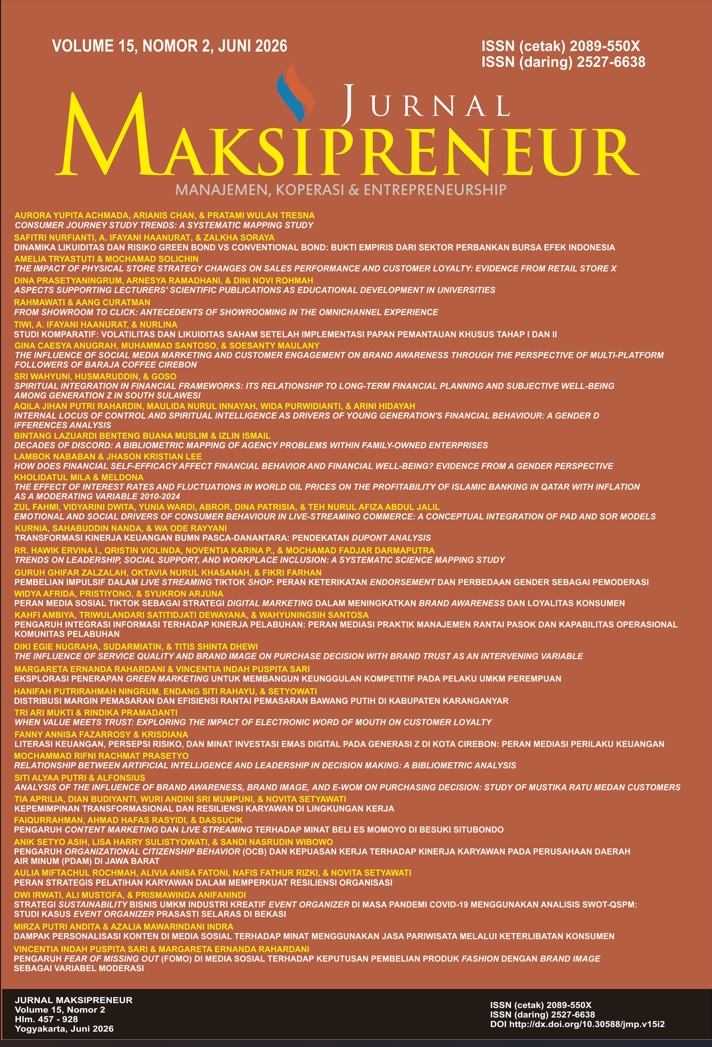
Internal Locus of Control and Spiritual Intelligence as Drivers of Young Generation’s Financial Behaviour: A Gender Differences Analysis
DOI:
https://doi.org/10.30588/jmp.v15i2.2572Keywords:
Internal Locus of Control, Spiritual Intelligence, Gender, Personal Financial Management BehaviourAbstract
Personal financial management behaviour is increasingly vital for Generation Z, who face rapid digitalisation, abundant information, and rising consumerism that influence their financial attitudes and choices. This study investigates the effects of Internal Locus of Control and Spiritual Intelligence on personal financial management behaviour, with gender as a moderating factor, using data from 154 respondents in Banyumas Regency collected through purposive sampling and analysed with PLS-SEM. The findings show that Internal Locus of Control positively and significantly enhances financial management behaviour, indicating that individuals with stronger self-control tend to manage finances more responsibly. Spiritual Intelligence also contributes positively, highlighting the influence of values and awareness on financial decisions. Gender further moderates both relationships, revealing behavioural differences between males and females. Overall, the study underscores the need to integrate psychological and spiritual elements into financial education for Generation Z.
References
Aghata, V., Supeni, R. E., Wijayantini, B., & Manajemen, P. S. (2025). Pengaruh Gender, Literasi Keuangan, Lifestyle Hedonis, dan Kepribadian terhadap Pengelolaan Keuangan Pribadi (Studi Kasus Mahasiswa PTS di Kota Jember). Jurnal Simki Economic, 8(1), 289–301. https://doi.org/0.29407/jse.v8i1.1174
Agustin, A., & Prapanca, D. (2023). Dampak Gaya Hidup Hedonisme dan Kecerdasan Spiritual Terhadap Perilaku Keuangan Anak Muda dengan Locus of Control sebagai Variabel Intervening. Indonesian Journal of Islamic Economics and Business, 8(2), 303–320. https://doi.org/10.30631/ijoieb.v8i2.1957
Ajzen, I. (1991). The theory of planned behaviour. Organizational Behaviour and Human Decision Processes, 50(2), 179–211. https://doi.org/10.1016/0749-5978(91)90020-T
Ajzen, I. (2020). The theory of planned behaviour: Frequently asked questions. Human Behavior and Emerging Technologies, 2(4), 299–415. https://doi.org/10.1002/hbe2.195
Amri, A., Ramdani, Z., Warsihna, J., & Tae, L. F. (2022). The Development and Validation of Financial Management Behaviour ( FMB ) Scale in Postgraduate Students. Jurnal Manajemen Indonesia, 22(2), 189–198. https://doi.org/10.25124/jmi.v22i2.4006
Amri, A., Widyastuti, T., Bahri, S., & Ramdani, Z. (2023). Effect of Individual Attributes toward Financial Management Behaviour through Locus of Control. ETIKONOMI, 22(2), 443–456.
Anna S, T. L., Prayudi, A., & Syahrial, H. (2025). The Effect of Spiritual Intelligence and Hedonistic Lifestyle on Personal Financial Management (Case Study of Employees at the P3AKB Office of the Provincial Government of North Sumatra). SAJMR: Southeast Asian Journal of Management and Research, 3(4), 67–81. https://doi.org/10.61402/sajmr.v3i4.494
Aqidah, N. A., & Hamida, H. (2025). Financial Management Behaviour in Indonesia: Gender Perspective. Owner Riset dan Jurnal Akuntansi, 9(1), 111–116. https://doi.org/10.33395/owner.v9i1.2573
Arestha, R., Camelia, C., Wanto, F., Hendy, H., & Mutiara, M. (2024). The Influence of Financial Literacy on the Consumptive Behaviour of Generation Z: A Systematic Literature Review. Jurnal Ekonomi, Akuntasi dan Manajemen Indonesia (JEAMI), 2(02), 95–103. https://doi.org/10.58471/jeami.v2i02.554
Ariesta, A. (2025). Riset OCBC (NISP) Ungkap Skor Kesehatan Finansial Generasi Muda RI Turun, Ini Faktor Pemicunya. IDX Channel.com, 13 September. https://www.idxchannel.com/banking/riset-ocbc-nisp-ungkap-skor-kesehatan-finansial-generasi-muda-ri-turun-ini-faktor-pemicunya
Arum, L. S., Zahrani, A., & Duha, N. A. (2023). Karakteristik Generasi Z dan Kesiapannya dalam Menghadapi Bonus Demografi 2030. Accounting Student Research Journal, 2(1), 59–72. https://doi.org/10.62108/asrj.v2i1.5812
Asaari, M. (2024). Pengaruh Financial Knowledge dan Internal Locus of Control Terhadap Personal Financial Management Behaviour Pelaku UMKM Di Kabupaten Bogor. Innovative: Journal of Social Science Research, 4(2), 2943–2956. https://doi.org/10.31004/innovative.v4i2.9784
Asih, F. Y., Innayah, M. N., Miftahuddin, A., & Rahmawati, I. Y. (2025). Memahami Perilaku Konsumtif Generasi Milenial: Peran Gaya Hidup, Locus of Control, dan Sikap Keuangan dengan Literasi Keuangan sebagai Variabel Moderasi. Jurnal Manajemen dan Bisnis Indonesia, 11(1), 1–19. https://doi.org/10.32528/jmbi.v11i1.2838
Atikasari, W., Innayah, M. N., Purwidianti, W., & Hidayah, A. (2025). Financial Literacy, Financial Inclusion, Locus of Control, and Financial Technology toward Financial Management of MSME. Asian Journal of Economics, Business and Accounting, 25(8), 46–60. https://doi.org/10.9734/ajeba/2025/v25i81914
Azhima, Z. A., & Pinem, D. (2024). Analysis of Financial Literacy, Financial Technology, and Lifestyle on Financial Behaviour of Generation Z in Pulo Village. Formosa Journal of Sustainable Research, 3(1), 79–98. https://doi.org/10.55927/fjsr.v3i1.7729
Bajtelsmit, V. L., & Bernasek, A. (1996). Why Do Women Invest Differently Than Men? Financial Counseling and Planning, 7, 1–10. https://doi.org/10.2139/ssrn.2238
Bodur, N. D., Dudu, S., Bozkus, S. C., & Elveren, A. Y. (2023). Gender differences in risk aversion: Evidence from private pension system in Türkiye. Women’s Studies International Forum. 101, 1–9. https://doi.org/10.1016/j.wsif.2023.102843
Buia, A. L., Rayyani, W. O., & Amin, A. R. S. (2024). Spiritual intelligence and lifestyle on personal financial management of overseas students studying in Makassar. International Journal of Economic Research and Financial Accounting (IJERFA), 2(4), 924–933. https://doi.org/10.55227/ijerfa.v2i4.145
Cahyapuspita, H. A., & Rita, M. R. (2022). Pengaruh Kecerdasan Spiritual, Intelektual, dan Emosional terhadap Pengelolaan Keuangan Pribadi Mahasiswa dengan Moderasi Peer Group. Journal of Business Management Education (JBME), 7(1), 81–97. https://doi.org/10.17509/jbme.v7i1.40940
Chen, C. L., & Dosinta, N. F. (2023). The Investment Decision on Generation Z in Pontianak. Management, Business, and Accounting (MBIA), 22(2), 263–279. https://doi.org/10.33557/mbia.v22i2.2477
Cicotto, G. (2025). Spiritual Intelligence: A New Form of Intelligence for a Sustainable and Humane Future. Encyclopedia, 5(3), 107. https://doi.org/10.3390/encyclopedia5030107
Clarence, J., & Pertiwi, D. (2023). Financial Management Behaviour Among Students : The Influence Of Digital Financial Literacy. International Journal of Financial and Investment Studies (IJFIS), 4(1), 9–16. https://doi.org/10.9744/ijfis.2.1.9-16
Damayanti, D., Tubastuvi, N., Purwidianti, W., & Aryoko, Y. P. (2023). Financial Management Behaviour: The Influence of Financial Knowledge, Financial Attitude, and Financial Literacy Mediated by Locus of Control. Indonesian Journal of Business Analytics, 3(6), 2331–2350. https://doi.org/10.55927/ijba.v3i6.6907
Damong, G. C., & Perez, C. (2024). Financial behaviour between male and female : a systematic literature review. Journal of Social Sciences and Management Studies, 3(4), 23–34. https://doi.org/10.56556/jssms.v3i4.1051
Dew, J., & Xiao, J. J. (2011). The Financial Management Behaviour Scale : Development and Validation. Journal of Financial Counseling and Planning, 22(1), 19–35.
Dewi, Y. S. (2024). Relationship of Knowledge about Ecological Concepts, Spiritual Intelligence and Locus of Control with Environmental Altruistic Behaviour in Students. Pakistan Journal of Life and Social Sciences (PJLSS), 22(2), 24433–24444. https://doi.org/10.57239/pjlss-2024-22.2.001746
Díaz-Caro, C., Martínez, F. F., Crespo-Cebada, E., & Sanguino, Á. M. (2025). A Quantitative Analysis of Sustainable Finance Preferences: Choice Patterns, Personality Traits, and Gender in SDG 7 Investments. Risks, 13(11), 226. https://doi.org/10.3390/risks13110226
Fatmawati, I., Lutfi, L., Studi, P., Manajemen, S., Timur, J., Keuangan, P. M., Keuangan, P., & Milenial, G. (2021). Pengaruh Lokus Pengendalian dan Pengetahuan Keuangan pada Perilaku Manajemen Keuangan Generasi Milenial dengan Moderasi Pendapatan. Jurnal Manajemen & Keuangan, 10(1), 58–71. https://doi.org/10.33059/jmk.v10i1.3340
Fransisca, V., & Ningsih, W. (2023). The Advancement of Technology and its Impact on Social Life in Indonesia. Devotion: Journal of Research and Community Service, 4(3), 860–864. https://doi.org/10.36418/devotion.v4i3.445
Hair, J. F., Hult, G. T., Ringle, C. M., & Sarstedt, M. (2022). A Primer on Partial Least Squares Structural Equation Modeling (PLS-SEM). Sage.
Hair, J. F., Risher, J. J., Sarstedt, M., & Ringle, C. M. (2019). When to use and how to report the results of PLS-SEM. European Business Review, 31(1), 2–24. https://doi.org/10.1108/EBR-11-2018-0203
Haudi, H. (2023). The Role of Financial Literacy, Financial Attitudes, and Family Financial Education on Personal Financial Management and Locus of Control of University Students. International Journal of Social and Management Studies (IJOSMAS), 4(2), 107–116. https://doi.org/10.5555/ijosmas.v4i2.289
Hefri, B. N. F. (2023). The mediating role of locus of control: Financial knowledge and financial attitude on financial management behaviour. Journal of Management and Business Insight, 1(2), 171–183. https://doi.org/10.12928/jombi.v1i2.759
Jaker, M., Majid, N., & Mutia, A. (2023). Pengaruh Literasi Keuangan, Sikap Keuangan dan Kepribadian terhadap Perilaku Pengelolaan Keuangan pada Mahasiswa di Kota Jambi. Jurnal Makesya, 3(2), 84–93. https://doi.org/https://doi.org/10.30631/makesya.v3i2.2012
Jangid, J., Bhardwaj, B., & Sharma, D. (2025). The nexus between spirituality and personal financial behaviour: A study of students with. LBS Journal of Management & Research, 22(2), 190–199. https://doi.org/10.1108/LBSJMR-03-2024-0011
Kabupaten Banyumas. (2025). Buku Profil Kependudukan 2024 untuk 2025. Dinas Kependudukan dan Pencatatan Sipil Kabupaten Banyumas. https://dindukcapil.banyumaskab.go.id/read/55414/buku-profil-kependudukan-tahun-2025-dindukcapil-banyumas
Khoirunnisa, I. R., & Rochmawati, R. (2021). Pengaruh Literasi Keuangan, Sikap Keuangan, dan Pendidikan Keuangan Keluarga terhadap Manajemen Keuangan Pribadi dengan Locus of Control Sebagai Variabel Intervening. Jurnal Pendidikan Akuntansi (JPAK), 9(2), 210–219. https://doi.org/10.26740/jpak.v9n2.p210-219
Kholilah, N. Al, & Iramani, R. (2013). Studi Financial Management Behaviour Pada Masyarakat Surabaya. Journal of Business & Banking, 3(1), 69–80. https://doi.org/10.14414/jbb.v3i1.255
Lailatul, N. (2022). Can Gender be a Moderating Variable in Micro Small Medium Enterprises Financial Behaviour? A Perspective from Financial Literacy, Financial Attitude, and Income. Jurnal Manajemen Bisnis, 13(2), 306–323. https://doi.org/10.18196/mb.v13i2.14199
Lestari, N. (2020). The Influence of Spiritual Intelligence and Gender on the Personal Financial of Management Students. Proceedings of the First International Conference on Applied Science and Technology (iCAST 2018), 298(iCAST 2018), 69–72. https://doi.org/10.2991/assehr.k.200813.017
Lukesi, E., Rahadjeng, E. R., & Satiti, N. R. (2021). Effect of financial attitudes, financial knowledge, locus of control, and financial self-efficacy to financial management behaviour in Millennial Generation. Jurnal Manajemen Bisnis dan Kewirausahaan, 1(01), 56–63. https://doi.org/10.22219/jamanika.v1i1.16027
Manafe, J. D., & Setyorini, T. (2023). The impact of emotional and spiritual intelligence on students’ personal financial management behaviour, parenting style as a mediator. Enrichment: Journal of Management, 13(4), 2615–2624. https://doi.org/10.35335/enrichment.v13i4.1635
Maria, M. (2022). Impact of Financial Literacy on Financial Behaviour and Entrepreneurial Intention: Gender as a Moderator. Study on Undergraduate Students in Kupang City. Enrichment: Journal of Management, 12(4), 3191–3195. https://doi.org/10.35335/enrichment.v12i4.764
Masdupi, E., Rasyid, R., & Rahmiati, R. (2020). Financial Management Behaviour at Productive Age Community in Bukittinggi. Proceedings of the 4th Padang International Conference on Education, Economics, Business and Accounting (PICEEBA-2 2019), 124, 673–681. https://doi.org/10.2991/aebmr.k.200305.133
Misbahuddin, A. A. (2023). Pengaruh literasi keuangan, kecerdasan spiritual, dan gaya hidup terhadap pengelolaan keuangan pribadi mahasiswa: Studi pada mahasiswa Universitas Islam Negeri Maulana Malik Ibrahim Malang. Thesis, Universitas Islam Negeri Maulana Malik Ibrahim.
Mutlu, U., & Ozer, G. (2021). The moderator effect of financial literacy on the relationship between locus of control and financial behaviour. Kybernetes, 51(3), 1114–1126. https://doi.org/10.1108/K-01-2021-0062
Navilla, M. S., Sumiati, S., & Juwita, H. A. J. (2025). Locus of Control and Its Influence on Generation Z’s Financial Management in Malang. Jurnal Ilmiah Manajemen Kesatuan, 13(5), 3337–3350. https://doi.org/10.37641/jimkes.v13i5.3631
Nurjanah, R., Asti, E. G., Rafikah, I., & Istiqomah, A. (2024). Implikasi Kontrol Diri, Kecerdasan Spiritual dan Literasi Keuangan dalam Pengelolaan Keuangan. Owner: Riset dan Jurnal Akuntansi, 8(2), 1439–1450. https://doi.org/10.33395/owner.v8i2.2202
Nyimbili, F., & Nyimbili, L. (2024). Types of Purposive Sampling Techniques with Their Examples and Application in Qualitative Research Studies. British Journal of Multidisciplinary and Advanced Studies, 5, 90–99.
https://doi.org/10.37745/bjmas.2022.0419
Park, S. Y., Yourell, J., Mcalister, K. L., & Huberty, J. (2023). Exploring Generation Z and Young Millennials’ Perspectives of a Spiritual Self-Care App and Their Spiritual Identity (Skylight): Qualitative Semistructured Interview Study. JMIR Formative Research, 7, e54284. https://doi.org/10.2196/54284
Parmitasari, R. D. A., Kara, M., Bulutoding, L., Alwi, Z., & Sriwijaya, M. (2020). Financial Behaviour of Indonesian Moslem Students Scholarship Recipients : The Role of Locus of Control and Financial Knowledge. International Journal of Advanced Engineering Research and Science (IJAERS), 7(4), 281–292.
Peetz, J., Robson, J., & Xuereb, S. (2021). The Role of Income Volatility and Perceived Locus of Control in Financial Planning Decisions. Frontiers in Psychology, 12, 1–13. https://doi.org/10.3389/fpsyg.2021.638043
Puspitasari, K. I., & Sriyono, S. (2024). Influence of Pocket Money, Social Environment, and Locus of Control on Financial Behaviour with Financial Technology as an Intervening Variable. UMSIDA Preprints Server, 5(5), 1–12. https://doi.org/10.21070/ups.4411
Putri, F. A., & Mulyani, E. (2023). Analisis Perbedaan Perilaku Investasi Saham Antara Wanita dan Pria di Pasar Modal Indonesia. Jurnal Eksplorasi Akuntansi, 5(3), 978–998. https://doi.org/10.24036/jea.v5i3.752
Putri, S. T., Suripto, S., Djausal, G. P., & Wardianto, K. B. (2025). The Personal Financial Management Behaviour of Generation Z. Forum of Management, 1, 1–11.
Putry, S. A., Sanosra, A., & Rahayu, J. (2025). Pengaruh Literasi Keuangan, Gaya Hidup, Uang Saku, dan Gender terhadap Pengelolaan Keuangan pada Mahasiswa Kota Banyuwangi. Jurnal Ilmiah Manajemen dan Kewirausahaan, 4(1), 273–288. https://doi.org/10.55606/jimak.v4i1.5191
Quang, L. T., Linh, N. D., Nguyen, D. Van, & Khoa, D. D. (2023). Behavioural Factors Influencing Individual Investors’ Decision Making In Vietnam Market. Journal of Eastern European and Central Asian Research (JEECAR), 10(2), 264–280. https://doi.org/10.15549/jeecar.v10i2.10
Rahmawati, U., & Marcella, E. (2023). Locus of control, financial knowledge, financial attitude, financial self-efficacy, and socioeconomic status as antecedents of financial management behaviour. Journal of Management and Business Insight, 1(1), 66–76. https://doi.org/10.12928/jombi.v1i1.561
Rahmayanti, D. (2023). The effect of internal locus of control and spiritual intelligence on personal financial management behaviour. Integrated Journal of Business and Economics, 7(1), 354–365. http://dx.doi.org/10.33019/ijbe.v7i1.596
Ramadhan, M. F., Sari, M. I., & Endah, R. (2023). Manajemen Keuangan Ibu-Ibu Aisyiyah: Personal Income, Sikap Keuangan, dan Kecerdasan Spiritual. Master: Jurnal Manajemen dan Bisnis Terapan, 3(2), 132–142. https://doi.org/10.30595/jmbt.v3i2.19666
Robson, J., & Peetz, J. (2020). Gender differences in financial knowledge, attitudes, and behaviours: Accounting for socioeconomic disparities and psychological traits. The Journal of Consumer Affairs, 54(3), 813–835. https://doi.org/10.1111/joca.12304
Rotter, J. (1966). General Expectancies for Internal Versus External Control of Reinforcement. Psychological Monographs, 80, 1–28. https://doi.org/10.1037/h0092976
Santoso, R. A., Vilantika, E., Soelistya, D., & Liu, Y. (2024). Locus of Control Mediates The Impact of Financial Knowledge, Attitudes, and Experience on Financial Behaviour. Jurnal Manajemen Bisnis, 15(2), 406–418. https://doi.org/10.18196/mb.v15i2.23506
Setyorini, H., & Usman, N. M. (2022). The Effect of Spiritual Intelligence, Personality, Financial Literacy on Family Financial Management in Pandemic Time. The International Journal of Business & Management, 10(9), 49–57. https://doi.org/10.24940/theijbm/2022/v10/i9/172343-415399-2-SM
Siringoringo, E. L., & Alhazami, L. (2025). Pengaruh Financial Knowledge, Financial Attitude, dan Internal Locus of Control terhadap Perilaku Manajemen Keuangan Generasi Z di Jakarta. Jejak Digital: Jurnal Ilmiah Multidisiplin, 1(5), 3620-3631. https://doi.org/10.63822/xz5qbp83
Sitorus, M. R. U., & Adlina, H. (2024). Pengaruh Financial Knowledge dan Internal Locus of Control terhadap Personal Financial Management Behaviour (Studi pada Pelaku UMKM di Jalan STM Kota Medan). Jurnal Ilmiah Wahana Pendidikan, 10(22), 826–838. https://doi.org/10.5281/zenodo.14576427
Suryantari, E. P., Cahyadi, L. D. C. R., & Suarjana, I. W. (2024). Mixed method dalam memprediksi perilaku keuangan perempuan pesisir Nusa Penida, Bali. JPPI (Jurnal Penelitian Pendidikan Indonesia), 10(3), 13–22. https://doi.org/10.29210/020243850
Sylvia, S., Aqsya, M. A., & Mas’ud, M. (2023). Financial Knowledge, Spiritual Intelligence, and Hedonism Lifestyle of Department Store Employees in Managing Personal Finance. Entrepreneurship and Small Business Research, 2(1), 42–51. https://doi.org/10.55980/esber.v2i1.92
Trisnowati, Y., Khoirina, M. M., & Putri, F. A. (2020). Faktor yang Mempengaruhi Financial Management Behavior pada Mahasiswa Fokus Keilmuan Ekonomi dan Bisnis Kabupaten Gresik. Jurnal Manajerial, 7(2), 110–123. https://doi.org/10.30587/jurnalmanajerial.v7i2.1087
Uifalean, R. (2024). Risk attitudes, financial literacy and financial behaviour: a gender specific comparison. The Review of Finance and Banking, 16(2), 249–271.
Vitriani, F. (2022). Financial Behaviour, Financial Literacy, And Locus Of Control During The Covid-19 Pandemic. International Journal of Economic Policy in Emerging Economies, 20(3/4), 333-339.
Wahyuni, E. S., & Ramadhan, F. (2022). Analisis Faktor yang Mempengaruhi Locus of Control dan Financial Management Behaviour dengan Financial Technology Sebagai Variabel Moderating pada Dosen di Batam Selama Masa Pandemic Covid 19. Jurnal Menara Ekonomi: Penelitian dan Kajian Ilmiah Bidang Ekonomi, 8(2), 102–115. https://doi.org/10.31869/me.v8i2.3737
Wei, Y. (2023). Gender Differences in Moral Judgement and Relevant Factors. Journal of Education, Humanities and Social Sciences, 22, 569–573. https://doi.org/10.54097/ehss.v22i.13061
Yunarsi, Y. (2022). Financial Literacy, Financial Attitude, and Internal Locus of Control towards Personal Financial Management. International Journal of Multi Discipline Science (IJ-MDS), 5(2), 75-88.
Yunita, N. (2020). Pengaruh Gender dan Kemampuan Akademis terhadap Literasi Keuangan dalam Perilaku Pengelolaan Keuangan pada Mahasiswa Jurusan Akuntansi. Prisma (Platform Riset Mahasiswa Akuntansi), 1(2), 1–12.
Yusanti, A. P. (2020). Pengaruh Gaya Hidup, Kecerdasan Spiritual dan Jenis Kelamin terhadap Perilaku Pengelolaan Keuangan Keluarga. Repositori Universitas Hayam Wuruk Perbanas.
Zirzis, M. (2024). Evolusi ekonomi di era digital: Kontribusi Generasi Z dalam perekonomian. Jurnal Literasi Indonesia (JLI), 1(2), 77–83.
Downloads
Published
How to Cite
Issue
Section
License
Copyright (c) 2026 Aqila Jihan Putri Rahardin, Maulida Nurul Innayah, Wida Purwidianti, Arini Hidayah

This work is licensed under a Creative Commons Attribution 4.0 International License.
Authors who publish with Jurnal Maksipreneur agree to the following terms:
Authors retain copyright and grant the Jurnal Maksipreneur right of first publication with the work simultaneously licensed under a Creative Commons Attribution 4.0 International License that allows others to share (copy and redistribute the material in any medium or format) and adapt (remix, transform, and build upon the material) the work for any purpose, even commercially with an acknowledgment of the work's authorship and initial publication in Jurnal Maksipreneur.
Authors are able to enter into separate, additional contractual arrangements for the non-exclusive distribution of the journal's published version of the work (e.g., post it to an institutional repository or publish it in a book), with an acknowledgment of its initial publication in Jurnal Maksipreneur. Authors are permitted and encouraged to post their work online (e.g., in institutional repositories or on their website) prior to and during the submission process, as it can lead to productive exchanges, as well as earlier and greater citation of published work (See The Effect of Open Access).