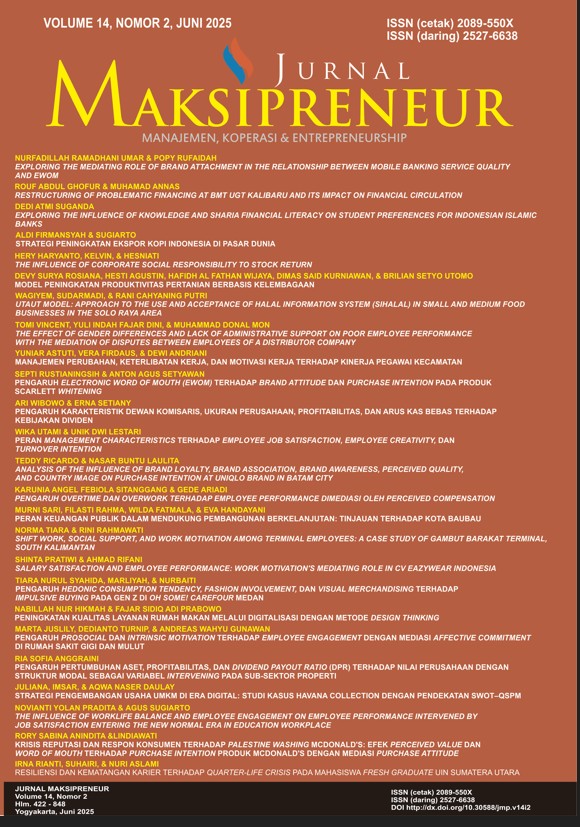
Exploring the Mediating Role of Brand Attachment in the Relationship between Mobile Banking Service Quality and eWOM
DOI:
https://doi.org/10.30588/jmp.v14i2.2134Keywords:
Brand Attachment, electronic Word of mouth (eWOM)Abstract
In today's digital era, the quality of mobile banking services is a crucial factor in the banking industry. This study evaluates how mobile banking service quality affects bank customers' brand attachment and electronic word of mouth (eWOM). The study employed an online survey and analyzed the data using a statistical technique called Partial Least Squares Structural Equation Modeling (PLS-SEM). The results revealed that value-added features, security and privacy, and interactivity positively affect brand attachment. In addition, value-added features also have a positive effect on eWOM. Brand attachment has a positive relationship with eWOM and mediates security/privacy, value-added features, and interactivity with eWOM.
References
Ahdiat, A. (2023). Transaksi Digital Banking di Indonesia Tumbuh 158% dalam 5 Tahun Terakhir. Databooks. https://databoks.katadata.co.id/datapublish/2023/07/05/transaksi-digital-banking-di-indonesia-tumbuh-158-dalam-5-tahun-terakhir
Ahmad, A., AlMallah, M. M., & AbedRabbo, M. (2022). Does eWOM influence entrepreneurial firms’ rate of diffusion of innovation? Journal of Research in Marketing and Entrepreneurship, 24(1), 92–111. https://doi.org/10.1108/JRME-01-2021-0012
Ahn, J. (2019). Consideration of rosy- and blue-side attachment with integrated resort brands. Journal of Destination Marketing and Management, 13, 1–9. https://doi.org/10.1016/j.jdmm.2019.05.001
Al Khasawneh, M., Abuhashesh, M., Ahmad, A., Masa’deh, R., & Alshurideh, M. T. (2021). Customers Online Engagement with Social Media Influencers’ Content Related to COVID 19 (pp. 385–404). https://doi.org/10.1007/978-3-030-67151-8_22
Albert, N., Merunka, D., & Valette-Florence, P. (2008). When consumers love their brands: Exploring the concept and its dimensions. Journal of Business Research, 61(10), 1062–1075. https://doi.org/10.1016/j.jbusres.2007.09.014
Arcand, M., PromTep, S., Brun, I., & Rajaobelina, L. (2017). Mobile banking service quality and customer relationships. International Journal of Bank Marketing, 35(7), 1066–1087. https://doi.org/10.1108/IJBM-10-2015-0150
Babić, A., Sotgiu, F., De, K., Tammo, V., & Bijmolt, H. A. (2015). The Effect of Electronic Word of Mouth on Sales: A Meta-Analytic Review of Platform, Product, and Metric Factors.
Donthu, N., Kumar, S., Pandey, N., Pandey, N., & Mishra, A. (2021). Mapping the electronic word-of-mouth (eWOM) research: A systematic review and bibliometric analysis. Journal of Business Research, 135, 758–773. https://doi.org/10.1016/j.jbusres.2021.07.015
Fianto, B. A., Rahmawati, C. K., & Supriani, I. (2021). Mobile banking services quality and its impact on customer satisfaction of Indonesian Islamic banks. Jurnal Ekonomi & Keuangan Islam, 7(1), 59–76. https://doi.org/10.20885/JEKI.vol7.is
Garzaro, D. M., Varotto, L. F., & Pedro, S. de C. (2021). Internet and mobile banking: the role of engagement and experience on satisfaction and loyalty. International Journal of Bank Marketing, 39(1), 1–23. https://doi.org/10.1108/IJBM-08-2020-0457
Ghorbanzadeh, D., & Shabbir, M. S. (2023). The role of country of origin image, brand image and eWOM in the intention to receive the Sinopharm vaccine. Journal of Social Marketing, 13(2), 172–193. https://doi.org/10.1108/JSOCM-03-2022-0047
Gómez-Suárez, M., & Veloso, M. (2020). Brand experience and brand attachment as drivers of WOM in hospitality. Spanish Journal of Marketing - ESIC, 24(2), 231–246. https://doi.org/10.1108/SJME-12-2019-0106
Hair, J. F., Hult, G. T. M., Ringle, C. M., Sarstedt, M., Danks, N. P., & Ray, S. (2021). Partial Least Squares Structural Equation Modeling (PLS-SEM) Using R. Springer International Publishing. https://doi.org/10.1007/978-3-030-80519-7
Haj Khalifa, A., Najaf, K., Atayah, O. F., & Dhiaf, M. (2023). The impact of electronic word-of-mouth on corporate performance during COVID-19. Electronic Commerce Research. https://doi.org/10.1007/s10660-023-09750-0
Hijazi, R. (2022). Mobile banking service quality and customer value co-creation intention: a moderated mediated model. International Journal of Bank Marketing, 40(7), 1501–1525. https://doi.org/10.1108/IJBM-01-2022-0004
Huang, E. Y., Lin, S. W., & Fan, Y. C. (2015). M-S-QUAL: Mobile service quality measurement. Electronic Commerce Research and Applications, 14(2), 126–142. https://doi.org/10.1016/j.elerap.2015.01.003
Inan, D. I., Hidayanto, A. N., Juita, R., Soemawilaga, F. F., Melinda, F., Puspacinantya, P., & Amalia, Y. (2023). Service quality and self-determination theory towards continuance usage intention of mobile banking. Journal of Science and Technology Policy Management, 14(2), 303–328. https://doi.org/10.1108/JSTPM-01-2021-0005
Jun, M., & Palacios, S. (2016). Examining the key dimensions of mobile banking service quality: an exploratory study. International Journal of Bank Marketing, 34(3), 307–326. https://doi.org/10.1108/IJBM-01-2015-0015
Kumar, J., & Nayak, J. K. (2019). Brand engagement without brand ownership: a case of non-brand owner community members. Journal of Product and Brand Management, 28(2), 216–230. https://doi.org/10.1108/JPBM-04-2018-1840
Kuo, Y. F., Wu, C. M., & Deng, W. J. (2009). The relationships among service quality, perceived value, customer satisfaction, and post-purchase intention in mobile value-added services. Computers in Human Behavior, 25(4), 887–896. https://doi.org/10.1016/j.chb.2009.03.003
Lacœuilhe, J. (2000). L’attachement à la marque : Proposition d’une échelle de mesure. Recherche et Applications En Marketing (French Edition), 15(4), 61–77. https://doi.org/10.1177/076737010001500404
Levy, S., & Hino, H. (2016). Emotional brand attachment: a factor in customer-bank relationships. International Journal of Bank Marketing, 34(2), 136–150. https://doi.org/10.1108/IJBM-06-2015-0092
Lin, H. F. (2013). Determining the relative importance of mobile banking quality factors. Computer Standards and Interfaces, 35(2), 195–204. https://doi.org/10.1016/j.csi.2012.07.003
Madadi, R., Torres, I. M., Fazli-Salehi, R., & Zúñiga, M. Á. (2022). Brand love and ethnic identification: the mediating role of brand attachment among African American consumers. Journal of Consumer Marketing, 39(4), 358–370. https://doi.org/10.1108/JCM-06-2020-3922
Malär, L., Krohmer, H., Hoyer, W. D., & Nyffenegger, B. (2011). Emotional Brand Attachment and Brand Personality: The Relative Importance of the Actual and the Ideal Self. Journal of Marketing, 75, 35–52.
Marcos, A. M. B. de F., & Coelho, A. F. de M. (2022). Service quality, customer satisfaction and customer value: holistic determinants of loyalty and word-of-mouth in services. TQM Journal, 34(5), 957–978. https://doi.org/10.1108/TQM-10-2020-0236
McLean, G. (2018). Examining the determinants and outcomes of mobile app engagement - A longitudinal perspective. Computers in Human Behavior, 84, 392–403. https://doi.org/10.1016/j.chb.2018.03.015
Mim, K. B., Jai, T., & Lee, S. H. (2022). The Influence of Sustainable Positioning on eWOM and Brand Loyalty: Analysis of Credible Sources and Transparency Practices Based on the S-O-R Model. Sustainability (Switzerland), 14(19). https://doi.org/10.3390/su141912461
Mostafa, R. B. (2020). Mobile banking service quality: a new avenue for customer value co-creation. International Journal of Bank Marketing, 38(5), 1107–1132. https://doi.org/10.1108/IJBM-11-2019-0421
Nam, K., Baker, J., Ahmad, N., & Goo, J. (2020). Determinants of writing positive and negative electronic word-of-mouth: Empirical evidence for two types of expectation confirmation. Decision Support Systems, 129. https://doi.org/10.1016/j.dss.2019.113168
Noor, U., Mansoor, M., & Shamim, A. (2022). Customers create customers!–Assessing the role of perceived personalization, online advertising engagement and online users’ modes in generating positive e-WOM. Asia-Pacific Journal of Business Administration. https://doi.org/10.1108/APJBA-11-2021-0569
Park, C. W., Macinnis, D. J., Priester, J., Eisingerich, A. B., & Iacobucci, D. (2010). Brand Attachment and Brand Attitude Strength: Conceptual and Empirical Differentiation of Two Critical Brand Equity Drivers. Journal of Marketing, 74, 1–17.
Prasad, S., Gupta, I. C., & Totala, N. K. (2017). Social media usage, electronic word of mouth and purchase-decision involvement. Asia-Pacific Journal of Business Administration, 9(2), 134–145. https://doi.org/10.1108/APJBA-06-2016-0063
Rageh Ismail, A., & Spinelli, G. (2012). Effects of brand love, personality and image on word of mouth: The case of fashion brands among young consumers. Journal of Fashion Marketing and Management: An International Journal, 16(4), 386–398. https://doi.org/10.1108/13612021211265791
Rajaobelina, L., Prom Tep, S., Arcand, M., & Ricard, L. (2021). The relationship of brand attachment and mobile banking service quality with positive word-of-mouth. Journal of Product and Brand Management, 30(8), 1162–1175. https://doi.org/10.1108/JPBM-02-2020-2747
Rejman Petrović, D., Nedeljković, I., & Marinković, V. (2022). The role of the hedonistic and utilitarian quality dimensions in enhancing user satisfaction in mobile banking. International Journal of Bank Marketing, 40(7), 1610–1631. https://doi.org/10.1108/IJBM-03-2022-0112
Shahid, S., Islam, J. U., Malik, S., & Hasan, U. (2022). Examining consumer experience in using m-banking apps: A study of its antecedents and outcomes. Journal of Retailing and Consumer Services, 65. https://doi.org/10.1016/j.jretconser.2021.102870
Shankar, A., Datta, B., Jebarajakirthy, C., & Mukherjee, S. (2020). Exploring Mobile Banking Service Quality: A Qualitative Approach. Services Marketing Quarterly, 41(2), 182–204. https://doi.org/10.1080/15332969.2020.1742982
Shimul, A. S., Faroque, A. R., & Cheah, I. (2023). Does brand attachment protect consumer–brand relationships after brand misconduct in retail banking? International Journal of Bank Marketing. https://doi.org/10.1108/IJBM-10-2022-0453
Suariedewi, I. G. A. A. M., & Suprapti, N. W. S. (2020). Effect of mobile service quality to e-trust to develop e-satisfaction and e-loyalty mobile banking services. International Research Journal of Management, IT and Social Sciences. https://doi.org/10.21744/irjmis.v7n1.836
Thorson, K. S., & Rodgers, S. (2006). Relationships Between Blogs as EWOM and Interactivity, Perceived Interactivity, and Parasocial Interaction. Journal of Interactive Advertising, 6(2), 5–44. https://doi.org/10.1080/15252019.2006.10722117
Trabelsi-Zoghlami, A., Berraies, S., & Ben Yahia, K. (2020). Service quality in a mobile-banking-applications context: do users’ age and gender matter? Total Quality Management and Business Excellence, 31(15–16), 1639–1668. https://doi.org/10.1080/14783363.2018.1492874
Tran, T. P., Furner, C. P., & Albinsson, P. A. (2021). Understanding drivers and outcomes of brand attachment in mobile branded apps. Journal of Consumer Marketing, 38(1), 113–124. https://doi.org/10.1108/JCM-02-2020-3657
Ugalde, C., Vila-Lopez, N., & Kuster-Boluda, I. (2023). Brand attachment toward functional, symbolic and hedonic brands. Journal of Fashion Marketing and Management, 27(3), 470–488. https://doi.org/10.1108/JFMM-09-2021-0228
Wang, W. T., Ou, W. M., & Chen, W. Y. (2019). The impact of inertia and user satisfaction on the continuance intentions to use mobile communication applications: A mobile service quality perspective. International Journal of Information Management, 44, 178–193. https://doi.org/10.1016/j.ijinfomgt.2018.10.011
Downloads
Published
How to Cite
Issue
Section
License
Copyright (c) 2025 Nurfadillah Ramadhani Umar, Popy Rufaidah

This work is licensed under a Creative Commons Attribution 4.0 International License.
Authors who publish with Jurnal Maksipreneur agree to the following terms:
Authors retain copyright and grant the Jurnal Maksipreneur right of first publication with the work simultaneously licensed under a Creative Commons Attribution 4.0 International License that allows others to share (copy and redistribute the material in any medium or format) and adapt (remix, transform, and build upon the material) the work for any purpose, even commercially with an acknowledgment of the work's authorship and initial publication in Jurnal Maksipreneur.
Authors are able to enter into separate, additional contractual arrangements for the non-exclusive distribution of the journal's published version of the work (e.g., post it to an institutional repository or publish it in a book), with an acknowledgment of its initial publication in Jurnal Maksipreneur. Authors are permitted and encouraged to post their work online (e.g., in institutional repositories or on their website) prior to and during the submission process, as it can lead to productive exchanges, as well as earlier and greater citation of published work (See The Effect of Open Access).