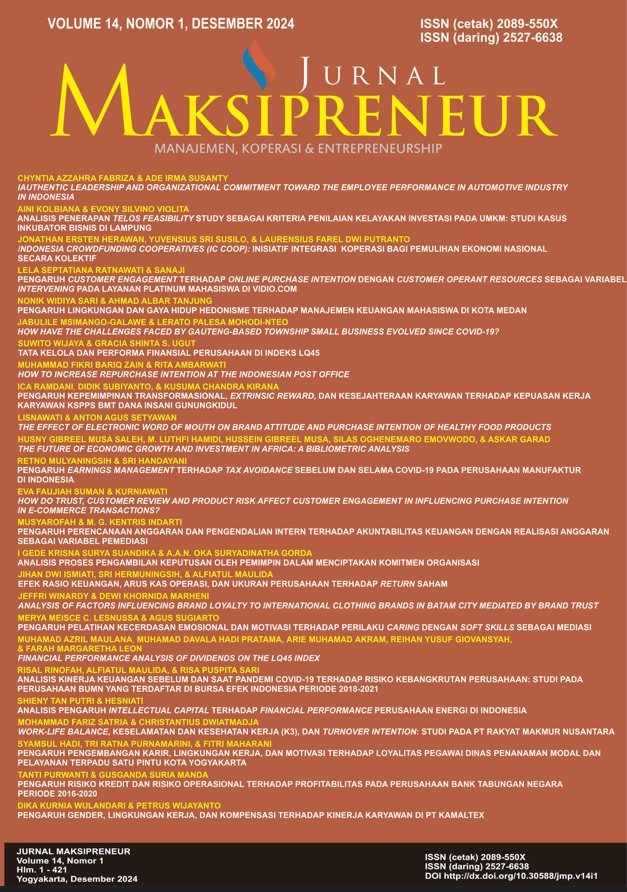
Work-life Balance, Keselamatan dan Kesehatan Kerja (K3), dan Turnover Intention: Studi pada PT Rakyat Makmur Nusantara
DOI:
https://doi.org/10.30588/jmp.v14i1.1671Abstract
The research aims to test the influence of Occupational Safety and Health (K3) and work-life balance (WLB) on turnover intentions among millennial employees at PT Rakyat Makmur Nusantara. Sampling in this study used a purposive sampling technique where a sample size of 103 respondents was obtained. The analysis technique used in this research is multiple linear regression. Based on the research that has been conducted, it can be concluded that work-life balance has a negative influence on turnover intention, while K3 has a positive influence on turnover intention.
References
Agustina, L. (2008). Pengaruh Work Family Conflict Terhadap Job Satisfaction dan Keinginan untuk Pindah (Turnover Intention) pada Profesi Akuntan Publik (Studi Empiris pada Kantor Akuntan Publik di DKI Jakarta& Bandung). Jurnal Ilmiah Akutansi, 7(2), 100–116.
Anandita, A., Ginting, E., & Nurprameswari, S. (2025). Pola Komunikasi Keluarga dengan Work Life Balance pada Karyawan Bank Syariah Indonesia. Jurnal Ilmu Sosia dan Humaniora, 3(1), 10–22.
Saputra, A. A. (2019). Pengaruh Program Kesehatan dan Keselamatan Kerja K3 Terhadap Produktivitas Kerja Pada PT PLN (Persero) Cabang Pinrang. Skripsi, UIN Alauddin Makassar.
Ardiansyah, A., Risnita, R., & Jailani, M. S. (2023). Teknik Pengumpulan Data dan Instrumen Penelitian Ilmiah Pendidikan pada Pendekatan Kualitatif dan Kuantitatif. Jurnal IHSAN: Jurnal Pendidikan Islam, 1(2), 1–9. https://doi.org/10.61104/ihsan.v1i2.57
Atiyah, Y., & Wibowo, E. K. (2023). Penerapan Keselamatan dan Kesehatan Kerja Pada Pegawai Saat Pandemi Covid-19 di Rumah Sakit Jantung dan Pembuluh Darah Harapan Kita. Jurnal Sumber Daya Aparatur, 5(2), 61–81. https://jurnal.stialan.ac.id/index.php/JSDA/article/view/652%0Ahttps://jurnal.stialan.ac.id/index.php/JSDA/article/view/652/422
Bintang, S. K., & Astiti, D. P. (2016). Work-Life Balance dan Intensi Turnover pada Pekerja Wanita Bali di Desa Adat Sading, Mangupura, Badung. Jurnal Psikologi Udayana, 3(3), 382–394.
Downes, C., & Koekemoer, E. (2011). Work–Life Balance Policies: Challenges and Benefits Associated with Implementing Flexitime. SA Journal of Human Resource Management, 9(1), 21–32. https://doi.org/10.4102/sajhrm.v9i1.382
Chemirmir, M. J., Musebe, R., & Nassiuma, B. K. (2018). The Role Of Work Life Balance On Employee Turnover In The Flower Industry In The North Rift Kenya. International Journal of Research in Social Sciences and Humanities, 7(1), 50–62.
Reskiputri, T. D., & Romadhoni, R. (2019). Pengaruh Keselamatan Kerja dan Kesehatan Kerja (K3) dan Turnover Intention terhadap Komitmen Organisasi dan Kinerja Karyawan. Jurnal Manajemen dan Bisnis Indonesia, 5(1), 145–154.
Ganapathi, I. M. D. (2016). Pengaruh Work Life Balance terhadap Kepuasan Kerja Karyawan (Studi pada PT. Bio Farma Persero). Jurnal Ecodemica, 4(1), 34–40. https://doi.org/10.29313/bcsbm.v4i1.9996
Ghozali, I. (2011). Aplikasi Analisis Multivariate dengan Program IBM SPSS 19. (1st Ed). Badan Penerbit Universitas Diponegoro.
Guilford, J. (1956). Fundamental Stastistic in Psychology and Education (3rd Ed). McGraw-Hill Book Company, Inc.
Hafid, M., & Prasetio, A. P. (2017). Pengaruh Work-Life Balance Terhadap Turnover Intention (Studi Pada Karyawan Divisi Food & Beverage Hotel Indonesia Kempinski Jakarta). Study & Management Research, 14(3), 52–61. http://stembi.ac.id/file/6. Muhammad Hafid.pdf
Indrawati, A. D., Bagus, I. G., Satrya, H., Ketut, S., & Dewi, S. (2019). Pengaruh Kesehatan dan Keselamatan Kerja pada Kepuasan Kerja dan Komitmen Organisasional. Jurnal Manajemen, Strategi Bisnis dan Kewirausahaan, 87(2), 105–115. https://doi.org/https://doi.org/10.24843/MATRIK:JMBK.2017.v11.i02.p01.
Iswardhani, I., Brasit, N., & Mardiana, R. (2019). The Effect of Worklife Balance and Burnout on Employee Job Satisfaction Studi Kasus pada Kantor BPJS Kesehatan Kedeputian Wilayah Sulawesi Selatan, Sulawesi Barat, Sulawesi Tenggara, dan Maluku. Hasanuddin Journal of Business Strategy, 1(2), 1–13.
Javed, M., Khan, M. A., Yasir, M., Aamir, S., & Ahmed, K. (2014). Effect of Role Conflict, Work Life Balance and Job Stress on Turnover Intention: Evidence from Pakistan. Journal of Basic and Applied Scientific Research, 4(3), 125–133.
Karatepe, O. M., & Azar, A. K. (2013). The Effects of Work–Family Conflict and Facilitation on Turnover Intentions: The Moderating Role of Core Self-Evaluations. International Journal of Hospitality & Tourism Administration, 14(3), 255–281.
Noor, J. (2011). Metode Penelitian Skripsi, Tesis, Disertasi & karya Ilmiah (1st Ed). Kharisma Putra Utama.
Nugraha, D. (2019). Pengaruh Leader Member Exchange (LMX) dan Work Life Balance terhadap Turnover Intention Karyawan Divisi Produksi di PT Mustika Dharmajaya. Jurnal AGORA, 7(2), 37–44.
Nurdin, S., & Rohaeni, H. (2020). Work-Life Balance dan Dampaknya terhadap Intention Turnover pada Generasi Millenial : Peran Mediasi Job Satisfaction. Jurnal Konsep Bisnis Dan Manajemen), 6(2), 121–132. https://doi.org/10.31289/jkbm.v6i2.3523
O’Neill, T. A., Hambley, L., Greidanus, N. S., & Mesler, R. M. (2009). Predicting Teleworker Success: An Exploration of Personality, Motivational, Situational, and Job Characteristics. New Technology Work and Employment, 24(2), 144–162. https://doi.org/10.1111/j.1468-005X.2009.00225.x
Oktaviani, H., & Budiono, B. (2018). Pengaruh Work Life Balance dan Perceived Organizational Support terhadap Turnover Intention Melalui Organizational Commitment Sebagai Variabel Intervening pada PT Berlian Jasa Terminal Indonesia. Jurnal Ilmu Manajemen (JIM), 6(3), 58–72.
Pradana, A., & Salehudin, I. (2015). Work Overload and Turnover Intention of Junior Auditors in Greater Jakarta, Indonesia. The South East Asian Journal of Management, 9(2), 108–124. https://doi.org/10.21002/seam.v9i2.4950
Prayogi, M. A., Koto, M., & Muhammad Arif. (2019). Kepuasan Kerja sebagai Variabel Intervening Pada Pengaruh Work-Life Balance dan Stres Kerja Terhadap Turnover Intention. Jurnal Ilmiah Manajemen dan Bisnis, 20(1), 39–51. https://doi.org/10.30596/jimb.v20i1.2987
Purwanti, L. D. (2017). Kualitas Kehidupan Kerja dan Produktivitas Kerja (Studi pada Karyawan Divisi Operasi dan Pemeliharan PT Pembangkitan Jawa Bali (PJB) Unit Pembangkitan Paiton). Jurnal Administrasi Bisnis (JAB), 44(1), 118–126.
Putera, R. I., & Harini, S. (2017). Pengaruh Keselamatan dan Kesehatan Kerja (K3) Terhadap Jumlah Penyakit Kerja dan Jumlah Kecelakaan Kerja Karyawan pada PT Hanei Indonesia. Jurnal Visionida, 3(1), 42. https://doi.org/10.30997/jvs.v3i1.951
Qodrizana, D. L., & Al Musadieq, M. (2018). Pengaruh Work-Life Balance Terhadap Kepuasan Kerja (Studi Pada Karyawan Perempuan Yayasan Insan Permata Tunggulwulung Kota Malang). Jurnal Administrasi Bisnis, 60(1), 9–17.
Rahmayati, T. E. (2021). Keseimbangan Kerja dan Kehidupan (Work Life Balanced) Pada Wanita Bekerja. Jurnal Insitusi Politeknik Ganesha Medan, 4(2), 129–141. https://doi.org/10.33395/juripol.v4i2.11098
Rawis, T. D., Jermias, T., & Arsjad, T. T. (2016). Perencanaan Biaya Keselamatan dan Kesehatan Kerja (k3) pada Proyek Konstruksi Bangunan. Jurnal Sipil Statik, 4(4), 241–252.
Rivai, A. (2019). Pengaruh Stres Kerja dan Lingkungan Kerja terhadap Keinginan Perawat untuk Berhenti Bekerja pada Rumah Sakit Columbia Asia Medan. Jurnal Ilmiah Abdi Ilmu, 12(2), 64–74.
Rondonuwu, F. A., Rumawas, W., & Asaloei, S. (2018). Pengaruh Work-life Balance Terhadap Kepuasan Kerja Karyawan Pada Hotel Sintesa Peninsula Manado. Jurnal Administrasi Bisnis, 7(2), 30–38.
Sanaky, M. M., Saleh, L. M., & Titaley, H. D. (2021). Analisis Faktor-Faktor Keterlambatan Pada Proyek Pembangunan Gedung Asrama Man 1 Tulehu Maluku Tengah. Jurnal Simetrik, 11(1), 432–439. https://doi.org/10.31959/js.v11i1.615
Sang, G., Valcke, M., Braak, J. van, & Tondeur, J. (2010). Student Teachers’ Thinking Processes and ICT Integration: Predictors of Prospective Teaching Behaviors with Educational Technology. Journal of Computers and Education, 54(1), 103–112. https://doi.org/10.1016/j.compedu.2009.07.010
Satwari, T., Musadieq, M., & Afrianty, T. (2016). Pengaruh Komitmen Organisasional Terhadap Turnover Intentional (Survei pada Karyawan Hotel Swiss-Belinn Malang). Jurnal Administrasi Bisnis, 40(2), 177–186.
Sinambela, S. (2016). Sumber Daya Manusia: Membangun Tim Kerja yang Solid untuk Meningkatkan Kinerja (1st Ed). Bumi Aksara.
Sugiyono, S. (2012). Memahami Penelitian Kualitaif (1st ed.). Alfabeta.
Suifan, T. S., Abdallah, A. B., & Diab, H. (2016). The Influence of Work Life Balance on Turnover Intention in Private Hospitals: The Mediating Role of Work Life Conflict. European Journal of Business and Management, 7(1), 16–22.
Teniwut, M. (2022). Teknik Pengumpulan Data dan Metode Penelitian, Media Indonesia. Media Indonesia. Retrieved April 2025, from https://mediaindonesia.com/humaniora/539107/teknikpengumpulan-data-dan-metode-penelitian
Utomo, V. F. C., Slamet, A. R., & Millanintyas, R. (2020). Pengaruh Turnover Intentions, Burnout, dan Work-Life Balance Terhadap Kinerja Karyawan di Koperasi Simpan Pinjam Primkoppabri (Primer Koperasi Purnawirawan ABRI) Kabupaten Blitar. Jurnal Lmiah Riset Manajemen, 9(5), 156–172.
Vellya, V., Pio, R. J., & Rumawas, W. (2020). Employee Engagement sebagai Pemoderasi Worklife Balance dengan Turnover Intention. Jurnal Productivity, 1(2), 168–173.
Wangi, V. K. N., Bahiroh, E., & Imron, A. (2020). Dampak Kesehatan dan Keselamatan Kerja, Beban Kerja, dan Lingkungan Kerja Fisik Terhadap Kinerja Karyawan. Jurnal Manajemen Bisnis, 7(1), 40–50. https://doi.org/10.33096/jmb.v7i1.532
Yusup, F. (2017). Uji Validitas dan Reliabilitas Instrumen Penelitian Kuantitatif. Jurnal Tarbiyah: Jurnal Ilmiah Kependidikan, 7(1), 17–23. https://doi.org/10.21831/jorpres.v13i1.12884
Downloads
Published
How to Cite
Issue
Section
License
Copyright (c) 2024 Mohammad Fariz Satria

This work is licensed under a Creative Commons Attribution 4.0 International License.
Authors who publish with Jurnal Maksipreneur agree to the following terms:
Authors retain copyright and grant the Jurnal Maksipreneur right of first publication with the work simultaneously licensed under a Creative Commons Attribution 4.0 International License that allows others to share (copy and redistribute the material in any medium or format) and adapt (remix, transform, and build upon the material) the work for any purpose, even commercially with an acknowledgment of the work's authorship and initial publication in Jurnal Maksipreneur.
Authors are able to enter into separate, additional contractual arrangements for the non-exclusive distribution of the journal's published version of the work (e.g., post it to an institutional repository or publish it in a book), with an acknowledgment of its initial publication in Jurnal Maksipreneur. Authors are permitted and encouraged to post their work online (e.g., in institutional repositories or on their website) prior to and during the submission process, as it can lead to productive exchanges, as well as earlier and greater citation of published work (See The Effect of Open Access).