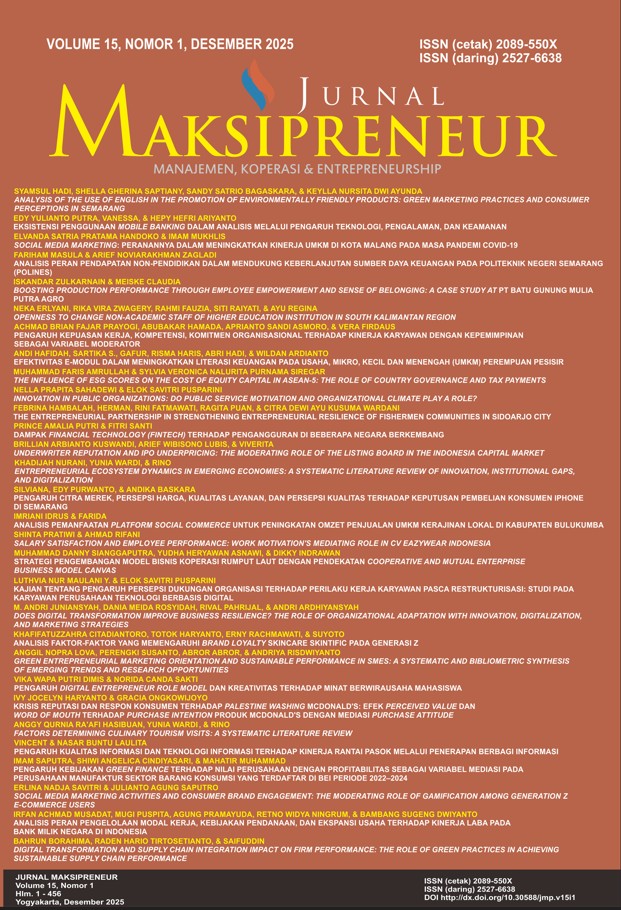
Kajian Tentang Pengaruh Persepsi Dukungan Organisasi terhadap Perilaku Kerja Karyawan Pasca Restrukturisasi: Studi pada Karyawan Perusahaan Teknologi Berbasis Digital
DOI:
https://doi.org/10.30588/jmp.v15i1.2087Keywords:
Layoff Survivor, Perceived Organizational Support, Job Insecurity, Task Performance, Digital Technology CompanyAbstract
The development of digital-based technology has triggered the phenomenon of Tech Winter, leading to layoffs and increasing job insecurity among surviving employees. This study aims to analyze the effect of perceived organizational support (POS) on job insecurity and its impact on the task performance and innovative behavior of layoff survivors. The study also explores how affective commitment acts as a mediator, while financial job dependence and organizational cynicism serve as moderators in the relationship between job insecurity and work performance, as well as innovative behavior among layoff survivors in digital technology companies. This research employs the Partial Least Squares Structural Equation Modelling (PLS-SEM) method to analyze the relationships between variables. The sample consists of 262 respondents who are layoff survivors working in digital technology companies in Indonesia. The results show that perceived organizational support (POS) has a significant effect in reducing job insecurity, which in turn improves task performance and innovative behavior. Affective commitment serves as a significant mediator, while financial job dependence and organizational cynicism moderate the impact of job insecurity on work outcomes. These findings highlight the importance of organizational support in mitigating job insecurity for employees after a layoff.
References
Adekiya, A. (2024). Perceived job insecurity and task performance: what aspect of performance is related to which facet of job insecurity. Current Psychology, 43(2), 1340–1358.
Adewuya, G., & Asaolu, O. (2023). Huge Technology Layoffs 2022-2023: Examining Job Security in the Technology Industry. International Journal of Science and Research (IJSR), 12(3), 1473–1481. https://doi.org/10.21275/sr23311223420
Adrian, A., Fiza, A. K., & Zulvia, Y. (2022). Job Insecurity and Innovative Work Behavior: Case Study on Hotel Employees During covid 19. Eighth Padang International Conference On Economics Education, Economics, Business and Management, Accounting and Entrepreneurship (PICEEBA-8 2021), 346–353.
Aguiar-Quintana, T., Nguyen, T. H. H., Araujo-Cabrera, Y., & Sanabria-Díaz, J. M. (2021). Do job insecurity, anxiety and depression caused by the COVID-19 pandemic influence hotel employees’ self-rated task performance? The moderating role of employee resilience. International Journal of Hospitality Management, 94, 102868.
Aliane, N., Al-Romeedy, B. S., Agina, M. F., Salah, P. A. M., Abdallah, R. M., Fatah, M. A. H. A., Khababa, N., & Khairy, H. A. (2023). How job insecurity affects innovative work behavior in the hospitality and tourism industry? The roles of knowledge hiding behavior and team anti-citizenship behavior. Sustainability, 15(18), 13956.
Amabile, T. M., & Pratt, M. G. (2016). The dynamic componential model of creativity and innovation in organizations: Making progress, making meaning. Research in Organizational Behavior, 36, 157–183.
Ancillai, C., Sabatini, A., Gatti, M., & Perna, A. (2023). Digital technology and business model innovation: A systematic literature review and future research agenda. Technological Forecasting and Social Change, 188, 122307.
Bagheri, Z., Talebi, A. A., Asgari, S., & Mehrabadi, M. (2022). Cover Image, Volume 78, Issue 1. Pest Management Science, 78(1), i–i.
Bakker, A. B., & Demerouti, E. (2008). Towards a model of work engagement. Career Development International, 13(3), 209–223.
Bakker, A. B., & Demerouti, E. (2014). Job Demands–Resources Theory. Wellbeing, III, 1–28. https://doi.org/10.1002/9781118539415.wbwell019
Blau, P. M. (1964). Exchange and Power in Social Life. John Wiley.
Bohle, L. S., Bal, P. M., Jansen, P. G. W., Leiva, P. I., & Alonso, A. M. (2017). How mass layoffs are related to lower job performance and OCB among surviving employees in Chile: An investigation of the essential role of psychological contract. The International Journal of Human Resource Management, 28(20), 2837–2860.
Coskun-Setirek, A., & Tanrikulu, Z. (2021). Digital innovations-driven business model regeneration: A process model. Technology in Society, 64, 101461.
Darvishmotevali, M., & Ali, F. (2020). Job insecurity, subjective well-being and job performance: The moderating role of psychological capital. International Journal of Hospitality Management, 87(January), 102462. https://doi.org/10.1016/j.ijhm.2020.102462
Değirmenci, B. (2022). The Effect of Job Insecurity on Job Performance During The Covid-19 Pandemic: The Moderating Role of Employee Resilience. Istanbul Management Journal, 0(92), 29–46. https://doi.org/10.26650/imj.2022.92.002
Duong, C. H., & Ho, Y.-H. (2024). Perceived organizational support and its impact on employee’s intention to stay: Dataset from the electronics industry in Vietnam. Data in Brief, 54, 110428.
El-Kassar, A.-N., Dagher, G. K., Lythreatis, S., & Azakir, M. (2022). Antecedents and consequences of knowledge hiding: The roles of HR practices, organizational support for creativity, creativity, innovative work behavior, and task performance. Journal of Business Research, 140, 1–10.
Guo, B., Wang, Y., Zhang, H., Liang, C., Feng, Y., & Hu, F. (2023). Impact of the digital economy on high-quality urban economic development: Evidence from Chinese cities. Economic Modelling, 120, 106194.
Hair, J., Risher, J. J., Sarstedt, M., & Ringle, C. M. (2019). When to use and how to report the results of PLS-SEM. European Business Review, 31(1), 2–24. https://doi.org/10.1108/EBR-11-2018-0203
Hair Jr, J. F., Hult, G. T. M., Ringle, C. M., Sarstedt, M., Danks, N. P., & Ray, S. (2021). Partial least squares structural equation modeling (PLS-SEM) using R: A workbook. Springer Nature.
Haldorai, K., Kim, W. G., & Phetvaroon, K. (2022). Beyond the bend: The curvilinear effect of challenge stressors on work attitudes and behaviors. Tourism Management, 90(April 2021), 104482. https://doi.org/10.1016/j.tourman.2021.104482
Haldorai, K., Kim, W. G., & Phetvaroon, K. (2024). Job insecurity and survivor workplace behavior following COVID-19 layoff. International Journal of Contemporary Hospitality Management, 36(1), 329–346.
Hellgren, J., Sverke, M., & Isaksson, K. (1999). A two-dimensional approach to job insecurity: Consequences for employee attitudes and well-being. European Journal of Work and Organizational Psychology, 8(2), 179–195.
Homans G. C. (1958). Social behavior as exchange. American Journal of Sociology, 63(6), 597–606. https://doi.org/10.1086/222355
Jiang, L. (2024). Rethinking job insecurity research: Challenging the homogeneous, linear, and negative effects of job insecurity. Applied Psychology, 73(4), 2013-2020. https://doi.org/10.1111/apps.12534
Karatepe, O. M., Okumus, F., & Saydam, M. B. (2024). Outcomes of job insecurity among hotel employees during COVID-19. International Hospitality Review, 38(1), 101–118. https://doi.org/10.1108/ihr-11-2021-0070
Liu, Y. (2024). The Effect of Perceived Organizational Climate and Affective Commitment on Employee Job Satisfaction. Proceedings of the 2023 4th International Conference on Management Science and Engineering Management (ICMSEM 2023). In Series: Advances in Economics, Business and Management Research. https://doi.org/10.2291/978-94-6463-256-9_20
Malhotra, N. K. (2020). Marketing Research: An Applied Orientation. Pearson.
Meyer, J. P., & Allen, N. J. (1991). A three-component conceptualization of organizational commitment. Human Resource Management Review, 1(1), 61–89.
Meyer, J. P., Stanley, D. J., Herscovitch, L., & Topolnytsky, L. (2002). Affective, continuance, and normative commitment to the organization: A meta-analysis of antecedents, correlates, and consequences. Journal of Vocational Behavior, 61(1), 20–52.
Neves, P. (2012). Organizational cynicism: Spillover effects on supervisor–subordinate relationships and performance. The Leadership Quarterly, 23(5), 965–976.
Ng, T. W. H., & Feldman, D. C. (2014). Subjective career success: A meta-analytic review. Journal of Vocational Behavior, 85(2), 169–179. https://doi.org/10.1016/j.jvb.2014.06.001
Nikmah, U., & Martdianty, F. (2021). Job insecurity, work engagement and job performance of employees in flexible working arrangement: Exploring the mediating role of psychological well-being. Sixth Padang International Conference On Economics Education, Economics, Business and Management, Accounting and Entrepreneurship (PICEEBA 2020), 458–463.
Pham, T. P. T., Van Nguyen, T., Van Nguyen, P., & Ahmed, Z. U. (2024). The Pathways to Innovative Work Behavior and Job Performance: Exploring the Role of Public Service Motivation, Transformational Leadership, and Person-Organization Fit in Vietnam’s Public Sector. Journal of Open Innovation: Technology, Market, and Complexity, 100315.
Probst, T. M. (2003). Development and validation of the Job Security Index and the Job Security Satisfaction scale: A classical test theory and IRT approach. Journal of Occupational and Organizational Psychology, 76(4), 451–467.
Rhoades, L., Eisenberger, R., & Armeli, S. (2001a). Affective commitment to the organization: the contribution of perceived organizational support. Journal of Applied Psychology, 86(5), 825.
Richter, A., Näswall, K., Bernhard-Oettel, C., & Sverke, M. (2014). Job insecurity and well-being: The moderating role of job dependence. European Journal of Work and Organizational Psychology, 23(6), 816–829.
Sadly, E., & Hasanah, U. (2022). A Phenomenon wave of mass terminations in the middle of rising economic growth in digital business companies (startups) and it’s effect on Islamic education. Edukasi Islami: Jurnal Pendidikan Islam, 11(03). https://doi.org/10.30868/ei.v11i03.3301
Sapulette, M. S., & Muchtar, P. A. (2023). Redefining Indonesia’s Digital Economy. ERIA Policy Brief, No 2022, 1–5 (January).
Sharma, J., & Dhar, R. L. (2016). Factors influencing job performance of nursing staff: mediating role of affective commitment. Personnel Review, 45(1), 161–182.
Shoss, M. K. (2017). Job insecurity: An integrative review and agenda for future research. Journal of Management, 43(6), 1911–1939.
Sverke, M., Hellgren, J., & Näswall, K. (2002). No security: a meta-analysis and review of job insecurity and its consequences. Journal of Occupational Health Psychology, 7(3), 242.
Syafitri, T. J. N., Syahrul, L., & Fahmy, R. (2022). The relationship of job insecurity, affective commitment, and job performance post COVID-19. Jurnal Mantik, 6(1), 10–17.
Wang, Q., Weng, Q., & Jiang, Y. (2020). When does affective organizational commitment lead to job performance?: integration of resource perspective. Journal of Career Development, 47(4), 380–393.
Witte, H. De. (1999). Job insecurity and psychological well-being: Review of the literature and exploration of some unresolved issues. European Journal of Work and Organizational Psychology, 8(2), 155–177.
Downloads
Published
How to Cite
Issue
Section
License
Copyright (c) 2025 Luthvia Nur Maulani Y., Elok Savitri Pusparini

This work is licensed under a Creative Commons Attribution 4.0 International License.
Authors who publish with Jurnal Maksipreneur agree to the following terms:
Authors retain copyright and grant the Jurnal Maksipreneur right of first publication with the work simultaneously licensed under a Creative Commons Attribution 4.0 International License that allows others to share (copy and redistribute the material in any medium or format) and adapt (remix, transform, and build upon the material) the work for any purpose, even commercially with an acknowledgment of the work's authorship and initial publication in Jurnal Maksipreneur.
Authors are able to enter into separate, additional contractual arrangements for the non-exclusive distribution of the journal's published version of the work (e.g., post it to an institutional repository or publish it in a book), with an acknowledgment of its initial publication in Jurnal Maksipreneur. Authors are permitted and encouraged to post their work online (e.g., in institutional repositories or on their website) prior to and during the submission process, as it can lead to productive exchanges, as well as earlier and greater citation of published work (See The Effect of Open Access).