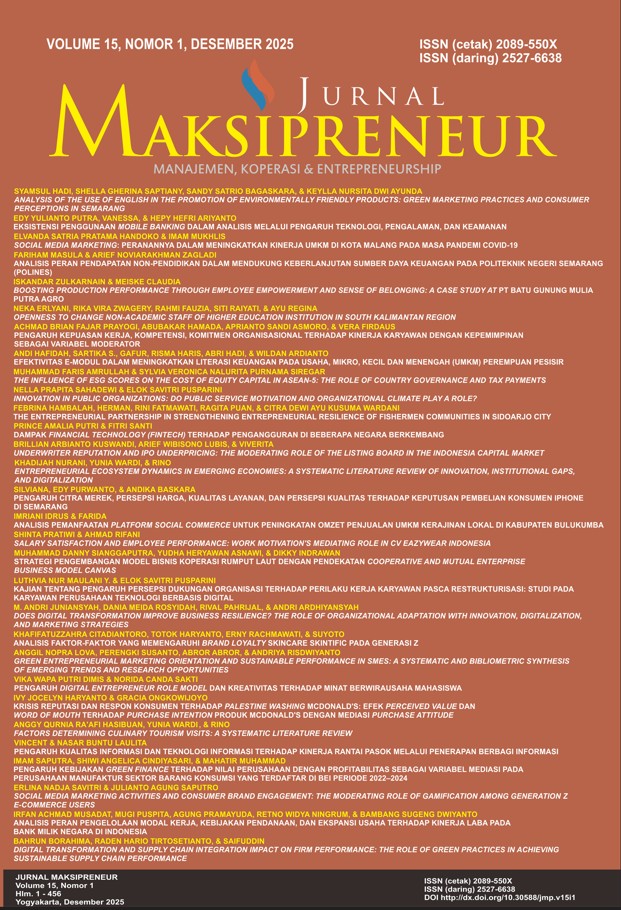
Innovation in Public Organizations: Do Public Service Motivation and Organizational Climate Play a Role?
DOI:
https://doi.org/10.30588/jmp.v15i1.2077Keywords:
Civil Servants, Innovative Work Behaviour, Organizational Climate, Public Organization, Public Service MotivationAbstract
COVID-19 and digitalization brought new challenges for organizations. Organizations needed to be agile to face these challenges. Innovation was the key for organizations to sustain their presence in the business world. This study examined the impact of public service motivation (PSM), organizational climate (OC), and psychological empowerment (PE) on innovative work behavior (IWB) in a public organization. Using a quantitative approach with Structural Equation Modeling (SEM) in LISREL 8.8, the results indicated that PSM and OC have a positive effect on PE. PE, in turn, enhanced IWB. Mediation analysis showed that PE partially mediated the relationship between the independent variables and IWB. The findings suggested that fostering creativity, autonomy, and recognition within the organization is key to enhancing innovation.
References
Amabile, T. M. (1997). Motivating Creativity in Organizations: On Doing What You Love and Loving What You Do. California Management Review, 40(1), 39−58. https://doi.org/10.2307/41165921
Amabile, T. M., Conti, R., Coon, H., Lazenby, J., & Herron, M. (1996). Assessing the Work Environment for Creativity. The Academy of Management Journal, 39(5), 1154−1184. https://doi.org/10.2307/256995
Chen, J., Walker, R. M., & Sawhney, M. (2020). Public service innovation: A typology. Public Management Review, 22(11), 1674−1695. https://doi.org/10.1080/14719037.2019.1645874
Conger, J. A., & Kanungo, R. N. (1988). The Empowerment Process: Integrating Theory and Practice. The Academy of Management Review, 13(3), 471−471. https://doi.org/10.2307/258093
De Jong, J., & Den Hartog, D. (2010). Measuring innovative work behaviour. Creativity and Innovation Management, 19(1), 23−36. https://doi.org/10.1111/j.1467-8691.2010.00547.x
Farr, J. L., & Ford, C. M. (1990). Individual Innovation. In M. A. West & J. L. Farr (Eds.), Innnovation and creativity at work: Psychological and organizational strategies ((pp. 63-80). John Wiley & Sons.
Gelaidan, H. M., Houtgraaf, G., & Al-kwifi, O. S. (2022). Creativity and innovation in rapidly developing Qatar: The impact of leadership and the mediation of psychological empowerment amidst rapid growth. International Journal of Public Sector Management, 35(3), 257−275. https://doi.org/10.1108/IJPSM-01-2021-0016
Hair, J. F., Black, W. C., Babin, B. J., & Anderson, R. E. (2019). Multivariate Data Analysis. Eighth Edition. www.cengage.com/highered
Heinonen, K., & Strandvik, T. (2021). Reframing service innovation: COVID-19 as a catalyst for imposed service innovation. Journal of Service Management, 32(1), 101−112. https://doi.org/10.1108/JOSM-05-2020-0161
Hughes, D. J., Lee, A., Tian, A. W., Newman, A., & Legood, A. (2018). Leadership, creativity, and innovation: A critical review and practical recommendations. Leadership Quarterly, 29(5), 549−569. https://doi.org/10.1016/j.leaqua.2018.03.001
Hussein, H. A., & Ameen, K. J. (2023). Relationship between Organizational Climate and Psychological Empowerment among Nurses at Primary Health Care Centers. International Journal of Body, Mind and Culture, 10(2), 315−323. https://doi.org/http://dx.doi.org/10.22122/ijbmc.v10i3.536
Isaksen, S. G., & Akkermns, H. J. (2011). Creative Climate: A Leadership Lever for Innovation. The Journal of Creative Behavior, 45(3), 161−187. https://doi.org/10.1002/j.2162-6057.2011.tb01425.x
Kim, S. (2009). Revising Perry's measurement scale of public service motivation. American Review of Public Administration, 39(2), 149−163. https://doi.org/10.1177/0275074008317681
Koh, D., Lee, K., & Joshi, K. (2019). Transformational leadership and creativity: A meta‐analytic review and identification of an integrated model. Journal of Organizational Behavior, 40(6), 625−650. https://doi.org/10.1002/job.2355
Krause, D. E. (2004). Influence-based leadership as a determinant of the inclination to innovate and of innovation-related behaviors. The Leadership Quarterly, 15(1), 79−102. https://doi.org/10.1016/j.leaqua.2003.12.006
Kundu, S. C., Kumar, S., & Gahlawat, N. (2019). Empowering leadership and job performance: mediating role of psychological empowerment. Management Research Review, 42(5), 605−624. https://doi.org/10.1108/MRR-04-2018-0183
Lie, D., Purba, E., Harini, S., Said, M., & Sudirman, A. (2022). Managing Innovative Work Behavior: The Role of Member-Leader Exchange, Organizational Climate and Psychological Empowerment. KnE Life Sciences, The 3rd International Conference on Advance & Scientific Innovation (ICASI) – Life Sciences Chapter, 243−255. https://doi.org/10.18502/kls.v0i0.11805
Liu, F., Chow, I. H. S., Zhang, J. C., & Huang, M. (2019). Organizational innovation climate and individual innovative behavior: Exploring the moderating effects of psychological ownership and psychological empowerment. Review of Managerial Science, 13(4), 771−789. https://doi.org/10.1007/s11846-017-0263-y
Lv, M., Yang, S., Lv, X. Y., Zhang, L., Chen, Z. Q., & Zhang, S. X. (2021). Organisational innovation climate and innovation behaviour among nurses in China: A mediation model of psychological empowerment. Journal of Nursing Management, 29(7), 2225−2233. https://doi.org/10.1111/jonm.13381
McLean, L. D. (2005). Organizational Culture’s Influence on Creativity and Innovation: A Review of the Literature and Implications for Human Resource Development. Advances in Developing Human Resources, 7(2), 226−246. https://doi.org/10.1177/1523422305274528
Miao, Q., Newman, A., Schwarz, G., & Cooper, B. (2018). How Leadership and Public Service Motivation Enhance Innovative Behavior. Public Administration Review, 78(1), 71−81. https://doi.org/10.1111/puar.12839
Moore, M. H., Sparrow, M., & Spelman, W. (1997). Innovation in Policing: From Production Lines to Jobs Shops. Innovation in American government, 274−298.
Negassi, S., Lhuillery, S., Sattin, J.-F., Hung, T.-Y., & Pratlong, F. (2019). Does the relationship between innovation and competition vary across industries? Comparison of public and private research enterprises. Economics of Innovation and New Technology, 28(5), 465−482. https://doi.org/10.1080/10438599.2018.1527552
Newnham, L., & McMurray, A. J. (2023). Land management innovation and sustainability in Victoria, Australia—a longitudinal view. Public Money & Management, 43(5), 447−455. https://doi.org/10.1080/09540962.2021.2001165
Ngoc Su, D., Luc Tra, D., Thi Huynh, H. M., Nguyen, H. H. T., & O’Mahony, B. (2021). Enhancing resilience in the Covid-19 crisis: Lessons from human resource management practices in Vietnam. Current Issues in Tourism, 24(22), 3189−3205. https://doi.org/10.1080/13683500.2020.1863930
Özkan, S., & Ahmed, M. A. (2022). Citizen satisfaaction with public services in Mogadishu Municipality [MogadİŞu beledİyesİnde kamu hİzmetlerİnden vatandaŞ memnunİyetİ]. TURAN: Stratejik Arastirmalar Merkezi, 14(54), 116−125. https://doi.org/https://doi.org/10.15189/1308-8041
Perry, J. L. (1996). Measuring Public Service Motivation: An Assessment of Construct Reliability and Validity. Journal of Public Administration Research and Theory, 6(1), 5−22. https://doi.org/10.1093/oxfordjournals.jpart.a024303
Perry, J. L., & Wise, L. R. (1990). The Motivational Bases of Public Service. Public Administration Review, 50(3), 367−367. https://doi.org/10.2307/976618
Peraturan Pimpinan PKN nomor 77/PKN.01/2020 tentang rencana strategis PKN tahun 2020-2024, (2020). https://jdih.pkn.go.id/in/home
PKN, B. P. d. P. (2024). Adaptive & agile: An Exit strategy for change. https://www.youtube.com/watch?v=Fa3XChm9Aok
Rafique, M. A., Hou, Y., Chudhery, M. A. Z., Gull, N., & Ahmed, S. J. (2023). The dimensional linkage between public service motivation and innovative behavior in public sector institutions; the mediating role of psychological empowerment. European Journal of Innovation Management, 26(1), 207−229. https://doi.org/10.1108/EJIM-02-2021-0098
Ritz, A., Brewer, G. A., & Neumann, O. (2016). Public Service Motivation: A Systematic Literature Review and Outlook. Public Administration Review, 76(3), 414−426. https://doi.org/10.1111/puar.12505
Scott, S. G., & Bruce, R. A. (1994). Determinants of innovative behavior: A path model of individual innovation in the workplace. Academy of Management Journal, 37(3), 580–607. https://doi.org/10.2307/256701
Slåtten, T. (2014). Determinants and effects of employee’s creative self-efficacy on innovative activities. International Journal of Quality and Service Sciences, 6(4), 326–347. https://doi.org/10.1108/IJQSS-03-2013-0013
Spreitzer, G. M. (1995). Psychological Empowerment in the Workplace: Dimensions, Measurement, and Validation. Academy of Management Journal, 38(5), 1442–1465. https://doi.org/10.2307/256865
Srirahayu, D. P., Ekowati, D., & Sridadi, A. R. (2023). Innovative work behavior in public organizations: A systematic literature review. Heliyon, 9(2), e13557. https://doi.org/10.1016/j.heliyon.2023.e13557
Suryani, S. T., Fachmi, M., Yahya, M., & Tamsah, H. (2023). Structural Modeling Analysis of Public Service Motivation on Civil Servants' Performance through Innovative Behavior. International Journal of Multicultural and Multireligious Understanding, 10(10), 404–404. https://doi.org/10.18415/ijmmu.v10i10.5235
TheGlobalEconomy.com. (2024). Public services index - Country rankings. Retrieved May 7 from https://www.theglobaleconomy.com/rankings/public_services_index/South-East-Asia/
Thomas, K. W., & Velthouse, B. A. (1990). Cognitive Elements of Empowerment: An "Interpretive" Model of Intrinsic Task Motivation. The Academy of Management Review, 15(4), 666–681. https://doi.org/10.2307/258687
Trus, M., Galdikiene, N., Balciunas, S., Green, P., Helminen, M., & Suominen, T. (2019). Connection between organizational culture and climate and empowerment: The perspective of nurse managers. Nursing & Health Sciences, 21(1), 54–62. https://doi.org/10.1111/nhs.12549
Vandenabeele, W., Ritz, A., & Neumann, O. (2018). Public service motivation: State of the art and conceptual cleanup. In E. Ongaro & S. Van Thiel (Eds.), Ongaro E and Van Thiel S (eds) The Palgrave Handbook of Public Administration and Management in Europe (pp. 261–278). Palgrave Macmillan UK. https://doi.org/10.1057/978-1-137-55269-3
Yasir, M., Majid, A., Yousaf, Z., Nassani, A. A., & Haffar, M. (2021). An integrative framework of innovative work behavior for employees in SMEs linking knowledge sharing, functional flexibility and psychological empowerment. European Journal of Innovation Management, 26(2), 289–308. https://doi.org/10.1108/ejim-02-2021-0091
Yuan, F., & Woodman, R. W. (2010). Innovative Behavior in the Workplace: The Role of Performance of Image Iutcome Expectation. The Academy of Management Journal, 53(2), 323–342.
Downloads
Published
How to Cite
Issue
Section
License
Copyright (c) 2025 Nella Prapita Sahadewi, Elok Savitri Pusparini

This work is licensed under a Creative Commons Attribution 4.0 International License.
Authors who publish with Jurnal Maksipreneur agree to the following terms:
Authors retain copyright and grant the Jurnal Maksipreneur right of first publication with the work simultaneously licensed under a Creative Commons Attribution 4.0 International License that allows others to share (copy and redistribute the material in any medium or format) and adapt (remix, transform, and build upon the material) the work for any purpose, even commercially with an acknowledgment of the work's authorship and initial publication in Jurnal Maksipreneur.
Authors are able to enter into separate, additional contractual arrangements for the non-exclusive distribution of the journal's published version of the work (e.g., post it to an institutional repository or publish it in a book), with an acknowledgment of its initial publication in Jurnal Maksipreneur. Authors are permitted and encouraged to post their work online (e.g., in institutional repositories or on their website) prior to and during the submission process, as it can lead to productive exchanges, as well as earlier and greater citation of published work (See The Effect of Open Access).