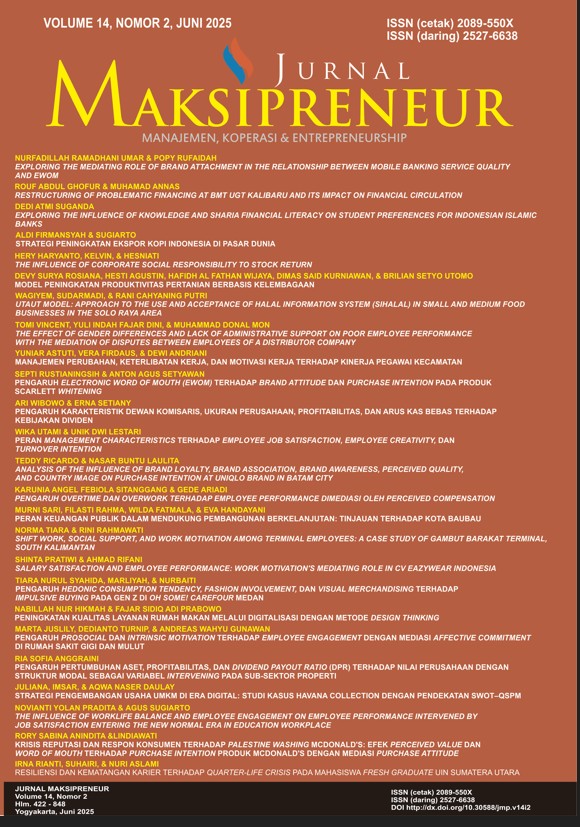
Peran Management Characteristics terhadap Employee Job Satisfaction, Employee Creativity, dan Turnover Intention
DOI:
https://doi.org/10.30588/jmp.v14i2.1203Keywords:
Supervisor Humility, Abusive Supervision, Employee Job Satisfaction, Employee Creativity, Turnover IntentionAbstract
The purpose of this study is to investigate the relationship between supervisor humility, abusive supervision, and employee job satisfaction, employee creativity, and turnover intention. This study adds a turnover intention variable, which aims to determine the effect of turnover intention on the level of employees’ job satisfaction, and this research is expected to contribute to increasing the information at the theoretical or scientific level of human resource management, and also has positive managerial implications for increasing employees’ job satisfaction. This study employs a purposive sampling method, drawing on 175 employees from service companies in Jakarta, Indonesia. We used LISREL's factor analysis and structural equation modeling (SEM) methods. The result of this study is that supervisor humility has an indirect positive effect on employees’ creativity. On the other hand, abusive supervision has an indirect negative impact, in which employees’ job satisfaction is mediated by this type of supervision. Meanwhile, employees’ job satisfaction doesn’t have a negative effect on turnover intention, while abusive supervision has a positive effect. In this case, employee job satisfaction does not mediate the relationship between supervisor humility and abusive supervision on turnover intention, because the effect of job satisfaction on turnover intention is also unstable within an organization or company. The Covid-19 pandemic is still ongoing.
References
Akehurst, G., Comeche, J. M., & Galindo, M. A. (2009). Job satisfaction and commitment in the entrepreneurial SME. Small Business Economics, 32(3), 277–289. https://doi.org/10.1007/s11187-008-9116-z
Alam, A., & Asim, M. (2019). Relationship Between Job Satisfaction And Turnover Intention. International Journal of Human Resource Studies, 9(2), 163. https://doi.org/10.5296/ijhrs.v9i2.14618
Alianto, A., & Anindita, R. (2014). Pengaruh Kompensasi Dan Work Life Balance Terhadap Kepuasa Kerja Dimediasi Stress Kerja. Jurnal Thesis Management, 1–18.
Asif, M., Qing, M., Hwang, J., & Shi, H. (2019). Ethical leadership, affective commitment, work engagement, and creativity: Testing a multiple mediation approach. Sustainability (Switzerland), 11(16). https://doi.org/10.3390/su11164489
Bothma, C. F. C., & Roodt, G. (2013). The validation of the turnover intention scale. SA Journal of Human Resource Management, 11(1), 1–12. https://doi.org/10.4102/sajhrm.v11i1.507
Caesens, G., Nguyen, N., & Stinglhamber, F. (2019). Correction to: Abusive Supervision and Organizational Dehumanization (Journal of Business and Psychology, (2019), 34, 5, (709-728), 10.1007/s10869-018-9592-3). Journal of Business and Psychology, 34(5), 729. https://doi.org/10.1007/s10869-018-9596-z
Cai, W., Khapova, S., Bossink, B., Lysova, E., & Yuan, J. (2020). Optimizing employee creativity in the digital era: Uncovering the interactional effects of abilities, motivations, and opportunities. International Journal of Environmental Research and Public Health, 17(3). https://doi.org/10.3390/ijerph17031038
Chan, M. E., & McAllister, D. J. (2014). Abusive supervision through the lens of employee state paranoia. Academy of Management Review, 39(1), 44–66. https://doi.org/10.5465/amr.2011.0419
Chen, H. T., & Wang, C. H. (2019). Incivility, satisfaction and turnover intention of tourist hotel chefs: Moderating effects of emotional intelligence. International Journal of Contemporary Hospitality Management, 31(5), 2034–2053. https://doi.org/10.1108/IJCHM-02-2018-0164
Dewi, T. R., Dyah, P., & Sihite, J. (2020). Pengaruh Abusive Supervision Terhadap Turnover Intention Karyawan Hotel. Mercubuana.Ac.Id, 6(03), 384–392.
Diyanto, A., Susanti, E., & Syah, T. Y. R. (2019). The Employee Innovation Intervening Role on Relationship between Work Engagement and Employee Performance. Journal of Multidisciplinary Academic, 03(05).
Endra, T. S. S. (2022). Pengaruh Motivasi Dan Kepuasan Kerja Terhadap Kinerja Karyawan Di Perusahaan Dazzel Yogyakarta. Among Makarti, 14(2), 50–61. https://doi.org/10.52353/ama.v14i2.218
Ganesan, S., & Weitz, B. A. (1996). The impact of staffing policies on retail buyer job attitudes and behaviors. Journal of Retailing, 72(1), 31–56. https://doi.org/10.1016/S0022-4359(96)90004-4
Ghayas, M. M., & Siddiqui, S. J. (2012). Impact of Job Satisfaction on Turnover Intentions in the Pharmaceutical Industry of Karachi. South Asian Journal of Management Sciences, 6(2), 42–49.
Gong, Y. (2010). Employee learning orientation, transformational leadership, and employee creativity: The mediating role of employee creative self-efficacy. Development and Learning in Organizations: An International Journal, 24(2), 366–372. https://doi.org/10.1108/dlo.2010.08124bad.003
Hackney, K. J., & Perrewé, P. L. (2018). A review of abusive behaviors at work: The development of a process model for studying abuse. Organizational Psychology Review, 8(1), 70–92. https://doi.org/10.1177/2041386618755724
Hair, J. F., Page, M., & Brunsveld, N. (2020). Essentials of Business Research Methods Fourth Edition. In Routledge Taylor & Francis Group. Routledge.
Hancock, J. I., Allen, D. G., Bosco, F. A., McDaniel, K. R., & Pierce, C. A. (2013). Meta-Analytic Review of Employee Turnover as a Predictor of Firm Performance. Journal of Management, 39(3), 573–603. https://doi.org/10.1177/0149206311424943
Harris, K. J., Kacmar, K. M., & Zivnuska, S. (2007). An investigation of abusive supervision as a predictor of performance and the meaning of work as a moderator of the relationship. Leadership Quarterly, 18(3), 252–263. https://doi.org/10.1016/j.leaqua.2007.03.007
Huang, W. R., & Su, C. H. (2016). The mediating role of job satisfaction in the relationship between job training satisfaction and turnover intentions. Industrial and Commercial Training, 48(1), 42–52. https://doi.org/10.1108/ICT-04-2015-0029
Huning, T. M., Hurt, K. J., & Frieder, R. E. (2020). The effect of servant leadership, perceived organizational support, job satisfaction and job embeddedness on turnover intentions: An empirical investigation. Evidence-Based HRM, 8(2), 177–194. https://doi.org/10.1108/EBHRM-06-2019-0049
Jiang, J., Wang, S., & Zhao, S. (2012). Does HRM facilitate employee creativity and organizational innovation? A study of Chinese firms. International Journal of Human Resource Management, 23(19), 4025–4047. https://doi.org/10.1080/09585192.2012.690567
Lee, J., Kim, S., Lee, J., & Moon, S. (2019). Enhancing employee creativity for a sustainable competitive advantage through perceived human resource management practices and trust in management. Sustainability (Switzerland), 11(8). https://doi.org/10.3390/su11082305
Li, N., Zhang, L., Xiao, G., Chen, J., & Lu, Q. (2019). The relationship between workplace violence, job satisfaction, and turnover intention in emergency nurses. International Emergency Nursing, 45(January), 50–55. https://doi.org/10.1016/j.ienj.2019.02.001
Lin, W., Ma, J., Zhang, Q., Li, J. C., & Jiang, F. (2018). How is Benevolent Leadership Linked to Employee Creativity? The Mediating Role of Leader–Member Exchange and the Moderating Role of Power Distance Orientation. Journal of Business Ethics, 152(4), 1099–1115. https://doi.org/10.1007/s10551-016-3314-4
Liu, D., Liao, H. U. I., & Loi, R. (2012). The Dark Side Of Leadership : A Three-Level Investigation Of The Cascading Effect Of Abusive Supervision On Employee Creativity Georgia Institute Of Technology University Of Maryland. Academy of Management Journal, 55(5), 1187–1212.
Londok, R. N., Areros, W. A., & Asaloei, S. (2019). Pengaruh Kepuasan Kerja Terhadap Kinerja Karyawan CV. Diagram Global Mandiri Manado. Jurnal Administrasi Bisnis, 9(1), 122. https://doi.org/10.35797/jab.9.1.2019.23708.122-127
Mackey, J. D., Frieder, R. E., Brees, J. R., & Martinko, M. J. (2017). Abusive Supervision: A Meta-Analysis and Empirical Review. Journal of Management, 43(6), 1940–1965. https://doi.org/10.1177/0149206315573997
Masykuroh, N. L., & Muafi, M. (2021). The influence of job insecurity and person-job fit on turnover intention mediated by job satisfaction. International Journal of Business Ecosystem & Strategy (2687-2293), 3(3), 01–12. https://doi.org/10.36096/ijbes.v3i3.271
Mathieu, C., & Babiak, P. (2016). Corporate psychopathy and abusive supervision: Their influence on employees’ job satisfaction and turnover intentions. Personality and Individual Differences, 91, 102–106. https://doi.org/10.1016/j.paid.2015.12.002
Meyerding, S. G. H. (2016). Job satisfaction and preferences regarding job characteristics of vocationals and master craftsman scholars and horticulture students in Germany. Review of Agricultural and Applied Economics, 19(01), 30–49. https://doi.org/10.15414/raae/2016.19.01.30-49
Miao, S., Fayzullaev, A. K., & Dedahanov, A. T. (2020). Management characteristics as determinants of employee creativity: The mediating role of employee job satisfaction. Sustainability (Switzerland), 12(5). https://doi.org/10.3390/su12051948
Morris, J. A., Brotheridge, C. M., & Urbanski, J. C. (2005). Bringing humility to leadership: Antecedents and consequences of leader humility. In Human Relations (Vol. 58, Issue 10, pp. 1323–1350). https://doi.org/10.1177/0018726705059929
Morris, M. G., & Venkatesh, V. (2010). Job characteristics and job satisfaction: understanding the role of enterprise resource planning system implementation. MIS Quarterly: Management Information Systems, 34(1), 143–161. https://doi.org/10.2307/20721418
Munro, J. (2012). Principals as leaders in literacy. https://www.education.vic.gov.au/
Ogbeibu, Samuel; Senadjki, Abdelhak; Tan, L. P. (2017). the Diffusion of Creative Ideas: a Dark Side Perspective of Trustworthiness Perception. The 19th Malaysian Finance Association Annual Conference (MFAC) 2017. ISBN: 978-967-11506-7-2, 2015, 70–88.
Ogbeibu, S., Senadjki, A., & Gaskin, J. (2018). The moderating effect of benevolence on the impact of organizational culture on employee creativity. Journal of Business Research, 90(November 2017), 334–346. https://doi.org/10.1016/j.jbusres.2018.05.032
Owens, B. P., & Hekman, D. R. (2012). Modeling how to grow: An inductive examination of humble leader behaviors, contingencies, and outcomes. Academy of Management Journal, 55(4), 787–818. https://doi.org/10.5465/amj.2010.0441
Owens, B. P., Johnson, M. D., & Mitchell, T. R. (2013). Expressed humility in organizations: Implications for performance, teams, and leadership. Organization Science, 24(5), 1517–1538. https://doi.org/10.1287/orsc.1120.0795
Peltokorpi, V., & Ramaswami, A. (2021). Abusive supervision and subordinates’ physical and mental health: The effects of job satisfaction and power distance orientation. International Journal of Human Resource Management, 32(4), 893–919. https://doi.org/10.1080/09585192.2018.1511617
Rigter, D. (2017). A study towards the relationship between Perceived Organizational Support and Turnover Intentions: The mediating role of Job Satisfaction. Tilburg University, June, 2–29. https://www.tilburguniversity.edu/about/university-library/
Saputra, B., & Anindita, R. (2021). Peran Servant Leadership dalam Meningkatkan Kepuasan dan Loyalitas Karyawan pada Industri Manufaktur. JENIUS (Jurnal Ilmiah Manajemen Sumber Daya Manusia), 5(1), 12. https://doi.org/10.32493/jjsdm.v5i1.13139
Scanlan, J. N., & Still, M. (2019). Relationships between burnout, turnover intention, job satisfaction, job demands, and job resources for mental health personnel in an Australian mental health service. BMC Health Services Research, 19(1), 1–12. https://doi.org/10.1186/s12913-018-3841-z
Shipton, H. J., West, M. A., Parkes, C. L., Dawson, J. F., & Patterson, M. G. (2006). When promoting positive feelings pays: Aggregate job satisfaction, work design features, and innovation in manufacturing organizations. European Journal of Work and Organizational Psychology, 15(4), 404–430. https://doi.org/10.1080/13594320600908153
Silaban, N., & Syah, T. Y. R. (2018). The Influence of Compensation and Organizational Commitment on Employees’ Turnover Intention. IOSR Journal of Business and Management (IOSR-JBM), 20(3). https://doi.org/10.9790/487X-2003010106
Strom, D. L., Sears, K. L., & Kelly, K. M. (2014). Work Engagement: The Roles of Organizational Justice and Leadership Style in Predicting Engagement Among Employees. Journal of Leadership and Organizational Studies, 21(1), 71–82. https://doi.org/10.1177/1548051813485437
Sunarta, S. (2019). Pentingnya Kepuasan Kerja. Efisiensi - Kajian Ilmu Administrasi, 16(2), 63–75. https://doi.org/10.21831/efisiensi.v16i2.27421
Takdir, S., Syah, T. Y. R., & Anindita, R. (2020). Cultural Intelligence Effect on Job Satisfaction over Employee Performance. Journal of Multidisciplinary Academic, 4(1), 28–33.
Tarigan, V., & Ariani, D. W. (2015). Empirical Study Relations Job Satisfaction, Organizational Commitment, and Turnover Intention. Advances in Management and Applied Economics, 5(2), 21–42. http://0-search.proquest.com.wam.leeds.ac.uk/docview/1664818489?accountid=14664%5Cnhttp://openurl.ac.uk/?genre=article&issn=17927544&title=Advances+in+Management+and+Applied+Economics&volume=5&issue=2&date=2015-03-01&atitle=Empirical+Study+Relations+Job+S
Tepper, B. (2007). Abusive supervision in work organizations: Review, synthesis, and research agenda. Journal of Management, 33(3), 261–289. https://doi.org/10.1177/0149206307300812
Tepper, B. J. (2000). Consequences of abusive supervision. Academy of Management Journal, 43(2), 178–190. https://doi.org/10.2307/1556375
Tepper, B. J., Simon, L., & Park, H. M. (2017). Abusive Supervision. Annual Review of Organizational Psychology and Organizational Behavior, 4(April), 123–152. https://doi.org/10.1146/annurev-orgpsych-041015-062539
Tomaževič, N., Seljak, J., & Aristovnik, A. (2014). Factors influencing employee satisfaction in the police service: The case of Slovenia. Personnel Review, 43(2), 209–227. https://doi.org/10.1108/PR-10-2012-0176
Tongchaiprasit, P., & Ariyabuddhiphongs, V. (2016). Creativity and turnover intention among hotel chefs: The mediating effects of job satisfaction and job stress. International Journal of Hospitality Management, 55, 33–40. https://doi.org/10.1016/j.ijhm.2016.02.009
Vinarski-Peretz, H., & Carmeli, A. (2011). Linking Care Felt to Engagement in Innovative Behaviors in the Workplace: The Mediating Role of Psychological Conditions. Psychology of Aesthetics, Creativity, and the Arts, 5(1), 43–53. https://doi.org/10.1037/a0018241
Watkins, C. E. (2020). Relational humility and clinical supervision: on hypotheses, method, and measurement. Clinical Supervisor, 39(2), 209–228. https://doi.org/10.1080/07325223.2020.1744056
Watkins, C. E., Hook, J. N., Mosher, D. K., & Callahan, J. L. (2019). Humility in clinical supervision: Fundamental, foundational, and transformational. Clinical Supervisor, 38(1), 58–78. https://doi.org/10.1080/07325223.2018.1487355
Ximenes, M., Supartha, W. G., Manuati Dewi, I. G. A., & Sintaasih, D. K. (2019). Entrepreneurial leadership moderating high performance work system and employee creativity on employee performance. Cogent Business and Management, 6(1). https://doi.org/10.1080/23311975.2019.1697512
Zellars, K. L., Tepper, B. J., & Duffy, M. K. (2002). Abusive supervision and subordinates’ organizational citizenship behavior. Journal of Applied Psychology, 87(6), 1068–1076. https://doi.org/10.1037/0021-9010.87.6.1068
Downloads
Published
How to Cite
Issue
Section
License
Copyright (c) 2025 Wika Utami, Unik Dwi Lestari

This work is licensed under a Creative Commons Attribution 4.0 International License.
Authors who publish with Jurnal Maksipreneur agree to the following terms:
Authors retain copyright and grant the Jurnal Maksipreneur right of first publication with the work simultaneously licensed under a Creative Commons Attribution 4.0 International License that allows others to share (copy and redistribute the material in any medium or format) and adapt (remix, transform, and build upon the material) the work for any purpose, even commercially with an acknowledgment of the work's authorship and initial publication in Jurnal Maksipreneur.
Authors are able to enter into separate, additional contractual arrangements for the non-exclusive distribution of the journal's published version of the work (e.g., post it to an institutional repository or publish it in a book), with an acknowledgment of its initial publication in Jurnal Maksipreneur. Authors are permitted and encouraged to post their work online (e.g., in institutional repositories or on their website) prior to and during the submission process, as it can lead to productive exchanges, as well as earlier and greater citation of published work (See The Effect of Open Access).