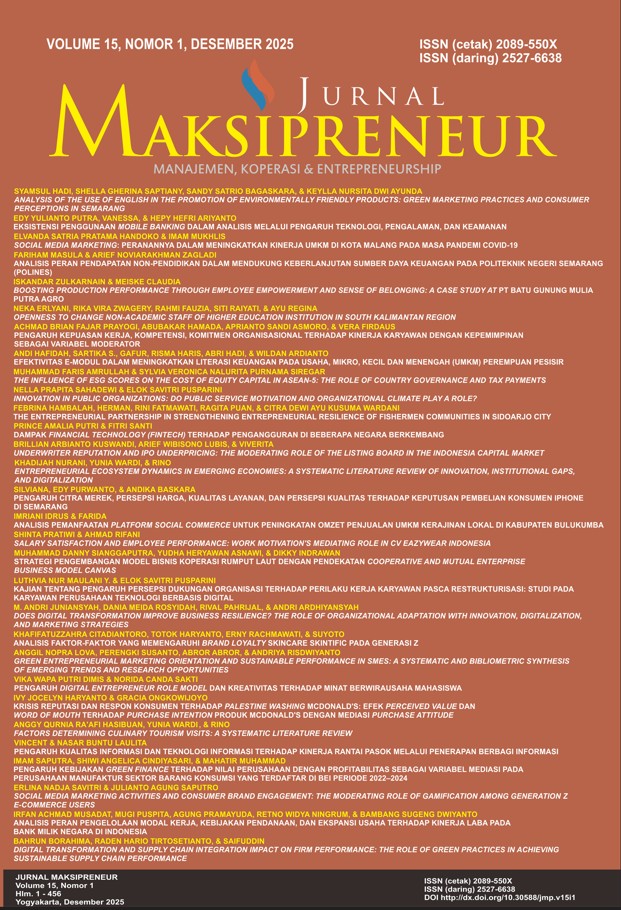
Social Media Marketing Activities and Consumer Brand Engagement: The Moderating Role of Gamification among Generation Z E-Commerce Users
DOI:
https://doi.org/10.30588/jmp.v15i1.2568Keywords:
Consumer Brand Engagement, Gamification, Social Media Marketing, Generation Z, E-commerceAbstract
This study examines the effect of Social Media Marketing Activities (SMMAs) on Consumer Brand Engagement (CBE) by considering the moderating role of gamification within the framework of the Elaboration Likelihood Model (ELM). The research focuses on Generation Z as active users of e-commerce platforms in Indonesia. Data were collected through an online survey involving 220 respondents and analyzed using the Partial Least Squares–Structural Equation Modeling (PLS-SEM) approach. The results indicate that the dimensions of entertainment, trendiness, and customization have a significant effect on consumer brand engagement, while interactivity and electronic word of mouth do not exhibit significant effects. Furthermore, gamification is found to strengthen most of the relationships between social media marketing activities and consumer brand engagement, except for the electronic word of mouth dimension. These findings suggest that emotional and experiential factors play a dominant role in shaping Generation Z consumers’ engagement. This study enhances digital marketing literature and provides practical insights for e-commerce companies to develop more effective, experience-focused marketing strategies.
References
Arif, F. (2024). 35 Data Statistik E-Commerce Indonesia di Tahun 2024. SEMNESIA: Search Engine Marketing Indonesia, 4 April. https://semnesia.com/blog/data-statistik-ecommerce-indonesia/#statistik-shopee
A’yun, M. Q. (2024). Memahami Generasi Z: Tantangan, Perilaku, dan Peluang. Badan Pusat Statistik. https://gorontalokab.bps.go.id/id/news/2025/02/05/30/memahami-generasi-z--tantangan--perilaku--dan-peluang.html
Bulu, D. S., & Natalia, E. C. (2024). The Effect of Gamification in Shopee Games on Users’ Brand Loyalty. Mediator: Jurnal Komunikasi, 17(2), 257–269. https://doi.org/10.29313/mediator.v17i2.3039
Cheung, M. L., Pires, G., & Rosenberger, P. J. (2020). The influence of perceived social media marketing elements on consumer–brand engagement and brand knowledge. Asia Pacific Journal of Marketing and Logistics, 32(3), 695–720. https://doi.org/10.1108/APJML-04-2019-0262
De Keyser, A., Verleye, K., Gemmel, P., & Kandampully, J. (2020). When ‘feeling right’ matters: A self-congruity perspective on consumer engagement in social media. Journal of Business Research, 116, 373–383. https://doi.org/https://doi.org/10.1016/j.jbusres
Deterding, S., Dixon, D., Khaled, R., & Nacke, L. (2011). From game design elements to gamefulness: Defining gamification. Proceedings of the 15th international Academic MindTrek conference: Envisioning future media environments. 9–15. https://doi.org/10.1145/2181037.2181040
Hamari, J., Koivisto, J., & Sarsa, H. (2014). Does gamification work? - A literature review of empirical studies on gamification. Proceedings of the Annual Hawaii International Conference on System Sciences, 3025–3034. https://doi.org/10.1109/HICSS.2014.377
Hazzam, J. (2022). The moderating role of age on social media marketing activities and customer brand engagement on Instagram social network. Young Consumers, 23(2), 197–212. https://doi.org/10.1108/YC-03-2021-1296
Hollebeek, L. D., Glynn, M. S., & Brodie, R. J. (2014). Consumer brand engagement in social media: Conceptualization, scale development and validation. Journal of Interactive Marketing, 28(2), 149–165. https://doi.org/10.1016/j.intmar.2013.12.002
Huang, M., Saleh, M. S., & Zolkepli, I. A. (2024). The moderating effect of environmental gamification on the relationship between social media marketing and consumer-brand engagement: A case study of Ant Forest Gen Z users. Heliyon, 10(4), e25948. https://doi.org/10.1016/j.heliyon.2024.e25948
Huotari, K., & Hamari, J. (2017). A definition for gamification: anchoring gamification in the service marketing literature. Electronic Markets, 27(1), 21–31. https://doi.org/10.1007/s12525-015-0212-z
Kim, A. J., & Ko, E. (2012). Do social media marketing activities enhance customer equity? An empirical study of luxury fashion brand. Journal of Business Research, 65(10), 1480–1486. https://doi.org/10.1016/j.jbusres.2011.10.014
Leclercq, T., Hammedi, W., & Poncin, I. (2020). The engagement process during value co-creation: Gamification in new product-development platforms. International Journal of Electronic Commerce, 24(1), 111–141. https://doi.org/10.1080/10864415.2019.1683704
Malarvizhi, C. A., Al Mamun, A., Jayashree, S., Naznen, F., & Abir, T. (2022). Modelling the significance of social media marketing activities, brand equity and loyalty to predict consumers’ willingness to pay premium price for portable tech gadgets. Heliyon, 8(8), e10145. https://doi.org/10.1016/j.heliyon.2022.e10145
Neves, J., Oliveira, M., Bacalhau, L. M., & Viseu, C. (2024). The Impact of Gamification on Consumer Engagement with Brands: Empirical Evidence. Cithara Journal, 64(12), 2–36.
Petty, R. E., & Cacioppo, J. T. (1986). Coomunication and Persuasion: Central and Peripheral Routes to Attitude Change. Springer-Verlag.
Petty, R. E., Haugtvedt, C., & Smith, S. M. (1995). Elaboration as a determinant of attitude strength: Creating attitudes that are presistent, resistant, and predictive of behavior. In R. E. Petty & J. A. Krosnick (Eds.), Attitude Strength: Antecedents and Consequences (pp. 93–130). Lawrence Erlbaum Associates, Inc.
Pu, G., Li, S., & Bai, J. (2023). Effect of Supply Chain Resilience on Firm’s Sustainable Competitive Advantage: A dynamic capability perspective. Environmental Science and Pollution Research, 30, 4881–4898. https://doi.org/10.1007/s11356-022-22483-1
Rosdiana, A., & Indrawati, I. (2025). The Impact of Social Media Marketing Elements on Consumer Brand Engagement, Brand Awareness, and Brand Image. Journal of Management, Accounting, General Finance and International Economic Issues, 4(1), 199–209. https://doi.org/10.55047/marginal.v4i1.1524
Sugiarti, U. (2025). Mayoritas Generasi Z Menghabiskan Waktu Luang dengan Media Sosial. Goodstats, 10 Februari. https://goodstats.id/article/mayoritas-generasi-z-menghabiskan-waktu-luang-dengan-media-sosial-KT9NM
Tarabieh, S. M. Z. A. (2022). The Impact of Social-media Marketing Activities on Consumers’ Loyalty Intentions: The Mediating Roles of Brand Awareness, Consumer Brand Engagement and Brand Image. Jordan Journal of Business Administration, 18(4), 477–499. https://doi.org/10.35516/jjba.v18i4.455
Wardhana, A. (2024). E-commerce in the Digital Edge. Edisi Indonesia. CV Eureka Media Aksara.
Zainuddin, N., Ireland, M., & Hanks, L. (2020). Designing gamified transformative services: Enhancing consumer well-being and engagement. Journal of Services Marketing, 34(2), 257–269. https://doi.org/10.1108/JSM-07-2019-0276
Downloads
Published
How to Cite
Issue
Section
License
Copyright (c) 2025 Erlina Nadja Savitri, Julianto Agung Saputro

This work is licensed under a Creative Commons Attribution 4.0 International License.
Authors who publish with Jurnal Maksipreneur agree to the following terms:
Authors retain copyright and grant the Jurnal Maksipreneur right of first publication with the work simultaneously licensed under a Creative Commons Attribution 4.0 International License that allows others to share (copy and redistribute the material in any medium or format) and adapt (remix, transform, and build upon the material) the work for any purpose, even commercially with an acknowledgment of the work's authorship and initial publication in Jurnal Maksipreneur.
Authors are able to enter into separate, additional contractual arrangements for the non-exclusive distribution of the journal's published version of the work (e.g., post it to an institutional repository or publish it in a book), with an acknowledgment of its initial publication in Jurnal Maksipreneur. Authors are permitted and encouraged to post their work online (e.g., in institutional repositories or on their website) prior to and during the submission process, as it can lead to productive exchanges, as well as earlier and greater citation of published work (See The Effect of Open Access).