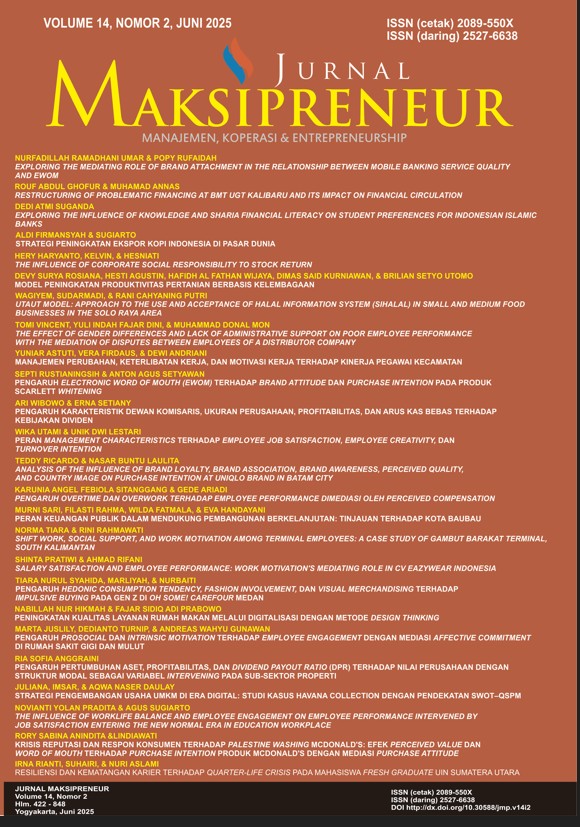
Pengaruh Electronic Word of Mouth (eWOM) terhadap Brand Attitude dan Purchase Intention pada Produk Scarlett Whitening
DOI:
https://doi.org/10.30588/jmp.v14i2.1574Keywords:
Electronic Word of Mouth (eWOM), Brand Attitude, Purchase Intention.Abstract
Social media has transformed the way conventional marketing operates and introduced a new form of digital marketing, known as Electronic Word of Mouth (eWOM). eWOM plays an important role in consumer purchasing decisions. The purpose of this study is to help businesspeople understand the benefits of eWOM in marketing efforts and to analyze the effect of eWOM generated by users through social media on brand attitudes and purchase intentions for Scarlett Whitening products. The population raised is male and female respondents who know Scarlett whitening products and have seen posts on social media about Scarlett whitening products. The non-probability sampling technique will be the sampling method. Sampling with a purposive type. In this study, a sample of 250 respondents met the research criteria, and the PLS SEM test tool in Smart PLS 3.0 software was used to process the data. The results of this study show that eWOM has a significant positive impact on Brand Attitude, eWOM has a significant positive impact on Purchase Intention, and Brand Attitude has a significant positive impact on Purchase Intention.
References
Abzari, M., Ghassemi, R. A., & Vosta, L. N. (2014). Menganalisis pengaruh media sosial terhadap sikap merek dan niat membeli: Kasus perusahaan Iran Khodro. Procedia-Social and Behavioral Sciences, 822–826.
Cheung, C. M., Lee, M. K., & Thadani, D.R. (2009). Dampak Positif Electronic Word-of-Mouth terhadap Keputusan Pembelian Online Konsumen. Springer.
Cheung, M., & Lee, K. (2012). Apa yang mendorong konsumen untuk menyebarkan kata elektronik dari mulut ke mulut di platform opini konsumen online. Sistem Pendukung Keputusan, 53, 218–225.
Doh, S., & Hwang, J. (2009). Bagaimana konsumen mengevaluasi eWOM (electronic word-of-mouth) pesan. Psikologi & Perilaku Cyber, 12(2), 193–197.
Elseidi, R., & El-Baz, D. (2016). Efek kata elektronik dari mulut ke mulut pada sikap merek konsumen, citra merek dan niat beli: Sebuah studi empiris di Mesir. Tinjauan Bisnis dan Manajemen, 7(5), 514–522.
Ghozali, I. (2013). Aplikasi Analisis Multivariate dengan Program IBM SPSS 21 Update PLS Regresi. Badan Penerbit Universitas Diponegoro.
Jeong, H., & Koo, D. (2015). Efek gabungan dari valensi dan atribut e-WOM pada penilaian konsumen untuk pesan dan produk: Efek moderasi dari tipe komunitas merek. Riset Internet, 25(1).
Joan, V. (2020). Produk Kecantikan Tembus Transaksi Rp210 Miliar, Brand Lokal Terfavorit. Dipetik 3, 2023 dari compas.co.id: https://compas.co.id/article/penjualan-produk-kecantikan/
Kudeshia, C., & Kumar, A. (2017). Social eWOM: Does it affect the Brand Attitude and Purcahse Intention of Brands? Management Research Review, 40(3), 310–330.
Lee, J., Park, D., & Han, I. (2011). Efek berbeda dari ulasan konsumen online terhadap niat beli konsumen tergantung pada kepercayaan di pusat perbelanjaan online: Perspektif periklanan. Riset Internet, 21(2), 187–206.
Lin, C., & Chen, J. (2013). Electronic word-of-mouth: Peran moderating keterlibatan produk dan citra merek. Prosiding Konferensi Internasional tentang Inovasi Teknologi dan Manajemen Industri, 29–47.
Miniard, P., Obermiller, C., & Page, T. J. (1983). Penilaian lebih lanjut pengaruh pengukuran pada hubungan niat-perilaku. Journal of Marketing Research, 20(2), 206–212.
Mutia, A. (2022). Perkiraan Pendapatan Produk Perawatan Diri dan Kecantikan di Indonesia (2014-2027). Dipetik 4, 2023, dari databoks.katadata.co.id: https://databoks.katadata.co.id/datapublish/2022/12/05/makin-meroket-pendapatan-produk-kecantikan-dan-perawatan-diri-di-ri-capai-rp11183-triliun-pada-2022
Nasehudin, T. S., & Gozali, N. (2012). Metode Penelitian Kuantitatif. CV. Pustaka Setia.
Olson, J., & Mitchell, A. (2000). Are Product Attribute Beliefs the Only Mediator of Advertising Effects on Brand Attitude? Journal of Marketing Research, 18(3), 318–332. https://doi.org/10.1177/002224378101800306
Park, D., Lee, J., & Han, I. (2007). Pengaruh ulasan konsumen online pada niat beli konsumen: Peran moderat keterlibatan. International Journal of Electronic Commerce, 11(4), 125–148.
Research & Markets. (2022). Skincare Products Market- Growth, Trends, and Forecasts (2023-2028). Diambil kembali dari Research & Markets: https://www.researchandmarkets.com/reports/5312396/skincare-products-market-growth-trends-covid
Schivinski, B., & Dabrowski, D. (2014). The effect of social media communication on consumer perceptions of brands. Journal of Marketing Communications, 22(2), 189–214. https://doi.org/10.1080/13527266.2013.871323
Summers, T. A., Belleau, B. D., and Yingjiao, X. (2006). Predicting purchase intention of a controversial luxury apparel product. J. Fashion Market. Manage. 10, 405–419. https://doi.org/10.1108/13612020610701947.
Tariq, M., Nawaz, M., Nawaz, M., & Butt, H. (2013). Persepsi pelanggan tentang branding dan niat beli: Studi FMCG di pasar berkembang. Journal of Basic and Applied Scientific Research, 3(2), 340–347.
Taylor, C. (2018). Era baru electronic word of mouth (eWOM): 'Be more chill' menolak kritik. Jurnal Periklanan Internasional, 37(6), 849–851.
Downloads
Published
How to Cite
Issue
Section
License
Copyright (c) 2025 Septi Rustianingsih, Anton Agus Setyawan

This work is licensed under a Creative Commons Attribution 4.0 International License.
Authors who publish with Jurnal Maksipreneur agree to the following terms:
Authors retain copyright and grant the Jurnal Maksipreneur right of first publication with the work simultaneously licensed under a Creative Commons Attribution 4.0 International License that allows others to share (copy and redistribute the material in any medium or format) and adapt (remix, transform, and build upon the material) the work for any purpose, even commercially with an acknowledgment of the work's authorship and initial publication in Jurnal Maksipreneur.
Authors are able to enter into separate, additional contractual arrangements for the non-exclusive distribution of the journal's published version of the work (e.g., post it to an institutional repository or publish it in a book), with an acknowledgment of its initial publication in Jurnal Maksipreneur. Authors are permitted and encouraged to post their work online (e.g., in institutional repositories or on their website) prior to and during the submission process, as it can lead to productive exchanges, as well as earlier and greater citation of published work (See The Effect of Open Access).