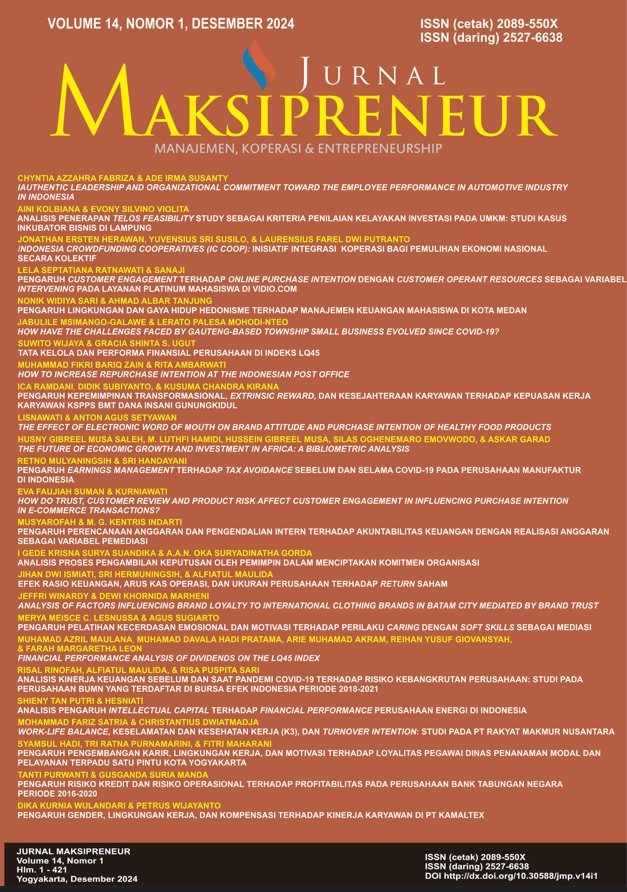
Pengaruh Gender, Lingkungan Kerja, dan Kompensasi terhadap Kinerja Karyawan di PT Kamaltex
DOI:
https://doi.org/10.30588/jmp.v14i1.1695Keywords:
gender, lingkungan kerja, kompensasi, kinerja karyawanAbstract
Human resources are crucial aspect of a company. A comfortable work environment means employees will work optimally. If employees do their work well, then high efficiency, effectiveness, and quality can be achieved in the company. This research aims to examine the effect of gender, work environment, and compensation on employee performance at PT Kamaltex. The research results show that compensation has a positive effect on employee performance, also that the work environment has a positive effect on employee performance, which means that the better the compensation and work environment of a company will provide a significant increase in employee performance.
References
Ariandi, M. A. (2022). Universitas Islam Riau. Universitas Islam Riau.
Ayu, M. I. (2017). Pengaruh Gender dan Stres Kerja terhadap Kinerja Karyawan pada PT Paragon Technology and Innovation Bandung (Survey pada Karyawan Wardah Cosmetics). Jurnal Riset Bisnis & Investasi, 3(2), 94–103.
Broadbridge, A., & Fielden, S. (2015). Handbook of Gendered Careers in Management: Getting in, Getting on, Getting out. Edward Elgar Publishing. https://doi.org/10.4337/9781782547709
Fakih, M. (2006). Analisis Gender dan Transformasi Sosial. Pustaka Belajar.
Gardjito, A. H., & Al Musadieq, M.G. E. N. (2014). Pengaruh Motivasi Kerja dan Lingkungan Kerja terhadap Kinerja Karyawan (Studi pada Karyawan Bagian Produksi PT Karmand Mitra Andalan Surabaya). Jurnal Administrasi Bisnis (JAB), 13(1), 1–8.
George, R. T. (2006). Prinsip-Prinsip Manajemen. Bumi Aksara.
Ghozali, I. (2013). Aplikasi Analisis Multivariate dengan Program SPSS (P. 232). Universitas Diponegoro.
Guilford, J. P., & Fruchter, B. (1978). Fundamental Statistics in Psychology and Education (6th ed.). McGraw-Hill.
Hasanah, H. N., & Yulianti, F. (2019). Analisis Motivasi Kerja dalam Meningkatkan Kinerja Karyawan pada Kantor PT Maju Terus Revintama Tanah Bumbu. Skripsi, Uniska.
Hasibuan, M. (2003). Manajemen Sumber Daya Manusia. Bumi Aksara.
Hidayat, Z., & Taufiq, M. (2012). Pengaruh Lingkungan Kerja dan Disiplin Kerja Serta Motivasi Kerja Terhadap Kinerja Karyawan Perusahaan PDAM Kab. Lumajang. Jurnal Wiga, 2(1), 79–97.
Hutomo, M., Setiawan, R., Bisnis, P. M., Manajemen, P. S., Petra, U. K., & Siwalankerto, J. (2015). Kinerja Karyawan pada PT Lestari Purnama Perkasa. Jurnal Ekonomi, 3(2), 60–69.
Jayaweera, T. (2015). Impact of Work Environmental Factors on Job Performance, Mediating Role of Work Motivation: A Study of the Hotel Sector in England. International Journal of Business and Management, 10(3), 271–278. https://doi.org/10.5539/Ijbm.V10n3p271
Kushartati, M. F. (2015). Pengaruh Kompensasi, Motivasi dan Lingkungan Kerja terhadap Kinerja Karyawan (Studi Kasus pada Kantor PD. BPR Bank Pasar Kabupaten Sukoharjo). Skripsi, Universitas Muhammadiyah Surakarta.
Kustono, A. S. (2011). Pengaruh Gender dan Lokus Kendali terhadap Kinerja Karyawan Perguruan Tinggi. Media Riset Akuntansi, 1(1), 5–18.
Lee, S. Y., & Brand, J. L. (2005). Effects of control over office workspace on perceptions of the work environment and work outcomes. Journal of Environmental Psychology, 25(3), 323–333. https://doi.org/10.1016/j.jenvp.2005.08.001
Malik, M. I., Ahmad A., Gomez, S. F., & Ali, M. (2011). A Study of the Work Environment and Employees’ Performance in Pakistan. African Journal of Business Management, 5(34). https://doi.org/10.5897/Ajbm11.1502
Meyer, E. J. (2010). Gender and Sexual Diversity in Schools. Springer.
Moeheriono. (2013). Pengukuran Kinerja Berbasis Kompensasi. PT Rajagrafindo Persada.
Murty, W. A., & Hudiwinarsih, G. (2012). Pengaruh Kompensasi, Motivasi dan Komitmen Organisasional terhadap Kinerja Karyawan Bagian Akuntansi (Studi Kasus pada Perusahaan Manufaktur di Surabaya). TIAR: The Indonesian Accounting Review, 2(2), 215–228. https://doi.org/10.14414/tiar.v2i02.97
Nawawi, I. (2014). Budaya Organisasi, Kepemimpinan, dan Kinerja Organisasi. Mitra Media Nusantara.
Nitisemito, A. (2005). Manajemen Personalia: Manajemen Sumber Daya Manusia. Ghalia Indonesia.
Nugraha, A., & Tjahjawati, S. S. (2018). Pengaruh Kompensasi terhadap Kinerja Karyawan. Jurnal Riset Bisnis dan Investasi, 3(3), 24. https://doi.org/10.35697/Jrbi.V3i3.942
Nugroho, A. S. (2011). Analisis Kesejahteraan Karyawan dan Motivasi Kerja Karyawan terhadap Prestasi Kerja Karyawan Outsourcing pada PT Perdana Perkasa Elastindo Cabang Bandung Stusi pada Mitra Kerja PT Perdana Pekersa Elastindo. Thesis, Universitas Komputer Indonesia.
Raziq, A., & Maulabakhsh, R. (2015). Impact of Working Environment on Job Satisfaction. Procedia Economics and Finance, 23, 717–725. https://doi.org/10.1016/S2212-5671(15)00524-9
Rivai, R. V. (2014). Manajemen Sumber Daya Manusia untuk Perusahaan dari Teori ke Praktik. Edisi Ketiga. Rajawali Pers.
Robbins, P. S. (2006). Perilaku Organisasi (B. Molan (Ed.); Edisi 10). Erlangga.
Santrock, J. W. (2003). Adolescence, Perkembangan Remaja (Edisi Keenam). Erlangga.
Sari, N. N. (2016). Pengaruh Pengembangan Karir terhadap Kinerja Karyawan PT PLN (Persero) Wilayah Kalimantan Utara Sektor Pembangkit Mahakam Samarinda. E-journal Administrasi Bisnis, 4(2), 620–630.
Sedarmayanti. (2009). Sumber Daya Manusia dan Produktivitas Kerja. Mandar Maju.
Siregar, S. (2010). Statistika Deskriptif untuk Penelitian Dilengkapi Perhitungan Manual dan Aplikasi SPSS Versi 17. Raja Grafindo Persada.
Sitorus, A. V. (2016). Dampak Ketimpangan Gender Terhadap Pertumbuhan Ekonomi di Indonesia. Sosio Informa, 2, 89–101.
Sudaryo, Y., Wibowo, A., & Sofiyati, A. (2018). Manajemen Sumber Daya Manusia: Kompensasi Tidak Langsung dan Lingkungan Kerja Fisik. Penerbit Andi.
Sugiyono, S. (2016). Kuantitatif, Kualitatif dan R&D. Alfabeta.
Widodo, E. S. (2015). Manajemen Pengembangan Sumber Daya Manusia. Pustaka Belajar.
Downloads
Published
How to Cite
Issue
Section
License
Copyright (c) 2024 Dika Kurnia Wulandari, Petrus Wijayanto

This work is licensed under a Creative Commons Attribution 4.0 International License.
Authors who publish with Jurnal Maksipreneur agree to the following terms:
Authors retain copyright and grant the Jurnal Maksipreneur right of first publication with the work simultaneously licensed under a Creative Commons Attribution 4.0 International License that allows others to share (copy and redistribute the material in any medium or format) and adapt (remix, transform, and build upon the material) the work for any purpose, even commercially with an acknowledgment of the work's authorship and initial publication in Jurnal Maksipreneur.
Authors are able to enter into separate, additional contractual arrangements for the non-exclusive distribution of the journal's published version of the work (e.g., post it to an institutional repository or publish it in a book), with an acknowledgment of its initial publication in Jurnal Maksipreneur. Authors are permitted and encouraged to post their work online (e.g., in institutional repositories or on their website) prior to and during the submission process, as it can lead to productive exchanges, as well as earlier and greater citation of published work (See The Effect of Open Access).