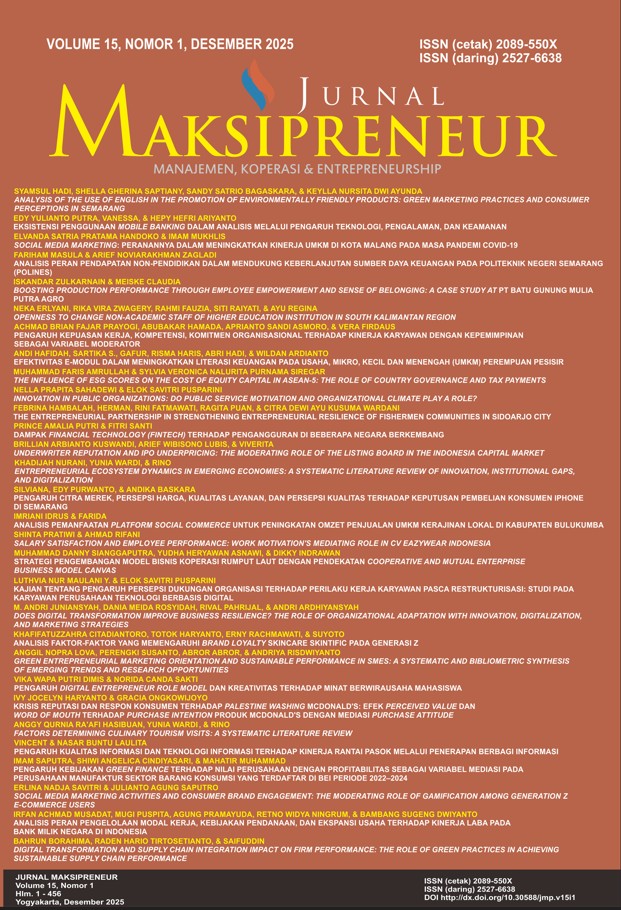
Boosting Production Performance Through Employee Empowerment and Sense of Belonging: A Case Study at PT Batu Gunung Mulia Putra Agro
DOI:
https://doi.org/10.30588/jmp.v15i1.2417Keywords:
Employee Empowerment, Production Employee Performance, Sense of BelongingAbstract
This study examines how employee empowerment influences production employees’ performance, with sense of belonging serving as a mediating mechanism. In competitive operations, empowerment that grants autonomy, recognizes contributions, and invites participation in decisions is expected to strengthen attachment to the organization and, in turn, productivity. The study contributes evidence from Indonesia’s agro-manufacturing sector, an important yet underexamined context. A quantitative explanatory design was employed. Relationships among constructs were estimated using Partial Least Squares Structural Equation Modeling. The population consisted of 98 production employees at PT Batu Gunung Mulia Putra Agro; total sampling yielded 42 respondents, including 40 employees and two supervisors. Data were collected through a structured questionnaire on a five-point Likert scale. Results indicate that empowerment significantly increases both sense of belonging and performance. Sense of belonging also exerts a positive effect on performance and mediates the relationship between empowerment and performance, suggesting an indirect pathway from empowerment to outcomes. Model diagnostics show accuracy, with R-square values of 0.631 for sense of belonging and 0.856 for performance. These findings imply that autonomy, recognition, and participatory decision-making are effective levers for cultivating emotional bonds and sustaining productivity. Organizations are encouraged to institutionalize empowerment-based policies to enhance performance.
References
Astuti, P. D., & Datrini, L. K. (2021). Green competitive advantage: Examining the role of environmental consciousness and green intellectual capital. Management Science Letters, 11(5), 1141–1152. https://doi.org/10.5267/j.msl.2020.11.025
Baumeister, R. F., & Leary, M. R. (1995). The need to belong: Desire for interpersonal attachments as a fundamental human motivation. Psychological Bulletin, 117(3), 497–529. https://doi.org/10.1037/0033-2909.117.3.497
Blau, G., Goldberg, D., & Kyser, D. (2023). Organizational belonging – proposing a new scale and its relationship to demographic, organization, and outcome variables. Journal of Workplace Behavioral Health, 38(3), 226–253. https://doi.org/10.1080/15555240.2023.2178448
Bonini, A., Panari, C., Caricati, L., & Mariani, M. G. (2024). The relationship between leadership and adaptive performance: A systematic review and meta-analysis. Plos One, 19(10), e0304720. https://doi.org/10.1371/journal.pone.0304720
Brown, E. R., Phills, C. E., Kahn, J., & Mukundan, S. (2025). Feeling a sense of belonging is associated with more motivation within organizations that value diversity and equity. Scientific Reports, 15, 23201. https://doi.org/10.1038/s41598-025-04456-9
Budiman, D., & Ardhiyansyah, A. (2023). The Effect of Employee Engagement, Marketing Capability and Innovation on Sustainable Customer Loyalty among MSMEs Customers in Indonesia. Jurnal Riset Ekonomi Manajemen (REKOMEN), 6(2), 96–108. https://doi.org/10.31002/rekomen.v6i2.1034
Chu, X., Yu, J., Litifu, A., Zhao, W., Wei, X., Wang, P., & Wei, J. (2024). Organizational support and task performance: A multiple mediation model. Frontiers in Psychology, 14, 1258177. https://doi.org/10.3389/fpsyg.2023.1258177
Cudjoe, J., Agyapong, D., Light, O., Frimpong, S. E., & Opoku, R. K. (2023). Psychological empowerment and job performance of star-rated hotels: The mediating role of emotional intelligence. Cogent Business & Management, 10(3), 2266131. https://doi.org/10.1080/23311975.2023.2266131
Deci, E. L., & Ryan, R. M. (2000). The “what” and “why” of goal pursuits: Human needs and the self-determination of behavior. Psychological Inquiry, 11(4), 227–268. https://doi.org/10.1207/S15327965PLI1104_01
Dessler, D. (2018). Human Resource Management: Personnel Human Resource Management. Mismain.Bsa.Kent.Edu (16 ed., Vol. 6, Nomor January 2009). Pearson Education. https://open.umn.edu/opentextbooks/BookDetail.aspx?bookId=71
Desta, A. G. M., & Mulie, H. (2024). The effect of empowering leadership practices on employees performance with the mediating role of work engagement: the case of ethio-telecom. Cogent Business & Management, 11(1), 2363589. https://doi.org/10.1080/23311975.2024.2307066
Forum, W. E. (2023). Future of Jobs Report 2023 IN. World Economic Forum.
Ghosh, P., Rai, A., & Sinha, A. (2023). Empowering employees for performance excellence: Evidence from manufacturing firms. Journal of Organizational Change Management, 36(5), 987–1005. https://doi.org/10.1108/JOCM-01-2022-0024
Hackman, J. R., & Oldham, G. R. (1976). Motivation through the Design of Work: Test of a Theory. Organizational Behavior and Human Performance, 16(1), 250–279.
Hagerty, B. M., Williams, R. A., Coyne, J. C., & Early, M. R. (1996). Sense of belonging and indicators of social and psychological functioning. Archives of Psychiatric Nursing, 10(4), 235–244.
Hair, J. F., Sarstedt, M., Ringle, C. M., Sharma, P. N., & Liengaard, B. D. (2024). Going beyond the untold facts in PLS-SEM and moving forward. European Journal of Marketing, 58(13), 81–106. https://doi.org/10.1108/EJM-08-2023-0645
Hashemi, R., Sadeghi, A., Roshanaei, G., & Purfarzad, Z. (2025). The relationship between the leader empowering behaviors and work engagement: The role of psychological empowerment as a mediating variable. BMC Nursing, 24(1), 652. https://doi.org/10.1186/s12912-025-03321-4
Hassard, J., Morris, J., & Xing, Y. (2023). Workplace empowerment, psychological empowerment, and work-related wellbeing in Southeast Asian employees: A cross-sectional survey. Asian Business & Management, 22(1), 58–76. https://doi.org/10.1057/s41291-022-00189-7
Jiang, Z., & Yang, J. (2023). Linking employee empowerment to job performance through belongingness: Evidence from Chinese SMEs. Asia Pacific Journal of Human Resources, 61(3), 450–470. https://doi.org/10.xxxx/apjhr.2023.450
Juyumaya, J. (2022). How psychological empowerment impacts task performance: The mediation role of work engagement and moderating role of age. Frontiers in Psychology, 13(13). https://doi.org/10.3389/fpsyg.2022.889936
Kepplinger, A., Braun, A., Fringer, A., & Roes, M. (2024). Opportunities for nurses to address employee voice in health care providers: A scoping review. BMC Nursing, 23(1), 651. https://doi.org/10.1186/s12912-024-02331-y
Kim, T., & Cho, W. (2024). Employee Voice Opportunities Enhance Organizational Performance When Faced With Competing Demands. Review of Public Personnel Administration, 44(4), 713–739. https://doi.org/10.1177/0734371X231190327
Kimpah, J., Rothmann, S., Ibrahim, H. I., Jaaffar, A. H., Vinahapsari, C. A., Wider, W., & Naces Udang, L. (2024). Individual cognitive empowerment and in-role performance: a matched-pair study. Frontiers in Psychology, 15, 1402029. https://doi.org/10.3389/fpsyg.2024.1402029
Lee, N. Y., Zablah, A. R., & Noble, S. M. (2023). A meta-analytic investigation of the organizational identification–job performance relationship in the frontlines. Journal of Retailing, 99(3), 370–384. https://doi.org/10.1016/j.jretai.2023.07.003
Li, W., Xv, Z., & Ji, B. (2024). How Empowering Leadership Can Improve New Employee Engagement: The Mediating Role of Employee Perceptions of Insider Status. Sage Open, 14(3). https://doi.org/10.1177/21582440241271243
Liu, Y., Fang, Y., Hu, L., Chen, N., Li, X., & Cai, Y. (2024). Inclusive leadership and employee workplace well-being: The role of vigor and supervisor developmental feedback. BMC Psychology, 12(540), 1–12. https://doi.org/10.1186/s40359-024-02029-5
Llorente-Alonso, M., Garia-Ael, C., & Topa, G. (2024). A meta-analysis of psychological empowerment: Antecedents, organizational outcomes, and moderating variables. Current Psychology, 43, 1759–1784. https://doi.org/10.1007/s12144-023-04369-8
Magno, F., Cassia, F., & Ringle, C. M. (2024). Using partial least squares structural equation modeling (PLS-SEM) in quality management: Evidence and future directions. The TQM Journal, 36(5), 1242–1251. https://doi.org/10.1108/TQM-06-2022-0197
McShane, S. L., & Von Glinow, M. A. (2018). Organizational Behavior (8th ed.). McGraw-Hill Education.
Orenuga, O. O., Akinbode, J., & Olabode, T. (2024). Sense of belonging and work engagement: Implications for performance in manufacturing firms. Journal of Workplace Behavioral Health, 39(1), 45–63. https://doi.org/10.1080/15555240.2023.2234567
Pacheco, P. O., Coello-Montecel, D., & Tello, M. (2023). Psychological Empowerment and Job Performance: Examining Serial Mediation Effects of Self-Efficacy and Affective Commitment. Administrative Sciences, 13(3), 76. https://doi.org/10.3390/admsci13030076
Qorri, A., Durmishi, N., & Rexhepi, G. (2024). Employee empowerment as a driver of performance in agro-industrial sectors. Journal of Agribusiness Management, 17(1), 75–89. https://doi.org/10.xxxx/jam.2024.75
Riak, C. N. G., & Wanyama, K. W. (2025). Examining the Effect of Employee Empowerment Programs on Employee Performance in Public Universities in South Sudan. Cross Current International Journal of Economics, Management and Media Studies, 7(02), 15–28. https://doi.org/10.36344/ccijemms.2025.v07i02.002
Sahadev, S., Chang, K., Malhotra, N., Kim, J.-H., Ahmed, T., & Kitchen, P. (2024). Psychological empowerment and creative performance: Mediating role of thriving and moderating role of competitive psychological climate. Journal of Business Research, 170, 114310. https://doi.org/10.1016/j.jbusres.2023.114310
Sarstedt, M., Hair, J. F., Pick, M., Liengaard, B. D., Radomir, L., & Ringle, C. M. (2022). Progress in partial least squares structural equation modeling use in marketing research in the last decade. Psychology & Marketing, 39(5), 1035–1064. https://doi.org/10.1002/mar.21640
Seo, J. (2023). Why Does the Impact of Psychological Empowerment Increase Employees’ Knowledge-Sharing Intention? A Moderated Mediation Model of Belonging and Perceived Organizational Support. Behavioral Sciences, 13(5), 387. https://doi.org/10.3390/bs13050387
Shannon, S., Carlin, A., Woods, C., Nevill, A. M., Murphy, N., & Murphy, M. H. (2022). Adherence to aerobic and muscle-strengthening components of the physical activity guidelines and mental health. Health Promotion International, 37(5). https://doi.org/10.1093/heapro/daac083
Spreitzer, G. M. (1995). Psychological Empowerment in the Workplace: Dimensions, Measurement, and Validation. The Academy of Management Journal, 38(5), 1442–1465.
Tajfel, H., & Turner, J. C. (2019). The Social Identity Theory of Intergroup Behavior. In S. Worchel & W. G. Austin (Ed.), Political Psychology (pp. 276–293). Nelson-Hall. https://doi.org/10.4324/9780203505984-16
Thissen, L. (2023). (Un)belonging at work: An overlooked ingredient of workplace health. Health Promotion International, 38(3). https://doi.org/10.1093/heapro/daac083
Thomas, K. W., & Velthouse, B. A. (1990). Cognitive Elements of Empowerment: An “Interpretive” Model of Intrinsic Task Motivation. Academy of Management Review, 15(4), 666–681. https://doi.org/10.5465/amr.1990.4310926
Tian, G., Liu, T., & Yang, R. (2023). Workplace loneliness mediates the relationship between perceived organizational support and job performance: Differing by extraversion. Frontiers in Psychology, 14, 1058513. https://doi.org/10.3389/fpsyg.2023.1058513
Ugwoke, E. O., Edeh, N. I., Nwokike, F. O., Ugwunwoti, E. P., Emmanuel, W. B., Idris, B. A., Odey, C., Samson, J., Nnamani, V. O., Yaro, J. T., Eya, G. M., Arua, G. C., Guma, E. T., & Kingsley, J. B. (2025). Joint mediation of psychological empowerment and work–life balance between transformational leadership and in-role performance of accounting personnel: 360-degree feedback. Journal of Management & Organization, 31(3), 1329–1348. https://doi.org/10.1017/jmo.2023.23
Urrila, L. I., Siiriäinen, A., & Mäkelä, L. (2025). Sense of belonging in hybrid work settings: A systematic review. Journal of Vocational Behavior, 157, 104096. https://doi.org/10.1016/j.jvb.2025.104096
Wordsworth, R., & Nilakant, V. (2021). Unexpected change: Career transitions following a significant extra-organizational shock. Journal of Vocational Behavior, 127, 103555. https://doi.org/10.1016/j.jvb.2021.103555
Yang, J. F., Shi, W., Chen, E. W., Luo, B. N., Zhao, J. Z., Yin, Z., & Tao, J. (2023). Are “outsiders” in? Exploring the impact of outsourced workers’ perceived insider status and job value status on job performance. Frontiers in Psychology, 14, 1159022. https://doi.org/10.3389/fpsyg.2023.1159022
Yang, Y., Obrenovic, B., Kamotho, D. W., Godinic, D., & Ostic, D. (2024). Enhancing Job Performance: The Critical Roles of Well-Being, Satisfaction, and Trust in Supervisor. Behavioral Sciences, 14(8), 688. https://doi.org/10.3390/bs14080688
Downloads
Published
How to Cite
Issue
Section
License
Copyright (c) 2025 Iskandar Zulkarnain, Meiske Claudia

This work is licensed under a Creative Commons Attribution 4.0 International License.
Authors who publish with Jurnal Maksipreneur agree to the following terms:
Authors retain copyright and grant the Jurnal Maksipreneur right of first publication with the work simultaneously licensed under a Creative Commons Attribution 4.0 International License that allows others to share (copy and redistribute the material in any medium or format) and adapt (remix, transform, and build upon the material) the work for any purpose, even commercially with an acknowledgment of the work's authorship and initial publication in Jurnal Maksipreneur.
Authors are able to enter into separate, additional contractual arrangements for the non-exclusive distribution of the journal's published version of the work (e.g., post it to an institutional repository or publish it in a book), with an acknowledgment of its initial publication in Jurnal Maksipreneur. Authors are permitted and encouraged to post their work online (e.g., in institutional repositories or on their website) prior to and during the submission process, as it can lead to productive exchanges, as well as earlier and greater citation of published work (See The Effect of Open Access).