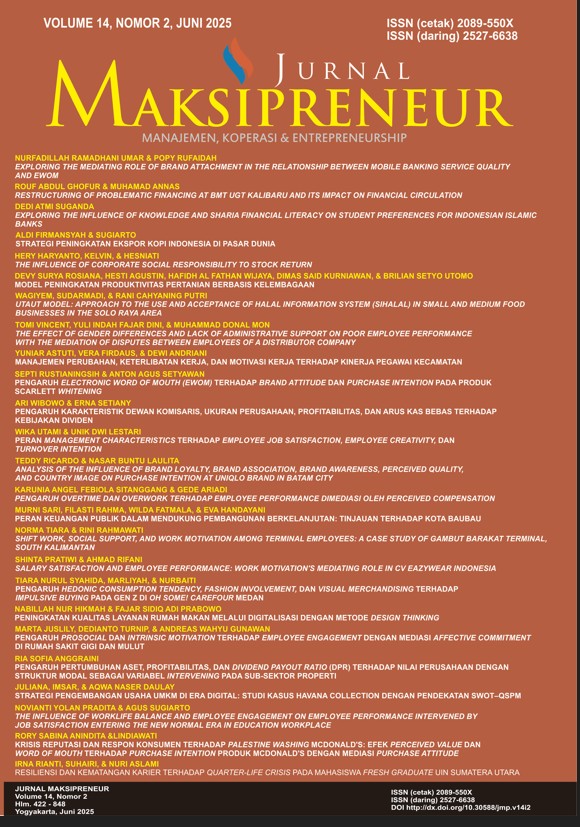
Shift Work, Social Support, and Work Motivation Among Terminal Employees: A Case Study of Gambut Barakat Terminal, South Kalimantan
DOI:
https://doi.org/10.30588/jmp.v14i2.2411Keywords:
Work Shift, Social Support, Work MotivationAbstract
This study examines how a shift work system affects employees’ work motivation, considering social support as a mediating mechanism. The research took place at Gambut Barakat Type A Terminal, South Kalimantan, a public service facility that operates continuously with rotating morning, afternoon, and night schedules. A quantitative, causal comparative design was employed, and all 35 shift employees were surveyed using standardized instruments for shift work and social support. Data were analyzed using Partial Least Squares Structural Equation Modeling. The results indicate that the shift work system has a positive impact on work motivation (β = 0.536) and also enhances perceived social support (β = 0.763). Social support has a positive effect on motivation (β = 0.383) and partially mediates the relationship between shift work and motivation (β = 0.409). The model yields an R² of 0.744, indicating that 74.4% of the variance in motivation is explained by the combined effect of shift work and social support. These findings highlight the importance of transparent and well-managed rosters accompanied by a supportive interpersonal climate. In continuous public service operations, equitable scheduling, combined with peer and supervisory support, can enhance employee motivation and help sustain performance over time.References
Ahlstedt, C., Moberg, L., Brulin, E., & Nyberg, A. (2024). Social support from manager and co-workers in relation to registered nurses’ work motivation in three healthcare settings: A cross-sectional study of a Swedish national sample. Journal of Nursing Scholarship, 56(6), 790–801. https://doi.org/10.1111/jnu.12995
Åkerstedt, T., Kecklund, G., Axelsson, J., & Lowden, A. (2022). Shift work and disturbed sleep/wakefulness. Occupational Medicine, 72(3), 130–137. https://doi.org/10.1093/occmed/kqab180
Albishri, F., & Zamzami, L. (2021). Perception of Effects of Shiftwork Questionnaire (PESQ) among ambulance service staff in Saudi Arabia: An exploratory factor analysis. Journal of Emergency Medicine, 58(2), 123–130.
Badan Pusat Statistik. (2023). Keadaan Ketenagakerjaan Indonesia Agustus 2023. BPS RI. https://www.bps.go.id/publication/2023/11/06/Keadaan-Ketenagakerjaan-Indonesia-Agustus-2023.html
Bakker, A. B. (2023). Job Demands-Resources Theory: Ten years later. Annual Review of Organizational Psychology and Organizational Behavior, 10. https://doi.org/10.1146/annurev-orgpsych-120920-053933
Chen, Y., Liu, X., Zhang, J., & Wang, Q. (2024). More than sleep problems? Testing five key health behaviors as reasons for quality of life issues among shift workers. Occupational Medicine and Health Affairs, 12(1), 45–55.
Cohen, S., & Wills, T. A. (1985). Stress, social support, and the buffering hypothesis. Psychological Bulletin, 98(2), 310–357.
Costa, G. (1996). The impact of shift and night work on health. Applied Ergonomics, 27(1), 9–16. https://doi.org/10.1016/0003-6870(95)00047-X
Demerouti, E. (2023). Job Demands--Resources theory in times of crises: New propositions and lessons from COVID-19. Organizational Psychology Review, 13(1), 3–33. https://doi.org/10.1177/20413866221135022
Demerouti, E., Bakker, A. B., Nachreiner, F., & Schaufeli, W. B. (2001). The job demands-resources model of burnout. Journal of Applied Psychology, 86(3), 499–512. https://doi.org/10.1037/0021-9010.86.3.499
den Broeck, A., Ferris, D. L., Chang, C. H., & Rosen, C. C. (2016). A review of self-determination theory’s basic psychological needs at work. Journal of Management, 42(5), 1195–1229. https://doi.org/10.1177/0149206316632058
den Broeck, A., Howard, J. L., Van Vaerenbergh, Y., Leroy, H., & Gagné, M. (2021). Beyond intrinsic and extrinsic motivation: A meta-analysis on self-determination theory’s multidimensional conceptualization of work motivation. Organizational Psychology Review, 11(3), 240–273. https://doi.org/10.1177/20413866211006173
Fornell, C., & Larcker, D. F. (1981). Structural equation models with unobservable variables and measurement error: Algebra and statistics. Journal of Marketing Research, 18(3), 382–388. https://doi.org/10.2307/3150980
Gagné, M. (2022). Understanding and shaping the future of work with self-determination theory. Nature Reviews Psychology, 1(8), 378–392. https://doi.org/10.1038/s44159-022-00056-w
Giurge, L. M., & Woolley, K. (2022). Working during non-standard work time undermines intrinsic motivation. Organizational Behavior and Human Decision Processes, 170, 104114. https://doi.org/10.1016/j.obhdp.2022.104114
Gou, J., Zhang, X., He, Y., He, K., & Xu, J. (2024). Effects of job demands, job resources, personal resources on night-shift alertness of ICU shift nurses: a cross-sectional survey study based on the job demands-resources model. BMC Nursing, 23(1), 648. https://doi.org/10.1186/s12912-024-02313-0
Hair, J. F., Hult, G. T. M., Ringle, C. M., & Sarstedt, M. (2021). Evaluating Measurement and Structural Model in PLS-SEM: Best Practices. European Journal of Marketing, 55(3), 464–495.
Hair, J. F., Sarstedt, M., Ringle, C. M., Sharma, P. N., & Liengaard, B. D. (2024). Going beyond the untold facts in PLS-SEM and moving forward. European Journal of Marketing, 58(13), 81–106. https://doi.org/10.1108/EJM-08-2023-0645
Harini, S., Kartini, A., & Rusmawan, D. (2024). Work motivation in mediating workload and work stress on nurse performance. Jurnal Kesehatan dan Psikologi Klinis, 9(2), 121–135.
Harris, R. (2024). Adaptive sleep behaviours and shift work tolerance during the transition to shift work. Sleep Medicine, 124(2). https://doi.org/10.1016/j.sleep.2024.10.003
Hasanah, N., Wahyudi, W., & Novitasari, D. (2022). The influence of workload and work environment on employee performance with job satisfaction as an intervening variable. Jurnal Manajemen dan Kewirausahaan, 24(1), 34–45. https://doi.org/10.9744/jmk.24.1.34-45
International Labour Organization. (2021). Working time and work organization. International Labour Office.
Jolly, P., Duval, J., & Gaudreau, P. (2021). The impact of social support on motivation and work engagement among shift workers. Journal of Occupational Health Psychology, 26(4), 453–468.
Karhula, K., Turunen, J., Hakola, T., Ojajärvi, A., Puttonen, S., Ropponen, A., Oksanen, T., & Härmä, M. (2020). Using participatory working-time scheduling software: Effects on working hours and wellbeing. Scandinavian Journal of Work, Environment & Health, 46(4), 446–455. https://doi.org/10.5271/sjweh.3881
Kim, H. W., Kim, J.-H., Lee, G., Lee, H.-L., Lee, H., & Kim, S.-S. (2024). The role of supervisor support in the association between night work and depressive symptoms: a gender-stratified analysis of 22,422 full-time wage workers in Korea. Epidemiology and Health, 46, e2024079. https://doi.org/10.4178/epih.e2024079
Liao, Y., Huang, M., Gu, Z., Li, C., Yu, Y., Zhang, Q., Lai, X., Liu, J., He, K., Chu, H., Zhao, Y., Wu, X., Wu, L., Li, Y., & Fang, S. (2025). Associations between perceived stress profiles, social connection and work engagement in clinical registered nurses: A mediation analysis and generalized additive models. BMC Nursing, 24, 1096. https://doi.org/10.1186/s12912-025-03754-x
Loef, B., Hulsegge, G., Proper, K. I., Paagman, H., Anema, J. R., & van Mechelen, W. (2023). Lifestyle mediates the link between shift work, obesity, and diabetes. International Archives of Occupational and Environmental Health, 96(6), 1287–1295. https://doi.org/10.1007/s00420-023-01987-3
Mori, K., Uehara, H., & Ota, A. (2024). Bridging perceived organizational support with learning orientation and work engagement. Journal of Occupational Health, 66(1), uiae024. https://doi.org/10.1093/joh/uiae024
Munn, L. T., O’Connell, N., Huffman, C., McDonald, S., Gibbs, M., Miller, C. D., Danhauer, S. C., Reed, M., Mason, L., Foley, K. L., Stopyra, J., & Gesell, S. B. (2025). Job-related factors associated with burnout and work engagement in emergency nurses: Evidence to inform systems-focused interventions. Journal of Emergency Nursing, 51(2), 249–260. https://doi.org/10.1016/j.jen.2024.10.007
Nawawi, H., Putri, F. M., & Ramadhani, A. S. (2025). Social support in rotating shift systems: A study of healthcare workers. Jurnal Psikologi Kerja Indonesia, 14(1), 55–70. https://doi.org/10.21009/jpki.2025.14.1.5
Nunnally, J. C., & Bernstein, I. H. (1994). Psychometric theory (3 ed.). McGraw-Hill.
Okojie, G., Ismail, I. R., Begum, H., Ferdous Alam, A. S. A., & Sadik-Zada, E. R. (2023). The Mediating Role of Social Support on the Relationship between Employee Resilience and Employee Engagement. Sustainability, 15(10), 7950. https://doi.org/10.3390/su15107950
Putra, R. D., Wahyuni, T. S., & Prasetyo, H. (2023). Organizational support for shift workers and its effect on performance: A case study. Jurnal Ilmu Manajemen Terapan, 14(1), 33–42.
Ren, Y., Li, G., Pu, D., He, L., Huang, X., Lu, Q., Du, J., & Huang, H. (2024). The relationship between perceived organizational support and burnout in newly graduated nurses from southwest China: the chain mediating roles of psychological capital and work engagement. BMC Nursing, 23, 719. https://doi.org/10.1186/s12912-024-02386-x
Ryan, R. M., & Deci, E. L. (2020). Intrinsic and extrinsic motivation from a self-determination theory perspective: Definitions, theory, practices, and future directions. Contemporary Educational Psychology, 60, 101860. https://doi.org/10.1016/j.cedpsych.2020.101860
Schoofs, H., Hornung, S., & Glaser, J. (2022). Prospective effects of social support on self-actualization at work. Journal of Occupational and Organizational Psychology, 95(2), 329–351.
Thoits, P. A. (2011). Mechanisms Linking Social Ties and Support to Physical and Mental Health. Journal of Health and Social Behavior, 52(2), 145–161. https://doi.org/10.1177/0022146510395592
Trépanier, S. G., Peterson, C., Gagné, M., Forest, J., Fernet, C., & Vallerand, R. J. (2022). Revisiting the Multidimensional Work Motivation Scale (MWMS). Journal of Vocational Behavior, 136, 103733. https://doi.org/10.1016/j.jvb.2022.103733
Vallières, A., Savard, J., & Morin, C. M. (2024). Changing the organisational work schedule of shift workers: Impact on insomnia and sleepiness. BMJ Open, 14, e. https://doi.org/10.1136/bmjopen-2023-
Vansteenkiste, M., Ryan, R. M., & Soenens, B. (2024). Self-determination theory and team motivation. Applied Psychology: An International Review, 73. https://doi.org/10.1111/apps.12526
Wang, L., Ma, Q., Fang, B., Su, Y., Lu, W., Liu, M., Li, X., Liu, J., & He, L. (2023). Shift work and risk of type 2 diabetes with elevated RBP4: OHSPIW cohort. BMC Public Health, 23, 1139. https://doi.org/10.1186/s12889-023-16091-y
Wen, H., Zhao, L., & Xu, Q. (2024). Effects of work-family conflict, social support, and burnout on job satisfaction among primary care physicians. Journal of Primary Healthcare Studies, 18(2), 211–229.
Wen, Z., Wu, S., Bai, L., Xu, J., Zhao, Y., Fang, J., & Jama, H. A. (2024). Effects of work--family conflict, social support and burnout on job satisfaction among primary care physicians in Huaihai economic zone. Frontiers in Psychiatry, 15, 1439636. https://doi.org/10.3389/fpsyt.2024.1439636
World Health Organization. (2020). Night shift work and chronic health conditions: Risk classification and prevention strategies. WHO Press.
Wu, J., Li, Y., Lin, Q., Fan, Y., Zhang, J., Liu, Z., Liu, X., Dai, P., Rong, X., & Zhong, X. (2024). The mediating role of perceived social support between work-family conflict and presenteeism among ICU nurses working shift work in Chinese public hospitals: A cross-sectional investigation. Plos One, 19(8), e0308673. https://doi.org/10.1371/journal.pone.0308673
Wu, Q. J., Gu, F., & Shen, X. (2022). Shift work and health outcomes: An umbrella review of systematic reviews. Journal of Clinical Sleep Medicine, 18(2), 653–662. https://doi.org/10.5664/jcsm.9676
Wu, Y., Zhang, Y., & Li, J. (2025). The relationship between social support and work engagement of rural teachers: A moderated mediation model. International Journal of Educational Psychology, 22(4), 1671–1688.
Yulianingsih, R., & Hartanto, E. (2023). Organizational climate and peer support in shift work environment. Jurnal Ilmu Manajemen Terapan, 10(3), 201–213. https://doi.org/10.24843/jimt.2023.v10.i3.p5
Zhang, P., Li, Y., Li, S., & others. (2024). Linkage between role stress and work engagement among specialty nurses: A cross-sectional study of China. BMJ Open, 14(8), e079979. https://doi.org/10.1136/bmjopen-2023-079979
Zhou, X., Li, Z., Huang, J., Yang, M., Zheng, L., & Zhou, Z. (2023). Resilience, organizational support, and innovative behavior may increase work engagement among nurses. Frontiers in Public Health, 11, 1124270. https://doi.org/10.3389/fpubh.2023.1124270
Downloads
Published
How to Cite
Issue
Section
License
Copyright (c) 2025 Norma Tiara, Rini Rahmawati

This work is licensed under a Creative Commons Attribution 4.0 International License.
Authors who publish with Jurnal Maksipreneur agree to the following terms:
Authors retain copyright and grant the Jurnal Maksipreneur right of first publication with the work simultaneously licensed under a Creative Commons Attribution 4.0 International License that allows others to share (copy and redistribute the material in any medium or format) and adapt (remix, transform, and build upon the material) the work for any purpose, even commercially with an acknowledgment of the work's authorship and initial publication in Jurnal Maksipreneur.
Authors are able to enter into separate, additional contractual arrangements for the non-exclusive distribution of the journal's published version of the work (e.g., post it to an institutional repository or publish it in a book), with an acknowledgment of its initial publication in Jurnal Maksipreneur. Authors are permitted and encouraged to post their work online (e.g., in institutional repositories or on their website) prior to and during the submission process, as it can lead to productive exchanges, as well as earlier and greater citation of published work (See The Effect of Open Access).