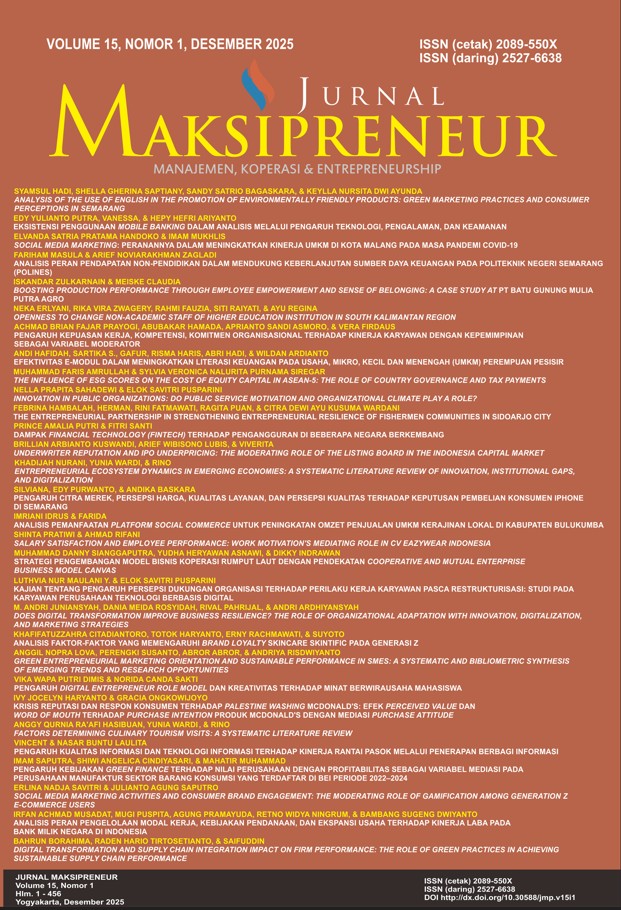
Eksistensi Penggunaan Mobile Banking Dalam Analisis Melalui Pengaruh Teknologi, Pengalaman, dan Keamanan
DOI:
https://doi.org/10.30588/jmp.v15i1.2410Keywords:
Mobile banking, user satisfaction, ease of use, security and privacy, user experienceAbstract
The purpose of this study is to analyze the factors that influence the sustainability of mobile application usage using the Technology Adoption Model (TAM) approach. The variables studied include ease of use, user experience, affective experience, and security & privacy. Data was collected through a survey of mobile banking users and analyzed statistically using quantitative methods. The results of the study indicate that ease of use, user experience, affective experience, and application security and privacy significantly influence user satisfaction. User satisfaction then becomes a key factor that mediates the influence of these variables on the intention to continue using mobile banking. These findings show that the higher the level of user satisfaction, the greater the likelihood that users will continue to use mobile banking services. Additionally, security and privacy were proven to be fundamental aspects of user trust and loyalty. The implications of this study are the importance of developing mobile banking applications that are easy to use, provide a positive experience, and ensure the security and privacy of user data to increase user satisfaction and loyalty in a sustainable manner. This study is expected to serve as a reference for developers and digital banking service providers in designing service improvement strategies in the current digital era.
References
Alalwan, A. A. (2020). Mobile food ordering apps: An empirical study of the factors affecting customer e-satisfaction and continued intention to reuse. International Journal of Information Management, 50, 28–44. https://doi.org/10.1016/j.ijinfomgt.2019.04.008
Al-Nabhani, K., Wilson, A., & McLean, G. (2022). Examining consumers’ continuous usage of multichannel retailers’ mobile applications. Psychology and Marketing, 39(1), 168–195. https://doi.org/10.1002/mar.21585
Chaouali, W., Lunardo, R., Ben Yahia, I., Cyr, D., & Triki, A. (2020). Design aesthetics as drivers of value in mobile banking: does customer happiness matter? International Journal of Bank Marketing, 38(1), 219–241. https://doi.org/10.1108/IJBM-03-2019-0100
Chaveesuk, S., Khalid, B., & Chaiyasoonthorn, W. (2022). Continuance intention to use digital payments in mitigating the spread of COVID-19 virus. International Journal of Data and Network Science, 6(2), 527–536. https://doi.org/10.5267/j.ijdns.2021.12.001
Cheng, T.-H., Chen, S.-C., & Hariguna, T. (2021). The Empirical Study of Usability and Credibility on Intention Usage of Government-to-Citizen Services. Journal of Applied Data Sciences, 2(2), 36–44.
Davis, F. D. (1989). Perceived Usefulness, Perceived Ease of Use, and User Acceptance of Information Technology. MIS Quarterly, 3, 319–340.
Egala, S. B., Boateng, D., & Mensah, S. A. (2021). To leave or retain? An interplay between quality digital banking services and customer satisfaction. International Journal of Bank Marketing, 39(7), 1420–1445. https://doi.org/10.1108/IJBM-02-2021-0072
Fornell, C., & Larcker, D. F. (1981). Evaluating Structural Equation Models with Unobservable Variables and Measurement Error. Journal of Marketing Research, 18(1), 39–50.
Hair, J. F., Risher, J. J., Sarstedt, M., & Ringle, C. M. (2019). When to use and how to report the results of PLS-SEM. European Business Review, 31(1), 2–24. https://doi.org/10.1108/EBR-11-2018-0203
Hasan, G., Jasfar, F., & Kristaung, R. (2020). Effect of Develop Strategy, Ethical Climate, on Quality Service to Customer Experience with Local Wisdom as a Moderating Variable. Proceedings of the International Conference on Management, Accounting, and Economy (ICMAE 2020). Atlantis Press, September 15, 2020. https://doi.org/10.2991/aebmr.k.200915.018
Hengky, L., & Ghozali, I. (2012). Partial Least Squares Konsep, Teknik dan Aplikasi. Universitas Diponegoro Press.
Henseler, J., Ringle, C. M., & Sarstedt, M. (2015). A new criterion for assessing discriminant validity in variance-based structural equation modeling. Journal of the Academy of Marketing Science, 43(1), 115–135. https://doi.org/10.1007/s11747-014-0403-8
Himel, Md. T. A., Ashraf, S., Bappy, T. A., Abir, M. T., Morshed, M. K., & Hossain, Md. N. (2021). Users’ attitude and intention to use mobile financial services in Bangladesh: An empirical study. South Asian Journal of Marketing, 2(1), 72–96. https://doi.org/10.1108/sajm-02-2021-0015
Hossain, Md. S., Hossain, Md. A., Masud, A. Al, & Hossain, M. S. (2025). Understanding the effect of millennial tourists’ accommodation service experiences using structural equation modeling techniques: an emerging economy context. South Asian Journal of Marketing, 6(1), 1–15 https://doi.org/10.1108/sajm-02-2023-0019
Irimia-Diéguez, A., Liébana-Cabanillas, F., Blanco-Oliver, A., & Lara-Rubio, J. (2025). What drives consumers to use P2P payment systems? An analytical approach based on the stimulus–organism–response (S-O-R) model. European Journal of Management and Business Economics, 34(2), 149–173. https://doi.org/10.1108/EJMBE-12-2022-0374
Jahan, N., & Shahria, G. (2022). Factors effecting customer satisfaction of mobile banking in Bangladesh: A study on young users’ perspective. South Asian Journal of Marketing, 3(1), 60–76. https://doi.org/10.1108/sajm-02-2021-0018
Kamboj, S., Sharma, M., & Sarmah, B. (2022). Impact of mobile banking failure on bank customers’ usage behaviour: the mediating role of user satisfaction. International Journal of Bank Marketing, 40(1), 128–153. https://doi.org/10.1108/IJBM-10-2020-0534
Kejela, A. B., & Porath, D. (2022). Influence of attitude on mobile banking acceptance and factors determining attitude of end-users in Ethiopia. Journal of Internet and Digital Economics, 2(1), 68–88. https://doi.org/10.1108/jide-08-2021-0007
Khasanah, N., Amin, F. M., & Permadi, A. (2023). The Effect of User Experience and Usability on User Satisfaction and Continuance Intention in the JConnect Mobile Application. TIERS Information Technology Journal, 4(2), 171–178. https://doi.org/10.38043/tiers.v4i2.4566
Kumar, P., Chauhan, S., Kumar, S., & Gupta, P. (2024). A meta-analysis of satisfaction in mobile banking: a contextual examination. International Journal of Bank Marketing, 42(3), 357–388. https://doi.org/10.1108/IJBM-04-2023-0236
Kumari, N., & Biswas, A. (2023). Does M-payment service quality and perceived value co-creation participation magnify M-payment continuance usage intention? Moderation of usefulness and severity. International Journal of Bank Marketing, 41(6), 1330–1359. https://doi.org/10.1108/IJBM-11-2022-0500
Liao, Z., Shi, X., & Yee, M. H. (2021). Enterprise e-banking satisfaction and continuance in business operations. Journal of General Management, 46(4), 313–321. https://doi.org/10.1177/0306307021990277
Mgiba, F. M., & Mxotwa, T. (2024). Communicating Banking Cyber-security Measures, Customer Ethical Concerns, Experience, and Loyalty Intentions: A Developing Economy’s Perspective. International Review of Management and Marketing, 14(3), 123–135. https://doi.org/10.32479/irmm.16095
Nadeem, M. A., Liu, Z., Pitafi, A. H., Younis, A., & Xu, Y. (2020). Investigating the repurchase intention of Bitcoin: empirical evidence from China. Data Technologies and Applications, 54(5), 625–642. https://doi.org/10.1108/DTA-10-2019-0182
Naeem, M., Ozuem, W., & Ward, P. (2022). Understanding the accessibility of retail mobile banking during the Covid-19 pandemic. International Journal of Retail and Distribution Management, 50(7), 860–879. https://doi.org/10.1108/IJRDM-02-2021-0064
Nagadeepa, C., Pushpa, A., Jaheer Mukthar, K. P., Rurush-Asencio, R., Sifuentes-Stratti, J., & Rodriguez-Kong, J. (2024). User’s Continuance Intention Towards Banker’s Chatbot Service – A Technology Acceptance Using SUS and TTF Model. Studies in Managerial and Financial Accounting, 36, 65–77. https://doi.org/10.1108/S1479-351220240000036006
Patrik, J. (2022). Faktor yang Memengaruhi untuk Menggunakan Mobile Banking dari Internet Banking Terhadap Penggunaan Konsumen Perbankan di Indonesia. SEIKO: Journal of Management & Business, 5(1), 2022–2284. https://doi.org/10.37531/sejaman.v5i1.1575
Petrović, D. R, Nedeljković, I., & Marinković, V. (2022). The role of the hedonistic and utilitarian quality dimensions in enhancing user satisfaction in mobile banking. International Journal of Bank Marketing, 40(7), 1610–1631. https://doi.org/10.1108/IJBM-03-2022-0112
Putra, E. Y., & Salim, F. F. (2023). Analysis of Factors Affecting Behavioral Intention in Using Mobile Wallets in Batam City. Jurnal Maksipreneur: Manajemen, Koperasi, dan Entrepreneurship, 12(2), 329. https://doi.org/10.30588/jmp.v12i2.1163
Rahman, S. Ur., Nguyen-Viet, B., Nguyen, Y. T. H., & Kamran, S. (2024). Promoting fintech: Driving developing country consumers’ mobile wallet use through gamification and trust. International Journal of Bank Marketing, 42(5), 841–869. https://doi.org/10.1108/IJBM-01-2023-0033
Riaz, H., Davidaviciene, V., Ahmed, H., & Meidute-Kavaliauskiene, I. (2022). Optimizing Customer Repurchase Intention through Cognitive and Affective Experience: An Insight of Food Delivery Applications. Sustainability (Switzerland), 14(19), 12936. https://doi.org/10.3390/su141912936
Ruangkanjanases, A., Khan, A., Sivarak, O., Rahardja, U., & Chen, S. C. (2024). Modeling the Consumers’ Flow Experience in E-commerce: The Integration of ECM and TAM with the Antecedents of Flow Experience. SAGE Open, 14(2). https://doi.org/10.1177/21582440241258595
Shah, A. M., Yan, X., & Qayyum, A. (2022). Adoption of mobile food ordering apps for O2O food delivery services during the Covid-19 outbreak. British Food Journal, 124(11), 3368–3395. https://doi.org/10.1108/BFJ-09-2020-0781
Shahid, S., Islam, J. U., Malik, S., & Hasan, U. (2022). Examining consumer experience in using M-banking apps: A study of its antecedents and outcomes. Journal of Retailing and Consumer Services, 65, 102870. https://doi.org/10.1016/j.jretconser.2021.102870
Sharma, N., Sharma, M., & Singh, T. (2024). Mobile banking app experience of generation Y and Z consumers. Asia Pacific Journal of Marketing and Logistics, 36(8), 2008–2027. https://doi.org/10.1108/APJML-08-2023-0793
Sultan, M. F., Tunio, M. N., Shamsi, A. F., & Imamuddin. (2023). Mobile banking in the context of developing asian countries: A thorough perspective based on customer’s intention, benefits, challenges, and security issues. In Financial Inclusion Accross Asia: Bringing Opportunities for Businesses. Choi-Meng Leong, Muhammad Ali, Syed Ali Raza, Chin-Hong Puah, & Ibrahim Halil Eksi (Eds.), 87–96. Emerald Publishing, Ltd. https://doi.org/10.1108/978-1-83753-304-620231007
Ugwuanyi, C. C., & Idoko, E. C. (2022). Effects of Self-service Technologies’ Attributes on Bank Customers’ Experience, Relationship Quality and Re-use Intention: Insights from a Developing Economy. Vision: The Journal of Business Perspective, 0(0). https://doi.org/10.1177/09722629221110035
Ul Haq, I., & Awan, T. M. (2020). Impact of e-banking service quality on e-loyalty in pandemic times through interplay of e-satisfaction. Vilakshan - XIMB Journal of Management, 17(1/2), 39–55. https://doi.org/10.1108/xjm-07-2020-0039
Yin, L. X., & Lin, H. C. (2022). Predictors of customers’ continuance intention of mobile banking from the perspective of the interactivity theory. Economic Research-Ekonomska Istrazivanja, 35(1), 6820–6849. https://doi.org/10.1080/1331677X.2022.2053782
Downloads
Published
How to Cite
Issue
Section
License
Copyright (c) 2025 Edy Yulianto Putra, Vanessa Vanessa, Hepy Hefri Ariyanto

This work is licensed under a Creative Commons Attribution 4.0 International License.
Authors who publish with Jurnal Maksipreneur agree to the following terms:
Authors retain copyright and grant the Jurnal Maksipreneur right of first publication with the work simultaneously licensed under a Creative Commons Attribution 4.0 International License that allows others to share (copy and redistribute the material in any medium or format) and adapt (remix, transform, and build upon the material) the work for any purpose, even commercially with an acknowledgment of the work's authorship and initial publication in Jurnal Maksipreneur.
Authors are able to enter into separate, additional contractual arrangements for the non-exclusive distribution of the journal's published version of the work (e.g., post it to an institutional repository or publish it in a book), with an acknowledgment of its initial publication in Jurnal Maksipreneur. Authors are permitted and encouraged to post their work online (e.g., in institutional repositories or on their website) prior to and during the submission process, as it can lead to productive exchanges, as well as earlier and greater citation of published work (See The Effect of Open Access).