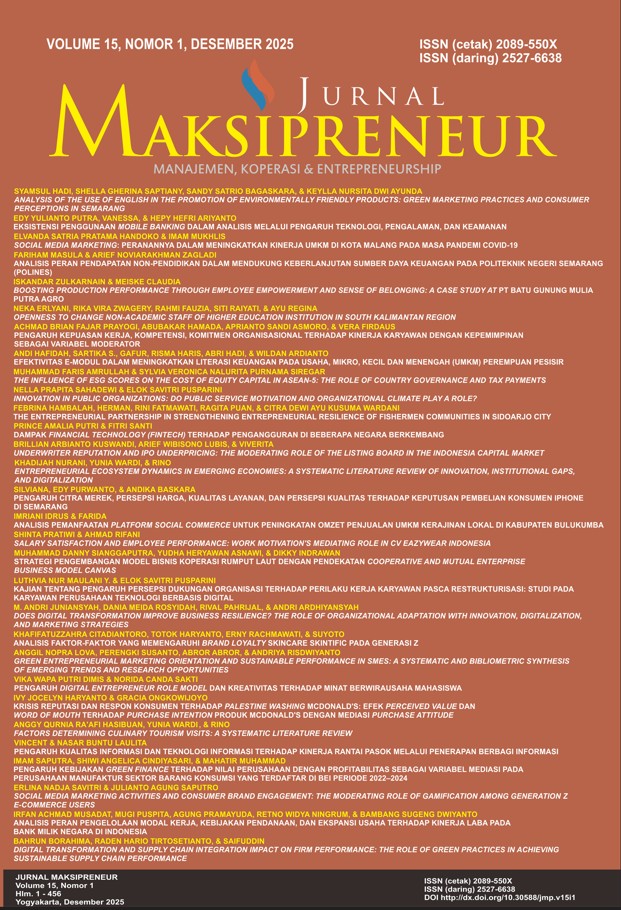
Dampak Financial Technology (Fintech) terhadap Pengangguran di Beberapa Negara Berkembang
DOI:
https://doi.org/10.30588/jmp.v15i1.2413Keywords:
Financial Technology, Financial Inclusion, UnemploymentAbstract
This study aims to analyze the effect of financial technology (fintech) adoption on unemployment rates in 77 developing countries with observation periods in 2014, 2017, and 2021. Fintech is represented by four main indicators, namely bank account ownership (BA), internet use for payments (IU), digital transactions (DP), and mobile money account ownership (MMA). The research data were sourced from the Global Findex Database and the World Bank, analyzed using panel data regression with a Random Effect Model (REM) approach through the Generalized Least Squares (GLS) method. The results of the study show that economic growth (GDP growth) has a significant negative effect on unemployment rates, in accordance with Okun's law. In terms of fintech, bank account ownership (BA) has a significant negative effect on unemployment, confirming the role of formal financial access in increasing employment opportunities. Conversely, internet use for payments (IU) has a significant positive effect on unemployment, indicating that passive utilization has not been able to encourage the creation of new jobs. Meanwhile, the variables of digital transactions (DP) and mobile money account ownership (MMA) did not show a significant effect on unemployment. Overall, the results of the study confirm that fintech has the potential to reduce unemployment rates in developing countries, but its impact is highly dependent on the form of adoption and the level of active use. The results have significant implications for financial inclusion policies and the role of financial technology in creating job opportunities.
References
Agarwal, S., Qian, W., Ren, Y., Tsai, H.-T., & Yeung, B. Y. (2020). The Real Impact of FinTech: Evidence from Mobile Payment Technology. SSRN Electronic Journal, 72303210. https://doi.org/10.2139/ssrn.3556340
Agrawal, A., Gans, J. S., & Goldfarb, A. (2019). Artificial intelligence: The ambiguous labor market impact of automating prediction. Journal of Economic Perspectives, 33(2), 31–50. https://doi.org/10.1257/jep.33.2.31
Aguilar, A., Frost, J., Guerra, R., Kamin, S., & Tombini, A. (2024). Digital payments, informality and economic growth. BIS Working Paper, 1196(1196). https://www.bis.org/publ/work1196.htm
Alexander, K. (2017). Financial Inclusion: The role of fintech and digital financial services.
Allen, J., Carbo-Valverde, S., Chakravorti, Sujit; Rodriguez-Fernandez, F., & Ardic, O. P. (2022). Assessing incentives to increase digital payment acceptance and usage: A machine learning approach. Plos One. https://doi.org/https://doi.org/10.1371/journal.pone.0276203
Andersen, A. L., Hansen, E. T., Johannesen, N., & Sheridan, A. (2022). Consumer responses to the COVID-19 crisis: evidence from bank account transaction data. Scandinavian Journal of Economics, 124(4), 905–929. https://doi.org/10.1111/sjoe.12512
Asif, M., Khan, M. N., Tiwari, S., Wani, S. K., & Alam, F. (2023). The Impact of Fintech and Digital Financial Services on Financial Inclusion in India. Journal of Risk and Financial Management, 16(2). https://doi.org/10.3390/jrfm16020122
Asongu, S. (2024). Fighting female unemployment: The role of female ownership of bank accounts in complementing female inclusive education (WP/24/009). https://hdl.handle.net/10419/298275?utm_source=chatgpt.com
Asongu, S. A., & Odhiambo, N. M. (2023). Female unemployment, mobile money innovations and doing business by females. Journal of Innovation and Entrepreneurship, 12(1). https://doi.org/10.1186/s13731-023-00319-7
Aspachs, O., Durante, R., Graziano, A., Mestres, J., Reynal-Querol, M., & Montalvo, J. G. (2021). Tracking the impact of COVID-19 on economic inequality at high frequency. Plos One, 16(3 March 2021), 1–14. https://doi.org/10.1371/journal.pone.0249121
Autor, D. H. (2015). Why Are There Still So Many Jobs? The History and Future of Workplace Automation. Journal of Economic Perspectives, 29(3), 3–30. https://doi.org/10.1257/jep.29.3.3
Ball, L. M., Leigh, D., Loungani, P., Beaudry, P., Blanchard, O., Citrin, D., Dao, M. C., Furceri, D., Goldby, M., Gourinchas, P.-O., Jimeno, J., Kose, A., & Matsumoto, A. (2013). NBER Working Paper Series Okun’s Law: Fit at Fifty? We are grateful to. http://www.nber.org/papers/w18668
Behr, P., Norden, L., & de Freitas Oliveira, R. (2024). Labor and Finance: The Effect of Bank Relationships. Journal of Financial and Quantitative Analysis, 59(1), 283–306. https://doi.org/10.1017/S0022109022001016
Bojjagani, S., Sastry, V. N., Chen, C. M., Kumari, S., & Khan, M. K. (2023). Systematic survey of mobile payments, protocols, and security infrastructure. Journal of Ambient Intelligence and Humanized Computing, 14(1), 609–654. https://doi.org/10.1007/s12652-021-03316-4
Boot, A., Hoffmann, P., Laeven, L., & Ratnovski, L. (2020). Fintech: What’s old, what’s new? Journal of Financial Stability, December. https://doi.org/https://doi.org/10.1016/j.jfs.2020.100836
Borenstein, M., Hedges, L. V., Higgins, J. P. T., & Rothstein, H. R. (2010). A basic introduction to fixed-effect and random-effects models for meta-analysis. Research Synthesis Methods, 1(2), 97–111. https://doi.org/10.1002/jrsm.12
Bromberg, L., Godwin, A., & Ramsay, I. (2018). Cross ‐ Border Cooperation in Financial Regulation : Crossing the Fintech Bridge. The Capital Markets Law Journal, 13(1), 1–24.
Buckley, R. P., & South, N. (2019). Sustainability, FinTech and Financial Inclusion (2019–006).
Cevik, S. (2024). Is Schumpeter Right? Fintech and Economic Growth. IMF Working Papers, (020), 1. https://doi.org/10.5089/9798400266324.001
Chomanski, B. (2019). Massive Technological Unemployment Without Redistribution: A Case for Cautious Optimism. Science and Engineering Ethics, 25(5), 1389–1407. https://doi.org/10.1007/s11948-018-0070-0
Cumming, D., Johan, S., & Reardon, R. (2023). Global fintech trends and their impact on international business: A review. Multinational Business Review, 31(3), 413–436. https://doi.org/10.1108/MBR-05-2023-0077
Danaher, J. (2017). Will Life Be Worth Living in a World Without Work? Technological Unemployment and the Meaning of Life. Science and Engineering Ethics, 23(1), 41–64. https://doi.org/10.1007/s11948-016-9770-5
Dewi, M. A. (2020). Dampak Fintech terhadap Perkembangan Inklusi Keuangan pada UMKM di Jawa Timur. Gorontalo Accounting Journal, 3(2), 68. https://doi.org/10.32662/gaj.v3i2.973
Drasch, B. J., Schweizer, A., & Urbach, N. (2018). Integrating the ‘Troublemakers’: A taxonomy for cooperation between banks and fintechs. Journal of Economics and Business, 100(June 2017), 26–42. https://doi.org/10.1016/j.jeconbus.2018.04.002
Gherghina, S. C., Botezatu, M. A., & Simionescu, L. N. (2021). Exploring the impact of electronic commerce on employment rate: Panel data evidence from European Union countries. Journal of Theoretical and Applied Electronic Commerce Research, 3157–3183. https://doi.org/10.3390/jtaer16070172
Griffis, V. W., & Stedinger, J. R. (2007). The use of GLS regression in regional hydrologic analyses. Journal of Hydrology, 344(1–2), 82–95. https://doi.org/10.1016/j.jhydrol.2007.06.023
Haddad, C., & Hornuf, L. (2019). The emergence of the global fintech market: economic and technological determinants. Small Business Economics, 53(1), 81–105. https://doi.org/10.1007/s11187-018-9991-x
Hjort, J., & Poulsen, J. (2019). The arrival of fast internet and employment in Africa. American Economic Review, 109(3), 1032–1079. https://doi.org/10.1257/aer.20161385
Jayachandran, S. (2021). Social Norms As a Barrier To Women’s Employment. IMF Economic Review, 69(3), 576–595.
Jiang, W., Tang, Y., Xiao, R., & Yao, V. (2021). Surviving the Fintech Disruption. SSRN Electronic Journal. https://doi.org/10.2139/ssrn.3838469
Kammoun, S., Loukil, S., & Romdhane, Y. B. (2020). The impact of FinTech on economic performance and financial stability in MENA zone. In Impact of Financial Technology (FinTech) on Islamic Finance and Financial Stability (pp. 253–277). IGI Global. https://doi.org/https://dx.doi.org/10.4018/978-1-7998-0039-2.ch013
Kang, S. (2014). Research in brief Race Against the Machine: How the Digital Revolution is Accelerating Innovation, Driving Productivity, and Irreversibly Transforming Employment and the Economy. The Lancet Diabetes and Endocrinology, 2(9), 686. https://doi.org/10.1016/S2213-8587(14)70150-0
Keynes, J. M. (1930). Economic Possibilities for Our Grandchildren. Nation and Athenaeum, 321–332. https://doi.org/https://doi.org/10.1007/978-1-349-59072-8_25
Keynes, J. M. (1931). Essays in Persuasion. In Essays in Persuasion (First edit). Macmillan. https://doi.org/10.1515/9783111456911-001
Khera, P., Ng, S., Ogawa, S., & Sahay, R. (2022). Measuring Digital Financial Inclusion in Emerging Market and Developing Economies: A New Index. Asian Economic Policy Review, 17(2), 213–230. https://doi.org/10.1111/aepr.12377
Kim, K. (2022). Assessing the impact of mobile money on improving the financial inclusion of Nairobi women. Journal of Gender Studies. https://doi.org/https://doi.org/10.1080/09589236.2021.1884536
Lederman, D., & Zouaidi, M. (2022). Incidence of the Digital Economy and Frictional Unemployment: International Evidence. Applied Economics, 54(51), 5873–5888. https://doi.org/10.1080/00036846.2022.2054927
Maino, R., Massara, A., Perez-Saiz, H., Sharma, P., & Sy, A. N. R. (2019). FinTech in Sub-Saharan African Countries: A Game Changer? https://www.imf.org/en/Publications/Departmental-Papers-Policy-Papers/Issues/2019/07/15/FinTech-in-Sub-Saharan-African-Countries-A-Game-Changer-47096
Manyika, J., Chui, M., & Bughin, J. (2013). Disruptive technologies: Advances that will transform life, business, and the global economy. McKinsey Global, May, 163.
Marginingsih, R. (2021). Financial Technology (Fintech) Dalam Inklusi Keuangan Nasional di Masa Pandemi Covid-19. Moneter - Jurnal Akuntansi dan Keuangan, 8(1), 56–64. https://doi.org/10.31294/moneter.v8i1.9903
Mehry, E.-B., Ashraf, S., & Marwa, E. (2021). The Impact of Financial Inclusion on Unemployment Rate in Developing Countries. International Journal of Economics and Financial Issues, 11(1), 79–93. https://doi.org/10.32479/ijefi.10871
Moyi, E. D. (2019). The effect of mobile technology on self-employment in Kenya. Journal of Global Entrepreneurship Research, 9(1), 1–13. https://doi.org/10.1186/s40497-019-0180-4
Ouédraogo, R., Sawadogo, R., & Sawadogo, H. (2021). Access to the banking sector and employment in Africa. Quarterly Review of Economics and Finance, 82(September), 260–269. https://doi.org/10.1016/j.qref.2021.09.009
Ozili, P. K. (2021). Financial inclusion and business cycles. Journal of Financial Economic Policy, 13(2), 180–199. https://doi.org/10.1108/JFEP-02-2020-0021
Ozili, P. K. (2022). Financial inclusion and sustainable development: An empirical association. Journal of Money and Business, 2(2), 186–198. https://doi.org/10.1108/jmb-03-2022-0019
Ozili, P. K. (2023). Big Data and Artificial Intelligence for Financial Inclusion Benefits and Issues. Artificial Intelligence, Fintech, and Financial Inclusion, 1–10. https://doi.org/10.1201/9781003125204-1
Romdhane, Y. B., Kammoun, S., & Loukil, S. (2024). The impact of Fintech on inflation and unemployment: the case of Asia. Arab Gulf Journal of Scientific Research, 42(1), 161–181. https://doi.org/10.1108/AGJSR-08-2022-0146
Ruddenklau, A. (2022). Pulse of Fintech H2´ 2021. KPGM International, January. https://kpmg.com/xx/en/home/insights/2022/01/pulse-of-fintech-h2-2021-global.html
Thiel, P., & Masters, B. (2014). Zero to one: Notes on startups, or how to build the future. Crown Business.
Walden, M. L. (2018). Occupation change and technological unemployment in North Carolina. Journal of Regional Analysis and Policy, 48(1), 12–22.
Zhang, X., Tan, Y., Hu, Z., Wang, C., & Wan, G. (2020). The Trickle-down Effect of Fintech Development: From the Perspective of Urbanization. China and World Economy, 28(1), 23–40. https://doi.org/10.1111/cwe.12310
Downloads
Published
How to Cite
Issue
Section
License
Copyright (c) 2025 Prince Amalia Putri, Fitri Santi

This work is licensed under a Creative Commons Attribution 4.0 International License.
Authors who publish with Jurnal Maksipreneur agree to the following terms:
Authors retain copyright and grant the Jurnal Maksipreneur right of first publication with the work simultaneously licensed under a Creative Commons Attribution 4.0 International License that allows others to share (copy and redistribute the material in any medium or format) and adapt (remix, transform, and build upon the material) the work for any purpose, even commercially with an acknowledgment of the work's authorship and initial publication in Jurnal Maksipreneur.
Authors are able to enter into separate, additional contractual arrangements for the non-exclusive distribution of the journal's published version of the work (e.g., post it to an institutional repository or publish it in a book), with an acknowledgment of its initial publication in Jurnal Maksipreneur. Authors are permitted and encouraged to post their work online (e.g., in institutional repositories or on their website) prior to and during the submission process, as it can lead to productive exchanges, as well as earlier and greater citation of published work (See The Effect of Open Access).