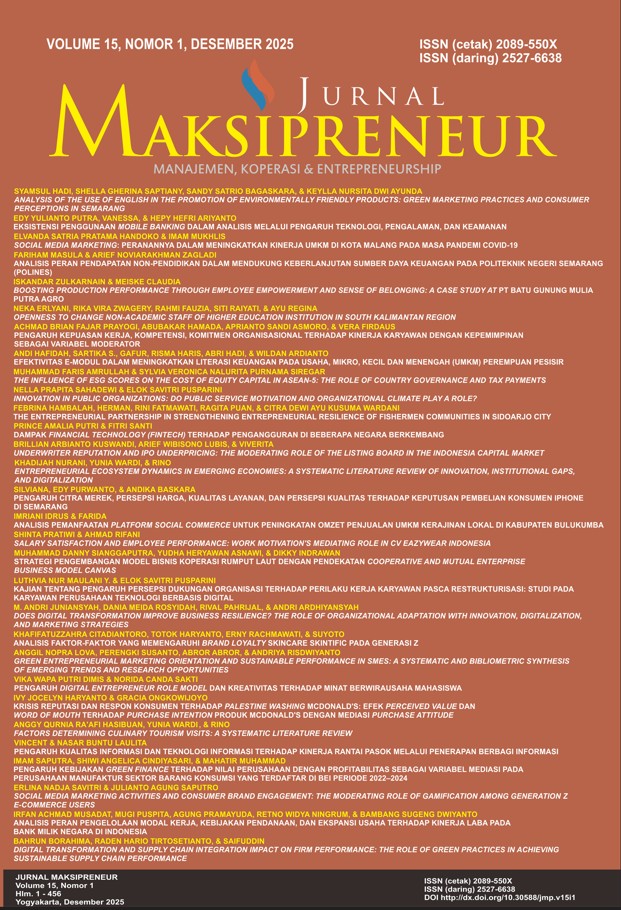
Openness to Change Non-Academic Staff of Higher Education Institution in South Kalimantan Region
DOI:
https://doi.org/10.30588/jmp.v15i1.1949Keywords:
openness to change, organizational trust, transformational leadership, transparent communication, non-academic staffAbstract
The competition in the global education market at the national level requires both public and private universities in the South Kalimantan region, as they must continue to strive to adapt to the demands of change and government policies if they want to survive. Enhancing services is essential for efficient university governance, particularly in the administrative domain. Traditionally performing routine work, non-academic staff must demonstrate an openness to change to fulfill changing service expectations. This study examines the variables that affect non-academic staff members' openness to change, emphasizing the functions of transformational leadership, transparent communication, and organizational trust. The research employs a quantitative design, with a cross-sectional survey design. The 251 participants were selected through purposive sampling. The instruments used include adapted scales such as the Openness to Change Scale, the Multifactor Leadership Questionnaire Form 5X-Short, the Transparent Communication Scale, and the Organizational Trust Inventory-Short Form. The multiple linear regression was utilized to analyze the data. The results show that transformational leadership, transparent communication, and organizational trust collectively affected openness to change, but only organizational trust individually affected openness to change. Therefore, these factors must be carefully considered and maintained to enhance non-academic staff's openness to change within universities.
References
Anardani, S., Riyanto, S., & Setiawan, D. (2021). Perancangan knowledge management system berbasis web pada tenaga kependidikan fakultas teknik Universitas PGRI Madiun. J. Teknol. Inf. dan Ilmu Komput, 8(1), 77. http://dx.doi.org/10.25126/jtiik.0813252
Anggreini, F., Hasyim, H., & Kusumapradja, R. (2022). Causality Analysis of Resistance to Change in Hospital: Transformational Leadership, Communication and Emotional Intelligence Approaches. European Journal of Business and Management Research, 7(2), 192−199. https://doi.org/10.24018/ejbmr.2022.7.2.1322
Asbari, M., Wijayanti, L. M., Hyun, C. C., Imelda, D., & Purwanto, A. (2020). Hard skills atau soft skills: Manakah yang lebih penting bagi inovasi guru. Edumaspul: Jurnal Pendidikan, 4(1), 1−20. https://doi.org/10.33487/edumaspul.v4i1.333
Asmoro, H., & Handoyo, S. (2021). Efek mediasi berbagi pengetahuan dalam kepemimpinan transformasional pada perilaku kerja inovatif karyawan rumah sakit. Ecopsy, 8(2), 95−108. https://dx.doi.org/10.20527/ecopsy.2021.03.009
Augustsson, H., Richter, A., Hasson, H., & Schwarz, U.T. (2017). The need for dual openness to change: A longitudinal study evaluating the impact of employees’ openness to organizational change content and process on intervention outcomes. The Journal of Applied Behavioral Science, 53(3), 349−368. https://doi.org/10.1177/0021886317691930
Azis, I. N., Sari, M. K., Tiara, R., Hoerudin, R., & Fardiah, D. (2022). Pribadi Yang Terbuka: Komunikasi interpersonal pekerja seks komersil di Saritem Bandung. Jurnal Communio: Jurnal Jurusan Ilmu Komunikasi, 11(2), 120−131. https://doi.org/10.35508/jikom.v11i2.6442
Basit, A., & Siddiqui, D. A. (2020). Authentic leadership and openness to change in Pakistani service industry: The mediating role of trust and transparent communication. Available at SSRN 3757483. https://dx.doi.org/10.2139/ssrn.3757483
Carter, M. Z., Armenakis, A. A., Feild, H. S., & Mossholder, K. W. (2013). Transformational leadership, relationship quality, and employee performance during continuous incremental organizational change. Journal of organizational behavior, 34(7), 942−958. https://doi.org/10.1002/job.1824
Chai, D. S., Song, J. H., & You, Y. M. (2020). Psychological ownership and openness to change: The mediating effects of work engagement, and knowledge creation. Performance Improvement Quarterly, 33(3), 305−326. https://doi.org/10.1002/piq.21326
Choi, M. (2011). Employees' attitudes toward organizational change: A literature review. Human Resource Management, 50(4), 479−500. https://doi.org/10.1002/hrm.20434
Cummings, L. L., & Bromiley, P. (1996). The Organizational Trust Inventory (OTI): Development and Validation. In R. M. Kramer & T. R. Tyler (Eds.), Trust in Organizations: Frontiers of Theory and Research, 302–330. Thousand Oaks, Sage. https://doi.org/10.4135/9781452243610.n15
Devos, G., Buelens, M., & Bouckenooghe, D. (2007). Contribution of content, context, and process to understanding openness to organizational change: Two experimental simulation studies. The Journal of Social Psychology, 147(6), 607−630. https://doi.org/10.3200/SOCP.147.6.607-630
Dinda, R. K., & Wahyuni, S. (2023, April). Peran mediasi kepercayaan organisasi dalam hubungan antara kepemimpinan transformasional, komunikasi transparan, dan openness to change studi pada karyawan milenial. In Seminar Nasional LPPM Ummat (Vol. 2). https://journal.ummat.ac.id/index.php/semnaslppm/article/view/14221
Erlyani, N., Ardi, R., & Suhariadi F. (2023). Openness to Change Scale in Higher Education: Adaptation and Validity of the Indonesia Version. Journal of Educational Analytics (JEDA), 2(4), 411−426. https://doi.org/10.55927/jeda.v2i4.6503
Erlyani, N., Suhariadi, F., & Ardi, R. (2024). Perceived impact of change as a mediating variable for change readiness in higher educational governance. Malaysian Journal of Learning and Instruction, 21(2), 321–348. https://doi.org/10.32890/mjli2024.21.2.11
Erlyani, N., Saphira, Y., Hartono, V. L., Justina, A., Zwagery, R. V., Suhariadi, F., & Ardi, R. (2024). Communication climate and organisational trust to readiness for change in higher education. SA Journal of Industrial Psychology, 50, 10. https://doi.org/10.4102/sajip.v50i0.2092
Erturk, A. (2008). A trust-based approach to promote employees’ openness to organizational change in turkey. International Journal of Manpower, 29(5), 462−483. https://doi.org/10.1108/01437720810888580
Gill, R. (2002). Change management−or change leadership? Journal of Change Management, 3(4), 307−318. https://doi.org/10.1080/714023845
Herold, D. M., Fedor, D. B., & Caldwell, S. D. (2007). Beyond change management: A multilevel investigation of contextual and personal influences on employees’ commitment to change. Journal of Applied Psychology, 92(4), 942−951. https://doi.org/10.1037/0021-9010.92.4.942
Holland, D., Krause, A., Provencher, J., & Seltzer, T. (2018). Transparency tested: The influence of message features on public perceptions of organizational transparency. Public Relations Review, 44(2), 256−264. https://doi.org/10.1016/j.pubrev.2017.12.002
Jati, I. R. A. P., Wijaya, H., & Pae, K. (2022). Dampak implementasi merdeka belajar kampus merdeka (MBKM) pada dosen, mahasiswa, dan tenaga kependidikan di Universitas Katolik Widya Mandala Surabaya. Eduka: Jurnal Pendidikan, Hukum, dan Bisnis, 7(1), 74−98. http://dx.doi.org/10.32493/eduka.v7i1.16787
Karlsson, S., & Ryttberg, M. (2016). Those who walk the talk: The role of administrative professionals in transforming universities into strategic actors. Nordic Journal of Studies in Educational Policy, 2016(2−3), 31537. https://doi.org/10.3402/nstep.v2.31537
Kim, J., Kang, S., & Lee, K. H. (2021). Evolution of digital marketing communication: Bibliometric analysis and network visualization from key articles. Journal of Business Research, 130, 552−563. https://doi.org/10.1016/j.jbusres.2019.09.043
Legi, H., Samosir, L., & Tambunan, L. L. (2023). Manajemen konflik dalam implementasi kurikulum merdeka di era digital. Nautical: Jurnal Ilmiah Multidisiplin Indonesia, 2(3), 196−203. https://doi.org/10.55904/nautical.v2i3.828
Li, M., Liu, W., Han, Y., & Zhang, P. (2016). Linking empowering leadership and change- oriented organizational citizenship behavior: The role of thriving at work and autonomy orientation. Journal of Organizational Change Management, 29(5), 732–750. https://doi.org/10.1108/JOCM-02-2015-0032
Lutz Allen, S., Smith, J. E., & Da Silva, N. (2013). Leadership Style in Relation to Organizational Change and Organizational Creativity: Perceptions from Nonprofit Organizational Members. Nonprofit Management & Leadership, 24(1), 23−42. https://doi.org/10.1002/nml.21078
Mahadi, N., Tamin, R. S. M., & Baskaran, S. (2020). Linking transparent communication and employees openness to change: Does recognition respect matter?. International Journal of Academic Research in Psychology, 7(1), 26–35. http://dx.doi.org/10.6007/IJARP/v7-i1/7164
Marshall, E. S. (2010). Transformational leadership in nursing: From expert clinician to influential leader. Springer Publishing Company.
Mascarenhas, C., Mendes, L., Marques, C., & Galvão, A. (2020). Exploring CSR’s influence on employees’ attitudes and behaviours in higher education. Sustainability Accounting, Management and Policy Journal, 11(4), 653−678. https://doi.org/10.1108/SAMPJ-04-2018-0101
Men, L. R. (2014). Internal reputation management: The impact of authentic leadership and transparent communication. Corporate Reputation Review, 17, 254−272. https://doi.org/10.1057/crr.2014.14
Men, L. R., & Bowen, S. (2017). Excellence in Internal Communication Management. Business Expert Press.
Miller, V. D., Johnson, J. R., & Grau, J. (1994). Antecedents to willingness to participate in a planned organizational change. Journal of Applied Communication Research, 22(1), 59−80. https://doi.org/10.1080/00909889409365387
Natalia, N., & Hidayat, D. (2021). Pengaruh servant leadership, iklim organisasi, dan kepuasan kerja terhadap kepercayaan organisasi guru [The effect of servant leadership, organization climate, and work satisfaction on organization trust of teachers]. Polyglot: Jurnal Ilmiah, 17(2), 232−250. https://doi.org/10.19166/pji.v17i2.1797
Nordin, N. (2012). The influence of leadership behavior and organizational commitment on organizational readiness for change in a higher learning institution. Asia Pacific Education Review, 13(2), 239−249. https://doi.org/10.1007/s12564-011-9200-y
Oreg, S., Vakola, M., & Armenakis, A. (2011). Change recipients’ reactions to organizational change: A sixty-year review of quantitative studies. Journal of Applied Behavioral Science, 47(4), 461−524. https://doi.org/10.1177/0021886310396550
Penava, S., & Šehić, D. (2014). The relevance of transformational leadership in shaping employee attitudes towards organizational change. Economic Annals, 59(200), 131−162. https://doi.org/10.2298/EKA1400131P
Peng, J., Li, M., Wang, Z., & Lin, Y. (2021). Transformational leadership and employees’ reactions to organizational change: Evidence from a meta-analysis. The Journal of applied behavioral science, 57(3), 369−397. https://doi.org/10.1177/0021886320920366
Peraturan Daerah Nomor 2 Tahun 2022 tentang Rencana Pembangunan Jangka Menengah Daerah Provinsi Kalimantan Selatan 2021-2026. Diakses dari: https://ppidutama.kalselprov.go.id/wp-content/uploads/2022/09/RPJMD-2021-2026-PROV-KALSEL-Plus-Perda.pdf
Portoghese, I., Galletta, M., Battistelli, A., Saiani, L., Penna, M. P., & Allegrini, E. (2012). Change‐related expectations and commitment to change of nurses: The role of leadership and communication. Journal of Nursing Management, 20(5), 582−591. https://doi.org/10.1111/j.1365-2834.2011.01322.x
Rawlins, B. (2008). Give the Emperor a Mirror: Toward Developing a Stakeholder Measurement of Organizational Transparency. Journal of Public Relations Research, 21(1), 71–99. https://doi.org/10.1080/10627260802153421
Sari, P. O. (2018). Pengaruh gaya kepemimpinan transformasional, komitmen afektif, komitmen kontinuans dan komitmen normatif terhadap kesiapan berubah (Studi pada Bank BRI kantor wilayah Yogyakarta). EXERO: Journal of Research in Business and Economics, 1(1), 68−89. DOI: https://doi.org/10.24071/exero.v1i1.1662
Schnackenberg, A. K., & Tomlinson, E. C. (2016). Organizational transparency: A new perspective on managing trust in organization-stakeholder relationships. Journal of management, 42(7), 1784−1810. https://doi.org/10.1177/014920631452520
Seppala, T., Lipponen, J., Bardi, A., & Pirttia-Backman, A. (2012). Change-oriented organizational citizenship behaviour: An interactive product of openness to change values, work unit identification, and sense of power. Journal of Occupational and Organizational Psychology, 85(1), 136−155. https://doi.org/10.1111/j.2044-8325.2010.02010.x
Shah, S. I., Afsar, B., & Shahjehan, A. (2020). Unique Contextual Conditions Affecting Coworker Knowledge Sharing and Employee Innovative Work Behaviors. Journal of Work and Organizational Psychology, 36(2), 125−134. https://doi.org/10.5093/jwop2020a12
Sinval, J., Miller, V., & Marôco, J. (2021). Openness toward organizational change scale (OTOCS): Validity evidence from Brazil and Portugal. Plos one, 16(4), e0249986. https://doi.org/10.1371/journal.pone.0249986
Streb, J. (2016). Openness, transformational leadership, and individual change readiness. A Theses by Master of Science, Department of Human Resources Development, Towson University. Retrieved from: https://mdsoar.org/items/3da66a61-9644-4b24-aec1-9a3a17364da8
Syahrial, Y., & Ananto, E. G. (2022). Pengaruh komunikasi simentris, komunikasi transparan pada isu vaksin Covid 19 terhadap hubungan pemerintah-warga negara. Humantech: Jurnal Ilmiah Multidisiplin Indonesia, 2(Special Issue 2), 579−598. https://doi.org/10.36418/jurnalsostech.v2i3.307
Thakur, R. R. & Srivastava, S. (2018). From resistance to readiness: Role of mediating variables. Journal of Organizational Change Management, 31(1), 230−247. https://doi.org/10.1108/JOCM-06-2017-0237
Verburg, R. M., Nienaber, A. M., Searle, R. H., Weibel, A., Den Hartog, D. N., & Rupp, D. E. (2018). The role of organizational control systems in employees’ organizational trust and performance outcomes. Group & organization management, 43(2), 179−206. https://doi.org/10.1177/1059601117725191
Wanberg, C. R., & Banas, J. T. (2000). Predictors and outcomes of openness to changes in a reorganizing workplace. Journal of Applied Psychology, 85(1), 132. https://doi.org/10.1037/0021-9010.85.1.132
Workeneh, M. M., & Abebe, A. S. (2019). Employee readiness to change and its determinants in administrative staff of bahir dar university in ethiopia. Human Resource Management Research, 9(9), 1−9. http://article.sapub.org/10.5923.j.hrmr.20190901.01.html
Yue, C. A., & Walden, J. (2023). Guiding employees through the COVID‐19 pandemic: An exploration of the impact of transparent communication and change appraisals. Journal of Contingencies and Crisis Management, 31(2), 198−211. https://doi.org/10.1111/1468-5973.12430
Yue, C. A., Men, L. R., & Ferguson, M. A. (2019). Bridging transformational leadership, transparent communication, and employee openness to change: The mediating role of trust. Public Relations Review, 45(3), 101779. https://doi.org/10.1016/j.pubrev.2019.04.012
Zainab, B., Akbar, W., & Siddiqui, F. (2022). Impact of transformational leadership and transparent communication on employee openness to change: Mediating role of employee organization trust and moderated role of change-related self-efficacy. Leadership & Organization Development Journal, 43(1), 1−13. https://doi.org/10.1108/LODJ-08-2020-0355
Downloads
Published
How to Cite
Issue
Section
License
Copyright (c) 2025 Neka Erlyani, Rika Vira Zwagery, Rahmi Fauzia, Siti Raiyati, Ayu Regina

This work is licensed under a Creative Commons Attribution 4.0 International License.
Authors who publish with Jurnal Maksipreneur agree to the following terms:
Authors retain copyright and grant the Jurnal Maksipreneur right of first publication with the work simultaneously licensed under a Creative Commons Attribution 4.0 International License that allows others to share (copy and redistribute the material in any medium or format) and adapt (remix, transform, and build upon the material) the work for any purpose, even commercially with an acknowledgment of the work's authorship and initial publication in Jurnal Maksipreneur.
Authors are able to enter into separate, additional contractual arrangements for the non-exclusive distribution of the journal's published version of the work (e.g., post it to an institutional repository or publish it in a book), with an acknowledgment of its initial publication in Jurnal Maksipreneur. Authors are permitted and encouraged to post their work online (e.g., in institutional repositories or on their website) prior to and during the submission process, as it can lead to productive exchanges, as well as earlier and greater citation of published work (See The Effect of Open Access).