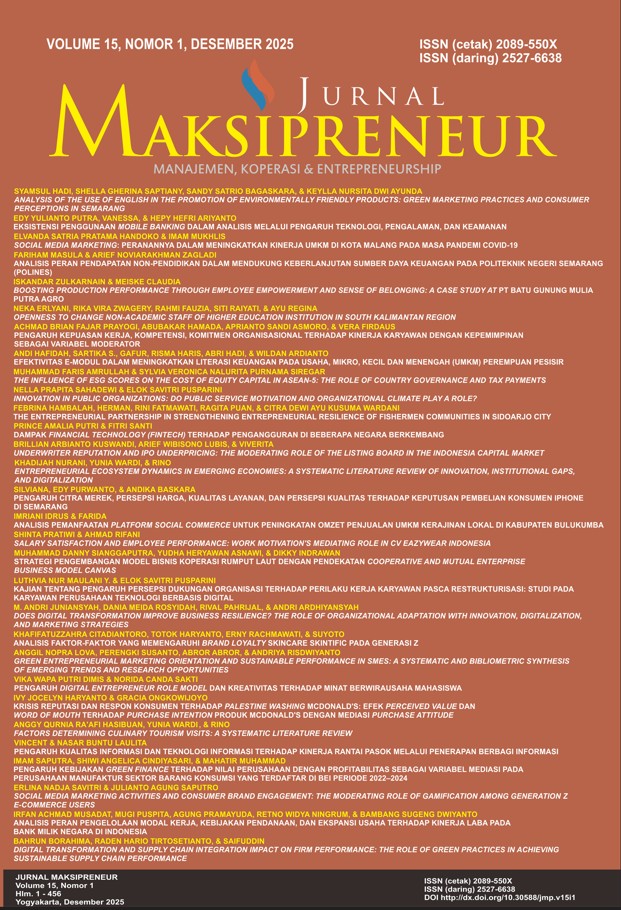
Analysis of the Use of English in the Promotion of Environmentally Friendly Products: Green Marketing Practices and Consumer Perceptions in Semarang
DOI:
https://doi.org/10.30588/jmp.v15i1.1937Keywords:
Promotion, Perception, Green marketing, Consumer, EnglishAbstract
This investigation examines consumer perceptions and green marketing practices in Semarang, with a particular emphasis on the use of English in promoting environmentally responsible products. Interviews with company representatives and focus group discussions with consumers are employed as qualitative research methods. The research indicates that companies have implemented a diverse array of green marketing practices; however, there are still deficiencies in their consistent and effective implementation. Green marketing practices are generally well-received by consumers, who are influenced by factors such as environmental awareness, prices, product quality, and confidence in companies' environmentally friendly claims. Diverse perceptions are generated by the utilization of English in promotional materials, with some individuals expressing apprehensions regarding potential confusion, while others find it effective in improving the product's image. The study enhances comprehension of ecological marketing strategies, and the necessity of more balanced approaches and integrated strategies in marketing communication is underscored, as well as consumer perceptions in Indonesia. Theoretical implications encompass the necessity of incorporating contextual factors into global marketing theory and the endorsement of the theory of planned behavior. The research's limitations include the necessity for further exploration and the limited generalization, as well as recommendations for future research.
References
Aisyah, S., & Syarfan, L. O. (2015). Analisis persepsi konsumen terhadap kualitas produk. Jurnal Valuta, 1(2), 336–352. https://journal.uir.ac.id/index.php/valuta/article/download/1285/809.
Ajzen, I. (1991). The theory of planned behavior. Organizational Behavior and Human Decision Processes, 50(2), 179–211. https://doi.org/10.1016/0749-5978(91)90020-T
Alcántara-Pilar, J. M., del Barrio-García, S., Crespo-Almendros, E., & Porcu, L. (2018). Toward an understanding of online information processing in e-commerce: The moderating role of need for cognition. Journal of Business Research, 87, 66–73.
Braun, V., & Clarke, V. (2006). Using thematic analysis in psychology. Qualitative Research in Psychology, 3(2), 77–101.
Campbell, B. A., Kryscynski, D., & Olson, D. M. (2017). Bridging Strategic Human Capital and Employee Entrepreneurship Research: A Labor Market Frictions Approach. Strategic Entrepreneurship Journal, 11(3), 344–356. https://doi.org/10.1002/sej.1264
Casalegno, C., Candelo, E., & Santoro, G. (2022). Exploring the Antecedents of Green and Sustainable Purchase Behaviour: A Comparison Among Different Generations. Psychology and Marketing, 39(5), 1007–1021. https://doi.org/10.1002/mar.21637
Cox, G. W. (2015). Marketing Sovereign Promises: The English Model. The Journal of Economic History, 75(1), 190–218. https://doi.org/10.1017/S0022050715000078
Creswell, J. W., & Poth, C. N. (2018). Qualitative inquiry and research design: Choosing among five approaches (4th ed.). SAGE Publications.
Dangelico, R. M., & Vocalelli, D. (2017). “Green Marketing”: An analysis of definitions, strategy steps, and tools through a systematic review of the literature. Journal of Cleaner Production, 165, 1263–1279.
Fuentes, C. (2015). How green marketing works: Practices, materialities, and images. Scandinavian Journal of Management, 31(2), 192–205.
Gerritsen, M., Nickerson, C., van Hooft, A., van Meurs, F., Korzilius, H., Nederstigt, U., Starren, M., & Crijns, R. (2010a). English in product advertisements in non-English-speaking countries in Western Europe: Product image and comprehension of the text. Journal of Global Marketing, 23(4), 349–365.
Gerritsen, M., Nickerson, C., van Hooft, A., van Meurs, F., Korzilius, H., Nederstigt, U., Starren, M., & Crijns, R. (2010b). English in Product Advertisements in Non-English-Speaking Countries in Western Europe: Product Image and Comprehension of the Text. Journal of Global Marketing, 23(4), 349–365. https://doi.org/10.1080/08911762.2010.504523
Ghozali, M., Sumarwan, U., & Handayani, W. (2020). Factors influencing customers’ intention to purchase eco-friendly products. Jurnal Aplikasi Manajemen dan Bisnis, 6(2), 341–353.
Guiyu, D., & Yi, C. (2017). Application of Case-Task Based Approach in Business English Teaching—A Case Study of the Marketing Course in SEIB of GDUFS. Higher Education Studies, 7(1), 23. https://doi.org/10.5539/hes.v7n1p23
Gunarathne, N., & Lee, K.-H. (2015). Environmental Management Accounting (EMA) for environmental management and organizational change. Journal of Accounting & Organizational Change, 11(3), 362–383. https://doi.org/10.1108/JAOC-10-2013-0078
Gupta, S., & Kumar, V. (2013). Sustainability as corporate culture of a brand for superior performance. Journal of World Business, 48(3), 311–320.
Hadi, S., Satato, Y. R., & Ainan, M. (2022). Studi Strategi Pemasaran Selama Masa Pandemi Covid 19 Pada UMKM Olahan Tempe Semarang. E-Bisnis: Jurnal Ilmiah Ekonomi dan Bisnis, 15(2), 375–381.
Handayani, W. (2017a). Green Consumerism : an Eco-Friendly Behaviour Form Through The Green Product Consumption and Green Marketing. Sinergi: Jurnal Ilmiah Ilmu Manajemen, 7(2). https://doi.org/10.25139/sng.v7i2.364
Handayani, W. (2017b). Green consumerism: an eco-friendly behaviour form through the green product consumption and green marketing. Sinergi: Jurnal Ilmiah Ilmu Manajemen, 7(2), 25–29.
Hartmann, P., & Apaolaza-Ibáñez, V. (2012). Consumer attitude and purchase intention toward green energy brands: The roles of psychological benefits and environmental concern. Journal of Business Research, 65(9), 1254–1263. https://doi.org/10.1016/j.jbusres.2011.11.001
Haryanti, D. M., & Subriadi, A. P. (2022). The effectiveness of social media marketing campaigns for eco-friendly products: A systematic literature review. Journal of Indonesian Economy and Business, 37(1), 1–15.
Hossain, T. M. T., Akter, S., Kattiyapornpong, U., & Dwivedi, Y. K. (2019). Multichannel integration quality: A systematic review and agenda for future research. Journal of Retailing and Consumer Services, 49, 154–163. https://doi.org/10.1016/j.jretconser.2019.03.019
Kemper, J. A., & Ballantine, P. W. (2019). What do we mean by sustainability marketing? Journal of Marketing Management, 35(3), 277–309.
Kotler, P., & Keller, K. L. (2016). Marketing Management (15th ed.). Pearson Education.
Leonidou, E., Christofi, M., Vrontis, D., & Thrassou, A. (2020). An integrative framework of stakeholder engagement for innovation management and entrepreneurship development. Journal of Business Research, 119, 245–258. https://doi.org/10.1016/j.jbusres.2018.11.054
Lestari, S. O., Hamzah, D., & Ramadhani, D. (2019). The use of English on Instagram captions of Indonesian Selebgrams. Advances in Social Science, Education and Humanities Research, 276, 245–248.
Mahmoud, T. O. (2018). Impact of Green Marketing Mix on Purchase Intention. International Journal of Advanced and Applied Sciences, 5(2), 127–135. https://doi.org/10.21833/ijaas.2018.02.020
Mishra, P., & Sharma, P. (2014). Green marketing: Challenges and opportunities for business. BVIMR Management Edge, 7(1), 78–86.
Neely, A., Adams, C., & Crowe, P. (2001). The performance prism in practice. Measuring Business Excellence, 5(2), 6–13. https://doi.org/10.1108/13683040110385142
Nguyen, A. T., Nguyen, T. H., & Nguyen, T. L. (2018). The effect of product quality on customer purchase intention: A case study of Vinamilk. Journal of Science Ho Chi Minh City Open University, 8(3), 103–115.
Papadas, K. K., Avlonitis, G. J., & Carrigan, M. (2017). Green marketing orientation: Conceptualization, scale development and validation. Journal of Business Research, 80, 236–246. https://doi.org/10.1016/j.jbusres.2017.05.024
Parguel, B., Benoît-Moreau, F., & Larceneux, F. (2011). How Sustainability Ratings Might Deter “Greenwashing”: A Closer Look at Ethical Corporate Communication. Journal of Business Ethics, 102(1), 15–28. https://doi.org/10.1007/s10551-011-0901-2
Patel, P. C., João Guedes, M., Pagano, M. S., & Olson, G. T. (2020). Industry profitability matters: The value of sustainable growth rate and distance from bankruptcy as enablers of venture survival. Journal of Business Research, 114, 80–92. https://doi.org/10.1016/j.jbusres.2020.04.004
Prabowo, B. A., & Saptiany, S. G. (2024). Exploration of Managerial Communication Styles and Employees’ Perceptions of Motivation and Performance. 3(1), 2829–3908. https://doi.org/10.56910/literacy.v3i1.1396
Rahbar, E., & Wahid, N. A. (2011). Investigation of green marketing tools’ effect on consumers’ purchase behavior. Business Strategy Series, 12(2), 73–83. https://doi.org/10.1108/17515631111114877
Rani, S., & Mishra, K. (2014). Green HRM: Practices and Strategic Implementation in the Organizations. International Journal on Recent and Innovation Trends in Computing and Communication, 2(11), 3633–3639.
Rusli, R. A., Budiono, A., Sakti, F. R., & Triana, D. (2020). Strategi pemasaran hijau (green marketing) dalam meningkatkan kepuasan pelanggan. Jurnal Ekonomi, 25(2), 244–260.
Sabaté-Dalmau, M. (2020). Marketing university students as mobile multilingual workers: the emergence of neoliberal lifestylers. International Journal of Multilingualism, 17(1), 11–29. https://doi.org/10.1080/14790718.2020.1682246
Santoro, G., Bresciani, S., Bertoldi, B., & Liu, Y. (2022). Cause-related marketing for successful cross-border post-acquisition performance: Exploring the moderating effects of cultural distance and communication. International Marketing Review, 39(5), 1017–1039.
Santoso, I., & Loisa, J. (2019). The use of English in Indonesian advertisements on television. K@ta, 21(2), 73–81.
Schmuck, D., Matthes, J., & Naderer, B. (2018). Misleading consumers with green advertising? An affect–reason–involvement account of greenwashing effects in environmental advertising. Journal of Advertising, 47(2), 127–145.
Setyawan, A., Noermijati, N., Sunaryo, S., & Aisjah, S. (2018). Green product buying intentions among young consumers: Extending the application of theory of planned behavior. Problems and Perspectives in Management, 16(2), 145–154.
Sharma, V., & Kushwaha, G. S. (2019). Eco-friendly product and green marketing: A study on consumers’ perception in India. International Journal of Green Economics, 13(1), 1–20.
Sheehan, M., Grant, K., & Garavan, T. (2018). Strategic talent management: A macro and micro analysis of current issues in hospitality and tourism. Worldwide Hospitality and Tourism Themes, 10(1), 28–41. https://doi.org/10.1108/WHATT-10-2017-0062
Sienatra, K. B., & Evani, E. S. (2021). Efek Green Marketing Mix terhadap Minat Beli Produk Ramah Lingkungan. Jurnal Manajemen Bisnis dan Kewirausahaan, 5(2), 220. https://doi.org/10.24912/jmbk.v5i2.10022
Stern, P. C., Dietz, T., Abel, T., Guagnano, G. A., & Kalof, L. (1999). A value-belief-norm theory of support for social movements: The case of environmentalism. Human Ecology Review, 6(2), 81–97.
Sugiyono, S. (2013). Metode Penelitian Manajemen. Bayu Media Publishing.
Sugiyono, S. (2018). Metode Penelitian Kombinasi. Alfabeta.
Susanto, H., & Sunardi. (2018). English in Indonesian outdoor signs. International Journal of Humanity Studies, 1(2), 234–244.
Taufique, K. M. R., Polonsky, M. J., Vocino, A., & Siwar, C. (2019). Measuring Consumer Understanding and Perception of Eco‐labelling: Item Selection and Scale Validation. International Journal of Consumer Studies, 43(3), 298–314. https://doi.org/10.1111/ijcs.12510
Usodo, H., Palupiningtyas, D., Agustina Deva PN, & Aland Satria AW. (2023). Intensi Berwisata Kuliner Kembali di Kota Semarang: Suatu Tinjauan Kepuasan Wisatawan. E-Bisnis: Jurnal Ilmiah Ekonomi dan Bisnis, 16(2), 437–451. https://doi.org/10.51903/e-bisnis.v16i2.1365
Valantina, I., & Niranjini, N. (2019). Contemporary CSR and green HRM practices by the organizations to attain sustainability in the millennial age. Emperor International Journal of Finance and Management Research, 1(2), 118–126.
Yadav, R., & Pathak, G. S. (2016). Young consumers’ intention towards buying green products in a developing nation: Extending the theory of planned behavior. Journal of Cleaner Production, 135, 732–739. https://doi.org/10.1016/j.jclepro.2016.06.120
Yulianto, H., Sutomo, Y., Palupiningtyas, D., & Nugraheni, K. S. (2022). Investigating the role of interactive social media and halal brand equity on purchase decision-making: Direct and indirect effects. Measuring Business Excellence, 26(4), 524–540. https://doi.org/10.1108/MBE-02-2021-0025
Yusiana, R., Widodo, A., & Sumarsih, U. (2021). Integration Consumer Response During the Pandemic Covid-19 on Advertising: Perception Study on Eco-labeling and Eco-brand Products Eco-care. Inclusive Society and Sustainability Studies, 1(2), 45–56. https://doi.org/10.31098/issues.v1i2.708
Downloads
Published
How to Cite
Issue
Section
License
Copyright (c) 2025 Syamsul Hadi, Shella Gherina Saptiany, Sandy Satrio Bagaskara, Keylla Nursita Dwi Ayunda

This work is licensed under a Creative Commons Attribution 4.0 International License.
Authors who publish with Jurnal Maksipreneur agree to the following terms:
Authors retain copyright and grant the Jurnal Maksipreneur right of first publication with the work simultaneously licensed under a Creative Commons Attribution 4.0 International License that allows others to share (copy and redistribute the material in any medium or format) and adapt (remix, transform, and build upon the material) the work for any purpose, even commercially with an acknowledgment of the work's authorship and initial publication in Jurnal Maksipreneur.
Authors are able to enter into separate, additional contractual arrangements for the non-exclusive distribution of the journal's published version of the work (e.g., post it to an institutional repository or publish it in a book), with an acknowledgment of its initial publication in Jurnal Maksipreneur. Authors are permitted and encouraged to post their work online (e.g., in institutional repositories or on their website) prior to and during the submission process, as it can lead to productive exchanges, as well as earlier and greater citation of published work (See The Effect of Open Access).