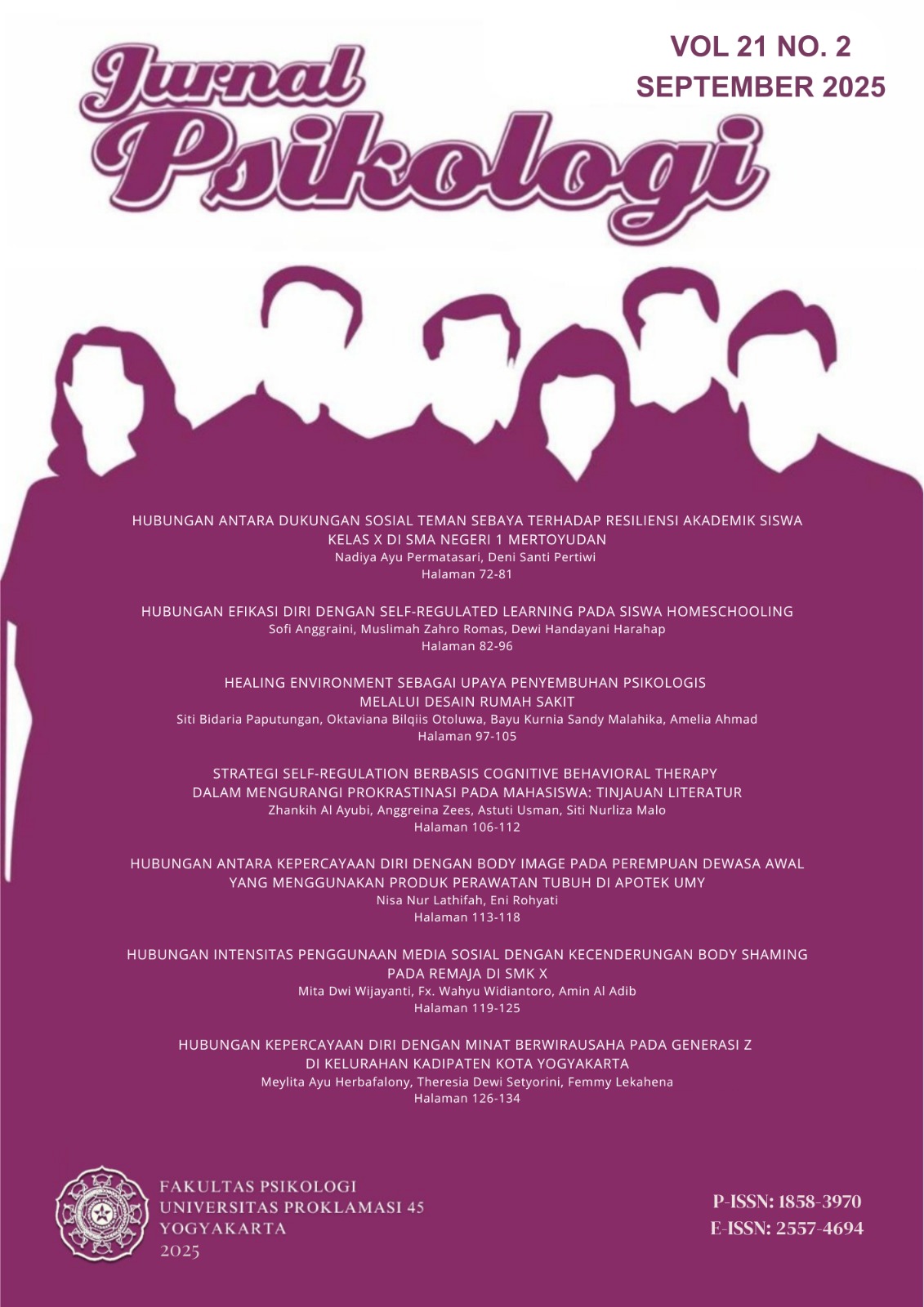
Strategi Self-Regulation Berbasis Cognitive Behavioral Therapy dalam Mengurangi Prokrastinasi pada Mahasiswa: Tinjauan Literatur
DOI:
https://doi.org/10.30588/jpsi.v21i2.2246Keywords:
Procrastination, university students, Cognitive Behavioral Therapy, self-regulation, counselingAbstract
Perkembangan teknologi digital telah memberikan dampak signifikan terhadap perilaku akademik mahasiswa, khususnya dalam meningkatkan kecenderungan prokrastinasi. Prokrastinasi bukan hanya kebiasaan buruk, melainkan masalah psikologis yang berkaitan dengan distorsi kognitif, manajemen waktu yang buruk, dan gangguan emosional. Artikel ini mengkaji pendekatan Cognitive Behavioral Therapy (CBT) sebagai strategi intervensi untuk mengatasi prokrastinasi akademik. CBT bekerja melalui restrukturisasi kognitif, teknik manajemen perilaku, dan self-monitoring guna mengubah pola pikir negatif menjadi pola pikir rasional dan membentuk kebiasaan produktif. Hasil tinjauan literatur menunjukkan bahwa CBT efektif dalam meningkatkan regulasi diri, mengurangi kecemasan akademik, dan mendorong keberhasilan studi mahasiswa. CBT direkomendasikan sebagai pendekatan konseling strategis yang dapat diterapkan di lingkungan pendidikan tinggi.
References
American Psychological Association. (2017). Ethical Principles of Psychologists and Code of Conduct. APA.
Bandura, A. (1986). Social Foundations of Thought and Action: A Social Cognitive Theory. Prentice Hall.
Beauchamp, T. L., & Childress, J. F. (2013). Principles of Biomedical Ethics (7th ed.). Oxford University Press.
Cirillo, F. (2018). The Pomodoro Technique: The Acclaimed Time-Management System That Has Transformed How We Work. Currency.
Cohen, S., Kamarck, T., & Mermelstein, R. (1983). A Global Measure of Perceived Stress. Journal of Health and Social Behavior, 24(4), 385–396. https://doi.org/10.2307/2136404
Corey, G. (2015). Theory and Practice of Counseling and Psychotherapy (10th ed.). Cengage Learning.
Covey, S. R. (2004). The 7 Habits of Highly Effective People: Powerful Lessons in Personal Change. Free Press.
Deci, E. L., & Ryan, R. M. (2000). The “What” and “Why” of Goal Pursuits: Human Needs and The Self-Determination of Behavior. Psychological Inquiry, 11(4), 227–268. https://doi.org/10.1207/S15327965PLI1104_01
Hidayat, R. (2019). Prokrastinasi dalam Pendidikan Tinggi: Faktor dan Solusi. Penerbit Universitas.
Kitchener, K. S. (1984). Intuition, Critical Evaluation, and Ethical Principles: The Foundation for Ethical Decisions in Counseling Psychology. The Counseling Psychologist, 12(3–4), 43–55. https://doi.org/10.1177/0011000084123005
Macan, T. H., Shahani, C., Dipboye, R. L., & Phillips, A. P. (1990). College Students’ Time Management: Correlations with Academic Performance and Stress. Journal of Educational Psychology, 82(4), 760–768. https://doi.org/10.1037/0022-0663.82.4.760
Pratama, Y. (2018). Strategi Mengatasi Malas Belajar dan Prokrastinasi. Pustaka Pelajar.
Puspitasari, N. (2021). Teknik Komunikasi Terapeutik dalam Konseling Mahasiswa. Gramedia Pustaka Utama.
Remley, T. P., & Herlihy, B. (2020). Ethical, Legal, and Professional Issues in Counseling (6th ed.). Pearson.
Sari, D., & Gunawan, A. (2020). Terapi Perilaku Kognitif untuk Prokrastinasi Mahasiswa. Jurnal Psikologi Indonesia, 15(2), 85–98. https://doi.org/10.22146/jpsi.2020.53592
Steel, P. (2007). The Nature of Procrastination: A Meta-Analytic and Theoretical Review of Quintessential Self-Regulatory Failure. Psychological Bulletin, 133(1), 65–94. https://doi.org/10.1037/0033-2909.133.1.65
Zimmerman, B. J., & Schunk, D. H. (2011). Self-Regulated Learning and Academic Achievement: Theoretical Perspectives. Routledge.
Downloads
Published
How to Cite
Issue
Section
License
Copyright (c) 2025 Zhankih Al Ayubi, Anggreina Zees, Astuti Usman, Siti Nurliza Malo

This work is licensed under a Creative Commons Attribution 4.0 International License.
Authors retain copyright and grant the Jurnal Psikologi right of first publication with the work simultaneously licensed under a Creative Commons Attribution 4.0 International License that allows others to share (copy and redistribute the material in any medium or format) and adapt (remix, transform, and build upon the material) the work for any purpose, even commercially with an acknowledgment of the work's authorship and initial publication in Jurnal Psikologi.
Authors are able to enter into separate, additional contractual arrangements for the non-exclusive distribution of the journal's published version of the work (e.g., post it to an institutional repository or publish it in a book), with an acknowledgment of its initial publication in Jurnal Psikologi. Authors are permitted and encouraged to post their work online (e.g., in institutional repositories or on their website) prior to and during the submission process, as it can lead to productive exchanges, as well as earlier and greater citation of published work (See The Effect of Open Access).