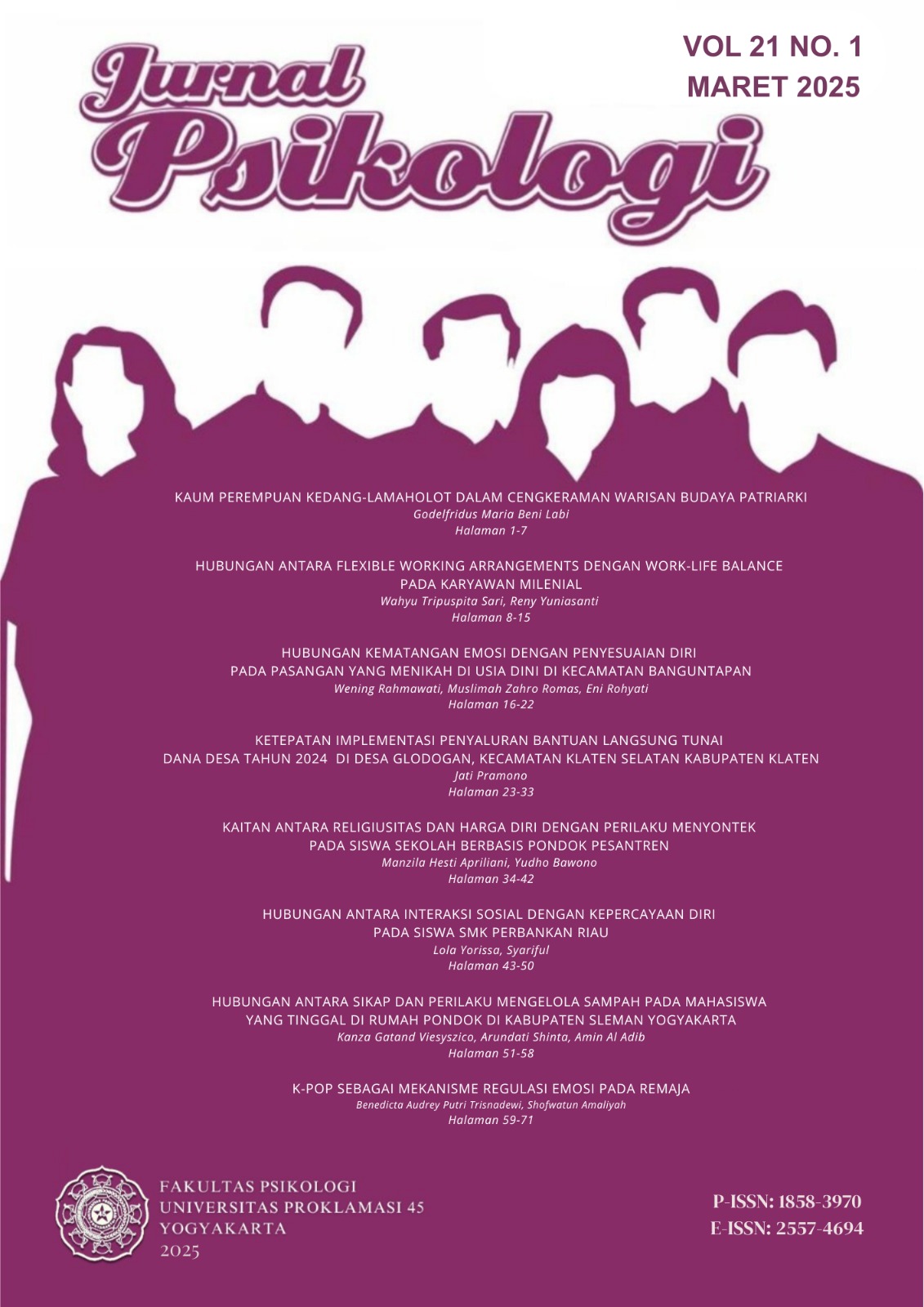
K-Pop sebagai Mekanisme Regulasi Emosi pada Remaja
DOI:
https://doi.org/10.30588/jpsi.v21i1.2394Keywords:
adolescents, emotion regulation, K-Pop, mental healthAbstract
The K-Pop phenomenon has become an important part of the lives of adolescents in various countries, including Indonesia. Music, concerts, and fandom activities not only serve as entertainment but can also be interpreted as one form of emotional regulation mechanism. This study aims to systematically review the role of K-Pop in supporting adolescent mental health, particularly through the Process Model of Emotion Regulation framework developed by Gross. The study found that adolescents' involvement in K-Pop is closely related to five emotion regulation strategies: situation selection, situation modification, attention deployment, cognitive change, and response modulation. Activities such as listening to K-Pop music, attending concerts, watching online contents, and interacting within fandom communities have been shown to help adolescents divert their attention from stress, build cognitive reinterpretations of negative experiences, and channel emotions adaptively. K-Pop can serve as a significant tool in supporting adolescent mental health, though parental guidance, educator support, and a balanced social environment remain essential to ensure its use is balanced.
References
Aldao, A., Nolen-Hoeksema, S., & Schweizer, S. (2010). Emotion-regulation strategies across psychopathology: A meta-analytic review. Clinical Psychology Review, 30(2), 217–237. https://doi.org/10.1016/j.cpr.2009.11.004
Amalia, N. R., Rejeki, A., & Wicaksono, A. S. (2024). Emotion Focused Coping pada Penggemar K-Pop yang Fanatik. Comit: Communication, Information and Technology Journal, 2(2). https://doi.org/10.47467/comit.v2i2.4722
Angela, L. (2024). From Screens to Souls: Parasocial Relationship, Belongingness, and Zest for Life Among Emerging Adulthood K-pop Fans. The Asian Conference on Psychology & the Behavioral Sciences 2024 Official Conference Proceedings, 203–215. https://doi.org/10.22492/issn.2187-4743.2024.18
Boelens, E., Van Beveren, M.-L., De Raedt, R., Verbeken, S., & Braet, C. (2021). Are Emotion Regulation Strategies Associated With Visual Attentional Breadth for Emotional Information in Youth? Frontiers in Psychology, 12. https://doi.org/10.3389/fpsyg.2021.637436
Chen, L. (2023). Influence of music on the hearing and mental health of adolescents and countermeasures. Frontiers in Neuroscience, 17. https://doi.org/10.3389/fnins.2023.1236638
Choi, H. (2024). Do K-Pop Consumers’ Fandom Activities Affect Their Happiness, Listening Intention, and Loyalty? Behavioral Sciences, 14(12), 1136. https://doi.org/10.3390/bs14121136
Chong, H. J., Kim, H. J., & Kim, B. (2024). Scoping Review on the Use of Music for Emotion Regulation. Behavioral Sciences, 14(9), 793. https://doi.org/10.3390/bs14090793
Dewi, W. P., & Puspita, W. D. (2024). A Descriptive Study on Attitudes toward Seeking Professional Psychological Help among Emerging Adults in a K-pop Fan Community. Developmental and Clinical Psychology, 5(1), 41–55. https://doi.org/10.15294/dcp.v5i1.6207
Fauziyah, L. N., Widiana, H. S., & Widyowati, A. (2024). Loneliness and psychological well-being among adolescents K-Pop fans. Empathy : Jurnal Fakultas Psikologi, 6(2), 159. https://doi.org/10.12928/empathy.v6i2.26151
Fernández-Company, J. F., García-Rodríguez, M., & Gamella González, D. J. (2024). Regulación del estado de ánimo a través de la música en la adolescencia. European Public & Social Innovation Review, 9, 1–18. https://doi.org/10.31637/epsir-2024-1363
Ferri, J., Schmidt, J., Hajcak, G., & Canli, T. (2016). Emotion regulation and amygdala-precuneus connectivity: Focusing on attentional deployment. Cognitive, Affective, & Behavioral Neuroscience, 16(6), 991–1002. https://doi.org/10.3758/s13415-016-0447-y
Galderisi, S., Heinz, A., Kastrup, M., Beezhold, J., & Sartorius, N. (2015). Toward a new definition of mental health. World Psychiatry, 14(2), 231. https://doi.org/10.1002/WPS.20231
Gross, J. J. (1998). The Emerging Field of Emotion Regulation: An Integrative Review. Review of General Psychology, 2(3), 271–299. https://doi.org/10.1037/1089-2680.2.3.271
Gross, J. J. (2002). Emotion regulation: Affective, cognitive, and social consequences. Psychophysiology, 39(3), 281–291. https://doi.org/10.1017/S0048577201393198
Gross, J. J. (2015). Emotion Regulation: Current Status and Future Prospects. Psychological Inquiry, 26(1), 1–26. https://doi.org/10.1080/1047840X.2014.940781
Gross, J. J., & Ford, B. Q. (2023). Handbook of Emotion Regulation (3rd ed.). Guilford Publications.
Gross, J. J., & John, O. P. (2003). Individual differences in two emotion regulation processes: Implications for affect, relationships, and well-being. Journal of Personality and Social Psychology, 85(2), 348–362. https://doi.org/10.1037/0022-3514.85.2.348
Hoffner, C. A., & Bond, B. J. (2022). Parasocial relationships, social media, & well-being. Current Opinion in Psychology, 45, 101306. https://doi.org/10.1016/j.copsyc.2022.101306
James, S. (2025). Affective Participation From the In-Between: The Platformization of K-Pop Fandom. Social Media + Society, 11(2). https://doi.org/10.1177/20563051251351390
Kementrian Kesehatan Republik Indonesia. (2023). Survei Kesehatan Indonesia 2023 Dalam Angka.
Kim, M. S., Wang, S., & Kim, S. (2023). Effects of Online Fan Community Interactions on Well-Being and Sense of Virtual Community. Behavioral Sciences, 13(11), 897. https://doi.org/10.3390/bs13110897
Klein, R. J., Nguyen, N. D., Gyorda, J. A., & Jacobson, N. C. (2022). Adolescent Emotion Regulation and Future Psychopathology: A Prospective Transdiagnostic Analysis. Journal of Research on Adolescence, 32(4), 1592–1611. https://doi.org/10.1111/jora.12743
Kulinski, J., Ofori, E. K., Visotcky, A., Smith, A., Sparapani, R., & Fleg, J. L. (2022). Effects of music on the cardiovascular system. Trends in Cardiovascular Medicine, 32(6), 390–398. https://doi.org/10.1016/j.tcm.2021.06.004
Leung, M. C., & Cheung, R. Y. M. (2020). Music engagement and well-being in Chinese adolescents: Emotional awareness, positive emotions, and negative emotions as mediating processes. Psychology of Music, 48(1), 105–119. https://doi.org/10.1177/0305735618786421
Lou, R. S. (2024). K-Pop as a Stress-Relief Mechanism Exploring Its Emotional Impact on Filipino Youth. Journal of Research in Social Science and Humanities, 3(12), 1–10. https://doi.org/10.56397/JRSSH.2024.12.01
Loureiro, C., Van der Meulen, K., & Del Barrio, C. (2024). Why I listen to music: Emotion regulation and identity construction through music in mid-adolescence. Empiria. Revista de Metodología de Ciencias Sociales, 60, 145–168. https://doi.org/10.5944/empiria.60.2024.39285
Marzali, A. (2016). Menulis Kajian Literatur. Jurnal Etnosia, 1(2), 27–36.
McRae, K., & Gross, J. J. (2020). Emotion regulation. Emotion, 20(1), 1–9. https://doi.org/10.1037/emo0000703
O’Bryan, E. M., Kraemer, K. M., Johnson, A. L., McLeish, A. C., & McLaughlin, L. E. (2017). Examining the role of attentional control in terms of specific emotion regulation difficulties. Personality and Individual Differences, 108, 158–163. https://doi.org/10.1016/j.paid.2016.12.015
Peters, V., Bissonnette, J., Nadeau, D., Gauthier-Légaré, A., & Noël, M.-A. (2024). The impact of musicking on emotion regulation: A systematic review and meta-analysis. Psychology of Music, 52(5), 548–568. https://doi.org/10.1177/03057356231212362
Pizarro, J. J., Zumeta, L. N., Bouchat, P., Włodarczyk, A., Rimé, B., Basabe, N., Amutio, A., & Páez, D. (2022). Emotional processes, collective behavior, and social movements: A meta-analytic review of collective effervescence outcomes during collective gatherings and demonstrations. Frontiers in Psychology, 13. https://doi.org/10.3389/fpsyg.2022.974683
Saarikallio, S. (2011). Music as emotional self-regulation throughout adulthood. Psychology of Music, 39(3), 307–327. https://doi.org/10.1177/0305735610374894
Sharma, M. (2023). Effect of KPOP Music on the Individuals’ Anxiety Symptoms and Emotional Regulation. The International Journal of Indian Psychology, 11(1). https://doi.org/10.25215/1101.076
Shu, S. (2022, March 28). Mental Health Awareness: Its Significance and Impact on Teenagers. Voices of Youth. https://www.voicesofyouth.org/blog/mental-health-awareness-its-significance-and-impact-teenagers
Trost, W., Trevor, C., Fernandez, N., Steiner, F., & Frühholz, S. (2024). Live music stimulates the affective brain and emotionally entrains listeners in real time. Proceedings of the National Academy of Sciences, 121(10). https://doi.org/10.1073/pnas.2316306121
Troy, A. S., Shallcross, A. J., Brunner, A., Friedman, R., & Jones, M. C. (2018). Cognitive reappraisal and acceptance: Effects on emotion, physiology, and perceived cognitive costs. Emotion, 18(1), 58–74. https://doi.org/10.1037/emo0000371
Wadlinger, H. A., & Isaacowitz, D. M. (2011). Fixing Our Focus: Training Attention to Regulate Emotion. Personality and Social Psychology Review, 15(1), 75–102. https://doi.org/10.1177/1088868310365565
World Health Organization. (2024, October 10). Mental health of adolescents. https://www.who.int/news-room/fact-sheets/detail/adolescent-mental-health
Zaini. (2023). GLOBALISASI MUSIK POPULER KOREA (K-POP) DALAM KONTEKS INDUSTRI BUDAYA. MULTIKULTURA, 2(3). https://doi.org/10.7454/multikultura.v2i3.1059
Downloads
Published
How to Cite
Issue
Section
License
Copyright (c) 2025 Benedicta Audrey Putri Trisnadewi, Shofwatun Amaliyah

This work is licensed under a Creative Commons Attribution 4.0 International License.
Authors retain copyright and grant the Jurnal Psikologi right of first publication with the work simultaneously licensed under a Creative Commons Attribution 4.0 International License that allows others to share (copy and redistribute the material in any medium or format) and adapt (remix, transform, and build upon the material) the work for any purpose, even commercially with an acknowledgment of the work's authorship and initial publication in Jurnal Psikologi.
Authors are able to enter into separate, additional contractual arrangements for the non-exclusive distribution of the journal's published version of the work (e.g., post it to an institutional repository or publish it in a book), with an acknowledgment of its initial publication in Jurnal Psikologi. Authors are permitted and encouraged to post their work online (e.g., in institutional repositories or on their website) prior to and during the submission process, as it can lead to productive exchanges, as well as earlier and greater citation of published work (See The Effect of Open Access).