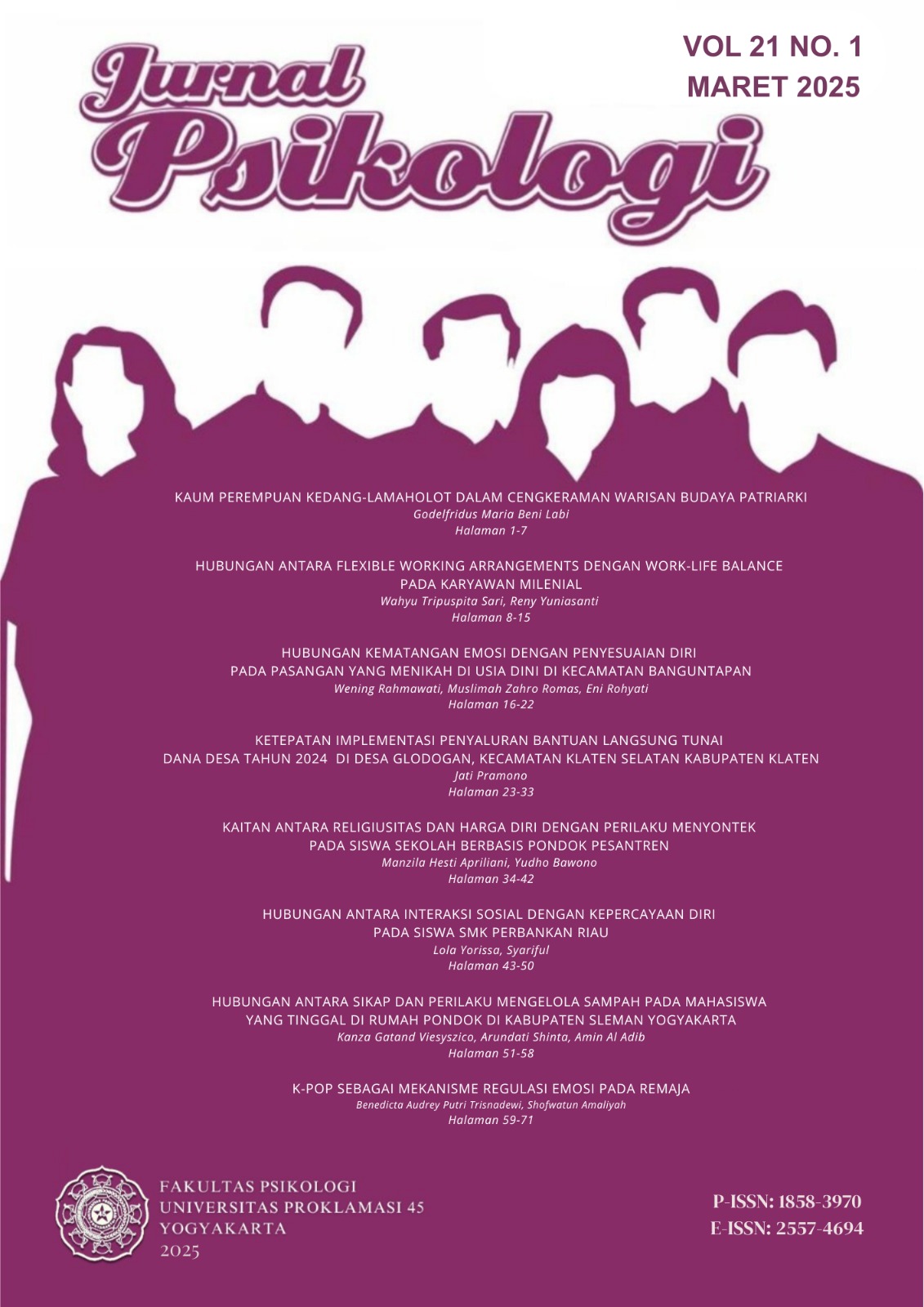
Hubungan Antara Interaksi Sosial Dengan Kepercayaan Diri Pada Siswa SMK Perbankan Riau
DOI:
https://doi.org/10.30588/jpsi.v21i1.2190Keywords:
social interaction, confident, studentAbstract
This study aims to find out empirically the relationship between social interaction and students confidence in vocational high school banking Riau. The hypothesis is that there is a positive relationship between social interaction and students confidence in vocational high school banking Riau. This means that the higher the social interaction, the higher the self-confidence. Vice versa, the lower the social interaction, the lower the self-confidence. The subjects in this study were 100 subjects of middle adolescent age 15-18 years. The sampling technique used is a purposive sample using a social interaction scale and a self-confidence scale. Based on the data analysis, the correlation coefficient value was 0.625 with p value = 0.000 (p <0.01), meaning that there was a significant positive the relationship between social interaction and students confidence in vocational high school banking Riau.
References
Ahmadi, A. (2007). Psikologi Sosial. Jakarta: Rineka Cipta.
Ali, M. & Asrori, M. (2014). Psikologi Remaja perkembangan peserta didik. Jakarta: PT Bumi Askara.
Arianti, Rosra & Oktariana. (2019). Hubungan antara percaya diri dengan interaksi sosial siswa SMK Darul Fikri kecamatan pugung kabupaten tanggamus. Jurnal sosial
Azwar, S. (2018).Penyusunan Skala Psikologi. Yogyakarta: Pustaka Pelajar.
Daradjat, Z. (2007). Kesehatan Mental. Jakarta: Gunung Agung.
Barbara. (2003). Confidenence-Percaya Diri Sumber Sukses dan Kemandirian. Jakarta: Gramedia Pustaka.
Fatimah, E. (2010). Psikologi Perkembangan (Perkembangan Peserta Didik). Bandung: Pustaka Setia.
Gerungan, W.A. (2006). Psikologi Sosial. Bandung: Refika Aditama.
Ghufron, M. N & Risnawita, S. (2012). Teori-Teori Psikologi. Jogjakarta: Ar-ruzz Media.
Hadi. (2016). Metodelogi Riset. Yogyakarta: Pustaka Pelajar
Hurlock, Elizabeth B.. 2003 Psikologi Perkembangan. Jakarta. Erlangga.
Khadijah (2011). Kemampuan Interaksi Sosial Siswa Dan Pengembangannya Oleh Guru Pembimbing. Jurnal
Pratiwi , Purwaningsihi, dan Cahyani (2020). Hubungan Antara Kepercayaan Diri Dengan Kemampuan Berinteraksi Sosial Pada Siswa Di Smkn 4 Yogyakarta. Jurnal Yogyakarta
Purwadi. (2004). Peroses pembentukan identitas diri remaja. Jurnal Psychologyca, 1(1), 43-52.
Riyadi. (2016). Materi Layanan Klasikal Bimbingan & Konseling untuk SMK. Yogyakarta: Paramitra Publishing.
Sahputra. (2018). Kontribusi kepercayaan diri terhadap interaksi sosial siswa. Jurnal Wahana Didaktika, 16 (1), 1-6.
Santoso, S. (2010). Teori-teori psikologi sosial. Yogyakarta: Reflika Aditama
Santrock, Jhon, W. (2007). Remaja jilid 2. Terjemahan oleh Sherly Saragih. Jakarta: Erlangga.
Santosa, Slamet, 2004. Dinamika Kelompok. Jakarta: Bumi Aksara
Sarwono, Sarlito W. (2016). Pengantar Psikologi Umum. Jakarta: Rajawali Pers
Siska, Sudarjo, & Purmaningsih. (2003). Kepercayaan diri dan kecemasan komunikasi interpersonal pada mahasiswa. Jurnal Psikologi, 02, 67 – 71.
Soekanto, S. 2012. Sosiologi suatu pengantar. Jakarta: Rajawali.
Yuli , Sarbudin , Irham , & Faijin. (2022). Hubungan Antara Interaksi Sosial Teman Sebaya Dengan Kepercayaan Diri Remaja Di Sekolah Menengah Kejuruan Negeri 3 Kota Bima. Jurnal Bimbingan dan Konseling, 05, 01.
Walgito, B. (2007). Bimbingan dan Konseling. (Studi dan Karir). Yogyakarta: Andi
Downloads
Published
How to Cite
Issue
Section
License
Copyright (c) 2025 Lola Yorissa, Syariful

This work is licensed under a Creative Commons Attribution 4.0 International License.
Authors retain copyright and grant the Jurnal Psikologi right of first publication with the work simultaneously licensed under a Creative Commons Attribution 4.0 International License that allows others to share (copy and redistribute the material in any medium or format) and adapt (remix, transform, and build upon the material) the work for any purpose, even commercially with an acknowledgment of the work's authorship and initial publication in Jurnal Psikologi.
Authors are able to enter into separate, additional contractual arrangements for the non-exclusive distribution of the journal's published version of the work (e.g., post it to an institutional repository or publish it in a book), with an acknowledgment of its initial publication in Jurnal Psikologi. Authors are permitted and encouraged to post their work online (e.g., in institutional repositories or on their website) prior to and during the submission process, as it can lead to productive exchanges, as well as earlier and greater citation of published work (See The Effect of Open Access).