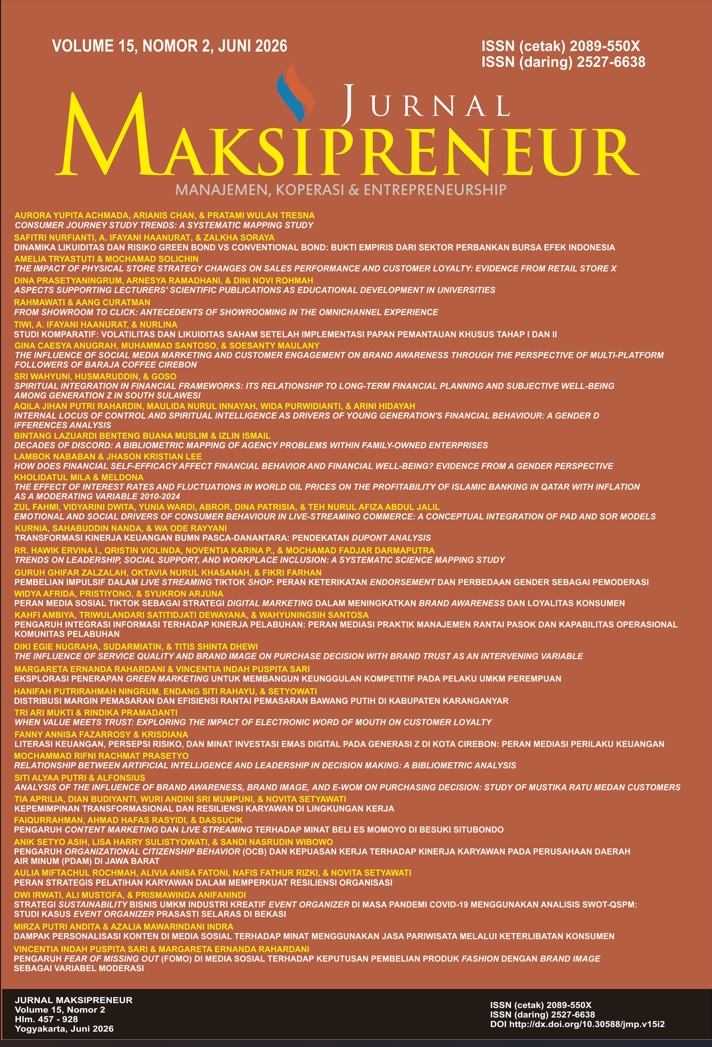
Pengaruh Integrasi Informasi terhadap Kinerja Pelabuhan: Peran Mediasi Praktik Manajemen Rantai Pasok dan Kapabilitas Operasional Komunitas Pelabuhan
DOI:
https://doi.org/10.30588/jmp.v15i2.2594Keywords:
External Information Integration, Internal Information Integration, Port Community Operational Capability, Port Performance, Supply Chain Management PracticesAbstract
The acceleration of digitalization in maritime logistics necessitates a comprehensive understanding of information integration mechanisms affecting port operational excellence. This study investigates the impact of internal and external information integration on port performance through the mediating roles of supply chain management practices and port community operational capability. Employing an explanatory quantitative approach, data were collected from 299 stakeholders across Indonesian port communities using a purposive sampling technique. Partial Least Squares Structural Equation Modeling analysis reveals that internal information integration indirectly influences port performance exclusively through both mediating variables, whereas external information integration demonstrates both direct and indirect effects. Supply chain management practices and port community operational capability serve as significant mediators, confirming Resource-Based View and Dynamic Capabilities Theory propositions. Findings indicate that effective digitalization transcends technological infrastructure advancement, requiring organizational capability development and collaborative ecosystem cultivation among stakeholders. This research contributes to theoretical advancement in port information integration literature and provides practical implications for port authorities to prioritize external collaboration, strengthening, and capability-building initiatives for optimizing digital transformation outcomes.
References
Al Azzani, A. (2024). The effect of internal and information integration on Oman container ports’ operational performance: The mediating role of supply chain management practices. Journal of Infrastructure, Policy and Development, 8. https://doi.org/10.24294/jipd.v8i9.8179
Alfidella, S., Kusumo, D. S., & S, D. D. J. (2015). Pengukuran Usability I-Caring Berbasis Iso 9241-11 dengan Menggunakan Partial Least Square (PLS). eProceedings of Engineering, 2(1), 1747–1755.
Atieh, A. A., & Abushaega, M. M. (2025). Achieving Supply Chain Sustainability Through Green Innovation : A Dynamic Capabilities-Based Approach in the Logistics Sector. Sustainability, 17(13), 5716. https://doi.org/10.3390/su17135716
Aulia, C., Yahya, P. S., Nurmayasari, L., Kelautan, D. T., Teknik, F., & Hasanuddin, U. (2025). Penerapan Smart Port System Berbasis IoT untuk Efisiensi Manajemen Operasional Pelabuhan di Indonesia: Rekayasa dan Manajemen Kepelabuhanan dan Trasportasi Laut. SENSISTEK: Riset Sains dan Teknologi Kelautan, 8(2), 79–88.
Dubey, R., Gunasekaran, A., & Childe, S. J. (2018). Big data analytics capability in supply chain agility: The moderating effect of organizational flexibility. Management Decision, 57(8), 2092–2112. https://doi.org/10.1108/MD-01-2018-0119
Dubey, R., Gunasekaran, A., Childe, S. J., Papadopoulos, T., & Fosso Wamba, S. (2017a). World class sustainable supply chain management: Critical review and further research directions. The International Journal of Logistics Management, 28(2), 332–362. https://doi.org/10.1108/IJLM-07-2015-0112
Dubey, R., Gunasekaran, A., Childe, S. J., Papadopoulos, T., Luo, Z., Wamba, S. F., & Roubaud, D. (2017b). Can big data and predictive analytics improve social and environmental sustainability? Technological Forecasting and Social Change, 144, 534-545. https://doi.org/10.1016/j.techfore.2017.06.020
Fatizhudin, F., Rudianto, R., Inkiriwang, A., & Pakpahan, M. (2025). Analisis Strategi Pengembangan Bisnis dalam Optimalisasi Konektivitas Logistik pada PT Agung Logistik di Pelabuhan Patimban Subang Indonesia. SENTRI: Jurnal Riset Ilmiah, 4(9), 1810–1821. https://doi.org/10.55681/sentri.v4i9.4416
Han, C. (2018). Assessing the Impacts of Port Supply Chain Integration on Port Performance. The Asian Journal of Shipping and Logistics, 34(2), 129–135. https://doi.org/10.1016/j.ajsl.2018.06.009
Husnawati, H., Astutik, I. Y., & Ambarsari, L. (2019). Karakterisasi dan Uji Bioaktivitas Pektin dari Kulit Pisang Kepok (Musa balbisiana) Hasil Ekstraksi dengan Berbagai Pelarut Asam. Current Biochemistry, 6(1), 1–10.
Ikrima, I., Santosa, W., & Dewayana, T. S. (2024). The Influence of Supply Chain Digitalization on Integration and Agility in Company Performance. Indonesian Interdisciplinary Journal of Sharia Economics (IIJSE), 7(3), 7852–7869. https://doi.org/10.31538/iijse.v7i3.5667
Ji, Y., Lu, J., Su, W., & Xie, D. (2025). Assessing Port Connectivity from the Perspective of the Supply Chain: A Bayesian Network-Based Integrated Approach. 1–21. Sustainability, 17(14), 6643. https://doi.org/10.3390/su17146643
Jiang, B., Haider, J., Li, J., Wang, Y., Yip, T. L., & Wang, Y. (2023). Exploring the impact of port-centric information integration on port performance: the case of Qingdao Port. Maritime Policy and Management, 50(4), 466–491. https://doi.org/10.1080/03088839.2021.2007551
Karjono, K., Kusumawati, E. D., Pambudi, M. A. L., & Karmanis, K. (2024). Maritime Supply Chain Optimisation: A Case Study of Blockchain Integration in Port Logistics Management. Journal of Maritime Technology and Society, 3(3), 132–138. https://doi.org/10.62012/mp.v3i3.41148
Li, S., Rao, S. S., Ragu-Nathan, T. S., & Ragu-Nathan, B. (2005). Development and validation of a measurement instrument for studying supply chain management practices. Journal of Operations Management, 23(6), 618–641. https://doi.org/10.1016/j.jom.2005.01.002
Nguyen, M. H., Phan, A. C., & Matsui, Y. (2021). Supply chain integration and economic performance: Empirical evidence from a developing country. Benchmarking: An International Journal, 29(9), 2710–2732. https://doi.org/10.1108/BIJ-01-2021-0004
Park, H., Howard, M. D., & Gomulya, D. (2018). The impact of knowledge worker mobility through an acquisition on breakthrough knowledge. Journal of Management Studies, 55, 86–107. https://doi.org/10.1111/joms.12320
Safuan, S. (2022). Penerapan Teknologi Digital di Pelabuhan Indonesia untuk Menurunkan Biaya Logistik Nasional. Jurnal Manajemen Transportasi & Logistik (JMTRANSLOG), 09(03), 211–222.
Santoro, G., Quaglia, R., Pellicelli, A. C., & De Bernardi, P. (2020). The interplay among entrepreneur, employees, and firm level factors in explaining SMEs openness: A qualitative micro-foundational approach. Technological Forecasting & Social Change, 151, 119820. https://doi.org/10.1016/j.techfore.2019.119820
Tongzon, J. L., & Nguyen, H-.O. (2021). Effects of port-shipping logistics integration on technical and allocative efficiency. The Asian Journal of Shipping and Logistics, 37(2), 109–116. https://doi.org/10.1016/j.ajsl.2021.01.001
Xaviera, R., Santosa, W., & Dewayana, T. (2024). The Effect of Cost, Innovation, and Logistic Capability on Competitive Advantage and Its Implications on Pharmaceutical Industry Supply Chain Performance. Indonesian Interdisciplinary Journal of Sharia Economics (IIJSE), 7(3), 7700–7720. https://doi.org/10.31538/iijse.v8i1.5661
Downloads
Published
How to Cite
Issue
Section
License
Copyright (c) 2026 Kahfi Ambiya, Triwulandari Satitidjati Dewayana, Wahyuningsih Santosa

This work is licensed under a Creative Commons Attribution 4.0 International License.
Authors who publish with Jurnal Maksipreneur agree to the following terms:
Authors retain copyright and grant the Jurnal Maksipreneur right of first publication with the work simultaneously licensed under a Creative Commons Attribution 4.0 International License that allows others to share (copy and redistribute the material in any medium or format) and adapt (remix, transform, and build upon the material) the work for any purpose, even commercially with an acknowledgment of the work's authorship and initial publication in Jurnal Maksipreneur.
Authors are able to enter into separate, additional contractual arrangements for the non-exclusive distribution of the journal's published version of the work (e.g., post it to an institutional repository or publish it in a book), with an acknowledgment of its initial publication in Jurnal Maksipreneur. Authors are permitted and encouraged to post their work online (e.g., in institutional repositories or on their website) prior to and during the submission process, as it can lead to productive exchanges, as well as earlier and greater citation of published work (See The Effect of Open Access).