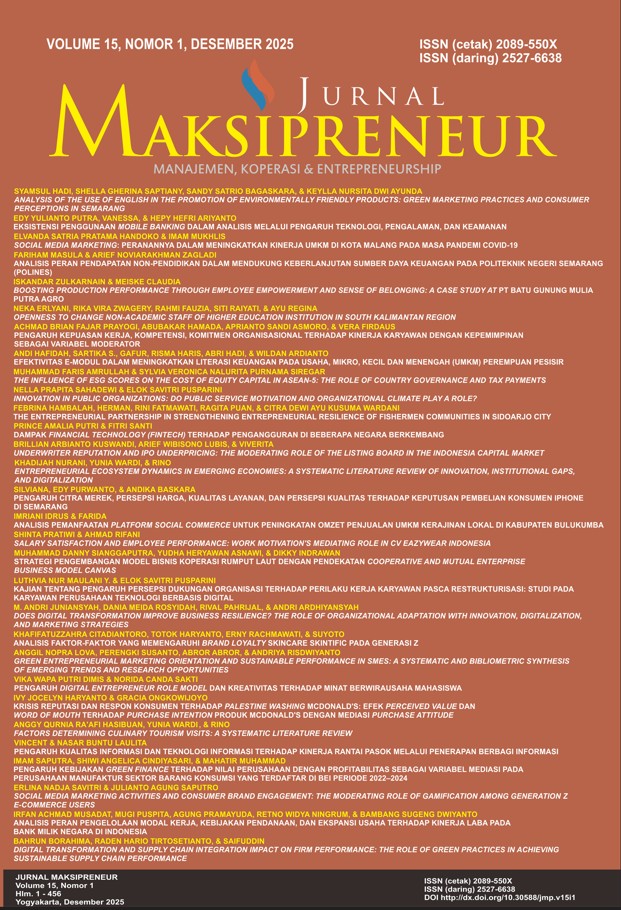
Pengaruh Modal Kerja, Struktur Modal, dan Pertumbuhan Perusahaan terhadap Capaian Laba Bank BUMN Indonesia
DOI:
https://doi.org/10.30588/jmp.v15i1.2425Keywords:
Working Capital, Capital Structure, Company Growth, Profit Achievement, State-Owned BanksAbstract
This study aims to analyze the effect of working capital, capital structure, and company growth on profit achievement in Indonesian state-owned banks (Bank BUMN). Efficiently managed working capital can enhance liquidity and profitability, while an optimal capital structure plays a role in balancing debt and equity to maximize company value. Additionally, company growth reflects business expansion, which can influence financial performance. This research employs a quantitative method, utilizing secondary data obtained from Bank BUMN's financial statements over a specific period. The analytical technique used is multiple linear regression to determine the relationship between the independent variables and profit achievement. The findings show that working capital significantly affects profit achievement, and capital structure also has a notable impact on profit achievement. In contrast, company growth does not influence profit achievement. These findings have implications for bank management in making decisions related to working capital management, capital structure policies, and growth strategies to enhance profitability.
References
Amrulloh, A., & Susilo, D. (2022). Pengaruh pertumbuhan perusahaan dan struktur modal terhadap profitabilitas bank-bank BUMN yang terdaftar di Bursa Efek Indonesia periode 2012–2021. Jurnal Manajemen dan Keuangan, 11(2), 145–158. https://doi.org/10.36448/jmk.v11i2.2784
Badan Pusat Statistik. (2024). Pertumbuhan Ekonomi Indonesia 2013–2023. Badan Pusat Statistik Republik Indonesia. https://www.bps.go.id
Basel Committee on Banking Supervision. (2011). Basel III: A global regulatory framework for more resilient banks and banking systems. Bank for International Settlements. https://www.bis.org
Dewi, R., & Siregar, H. (2022). Kredit, risiko, dan profitabilitas perbankan di Indonesia. Jurnal Keuangan dan Perbankan, 26(1), 1–15. https://doi.org/10.26905/jkdp.v26i1.7352
Durbin, J., & Watson, G. S. (1950). Testing for serial correlation in least squares regression I. Biometrika, 37(3–4), 409–428. https://doi.org/10.1093/biomet/37.3-4.409
Erdi, T. W. (2024). Pengaruh Struktur Modal, Pertumbuhan Perusahaan, dan Profitabilitas Terhadap Nilai Perusahaan Pada Perusahaan Infrastruktur di Indonesia. Jurnal Akuntansi dan Pajak, 25(1), 1–6.
Field, A. (2018). Discovering Statistics Using IBM SPSS Statistics (5th ed.). SAGE Publications. https://doi.org/10.4135/9781526419521
Gitman, L. J., & Zutter, C. J. (2018). Principles of Managerial Finance (14th ed.). Pearson Education.
Gujarati, D. N., & Porter, D. C. (2009). Basic Econometrics (5th ed.). McGraw-Hill. https://doi.org/10.2307/2238080
Haffizah, H., & Patrisia, D. (2025). Pengaruh Risiko Likuiditas, Risiko Kredit, Risiko Tingkat Bunga terhadap Profitabilitas Bank yang Terdaftar di BEI dengan Rasio Kecukupan Modal sebagai Variabel Moderasi. Journal of Accounting and Finance Management, 6(2), 904–916. https://doi.org/10.38035/jafm.v6i2.2037
Manurung, T. M. S., & Wildan, M. (2023). Pengaruh Struktur Modal dan Ukuran Perusahaan terhadap Nilai Perusahaan Studi Kasus pada Perusahan Sektor Makanan dan Minuman yang Terdaftar di BEI Periode 2016-2020. Jurnal Ilmiah Manajemen Kesatuan (JIMKES), 11(1), 83–90. https://doi.org/10.37641/jimkes.v11i1.1661
Modigliani, F., & Miller, M. H. (1958). The cost of capital, corporation finance and the theory of investment. The American Economic Review, 48(3), 261–297. https://doi.org/10.2307/1809766
Myers, S. C. (1977). Determinants of corporate borrowing. Journal of Financial Economics, 5(2), 147–175. https://doi.org/10.1016/0304-405X(77)90015-0
Myers, S. C. (2020). Capital structure. Journal of Economic Perspectives, 34(4), 1–24. https://doi.org/10.1257/jep.34.4.1
Pandey, I. M. (2019). Working capital management and profitability of banks in emerging economies. Journal of Financial Management, 10(2), 45–60. https://doi.org/10.2139/ssrn.3315631
Rahman, M. M., Hamid, K., & Khan, A. (2021). Liquidity risk and bank profitability: Evidence from developing countries. Asian Journal of Economics and Banking, 5(1), 45–62. https://doi.org/10.1108/AJEB-11-2020-0095
Razali, N. M., & Wah, Y. B. (2011). Power comparisons of Shapiro–Wilk, Kolmogorov–Smirnov, Lilliefors and Anderson–Darling tests. Journal of Statistical Modeling and Analytics, 2(1), 21–33. https://doi.org/10.1515/bile-2015-0008
Rossa, D., & Dewi, S. P. (2024). Pengaruh struktur modal, ukuran perusahaan, dan likuiditas terhadap pertumbuhan perusahaan BUMN. Jurnal Akuntansi dan Keuangan Indonesia, 21(1), 55–70. https://doi.org/10.21002/jaki.2024.04
Smith, J., Brown, A., & Taylor, R. (2023). Corporate financial performance and firm growth: Evidence from emerging markets. Journal of Corporate Finance, 78, 102321. https://doi.org/10.1016/j.jcorpfin.2023.102321
Wooldridge, J. M. (2020). Introductory Econometrics: A Modern Approach (7th ed.). Cengage Learning. https://doi.org/10.1093/0199676822.001.0001
Downloads
Published
How to Cite
Issue
Section
License
Copyright (c) 2025 Irfan Achmad Musadat, Mugi Puspita, Agung Pramayuda, Retno Widya Ningrum, Bambang Sugeng Dwiyanto

This work is licensed under a Creative Commons Attribution 4.0 International License.
Authors who publish with Jurnal Maksipreneur agree to the following terms:
Authors retain copyright and grant the Jurnal Maksipreneur right of first publication with the work simultaneously licensed under a Creative Commons Attribution 4.0 International License that allows others to share (copy and redistribute the material in any medium or format) and adapt (remix, transform, and build upon the material) the work for any purpose, even commercially with an acknowledgment of the work's authorship and initial publication in Jurnal Maksipreneur.
Authors are able to enter into separate, additional contractual arrangements for the non-exclusive distribution of the journal's published version of the work (e.g., post it to an institutional repository or publish it in a book), with an acknowledgment of its initial publication in Jurnal Maksipreneur. Authors are permitted and encouraged to post their work online (e.g., in institutional repositories or on their website) prior to and during the submission process, as it can lead to productive exchanges, as well as earlier and greater citation of published work (See The Effect of Open Access).