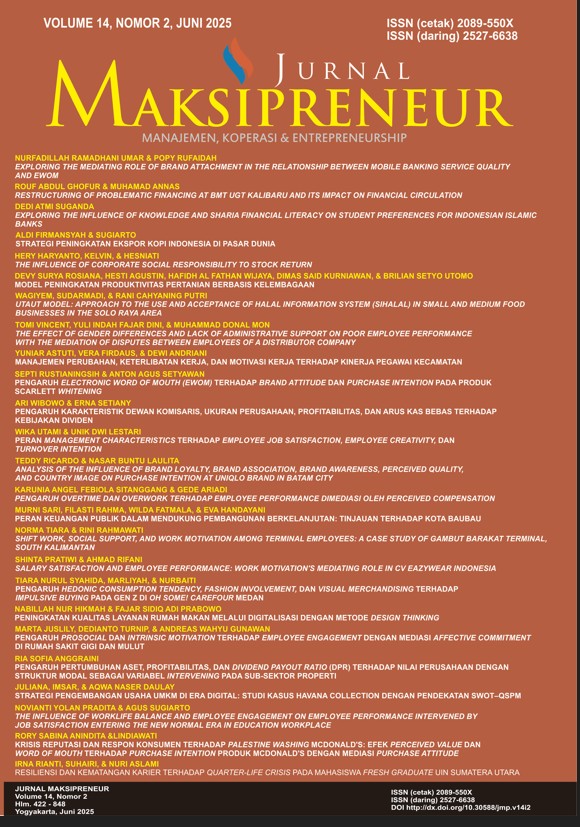
Restructuring of Problematic Financing at BMT UGT Kalibaru and Its Impact on Financial Circulation
DOI:
https://doi.org/10.30588/jmp.v14i2.2012Keywords:
Strategy, Financing Restructuring, Financial Circulation, BMTAbstract
Baitul Maal wa Tamwil serves as a representation of Islamic financial institutions established by government entities to foster and develop a banking framework that aligns with the principles of Islamic doctrine. One of its leading products is Islamic financing. Behind the scenes, financing restructuring often occurs due to problems. This study focuses on BMT UGT Kalibaru in handling financing cases. This study aims to 1) analyze the causes of problematic financing, 2) examine the stages of resolution used by BMT UGT Kalibaru in handling problematic financing cases, and 3) determine the impacts caused and their solutions. This type of research is a case study. The data sources used are primary and secondary data. Data collection techniques use documentation, archival recordings, interviews, and observations. Data analysis uses an interactive model. The results of this study state that: 1) the causes of problematic financing in general are two causes, namely internal and external causes, and 2) the stages of resolving problematic financing in general are two paths, namely litigation and non-litigation. The mechanism carried out by BMT UGT Kalibaru starts from the rescheduling stage, re-requirements, collateral deliberation, and collateral confiscation, 3) the impact of problematic financing results in members being unable to withdraw savings and the state of financial circulation in the office.
References
Abidin, Z. R. M. (2020). Regulasi Baitul Maal Wa Tamwil (BMT) di Indonesia. Skripsi, Universitas Muhammadiyah Jakarta.
Akbar, E. E. (2023). Restrukturisasi Pembiayaan Bank Syariah Indonesia. Jurnal Ilmiah Manajemen dan Kewirausahaan (JUMANAGE), 2(1), 152–157. https://doi.org/10.33998/jumanage.2023.2.1.711
Amin, M. M., & Ridlwan, A. A. (2022). Strategi Penyelesaian Pembiayaan Murabahah Terhadap Eksistensi Likuiditas (Studi Kasus BMT-UGT Nusantara KCP Kota Probolinggo). 3(2), 69–84. https://doi.org/https://doi.org/10.33752/jies.v3i2.5944
Amratul, K. (2020). Peran Baitul Mal Wat Tamwil (Bmt) Taman Indah dalam Memberdayakan Ekonomi Masyarakat di Kecamatan Baitussalam Kabupaten Aceh Besar. Skripsi, UIN Ar-Raniry, 1–23.
Anggito, A. & Setiawan, J. (2018). Metodologi Penelitian Kualitatif (Cetakan Pertama). CV. Jejak.
Aznin, N., & Alam, A. P. (2022). Analisis Kelayakan Penyaluran Pembiayaan Murabahah pada PT Bank Syariah Indonesia, Tbk. KCP Stabat. Al-Istimrar: Jurnal Ekonomi Syariah, 1(1), 9–15. https://doi.org/https://doi.org/10.59342/istimrar.v1i1.51
Ekaningsih, L. A. F., Kharis, K. M., & Fathoni, J. (2019). Kebijakan Resceduling dalam Perspektif Hukum Islam. Jurnal Darussalam: Jurnal Pendidikan, Komunikasi dan Pemikiran Hukum Islam, XI(1), 115–131. https://doi.org/https://doi.org/10.30739/darussalam.v11i1.452
Elwardah, K. (2020). Optimalisasi Penyelesaian Pembiayaan Bermasalah Pada BMT Kota Mandiri Bengkulu. Al-Intaj: Jurnal Ekonomi dan Perbankan Syariah, 6(2), 59. https://doi.org/10.29300/aij.v6i2.3351
Fadila, R. A., & Wulandari, A. P. (2023). Literature Review Analisis Data Kualitatif: Tahap Pengumpulan Data. Mitita Jurnal Penelitian, 1(3), 34–46.
Fajri, I., & Muksal, M. (2021). Implementation of Sharia Funding Agreement on Gala Implementasi Akad Pembiayaan Syariah pada Gala (Gadai Tradisional). International Journal of Islamic Studies and Social Sciences, 3(1), 1–34. https://doi.org/https://doi.org/10.56613/islam-universalia.v3i1.189
Firmansyah, H., Nawatmi, S., Zamora, R. A., Sufyati HS., S., Mardani, D. A., Fariati, W. T., Sukarnoto, T., Arumingtyas, F., Winarni, E., Abdurohim, A., Susiati, S., Pratama, G., Pratama, F. A., Indarto, S. L., Azifah, N., & Jenita, J. (2021). Teori dan Praktik Manajemen Bank Syariah (Cetakan 1). Insania.
Hanafi, M. M. (2019). Al-Qur’an dan Terjemahannya Edisi Penyempurnaan 2019, Juz 1-10. Proceedings of the National Academy of Sciences, 3(1). Lajnah Pentashihan Mushaf Al-Qur’an. https://doi.org/10.1016/j.bpj.2015.06.056%0A
Hariyani, I. (2010). Restrukturisasi dan Penghapusan Kredit Macet (Ceatakan 1). PT Gramedia.
Hasyim, H. (2024). Wawancara di BMT UGT Kalibaru.
Hidayat, S., Alaydrus, Z. M., & Bakri, M. (2022). Strategi Penyelesaian Pembiayaan Bermasalah Berbasis Islamic Enterpreneurship di BMT Se-Kota Jepara. Jurnal Ekonomi Syariah Pelita Bangsa, 7(01), 93–102. https://doi.org/10.37366/jespb.v7i01.381
Himmawan, D., Suharmono, S., Permana, U., & Dewi, A. (2023). Implementasi Akad Murabahah Pada Pembiayaan Mikro di bank Syariah Indonesia Indramayu KCP Soeprapto. 2(1), 12–19. https://doi.org/https://doi.org/10.31943/jsef.v2i1.12
Imaniyati, S. N. (2010). Aspek-Aspek Hukum BMT (Baitul Maal wat Tamwil (cetakan 1). PT Citra Aditya Bakti.
Khairunnisa, I., Mukhsin, M., & Roni, A. (2022). Strategi Keberlanjutan Baitul Maal Wat Tamwil di Kota Yogyakarta dengan Metode Analytical Network Process. Ekonomi dan Perbankan Syariah, 8(1). https://doi.org/https://doi.org/10.29300/aij.v8i1.6297
Kholiq, A., & Rahmawati, R. (2020). Dampak Implementasi Restrukturisasi Pembiayaan terhadap Likuiditas Bank Syariah pada Situasi Pandemi Covid-19. El-Barka: Journal of Islamic Economics and Business, 3(2), 282–316. https://doi.org/10.21154/elbarka.v3i2.2472
Mawardi, I. (2023). Mitigasi Pembiayaan Bermasalah Pada BMT UGT Sidogiri Cabang Larangan Sidoarjo. Jurnal Ilmu Akuntansi dan Bisnis Syariah, 5(2).
Melina, F. (2020). Pembiayaan Murabahah di Baitul Maal Wat Tamwil (BMT). Jurnal Tabarru’: Islamic Banking and Finance, 3(2), 269–280. https://doi.org/10.25299/jtb.2020.vol3(2).5878
Miles, B. M., Huberman, M. A., & Saldana, J. (2014). Qualitative Data Analysis (edisi ketiga). Sage Publications.
Munandar, A., & Ridwan, H. A. (2023). Tafsir Surat An-Nisa Ayat 29 Sebagai Landasan Hukum Akad Ba’i Assalam dalam Praktek Jual Beli Online. Rayah Al-Islam, 7(1), 271–287. https://doi.org/10.37274/rais.v7i1.659
Muslim, T., & Novizas, A. (2018). Eksistensi Baitul mal wa tamwil (BMT) dalam Perekonomian Islam. III(1), 27–35. https://doi.org/https://doi.org/10.36722/jmih.v3i1.749
Ningsih, K. N. W. (2020). Strategi Pemasaran Pembiayaan Mikro Sanitasi Berbasis Akad Murabahah di Koperasi Simpan Pinjam Pembiayaan Syariah Syirkah Fastabiqul Khoirot Cabang Jatiroto. Muhasabatuna: Jurnal Akuntansi Syariah, 2(1), 37. https://doi.org/10.54471/muhasabatuna.v2i1.704
Nurzianti, R. (2021). Revolusi Lembaga Keuangan Syariah dalam Teknologi dan Kolaborasi Fintech. Jurnal Inovasi Penelitian, 2(1), 37.
Pamitkatsih, M. (2020). Model Kebijakan Relaksasi pada Anggota Pembiayaan BMT Tumang Kantor Cabang Sukoharjo. Jurnal Manajemen Ekonomi, 8(75), 147–154. https://ejournal.unugha.ac.id/index.php/amanu/article/view/331
Rany, N., & Yunita, J. (2022). Metodologi Penelitian Kualitatif Bidang Kesehatan. CV Global Aksara Pers.
Rusandi, R., & Rusli, R. (2021). Merancang Penelitian Kualitatif Dasar/Deskriptif dan Studi Kasus. Al-Ubudiyah: Jurnal Pendidikan Dan Studi Islam, 2(1), 48–60. https://doi.org/10.55623/au.v2i1.18
Soemitra, A., Nawawi., M. Z., & Syahbudi, M. (2022). Pembiayaan Syariah: Untuk Usaha Mikro di Indonesia (Cetakan 1). Merdeka Kreasi Group.
Sugianto, S. (2022). Pengembangan Baitul Maal Wat-Tamwil untuk Pemberdayaan Ekonomi Umat. Jurnal Pendidikan dan Konseling, 4(September), 2178–2179. https://doi.org/https://doi.org/10.31004/jpdk.v4i4.5729
Ubaidillah, M., & Aji, R. H. S. (2020). Tinjauan Atas Implementasi Perpanjangan Masa Angsuran untuk Pembiayaan di Bank Syariah pada Situasi Pandemi Covid-19. Islamic Banking: Jurnal Pemikiran dan Pengembangan Perbankan Syariah, 6(1), 1–16. https://doi.org/10.36908/isbank.v6i1.159
Ulpah, M. (2024). Strategi Penyelesaian Pembiayaan Bermasalah pada Bank Syariah. Money: Journal of Financial and Islamic Banking, 2(2), 131–141. https://doi.org/10.31004/money.v2i2.24070
Wahid, W. (2024). Wawancara Bersama AOP (Account Officer Pembiayaan) BMT UGT Kalibaru.
Yin, R. (2014). Case Study Research (Desain and Methods) (edisi keempat). Sage Publications.
Yunita, I., Homaidi, A., Fakih, L., Saleh, T., Dwi, J., & Fatah, Z. (2022). Perancangan Sistem Informasi Akuntansi Untuk Akuntabilitas Keuangan di KBIHU Hafas. Jurnal Aplikasi Teknologi Informasi dan Manajemen (JATIM), 3(1), 1–11. https://doi.org/10.31102/jatim.v3i1.1421
Downloads
Published
How to Cite
Issue
Section
License
Copyright (c) 2025 Rouf Abdul Ghofur, Muhamad Annas

This work is licensed under a Creative Commons Attribution 4.0 International License.
Authors who publish with Jurnal Maksipreneur agree to the following terms:
Authors retain copyright and grant the Jurnal Maksipreneur right of first publication with the work simultaneously licensed under a Creative Commons Attribution 4.0 International License that allows others to share (copy and redistribute the material in any medium or format) and adapt (remix, transform, and build upon the material) the work for any purpose, even commercially with an acknowledgment of the work's authorship and initial publication in Jurnal Maksipreneur.
Authors are able to enter into separate, additional contractual arrangements for the non-exclusive distribution of the journal's published version of the work (e.g., post it to an institutional repository or publish it in a book), with an acknowledgment of its initial publication in Jurnal Maksipreneur. Authors are permitted and encouraged to post their work online (e.g., in institutional repositories or on their website) prior to and during the submission process, as it can lead to productive exchanges, as well as earlier and greater citation of published work (See The Effect of Open Access).