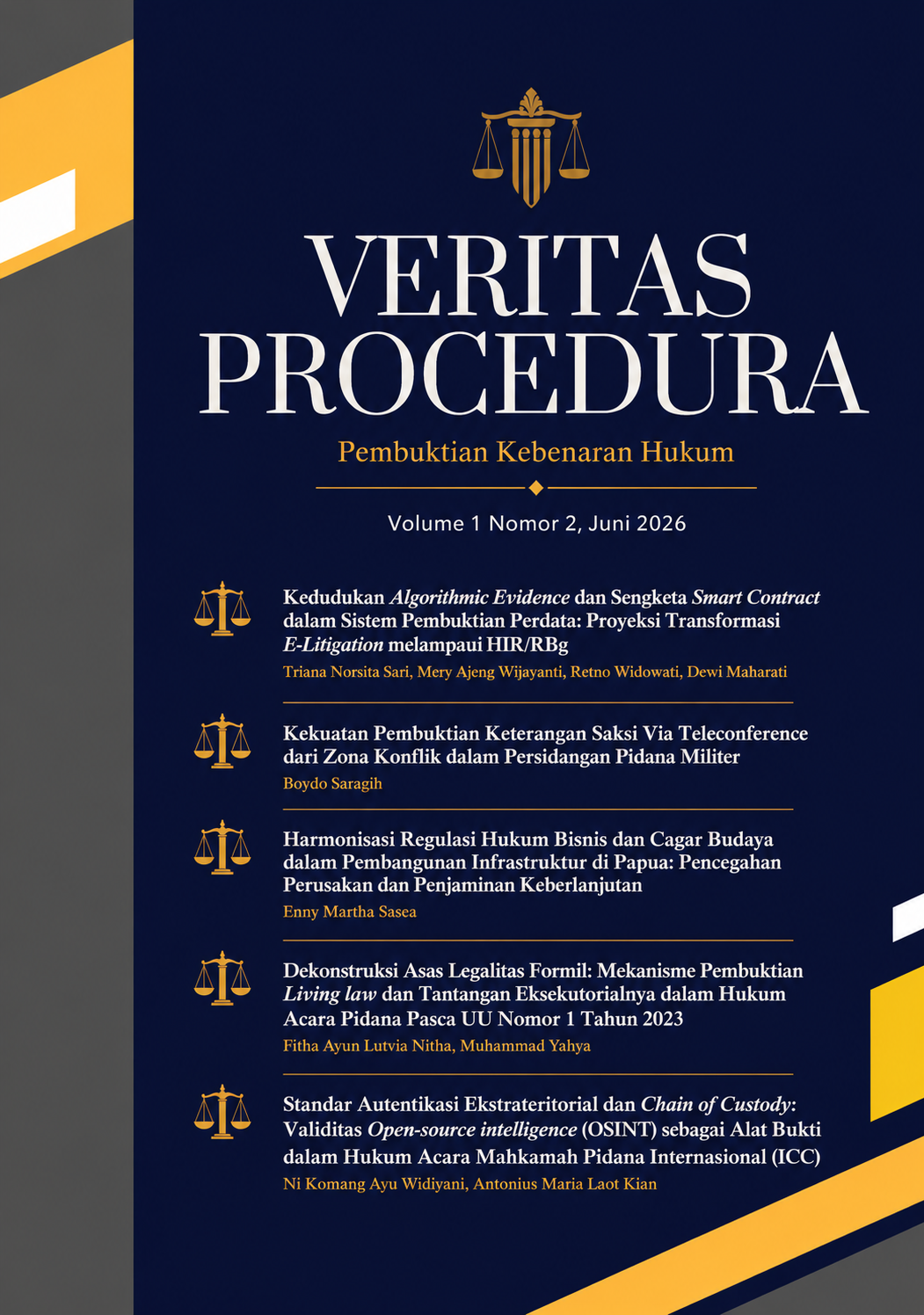
Kedudukan Algorithmic Evidence dan Sengketa Smart Contract dalam Sistem Pembuktian Perdata: Proyeksi Transformasi E-Litigation melampaui HIR/RBg
Keywords:
algorithmic evidence, smart contract, civil evidence, e-litigation, HIR/RBgAbstract
Indonesian civil procedural law still rests on colonial products, namely the HIR and the RBg, which adopt a closed and enumerative system of evidence binding judges to five recognised instruments under Article 164 HIR, Article 284 RBg, and Article 1866 of the Civil Code. While the Electronic Information and Transactions Law has extended valid evidence to electronic information and documents, and the Supreme Court has digitised litigation through e-court and e-litigation regulations, those reforms merely migrate physical files into digital form. This article argues that such digitisation does not answer two deeper problems generated by financial and contractual modernity. First, it analyses the status of algorithmic evidence and blockchain traces within an evidentiary regime designed for human-made documents, where authentication, integrity, and the opacity of algorithms strain existing categories. Second, it examines how a civil judge should adjudicate breach of contract over a self-executing smart contract that performs without human intervention, where the immutability of the executed transaction collides with classical remedies of rescission and damages. Using a normative juridical method with statutory, conceptual, and comparative approaches, the article concludes that genuine transformation requires reforming the evidentiary paradigm beyond HIR/RBg, establishing authentication standards, code-auditing expertise, and an e-litigation architecture capable of ingesting algorithmic and blockchain data rather than mere documents.
References
A. Books
De Filippi, Primavera, dan Aaron Wright. Blockchain and the Law: The Rule of Code. Cambridge, MA: Harvard University Press, 2018.
Fakhriah, Efa Laela. Bukti Elektronik dalam Sistem Pembuktian Perdata. Bandung: Alumni, 2011.
Fuady, Munir. Teori Hukum Pembuktian (Pidana dan Perdata). Bandung: Citra Aditya Bakti, 2006.
Harahap, M. Yahya. Hukum Acara Perdata tentang Gugatan, Persidangan, Penyitaan, Pembuktian, dan Putusan Pengadilan. Jakarta: Sinar Grafika, 2017.
Lessig, Lawrence. Code: Version 2.0. New York: Basic Books, 2006.
Marzuki, Peter Mahmud. Penelitian Hukum. Jakarta: Kencana, 2017.
Mertokusumo, Sudikno. Hukum Acara Perdata Indonesia. Yogyakarta: Liberty, 2006.
Miru, Ahmadi. Hukum Kontrak dan Perancangan Kontrak. Jakarta: Raja Grafindo Persada, 2011.
Subekti, R. Hukum Pembuktian. Jakarta: Pradnya Paramita, 1995.
Subekti, R. Hukum Perjanjian. Jakarta: Intermasa, 2005.
B. Journal Articles
Fakhriah, Efa Laela. ‘Penemuan Hukum oleh Hakim melalui Pembuktian dengan Menggunakan Bukti Elektronik dalam Mengadili dan Memutus Sengketa Perdata’. Jurnal Bina Mulia Hukum 5(1) (2020).
Szabo, Nick. ‘Smart Contracts: Building Blocks for Digital Markets’. EXTROPY: The Journal of Transhumanist Thought 16 (1996).
Werbach, Kevin, dan Nicolas Cornell. ‘Contracts Ex Machina’. Duke Law Journal 67(2) (2017).
C. Legislation
Kitab Undang-Undang Hukum Perdata (Burgerlijk Wetboek).
Herzien Inlandsch Reglement (HIR).
Rechtsreglement voor de Buitengewesten (RBg).
Undang-Undang Nomor 11 Tahun 2008 tentang Informasi dan Transaksi Elektronik.
Undang-Undang Nomor 19 Tahun 2016 tentang Perubahan atas Undang-Undang Nomor 11 Tahun 2008 tentang Informasi dan Transaksi Elektronik.
Undang-Undang Nomor 1 Tahun 2024 tentang Perubahan Kedua atas Undang-Undang Nomor 11 Tahun 2008 tentang Informasi dan Transaksi Elektronik.
Peraturan Pemerintah Nomor 71 Tahun 2019 tentang Penyelenggaraan Sistem dan Transaksi Elektronik.
Peraturan Mahkamah Agung Nomor 3 Tahun 2018 tentang Administrasi Perkara di Pengadilan Secara Elektronik.
Peraturan Mahkamah Agung Nomor 1 Tahun 2019 tentang Administrasi Perkara dan Persidangan di Pengadilan Secara Elektronik.
Peraturan Mahkamah Agung Nomor 7 Tahun 2022 tentang Perubahan atas Peraturan Mahkamah Agung Nomor 1 Tahun 2019 tentang Administrasi Perkara dan Persidangan di Pengadilan Secara Elektronik.
D. Official Reports and Documents
Putusan Mahkamah Konstitusi Nomor 20/PUU-XIV/2016, 7 September 2016.
Downloads
Published
How to Cite
Issue
Section
License
Copyright (c) 2026 Triana Norsita Sari, Mery Ajeng Wijayanti, Retno Widowati, Dewi Maharati

This work is licensed under a Creative Commons Attribution 4.0 International License.
Authors who publish with Veritas Procedura agree to the following terms:
Authors retain copyright and grant the Veritas Procedura (VP) right of first publication with the work simultaneously licensed under a Creative Commons Attribution 4.0 International License that allows others to share (copy and redistribute the material in any medium or format) and adapt (remix, transform, and build upon the material) the work for any purpose, even commercially with an acknowledgment of the work's authorship and initial publication in VP.
Authors are able to enter into separate, additional contractual arrangements for the non-exclusive distribution of the journal's published version of the work (e.g., post it to an institutional repository or publish it in a book), with an acknowledgment of its initial publication in Veritas Procedura (VP). Authors are permitted and encouraged to post their work online (e.g., in institutional repositories or on their website) prior to and during the submission process, as it can lead to productive exchanges, as well as earlier and greater citation of published work (See The Effect of Open Access).