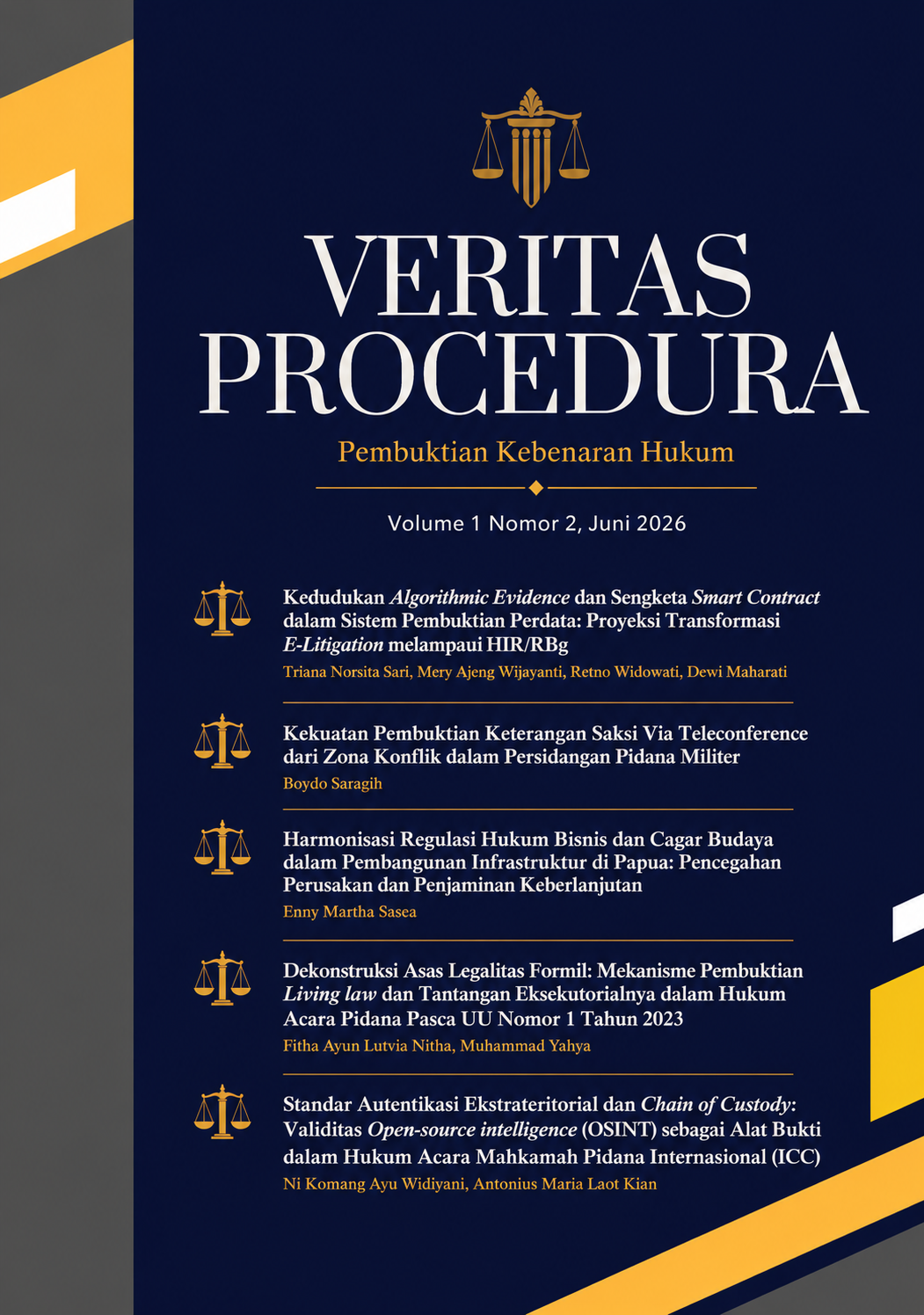
Harmonisasi Regulasi Hukum Bisnis dan Cagar Budaya dalam Pembangunan Infrastruktur di Papua: Pencegahan Perusakan dan Penjaminan Keberlanjutan
Keywords:
Cultural Heritage, Business Law, Indigenous Communities, Infrastructure Development, Papua.Abstract
Infrastructure development in Papua, aimed at accelerating economic growth, often threatens the preservation of cultural heritage sites, such as the Aitumeiri Stone Civilization Site in Wondama, due to a lack of harmonization between business regulations and cultural heritage protection. This study aims to analyze national and regional legal frameworks, implementation challenges, and harmonization strategies to prevent destruction and ensure cultural sustainability. Using a normative legal approach and qualitative analysis, this study examines Law No. 11 of 2010 on Cultural Heritage, Law No. 2 of 2021 on Special Autonomy for Papua, and Government Regulation No. 1 of 2022. The findings indicate that conflicts of interest between development and preservation, resource constraints, and the lack of participation by indigenous communities hinder the preservation of cultural heritage sites. These challenges are exacerbated by weak inter-institutional coordination and low awareness among business actors regarding cultural values.
This article recommends strengthening collaborative-based regulations, establishing zoning guidelines for cultural sites, applying conservation ethics in business projects, and empowering indigenous communities through education and the recognition of customary rights. The Aitumeiri Site case study illustrates the need to integrate local wisdom into development planning. Through a synergistic approach involving the government, businesses, and indigenous communities, regulatory harmonization can create a balance between economic development and cultural preservation, ensuring that Papua’s cultural heritage remains intact amidst the dynamics of infrastructure development.
References
A. Books
Aditjondro, George Junus. Cahaya Bintang Kejora: Papua Barat dalam Kajian Sejarah, Budaya, Ekonomi, dan Hak Asasi Manusia. Jakarta: Elsam, 2000.
Aplin, Graeme. Heritage: Identification, Conservation, and Management. Melbourne: Oxford University Press, 2002.
Appadurai, Arjun. Modernity at Large: Cultural Dimensions of Globalization. Minneapolis: University of Minnesota Press, 1996.
Champion, Erik. Critical Gaming: Interactive History and Virtual Heritage. Ashgate Publishing, 2015.
Coombe, Rosemary J. The Cultural Life of Intellectual Properties: Authorship, Appropriation, and the Law. Duke University Press, 1998.
Giay, Benny. Menuju Papua Baru: Beberapa Pokok Pikiran sekitar Emansipasi Orang Papua. Jayapura: Deiyai/Els-ham Papua, 2000.
Healey, Patsy. Collaborative Planning: Shaping Places in Fragmented Societies. University of British Columbia Press, 2006.
Koentjaraningrat. Manusia dan Kebudayaan di Indonesia. Jakarta: Djambatan, 2009.
Marzuki, Peter Mahmud. Penelitian Hukum. Jakarta: Kencana, 2009.
McGibbon, Rodd. Secessionist Challenges in Aceh and Papua: Is Special Autonomy the Solution? Washington: East-West Center, 2004.
Persoon, Gerard A., dan Diny M.E. van Est. Co-management of Natural Resources: The Concept and Aspects of Implementation. Leiden University: Naturemans Project, 2000.
Pickard, Robert. Policy and Law in Heritage Conservation. London: Spon Press, 2001.
Rodwell, Dennis. Conservation and Sustainability in Historic Cities. Oxford: Blackwell Publishing, 2007.
Tanudirjo, Daud Aris. “Pengelolaan Sumber Daya Arkeologi di Indonesia: Masa Lalu, Kini, dan Tantangan di Masa Depan.” Dalam Manusia dalam Ruang: Studi Kawasan dalam Arkeologi. Jakarta: Wedatama Widya Sastra, 2009.
Throsby, David. Economics and Culture. Cambridge: Cambridge University Press, 2001.
B. Article Journals
Aas, Christina, et al. “Stakeholder Collaboration and Heritage Management.” Annals of Tourism Research, Vol. 32, No. 1 (2005): 28-48.
Ahmad, Yahaya. “The Scope and Definitions of Heritage: From Tangible to Intangible.” International Journal of Heritage Studies, Vol. 12, No. 3 (2006): 292-300.
Aspinall, Edward, dan Mark T. Berger. “The Break-up of Indonesia? Nationalisms after Decolonisation and the Limits of the Nation-State in Post-Cold War Southeast Asia.” Third World Quarterly, Vol. 22, No. 6 (2001): 1003-1024.
Geria, I Made. “Peningkatan Kesadaran Masyarakat dalam Pelestarian Cagar Budaya.” Jurnal Arkeologi, Vol. 12, No. 1 (2019): 25.
Komurcu, Mehmet. “Cultural Heritage Endangered by Large Dams and Its Protection under International Law.” Wisconsin International Law Journal, Vol. 20 (2001): 240.
McBeth, John. “Mining and Cultural Heritage in Papua: A Growing Conflict.” Asia Pacific Journal, Vol. 18, No. 3 (2020): 45.
Moropoulou, Antonia, et al. “Non-destructive Techniques as a Tool for the Protection of Built Cultural Heritage.” Construction and Building Materials, Vol. 48 (2013): 1222-1239.
Nurjaya, I Nyoman. “Hak Ulayat Masyarakat Hukum Adat dalam Perspektif Perlindungan Hukum.” Jurnal Hukum dan Pembangunan, Vol. 40, No. 2 (2010): 156-160.
Remondino, Fabio. “Heritage Recording and 3D Modeling with Photogrammetry and 3D Scanning.” Remote Sensing, Vol. 3, No. 6 (2011): 1104-1138.
Roders, Ana Pereira, dan John L. Oers. “Editorial: Bridging Cultural Heritage and Sustainable Development.” Journal of Cultural Heritage Management and Sustainable Development, Vol. 1, No. 1 (2011): 5-14.
Salazar, Noel B. “Community-based Cultural Tourism: Issues, Threats and Opportunities.” Journal of Sustainable Tourism, Vol. 20, No. 1 (2012): 9-22.
UNESCO. “Guidelines for the Protection of Cultural Heritage.” International Journal of Cultural Property, Vol. 15, No. 2 (2008): 165.
Wahanisa, Rofi, dan Septhian Eka Adiyatma. “Konsepsi Asas Kelestarian Dan Keberlanjutan Dalam Perlindungan Dan Pengelolaan Lingkungan Hidup Dalam Nilai Pancasila.” Bina Hukum Lingkungan, Vol. 6, No. 1 (2021): 93-118.
UNESCO. Operational Guidelines for the Implementation of the World Heritage Convention. UNESCO World Heritage Centre, 2019.
C. Legislation
Peraturan Pemerintah Republik Indonesia Nomor 38 Tahun 2007 tentang Pembagian Urusan Pemerintahan Antara Pemerintah, Pemerintahan Daerah Provinsi, dan Pemerintahan Daerah Kabupaten/Kota.
Peraturan Pemerintah Republik Indonesia Nomor 1 Tahun 2022 tentang Pengelolaan Cagar Budaya Secara Partisipatif.
Undang-Undang Republik Indonesia Nomor 11 Tahun 2010 tentang Cagar Budaya.
Undang-Undang Republik Indonesia Nomor 2 Tahun 2021 tentang Perubahan Kedua atas Undang-Undang Nomor 21 Tahun 2001 tentang Otonomi Khusus Bagi Provinsi Papua.
C. Disertation
Sasea, Enny Martha. “Pengaturan Kewenangan Perlindungan dan Pelestarian Cagar Budaya di Tanah Papua.” Disertasi, Universitas Hasanuddin, 2025.
F. Internet
“Lawatan Sejarah Daerah di Teluk Wondama.” Balai Pelestarian Nilai Budaya Papua. Diakses dari https://kebudayaan.kemdikbud.go.id/bpnbpapua/lawatan-sejarah-daerah-di-teluk-wondama/
“Nasionalisme Dua Sisi.” Historia.id. Diakses dari https://www.historia.id/article/nasionalisme-dua-sisi-v2L16
“Pemkab Teluk Wondama Rampungkan Revitalisasi Batu Peradaban Aitumieri.” Antara News Papua Barat. Diakses dari https://papuabarat.antaranews.com/berita/50063/pemkab-teluk-wondama-rampungkan-revitalisasi-batu-peradaban-aitumieri
“Pemkab Wondama Revitalisasi Situs Rohani Bukit Aitumeiri.” Antara News Papua Barat. Diakses dari https://papuabarat.antaranews.com/berita/14833/pemkab-wondama-revitalisasi-situs-rohani-bukit-aitumeiri
Downloads
Published
How to Cite
Issue
Section
License
Copyright (c) 2026 Enny Martha Sasea

This work is licensed under a Creative Commons Attribution 4.0 International License.
Authors who publish with Veritas Procedura agree to the following terms:
Authors retain copyright and grant the Veritas Procedura (VP) right of first publication with the work simultaneously licensed under a Creative Commons Attribution 4.0 International License that allows others to share (copy and redistribute the material in any medium or format) and adapt (remix, transform, and build upon the material) the work for any purpose, even commercially with an acknowledgment of the work's authorship and initial publication in VP.
Authors are able to enter into separate, additional contractual arrangements for the non-exclusive distribution of the journal's published version of the work (e.g., post it to an institutional repository or publish it in a book), with an acknowledgment of its initial publication in Veritas Procedura (VP). Authors are permitted and encouraged to post their work online (e.g., in institutional repositories or on their website) prior to and during the submission process, as it can lead to productive exchanges, as well as earlier and greater citation of published work (See The Effect of Open Access).