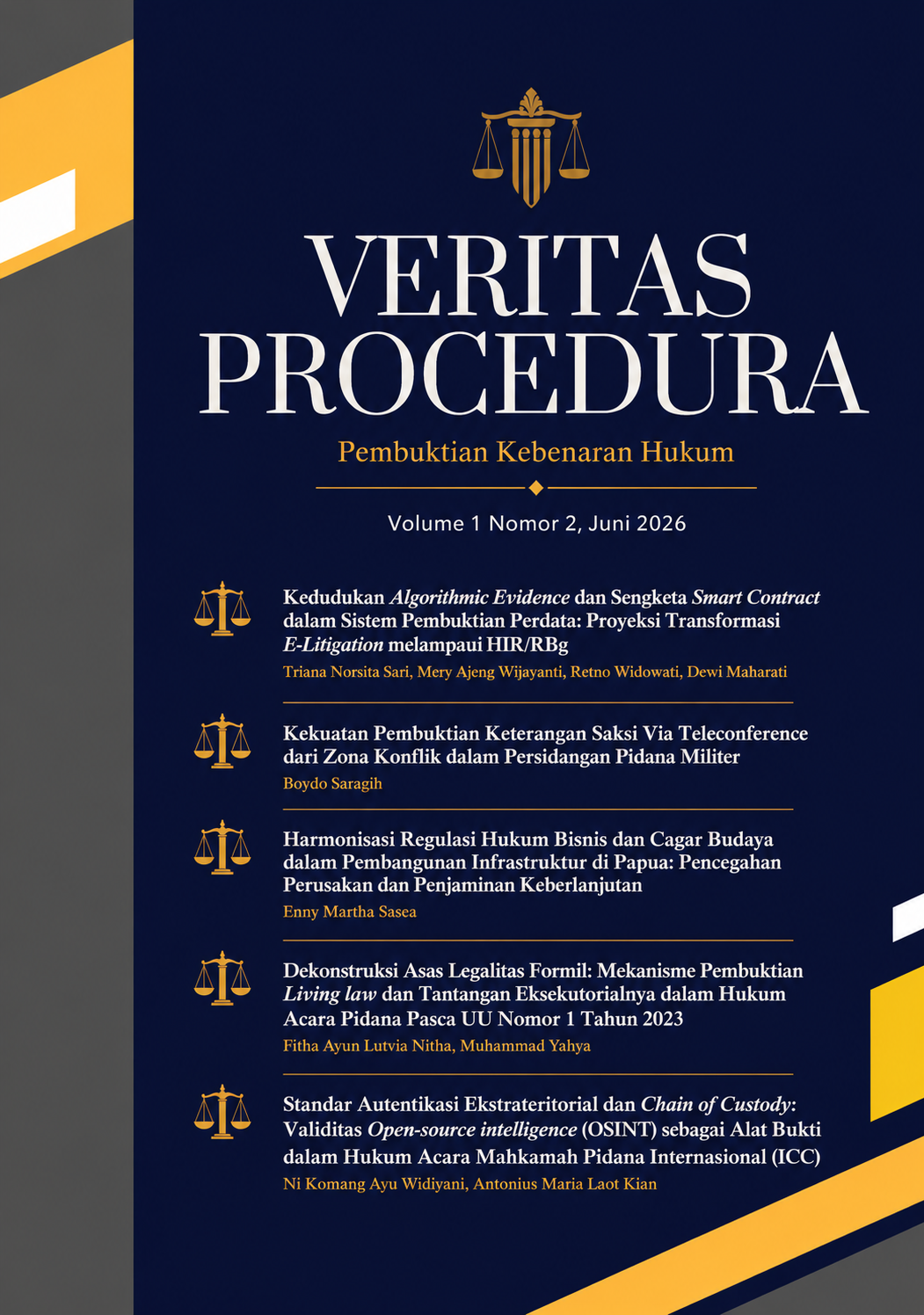
Dekonstruksi Asas Legalitas Formil: Mekanisme Pembuktian Living Law dan Tantangan Eksekutorialnya dalam Hukum Acara Pidana Pasca UU Nomor 1 Tahun
Keywords:
formal legality, living law, criminal evidence, ; customary criminal offence;, executionAbstract
The enactment of Law Number 1 of 2023 on the Criminal Code and Law Number 20 of 2025 on the Criminal Procedure Code marks a paradigmatic shift in Indonesian criminal justice. Article 2 of the Criminal Code recognises the living law within society as a basis for punishment, partially deconstructing the principle of formal legality (nullum crimen sine lege scripta) that had governed the colonial Wetboek van Strafrecht. This article examines, through a normative juridical method using statutory and conceptual approaches, how that recognition is operationalised after Government Regulation Number 55 of 2025 and how customary offences are to be proven and executed under the new Criminal Procedure Code. It argues that the recognition does not abandon formal legality but re-channels it: an unwritten norm becomes a punishable offence only after being formalised in a regional regulation, so that what appears to be material legality operates, procedurally, as a deferred form of formal legality. The principal problems are evidentiary and executorial. The new evidentiary regime, which abolishes the category of indications and demands authentication and lawful acquisition of evidence, struggles to accommodate the proof of a customary norm whose existence is a normative-sociological fact rather than an ordinary event. Meanwhile, the customary-obligation sanction creates execution difficulties because it depends on communal mechanisms outside the state apparatus. The article concludes that legal certainty and human-rights protection require strict normative parameters, a clear evidentiary standard for expert proof of living law, and an integrated execution scheme.
References
A. Books
Arief, Barda Nawawi. Bunga Rampai Kebijakan Hukum Pidana. Bandung: Citra Aditya Bakti, 1996.
Ehrlich, Eugen. Fundamental Principles of the Sociology of Law. Cambridge, MA: Harvard University Press, 1936.
Hamzah, Andi. Hukum Acara Pidana Indonesia. Jakarta: Sinar Grafika, 2014.
Hiariej, Eddy O.S. Teori dan Hukum Pembuktian. Jakarta: Penerbit Erlangga, 2012.
Hiariej, Eddy O.S. Prinsip-Prinsip Hukum Pidana. Edisi revisi. Yogyakarta: Cahaya Atma Pustaka, 2016.
Marzuki, Peter Mahmud. Penelitian Hukum. Jakarta: Kencana, 2017.
Moeljatno. Asas-Asas Hukum Pidana. Jakarta: Rineka Cipta, 2008.
Muladi, dan Barda Nawawi Arief. Teori-Teori dan Kebijakan Pidana. Bandung: Alumni, 1992.
Rahardjo, Satjipto. Ilmu Hukum. Bandung: Citra Aditya Bakti, 2014.
Saleh, Roeslan. Perbuatan Pidana dan Pertanggungjawaban Pidana: Dua Pengertian Dasar dalam Hukum Pidana. Jakarta: Aksara Baru, 1983.
Sasangka, Hari, dan Lily Rosita. Hukum Pembuktian dalam Perkara Pidana. Bandung: Mandar Maju, 2003.
B. Journals Articles
Griffiths, John. ‘What is Legal Pluralism?’. Journal of Legal Pluralism and Unofficial Law 24 (1986).
Ravizki, Eka Nanda, dkk. ‘Tinjauan Terhadap Asas Legalitas dan Hukum yang Hidup dalam Masyarakat sebagai Dasar Pemidanaan Menurut UU No. 1 Tahun 2023’. Jurnal Sosial Humaniora dan Pendidikan (Inovasi) (2025).
Widayati, Lidya Suryani. ‘Perluasan Asas Legalitas dalam RUU KUHP’. Negara Hukum: Jurnal Ilmu Hukum 2(2) (2011).
C. Legislation
Undang-Undang Dasar Negara Republik Indonesia Tahun 1945.
Undang-Undang Darurat Nomor 1 Tahun 1951 tentang Tindakan-Tindakan Sementara untuk Menyelenggarakan Kesatuan Susunan, Kekuasaan, dan Acara Pengadilan-Pengadilan Sipil.
Undang-Undang Nomor 8 Tahun 1981 tentang Hukum Acara Pidana.
Undang-Undang Nomor 48 Tahun 2009 tentang Kekuasaan Kehakiman.
Undang-Undang Nomor 12 Tahun 2011 tentang Pembentukan Peraturan Perundang-undangan.
Undang-Undang Nomor 1 Tahun 2023 tentang Kitab Undang-Undang Hukum Pidana.
Undang-Undang Nomor 20 Tahun 2025 tentang Kitab Undang-Undang Hukum Acara Pidana.
Peraturan Pemerintah Nomor 55 Tahun 2025 tentang Tata Cara dan Kriteria Penetapan Hukum yang Hidup dalam Masyarakat.
Peraturan Menteri Dalam Negeri Nomor 52 Tahun 2014 tentang Pedoman Pengakuan dan Perlindungan Masyarakat Hukum Adat.
D. Official Reports and Documents
Putusan Mahkamah Konstitusi Nomor 46/PUU-XIV/2016, 14 Desember 2017.
Downloads
Published
How to Cite
Issue
Section
License
Copyright (c) 2026 Muhammad Yahya, Fitha Ayun Lutvia Nitha

This work is licensed under a Creative Commons Attribution 4.0 International License.
Authors who publish with Veritas Procedura agree to the following terms:
Authors retain copyright and grant the Veritas Procedura (VP) right of first publication with the work simultaneously licensed under a Creative Commons Attribution 4.0 International License that allows others to share (copy and redistribute the material in any medium or format) and adapt (remix, transform, and build upon the material) the work for any purpose, even commercially with an acknowledgment of the work's authorship and initial publication in VP.
Authors are able to enter into separate, additional contractual arrangements for the non-exclusive distribution of the journal's published version of the work (e.g., post it to an institutional repository or publish it in a book), with an acknowledgment of its initial publication in Veritas Procedura (VP). Authors are permitted and encouraged to post their work online (e.g., in institutional repositories or on their website) prior to and during the submission process, as it can lead to productive exchanges, as well as earlier and greater citation of published work (See The Effect of Open Access).