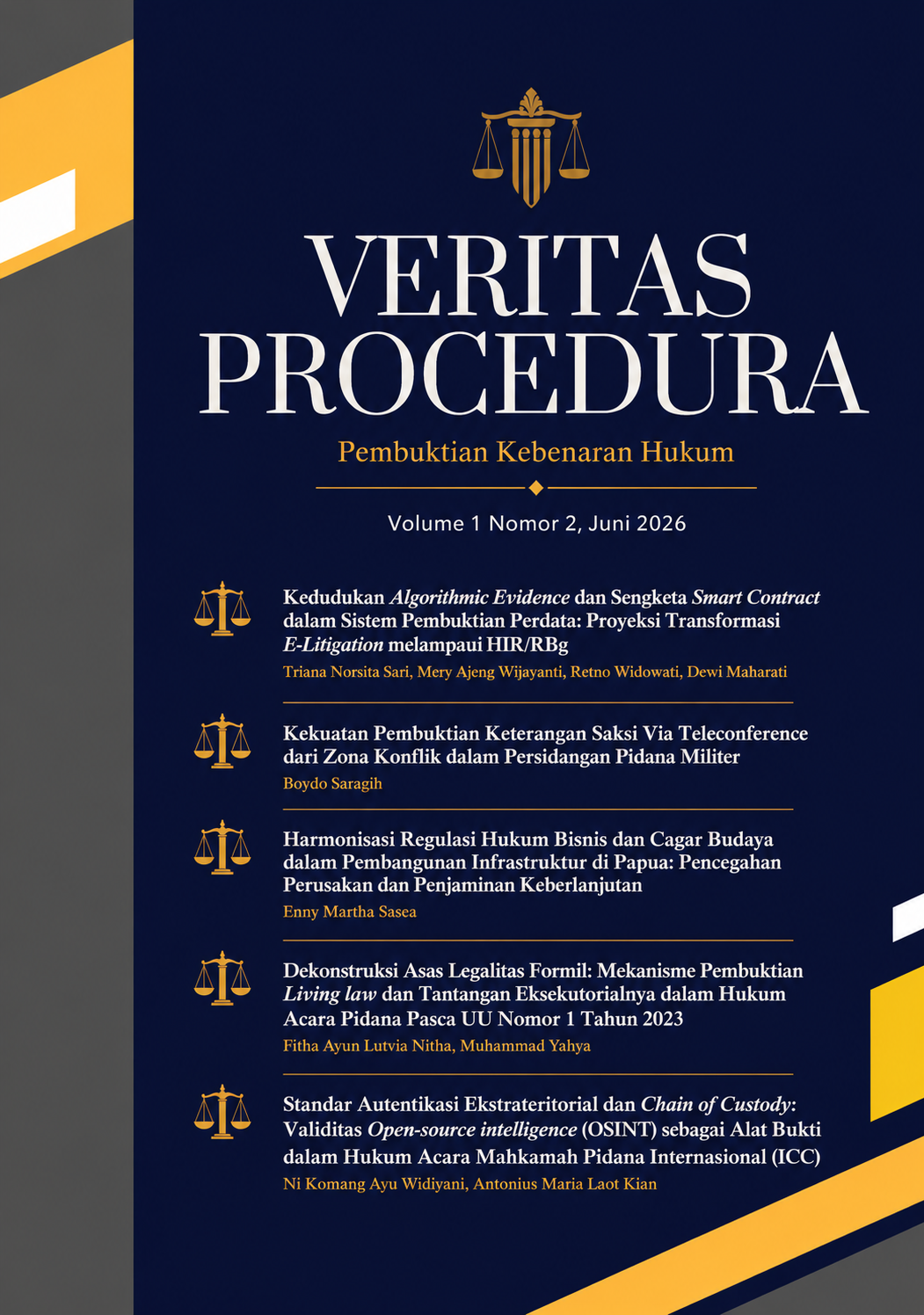
Standar Autentikasi Ekstrateritorial dan Chain of Custody: Validitas Open-Source Intelligence (OSINT) sebagai Alat Bukti dalam Hukum Acara Mahkamah Pidana Internasional (ICC)
Keywords:
OSINT, digital evidence, chain of custody, deepfake, International Criminal CourtAbstract
Modern armed conflicts increasingly generate evidence of war crimes and genocide from open sources, namely amateur videos on social media, satellite imagery, and digital traces documented by civilians. The International Criminal Court has begun relying on such open-source intelligence, most notably in the Al-Werfalli arrest warrant, which was the first to rest largely on social media footage. Yet the Rome Statute and its Rules of Procedure and Evidence do not comprehensively regulate standards for purely digital evidence; they establish a free system of evidentiary assessment that is flexible on admissibility but silent on authentication. This article analyses the validity of open-source intelligence as evidence in ICC procedure and the extraterritorial authentication and digital chain-of-custody standards it demands, then examines how the Court should adapt its evidentiary procedure to verify deepfakes and protect the accused's fair trial rights amid a flood of digital misinformation. Using a normative juridical method with statutory, case, conceptual, and comparative approaches, the article argues that the Court must operationalise emerging standards such as the Berkeley Protocol, establish provenance documentation and hash-verification protocols, build digital forensic capacity and deepfake-detection procedures, and safeguard equality of arms, so that the evidentiary weight of open-source material rests on verifiable provenance rather than apparent persuasiveness.
References
A. Books
Cassese, Antonio, et al. (eds.). The Rome Statute of the International Criminal Court: A Commentary. Oxford: Oxford University Press, 2002.
Marzuki, Peter Mahmud. Penelitian Hukum. Jakarta: Kencana, 2017.
Office of the United Nations High Commissioner for Human Rights dan Human Rights Center University of California, Berkeley. Berkeley Protocol on Digital Open Source Investigations. UN Doc HR/PUB/20/2. New York dan Jenewa: United Nations, 2022.
B. Journal Articles
Chesney, Robert, dan Danielle Keats Citron. ‘Deep Fakes: A Looming Challenge for Privacy, Democracy, and National Security’. California Law Review 107 (2019).
De Arcos Tejerizo, Marina. ‘Digital Evidence and Fair Trial Rights at the International Criminal Court’. Leiden Journal of International Law 36(3) (2023).
Freeman, Lindsay. ‘Digital Evidence and War Crimes Prosecutions: The Impact of Digital Technologies on International Criminal Investigations and Trials’. Fordham International Law Journal 41(2) (2018).
Gabriele, Chiara, Kelly Matheson, dan Raquel Vazquez Llorente. ‘The Role of Mobile Technology in Documenting International Crimes: The Affaire Castro et Kizito in the Democratic Republic of Congo’. Journal of International Criminal Justice 19(1) (2021).
Hamilton, Rebecca J. ‘User-Generated Evidence’. Columbia Journal of Transnational Law 57 (2018).
Koenig, Alexa. ‘“Half the Truth Is Often a Great Lie”: Deep Fakes, Open Source Information, and International Criminal Law’. AJIL Unbound 113 (2019).
C. Online Resources
Irving, Emma. ‘And So It Begins… Social Media Evidence in an ICC Arrest Warrant’. Opinio Juris, 17 Agustus 2017.
D. Legislation
Rome Statute of the International Criminal Court (Statuta Roma), 17 Juli 1998.
Rules of Procedure and Evidence of the International Criminal Court.
E. Court Decisions
Prosecutor v. Al-Werfalli, ICC-01/11-01/17, Warrant of Arrest (Pre-Trial Chamber I, 15 Agustus 2017); Second Warrant of Arrest (4 Juli 2018).
Prosecutor v. Al Mahdi, ICC-01/12-01/15, Judgment and Sentence (27 September 2016).
Prosecutor v. Lubanga Dyilo, ICC-01/04-01/06, Trial Chamber I (Judgment, 14 Maret 2012).
Situation in Ukraine, ICC Pre-Trial Chamber II, Warrants of Arrest (Putin dan Lvova-Belova), 17 Maret 2023.
Situation in the State of Palestine, ICC Pre-Trial Chamber I, Warrants of Arrest (Netanyahu, Gallant, dan Al-Masri/Deif), 21 November 2024.
Downloads
Published
How to Cite
Issue
Section
License
Copyright (c) 2026 Ni Komang Ayu Widiyani, Antonius Maria Laot Kian

This work is licensed under a Creative Commons Attribution 4.0 International License.
Authors who publish with Veritas Procedura agree to the following terms:
Authors retain copyright and grant the Veritas Procedura (VP) right of first publication with the work simultaneously licensed under a Creative Commons Attribution 4.0 International License that allows others to share (copy and redistribute the material in any medium or format) and adapt (remix, transform, and build upon the material) the work for any purpose, even commercially with an acknowledgment of the work's authorship and initial publication in VP.
Authors are able to enter into separate, additional contractual arrangements for the non-exclusive distribution of the journal's published version of the work (e.g., post it to an institutional repository or publish it in a book), with an acknowledgment of its initial publication in Veritas Procedura (VP). Authors are permitted and encouraged to post their work online (e.g., in institutional repositories or on their website) prior to and during the submission process, as it can lead to productive exchanges, as well as earlier and greater citation of published work (See The Effect of Open Access).