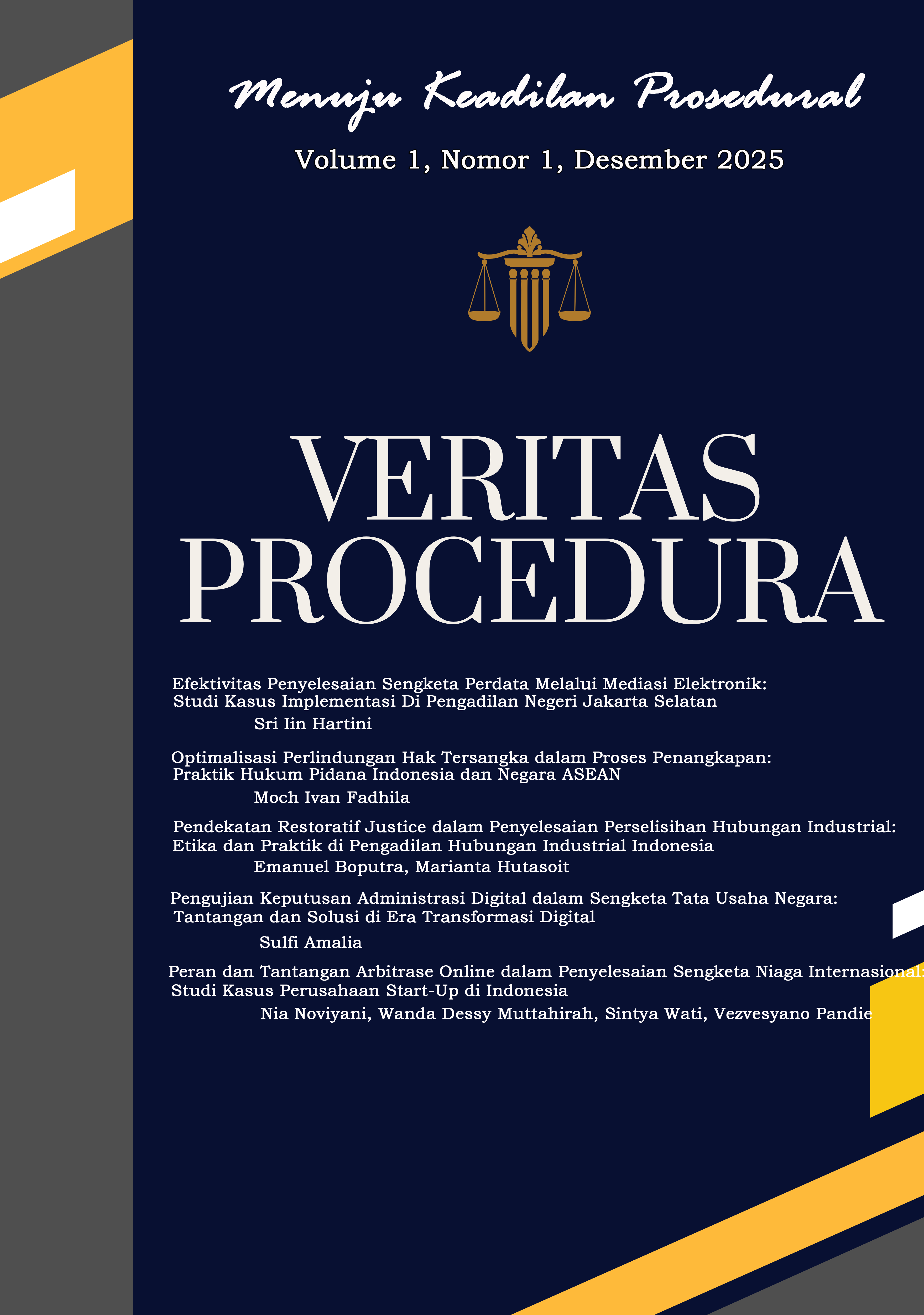
Optimalisasi Perlindungan Hak Tersangka dalam Proses Penangkapan: Studi Perbandingan Praktik Hukum Pidana Indonesia dan Negara ASEAN
Keywords:
Protection of Suspects' Rights, Arrest Process, Criminal Procedure Law, ASEAN Comparison, Judicial Best PracticesAbstract
The protection of suspects' rights during the arrest process is a crucial indicator of the quality of the criminal justice system, where the principle of the presumption of innocence demands mechanisms that prevent arbitrariness. This article analyzes the legal regulations in Indonesia through the 1945 Constitution, the Criminal Procedure Code, and the Human Rights Law, which provide a strong normative basis such as the right to information, legal aid, humane treatment, and family notification, although their implementation is hampered by delays in legal access, warrantless arrests, and allegations of violence, as noted in the 2023 National Human Rights Commission (Komnas HAM) Report. Through a juridical normative approach and comparative studies with ASEAN countries (Malaysia, Singapore, Thailand, the Philippines, and Vietnam), the main points are similarities in legal processes under the ICCPR and the 2012 AHRD, but significant differences in judicial oversight (strict detention hearings in Malaysia and Singapore vs. ex post facto pretrial hearings in Indonesia) and access to legal aid. Best practices such as 24/7 lawyers, video-recorded interrogations, and data transparency are recommended for contextual adaptation for optimization. The conclusion clearly demonstrates the need for reforms that include strengthening judicial oversight and monitoring, contributing to the ASEAN regional rule of law, with suggestions for future empirical research on the impact of technology on human rights violations.
Perlindungan hak tersangka dalam proses penangkapan merupakan indikator krusial kualitas sistem pidana pidana, di mana prinsip praduga tidak bersalah menuntut mekanisme yang mencegah kesewenang-wenangan. Artikel ini menganalisis pengaturan hukum di Indonesia melalui UUD 1945, KUHAP, dan UU HAM, yang memberikan dasar normatif kuat seperti hak informasi, bantuan hukum, perlakuan manusiawi, dan pemberitahuan keluarga, meskipun implementasinya terhambat oleh keterlambatan akses hukum, penangkapan tanpa surat perintah, dan dugaan kekerasan, sebagaimana terjadi dalam Laporan Komnas HAM 2023. Melalui pendekatan normatif yuridis dan studi perbandingan dengan negara-negara ASEAN (Malaysia, Singapura, Thailand, Filipina, Vietnam), utama menunjukkan persamaan dalam proses hukum berdasarkan ICCPR dan AHRD 2012, namun perbedaan signifikan pada pengawasan judicial (sidang penahanan ketat di Malaysia-Singapura vs praperadilan ex post facto di Indonesia) serta akses bantuan hukum. Praktik terbaik seperti pengacara yang bertugas 24/7, interogasi perekaman video, dan transparansi data direkomendasikan untuk adaptasi kontekstual guna optimalisasi. Kesimpulannya jelas perlunya reformasi mencakup penguatan pengawasan dan pemantauan peradilan, yang berkontribusi pada supremasi hukum regional ASEAN, dengan saran penelitian empiris masa depan mengenai dampak teknologi pada pelanggaran hak
References
A. Books
Adami Chazawi, Hukum Pidana Materiil dan Formil Korupsi di Indonesia (Malang: Bayumedia Publishing, 2005).
Andi Hamzah, Hukum Acara Pidana Indonesia, Edisi Kedua (Jakarta: Sinar Grafika, 2014).
Andrew Harding, The Constitution of Malaysia: A Contextual Analysis (Oxford: Hart Publishing, 2012).
Andrew Harding and Penelope Nicholson, eds., New Courts in Asia (London: Routledge, 2010).
C. Raj Kumar and D.K. Srivastava, eds., Human Rights and Criminal Justice in ASEAN (Leiden: Brill Nijhoff, 2015).
Chen Siyuan and Lionel Leo, eds., The Criminal Justice System of Singapore (Singapore: Singapore Academy of Law, 2016).
David T. Johnson and Franklin E. Zimring, The Next Frontier: National Development, Political Change, and the Death Penalty in Asia (Oxford: Oxford University Press, 2009).
Dinah Shelton, ed., International Human Rights Law (Oxford: Oxford University Press, 2013).
Eddy O.S. Hiariej, Prinsip-Prinsip Hukum Pidana (Yogyakarta: Cahaya Atma Pustaka, 2016).
Frans Hendra Winarta, Bantuan Hukum: Suatu Hak Asasi Manusia Bukan Belas Kasihan (Jakarta: Elex Media Komputindo, 2009).
H.P. Lee, Constitutional Conflicts in Contemporary Malaysia (Kuala Lumpur: Oxford University Press, 2017).
Indriyanto Seno Adji, Praperadilan: Instrumen Perlindungan HAM dalam KUHAP (Jakarta: Themis Publishing, 2019).
Jeffrey Pinsler, Evidence and the Litigation Process, 7th ed. (Singapore: LexisNexis, 2020).
Jimly Asshiddiqie, Pengantar Ilmu Hukum Tata Negara (Jakarta: Rajawali Pers, 2009).
Karthigesu Rajasooria, Criminal Procedure in Malaysia and Singapore (Singapore: LexisNexis, 2018).
Kevin Y.L. Tan and Thio Li-ann, Constitutional Law in Malaysia and Singapore, 3rd ed. (Singapore: LexisNexis, 2010).
Lilik Mulyadi, Hukum Acara Pidana: Normatif, Teoretis, Praktik dan Permasalahannya (Bandung: Alumni, 2012).
Manfred Nowak, U.N. Covenant on Civil and Political Rights: CCPR Commentary, 2nd ed. (Kehl: N.P. Engel Publisher, 2005).
M. Yahya Harahap, Pembahasan Permasalahan dan Penerapan KUHAP: Penyidikan dan Penuntutan, Edisi Kedua (Jakarta: Sinar Grafika, 2012).
Nigel S. Rodley dan Matt Pollard, The Treatment of Prisoners under International Law, 3rd ed. (Oxford: Oxford University Press, 2009).
Nik Ramlah Mahmood, Preventive Detention and Human Rights in Malaysia (Kuala Lumpur: SIRD, 2013).
Office of the Council of State Thailand, Criminal Procedure Reform Act B.E. 2560 (2017): Explanatory Notes (Bangkok: Office of the Council of State, 2017).
Open Government Partnership, Open Data in Criminal Justice: Global Best Practices (Washington, D.C.: OGP, 2020).
Philip Eldridge, The Politics of Human Rights in Southeast Asia (London: Routledge, 2002).
Pip Nicholson, ed., Law and Development and the Global Discourses of Legal Transfers (Cambridge: Cambridge University Press, 2013).
Rhona K.M. Smith et al., Hukum Hak Asasi Manusia (Yogyakarta: PUSHAM UII, 2008).
Roger Smith, International Perspectives on Access to Justice (The Hague: Eleven International Publishing, 2010).
Shad Saleem Faruqi, Document of Destiny: The Constitution of the Federation of Malaysia (Petaling Jaya: Star Publications, 2008).
Stanley Yeo, Neil Morgan, and Chan Wing Cheong, Criminal Law in Malaysia and Singapore, 3rd ed. (Singapore: LexisNexis, 2018).
Thio Li-ann, A Treatise on Singapore Constitutional Law, 2nd ed. (Singapore: Academy Publishing, 2020).
Todung Mulya Lubis, Bantuan Hukum dan Kemiskinan Struktural (Jakarta: LP3ES, 1986).
B. Journal Articles
Andrew Ashworth dan Lucia Zedner, "Defending the Criminal Law: Reflections on the Changing Character of Crime, Procedure, and Sanctions," Criminal Law and Philosophy 2, no. 1 (2008): 25-26.
Andrew Ashworth, "Criminal Proceedings After the Human Rights Act: The First Year," Criminal Law Review, 2001: 855-870.
Barak Ariel et al., "The Effect of Police Body-Worn Cameras on Use of Force and Citizens' Complaints," Journal of Quantitative Criminology 31, no. 3 (2015): 509-535.
Benjamin Joshua Ong and Foo Chee Hock, "Pre-Trial Detention and Bail in Singapore," Asian Journal of Comparative Law 15, no. 2 (2020): 234-258.
Cheang Soh Liang, "Access to Legal Advice in Singapore: A Critical Analysis," Singapore Law Review 37 (2019): 145-168.
Erasmus A.T. Napitupulu, "Praperadilan di Indonesia: Fungsi dan Realitas," Jurnal Hukum dan Pembangunan 47, no. 3 (2017): 334-359.
Kumaralingam Amirthalingam and Lau Kwan Ho, "The Right to Counsel Revisited: Restrictions on Access to Legal Advice in Singapore," Singapore Journal of Legal Studies, 2019: 456-479.
Leslie Sebba, "The Right of the Accused to Notification of Relatives," Israel Law Review 12, no. 4 (1977): 502-528.
Michael Hor, "The Criminal Procedure Code 2010: Retrospect and Prospect," Singapore Academy of Law Journal 23, no. 1 (2011): 23-52.
Michael Hor, "Terrorism and the Criminal Law: Singapore's Solution," Singapore Law Review 25 (2007): 30-55.
Roger Smith and Alan Paterson, "Face-to-Face Legal Services and Their Alternatives: Global Lessons from the Digital Revolution," Fordham Urban Law Journal 38, no. 2 (2011): 333-377.
Thio Li-ann, "Soft Constitutional Law and the Management of Religious Liberty and Order in Singapore," Journal of Legal Pluralism and Unofficial Law 63 (2011): 67-89.
Trevor Ryan Guay, "Comparative Analysis of Legal Aid Systems in Southeast Asia," Asian Journal of Law and Society 6, no. 2 (2019): 287-312.
Vitit Muntarbhorn, "Anatomy of an ASEAN Dilemma: The 'Depoliticized' Approach to Human Rights," Contemporary Southeast Asia 4, no. 4 (1983): 371-398.
C. Legislation
ASEAN, ASEAN Human Rights Declaration, adopted 18 November 2012, Phnom Penh.
Indonesia, Undang-Undang Dasar Negara Republik Indonesia Tahun 1945.
Indonesia, Undang-Undang tentang Hukum Acara Pidana, UU No. 8 Tahun 1981, LN No. 76 Tahun 1981, TLN No. 3209.
Indonesia, Undang-Undang tentang Hak Asasi Manusia, UU No. 39 Tahun 1999, LN No. 165 Tahun 1999, TLN No. 3886.
Indonesia, Undang-Undang tentang Bantuan Hukum, UU No. 16 Tahun 2011, LN No. 104 Tahun 2011.
Indonesia, Undang-Undang tentang Pengesahan Convention Against Torture, UU No. 5 Tahun 1998, LN No. 164 Tahun 1998.
Kepolisian Negara Republik Indonesia, Peraturan Kepala Kepolisian Negara Republik Indonesia Nomor 8 Tahun 2009, 17 Juli 2009.
Malaysia, Criminal Procedure Code.
Malaysia, Federal Constitution.
Philippines, Constitution 1987.
Singapore, Constitution of the Republic of Singapore.
Singapore, Criminal Justice Reform Act 2018.
Singapore, Criminal Procedure Code.
Singapore, Evidence Act.
Singapore, Internal Security Act.
Thailand, Constitution B.E. 2560 (2017).
United Nations, International Covenant on Civil and Political Rights.
United Nations General Assembly, Body of Principles for the Protection of All Persons under Any Form of Detention or Imprisonment, Resolution 43/173, 9 December 1988.
United Nations, Convention Against Torture, adopted 10 December 1984, 1465 UNTS 85.
United Nations Human Rights Committee, General Comment No. 35: Article 9, CCPR/C/GC/35, 16 December 2014.
Vietnam, Constitution 2013.
D. Case Law
Mahkamah Konstitusi, Putusan Nomor 013/PUU-I/2003, 16 Desember 2004.
Malaysia, Security Offences (Special Measures) Act 2012 (Act 747); Nordin Salleh v Public Prosecutor [2014] 4 MLJ 561.
Malaysia, Criminal Procedure Code, Section 117; Public Prosecutor v Datuk Seri Anwar Ibrahim [2015] 1 MLJ 153.
E. Official Reports and Documents
Asia-Pacific Human Rights Information Center, Human Rights Education in Asian Schools Vol. VIII (Osaka: HURIGHTS, 2018).
Human Rights Watch, Creating a Culture of Fear: The Criminalization of Peaceful Expression in Malaysia (New York: HRW, 2015).
Kittipong Kittayarak, "Bail and Pre-Trial Detention in Thailand: Law, Practice and Challenges," in Pre-Trial Detention in the ASEAN Region, ed. Carolyn Hoyle and Mai Sato (London: Routledge, 2019).
Komisi Nasional Hak Asasi Manusia, Laporan Tahunan Komnas HAM 2023 (Jakarta: Komnas HAM, 2023).
Law Society of Singapore, Criminal Legal Aid Scheme Guidelines 2015 (Singapore: Law Society, 2015).
Malaysian Bar Council, Access to Justice Report 2022 (Kuala Lumpur: Malaysian Bar, 2022).
National Legal Aid Foundation Malaysia, Annual Report 2022 (Kuala Lumpur: YBGK, 2022).
Open Society Justice Initiative, Pretrial Detention and Torture: Why Pretrial Detainees Face the Greatest Risk (New York: Open Society Foundations, 2011).
Singapore Police Force, Annual Report 2022 (Singapore: SPF, 2022).
Singapore State Courts, Annual Report 2022 (Singapore: State Courts, 2022).
Singapore Police Force, Police Gazette 2018: Guidelines on Duty Lawyer Scheme (Singapore: SPF, 2018).
SUARAM, Malaysia Human Rights Report 2022: Civil and Political Rights (Petaling Jaya: SUARAM, 2022).
SUHAKAM, Annual Report 2022 (Kuala Lumpur: SUHAKAM, 2022).
Downloads
Published
How to Cite
Issue
Section
License
Copyright (c) 2025 Moch Ivan Fadhila

This work is licensed under a Creative Commons Attribution 4.0 International License.
Authors who publish with Veritas Procedura agree to the following terms:
Authors retain copyright and grant the Veritas Procedura (VP) right of first publication with the work simultaneously licensed under a Creative Commons Attribution 4.0 International License that allows others to share (copy and redistribute the material in any medium or format) and adapt (remix, transform, and build upon the material) the work for any purpose, even commercially with an acknowledgment of the work's authorship and initial publication in VP.
Authors are able to enter into separate, additional contractual arrangements for the non-exclusive distribution of the journal's published version of the work (e.g., post it to an institutional repository or publish it in a book), with an acknowledgment of its initial publication in Veritas Procedura (VP). Authors are permitted and encouraged to post their work online (e.g., in institutional repositories or on their website) prior to and during the submission process, as it can lead to productive exchanges, as well as earlier and greater citation of published work (See The Effect of Open Access).