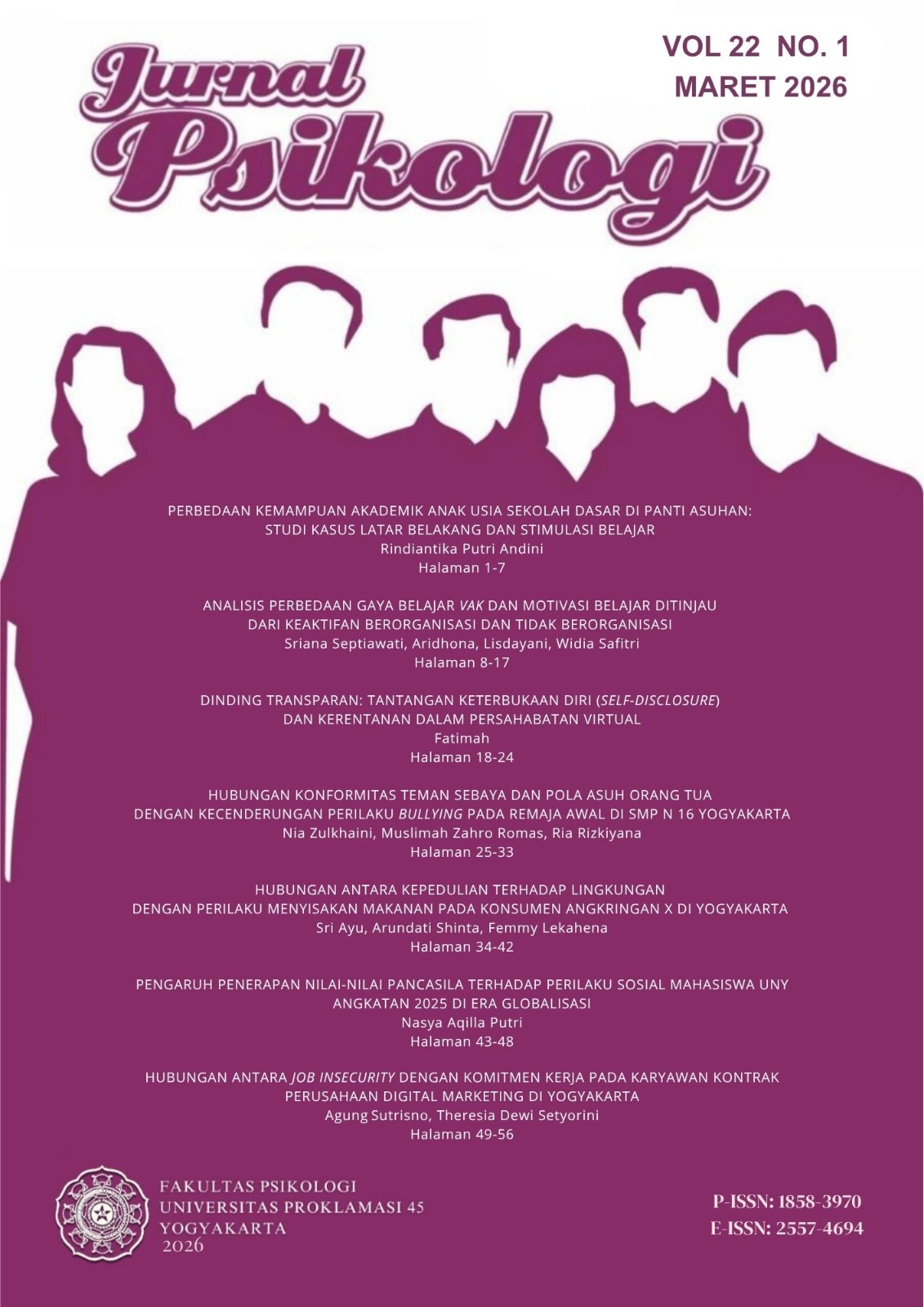
Analisis Perbedaan Gaya Belajar VAK dan Motivasi Belajar Ditinjau dari Keaktifan Berorganisasi dan Tidak Berorganisasi
DOI:
https://doi.org/10.30588/jpsi.v22i1.2551Keywords:
Learning styles, VAK, Motivation, OrganizationAbstract
Adolescents often feel pressured to conform to their peers, particularly in terms of physical appearance, behavior, and social values. The current phenomenon of adolescent problems is diverse, encompassing psychological, social, and educational challenges. Education is an activity that is inseparable from the learning process, both inside and outside the classroom. The Student Council (OSIS) serves as a forum for student development aimed at developing students' interests, talents, and potential holistically. Learning styles are preferred ways of thinking, processing, and understanding information. The root of the educational crisis is ineffective learning. Learning motivation is a change in energy within an individual characterized by the emergence of affective feelings and reactions in achieving goals. This study aims to analyze the differences in learning styles (VAK) and Learning Motivation in terms of Organizational and Non-Organizational Engagement. The data collection method used was a questionnaire on learning styles (VAK) and Learning Motivation. Overall, the Spearman coefficient (ρ = 0.284) indicates a weak positive relationship between learning styles and learning motivation. A p-value of 0.002 indicates that this relationship is statistically significant (p < 0.05). This means that, although not strong, there is a tendency for certain learning styles, particularly kinesthetic learning, to be associated with higher levels of learning motivation. This finding underscores the importance of learning approaches that support active and enjoyable learning styles in maintaining or enhancing student learning motivation.
References
Anugraheni, A. R., Separina, C. A., Paramitasari, S. P., Vionita, V. K., & Husna, A. N. 2019. Skala motivasi belajar: konstruksi dan analisis psikometri. In Prosiding University Research Colloquium (pp. 66-69).
Cahyono, W., Rahmawati, A. D., & Mashuri, A. 2023. Analisis kemampuan komunikasi matematis berdasarkan gaya belajar pada materi pola bilangan. Jurnal Jendela Matematika, 1(2), 57-62.
Fitriyani, R. (2019). Hubungan antara Gaya Belajar VAK dengan Motivasi Belajar Siswa SMP Negeri di Kota Bandung. Jurnal Psikologi Pendidikan, 10(1), 45–53.
Hamalik, O.2004. Psikologi Belajar dan Mengajar. Bandung: Sinar Baru Algensindo.
Hamzah B. Uno. 2017. Teori Motivasi dan Pengukurannya (Analisis di bidang pendidikan). Jakarta: Bumi Aksara
Handayani, R. (2020). Perbedaan Motivasi Belajar antara Siswa Laki-laki dan Perempuan pada Pembelajaran Jarak Jauh. Jurnal Pendidikan, 28(2), 101–109.
Herlina, S., & Suryadi, T. (2020). Analisis Tingkat Motivasi Belajar Siswa SMA dan Faktor yang Mempengaruhinya. Jurnal Pendidikan Karakter, 11(1), 43–52.
Himma, T., & Nugroho, A. S. 2023. Vox edukasi : Jurnal ilmiah ilmu pendidikan analisis gaya belajar siswa dalam pembelajaran IPAS di Kelas IV UPT SDN 19 Gresik. 14, 330–340.
Kurniawan, A., & Rahayu, S. (2018). Perbedaan Motivasi Belajar Berdasarkan Jenis Kelamin pada Siswa SMP. Jurnal Psikologi Pendidikan dan Konseling, 5(1), 45–53.
Latifah, N., & Mulyani, E. (2018). Faktor-faktor yang Mempengaruhi Motivasi Belajar pada Siswa Kelas XI SMA di Kota Semarang. Jurnal Psikologi Pendidikan dan Konseling, 4(2), 88–97.
Mas' uda, N. A., Paryontri, R. A., & Fahmawati, Z. N. 2024. Hubungan keaktifan berorganisasi dan motivasi belajar siswa dengan prestasi akademik di Sekolah Menengah Kejuruan. G-Couns: Jurnal Bimbingan dan Konseling, 9(1), 574-587.
Pew Research Center. 2020. The State of Gen Z: Trends in Social Media and Technology. Retrieved from Pew Research Center.
Purnamasari, Y. (2021). Pengaruh Gaya Belajar terhadap Motivasi Belajar Siswa Kelas XI di SMA Negeri 4 Bekasi. Jurnal Ilmiah Pendidikan, 7(3), 123–132.
Putra, M. I., & Fitria, T. N. (2021). Pengaruh Keaktifan Organisasi terhadap Keterampilan Sosial dan Motivasi Belajar Siswa SMA. Jurnal Bimbingan Konseling, 10(1), 15–22.
Rahmat, A., Askolani, A., & Rahwana, K. A. 2023. Pengaruh keaktifan berorganisasi dan motivasi belajar terhadap prestasi akademik. Pusat Publikasi Ilmu Manajemen, 1(4), 137-150.
Rahmawati, L., & Subandi, M. (2020). Faktor-faktor yang Mempengaruhi Motivasi Belajar pada Siswa Sekolah Menengah Pertama. Psikodimensia, 19(1), 34–41.
Reksa. 2021. https://ditsmp.kemdikbud.go.id/osis-organisasi-siswa-intra-sekolah-melatih-anak-smp-menjadi-seorang-pemimpin/
Rezki, F., Cyntia, C., Zuhel, A. S., Pangestu, A., & Zulkifli, H. 2023. Hubungan gaya belajar visual, auditori dan kinestik terhadap peningkatan kecerdasan verbal-linguistik. Inspirasi Dunia: Jurnal Riset Pendidikan Dan Bahasa, 2(1), 01-08.
Riduwan. 2014. Metode Dan Teknik Menyusun Proposal Penelitian. Bandung : Alfabeta.
Sardiman. 2014. Interaksi dan Motivasi Belajar-Mengajar. Jakarta:Rajawali Pers.
Sari, D. P., & Hidayat, T. (2021). Distribusi Gaya Belajar VAK pada Siswa SMA Negeri 2 Bandung. Jurnal Penelitian Pendidikan, 28(1), 55–63.
Shoimin, A.2014. Model Pembelajaran Inovatif dalam Kurikulum 2013. Yogyakarta: Ar-Ruzz Media.
Sugianto, A. 2021. Kuesioner Gaya Belajar Siswa. Repo-Dosen. Ulm. Ac. Id, 1-6.
Sugiono, D. 2020. Metode Penelitian Administrasi.
Susanti, N. (2022). Pengaruh Keaktifan Berorganisasi terhadap Prestasi Akademik dan Motivasi Belajar Mahasiswa. Jurnal Manajemen Pendidikan, 5(2), 88–97.
Susanti, N. (2022). Pengaruh Keaktifan Berorganisasi terhadap Prestasi Akademik dan Motivasi Belajar Mahasiswa. Jurnal Manajemen Pendidikan, 5(2), 88–97
Twenge, J. M. 2017. Igen: Why Today's Super-Connected Kids Are Growing Up Less Rebellious, More Tolerant, Less Happy—and Completely Unprepared for Adulthood. Atria Books.
Wilda, A. 2017. Upaya guru dalam mengatasi diferensiasi gaya belajar siswa pada mata pelajaran fikih (Studi kasus di MAN 2 Ponorogo). (Disertasi), IAIN Ponorogo
Winkel, WS. 2009. Psikologi Pendidikan dan Evaluasi Belajar. Jogjakarta: Media Abadi
Yunita, L. (2019). Preferensi Gaya Belajar Siswa Sekolah Menengah dan Implikasinya terhadap Strategi Mengajar. EduHumaniora, 11(2), 134–142.
Downloads
Published
How to Cite
Issue
Section
License
Copyright (c) 2026 sriana, Aridhona Aridhona, Lisdayani Lisdayani, Widia Safitri

This work is licensed under a Creative Commons Attribution 4.0 International License.
Authors retain copyright and grant the Jurnal Psikologi right of first publication with the work simultaneously licensed under a Creative Commons Attribution 4.0 International License that allows others to share (copy and redistribute the material in any medium or format) and adapt (remix, transform, and build upon the material) the work for any purpose, even commercially with an acknowledgment of the work's authorship and initial publication in Jurnal Psikologi.
Authors are able to enter into separate, additional contractual arrangements for the non-exclusive distribution of the journal's published version of the work (e.g., post it to an institutional repository or publish it in a book), with an acknowledgment of its initial publication in Jurnal Psikologi. Authors are permitted and encouraged to post their work online (e.g., in institutional repositories or on their website) prior to and during the submission process, as it can lead to productive exchanges, as well as earlier and greater citation of published work (See The Effect of Open Access).