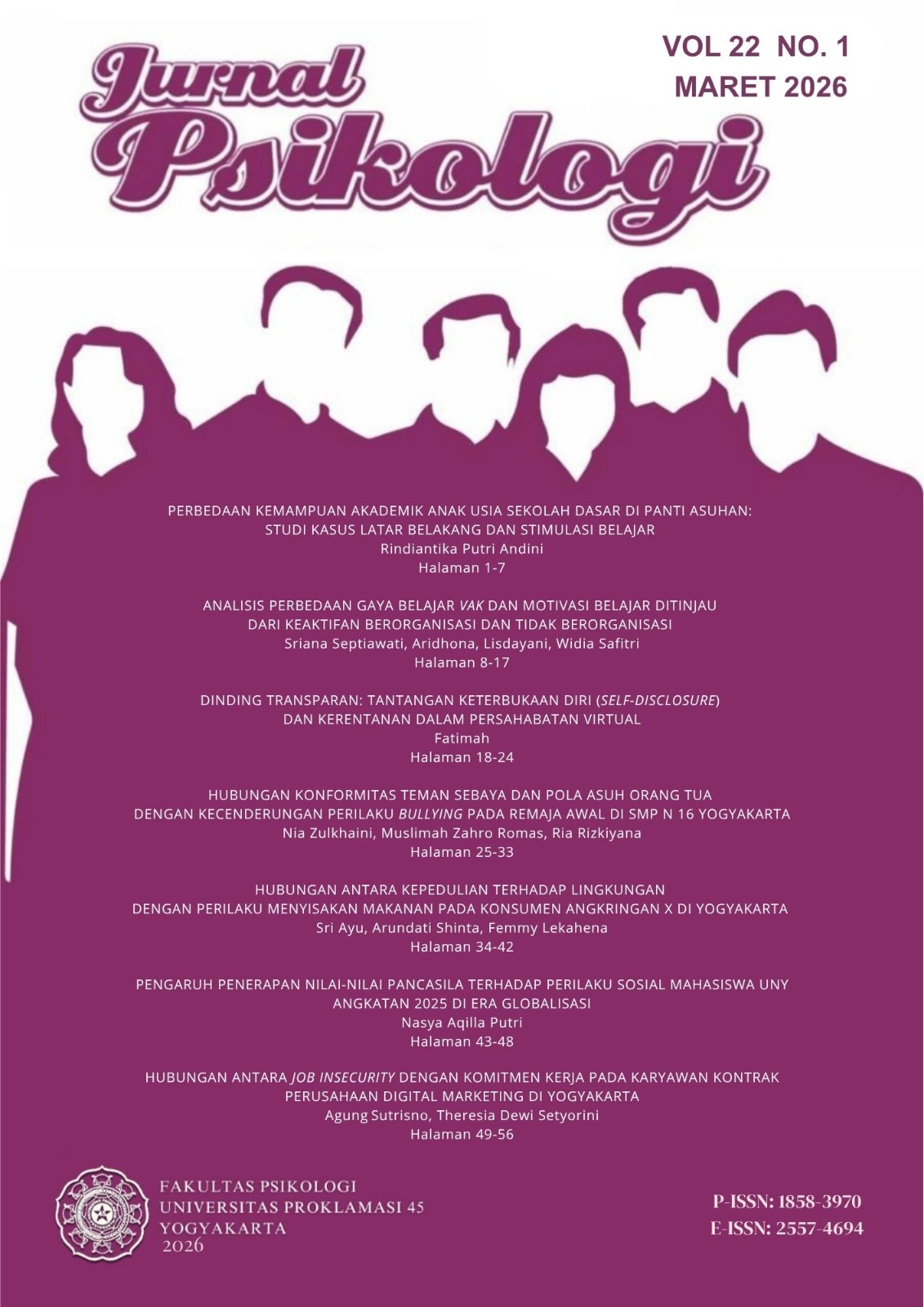
Hubungan Konformitas Teman Sebaya dan Pola Asuh Orang Tua dengan Kecenderungan Perilaku Bullying pada Remaja Awal di SMP N 16 Yogyakarta
DOI:
https://doi.org/10.30588/jpsi.v22i1.2393Keywords:
Peer Conformity, Parenting Styles, Bullying TendenciesAbstract
This study aimed to examine the relationship between peer confformity and parenting styles and the tendency to engage in bullying behavior among early adolescents at SMP N 16 Yogyakarta. The tendency to engage in bullying behavior is defined as a deliberete intetion to harm others physically, verbally, or psychologically. Factors influencing this tendency include peer conformity and parenting styles. The research employed a quantitative method with cluster random sampling, involving a total of 128 students. The instruments used in this study comprised a significant relationship between peer conformity and parenting styles and the tendency to engage in bullying behavior among early adolescents at SMP N 16 Yogyakarta (r = 0,145).
References
Agisyaputri, E., Nadia, A, N., & Ipah, S. (2023). Identifikasi fenomena perilaku bullying pada remaja. Jurnal Bimbingan Konseling dan Psikologi. 3(1), 19-30.
Akbar, M. I. I., & Mohammad, Z. F. (2022). Hubungan pola asuh otoriter orang tua dengan perilaku bullying pada remaja. Jurnal Ilmiah Permas: Jurnal Ilmiah STIKES Kendal. 12(4), 863-870.
Baumrind, D. (1991). The influence of parenting style on adolescent competence and substance use. Jurnal of Early Adolescense. 11(1), 56-95.
Bulu, Y., Neni. M., & Sulasmini. (2019). Faktor-faktor yang mempengaruhi perilaku bullying pada remaja awal. Jurnal Nursing News. 4(1), 54-66.
Cahya, E. N., Andik, M., & Amanda, P. R. (2019). Hubungan antara konformitas teman sebaya dan regulasi emosi dengan kecenderungan perilaku bullying pada remaja. Jurnal Insight. 15(1), 124-136.
Fajarwati, R. (2015). “Pengaruh konsep dir, konformitas teman sebaya dan pola asuh orang tua terhadap perilaku bullying siswa SD an-nisaa’ tangerang selatan”.Tesis. Jakarta: Fakultas Psikologi. Universitas Islam Negeri Syarif Hidayatullah Jakarta.
Fajri, A. D. (2021).” Hubungan antara konformitas teman sebaya dengan perilaku bullying pada siswa kelas XI SMA Negeri 14 kota Pekanbaru”. Skirpsi. Riau: Program Studi Psikologi Fakultas Psikologi. Universitas Islam Negeri Sultan Syarif Kasim Riau.
Isroani, F., Syahruddin, M., Ahmad, Q., Putri, H.P., & Andi, R.K. (2023). Psikologi Perkembangan. Sumatera Barat: Mitra Cendekia Media.
Jayadi, Y. I., Fatmawati, M., & Khaeratul, E. (2020). Prevention of bullying in SD inpres balang-bakang students. Jurnal Pengabdian Masyarakat. 1(2), 9-18.
Lala, E. A., Marhisar, S., & Wina, L. R. (2021). Konforitas teman sebaya dan perilaku bullying di SMP Negeri 6 karawang. Jurnal Psikologi Prima. 4(1), 12-19.
Liu, Z., Liu, H., Zheng, J., Bao, Y., Zhao, S., & Yu, Y. (2024). Prevalence and associated factors of scholl bullying among adolescents in inner mongolia, china. Heliyon. 10(9), e32322.
Meilani, N. P. K., & David, H. T. (2023). Dampak konformitas teman sebaya pada remaja: Systematic review. Jurnal of Social Science Research. 3(5), 2544-2559.
Myers, D. G. (2012). Psikologi Sosial Jilid 2. Jakarta: Salemba Humanika.
Noya, A., Josias, T., & Erlin, K. Analis faktor-faktor penyebab perilaku bullying pada remaja. Humanligh Journal of Psychology. 5(1), 1-16.
Olweus, D. (1993). Bullying at scholl: What we know and what we can do. Cornwall: Blackwell Publishing.
Rahmat, N.I., Intan, D.H., & Muhammad, N. (2023). Analisis faktor-faktor yang menyebabkan bullying di madrasah ibtidaiyah. Jurnal Basicedu. 7(6), 3804-3815.
Rizki, F., & Agung, A. (2020). Faktor-faktor yang berhubungan dengan perilaku bullying pada remaja di sekolah menengah pertama di bandar lampung. Jurnal Keperawatan Sriwijaya. 7(1), 26-33.
Saputri, L. (2022). Pengaruh pola asuh orang tua terhadap perilaku bullying siswa SMP N 1 wedung. Jurnal Bimbingan dan Konseling. 7(1), 98-113.
Siregar, S. (2013). Metode Penelitian Kuantitatif. Jakarta: Kencana.
Spernes, K. (2020). The transition between primary and secondary school: A thematic review emphasising social and emotional issues. Research Papers in Education. 37(1), 1-18.
Sunny, S., Oktavianto, E., Timiyatun, E., Keperawatan, P., Surya, S., & Yogyakarta, G. (2024). Kecerdasan spiritual dan perilaku bullying pada remaja: studi korelasional spiritual intelligence and bullying behaviour in adolescents: a correlation study. Jurnal Penelitian Kesehatan. 1(1), 47-52.
Tis’Ina, N. A., & Suroso. (2015). Pola asuh otoriter, konformitas dan perilaku bullying. Jurnal Psikologi Indonesia. 4(2), 153-161.
Wulandari, D., Nelwati., & Reni, D. (2024). Hubungan pola asuh orang tua, lingkungan teman sebaya, dan lingkungan sekolah dengan perilaku bullying pada remaja di SMK kota payakumbuah tahun 2023. Jurnal Ners. 8(1), 144-153.
Wylie, E., Vaillancourt, T., & Mcdougall, P. (2023). Bullying involvement and the trantition to high school: A brief report. Aggressive Behavior. 49(1), 5-12.
Downloads
Published
How to Cite
Issue
Section
License
Copyright (c) 2026 Nia Zulkhaini, Muslimah Zahro Romas, Ria Rizkiyana

This work is licensed under a Creative Commons Attribution 4.0 International License.
Authors retain copyright and grant the Jurnal Psikologi right of first publication with the work simultaneously licensed under a Creative Commons Attribution 4.0 International License that allows others to share (copy and redistribute the material in any medium or format) and adapt (remix, transform, and build upon the material) the work for any purpose, even commercially with an acknowledgment of the work's authorship and initial publication in Jurnal Psikologi.
Authors are able to enter into separate, additional contractual arrangements for the non-exclusive distribution of the journal's published version of the work (e.g., post it to an institutional repository or publish it in a book), with an acknowledgment of its initial publication in Jurnal Psikologi. Authors are permitted and encouraged to post their work online (e.g., in institutional repositories or on their website) prior to and during the submission process, as it can lead to productive exchanges, as well as earlier and greater citation of published work (See The Effect of Open Access).