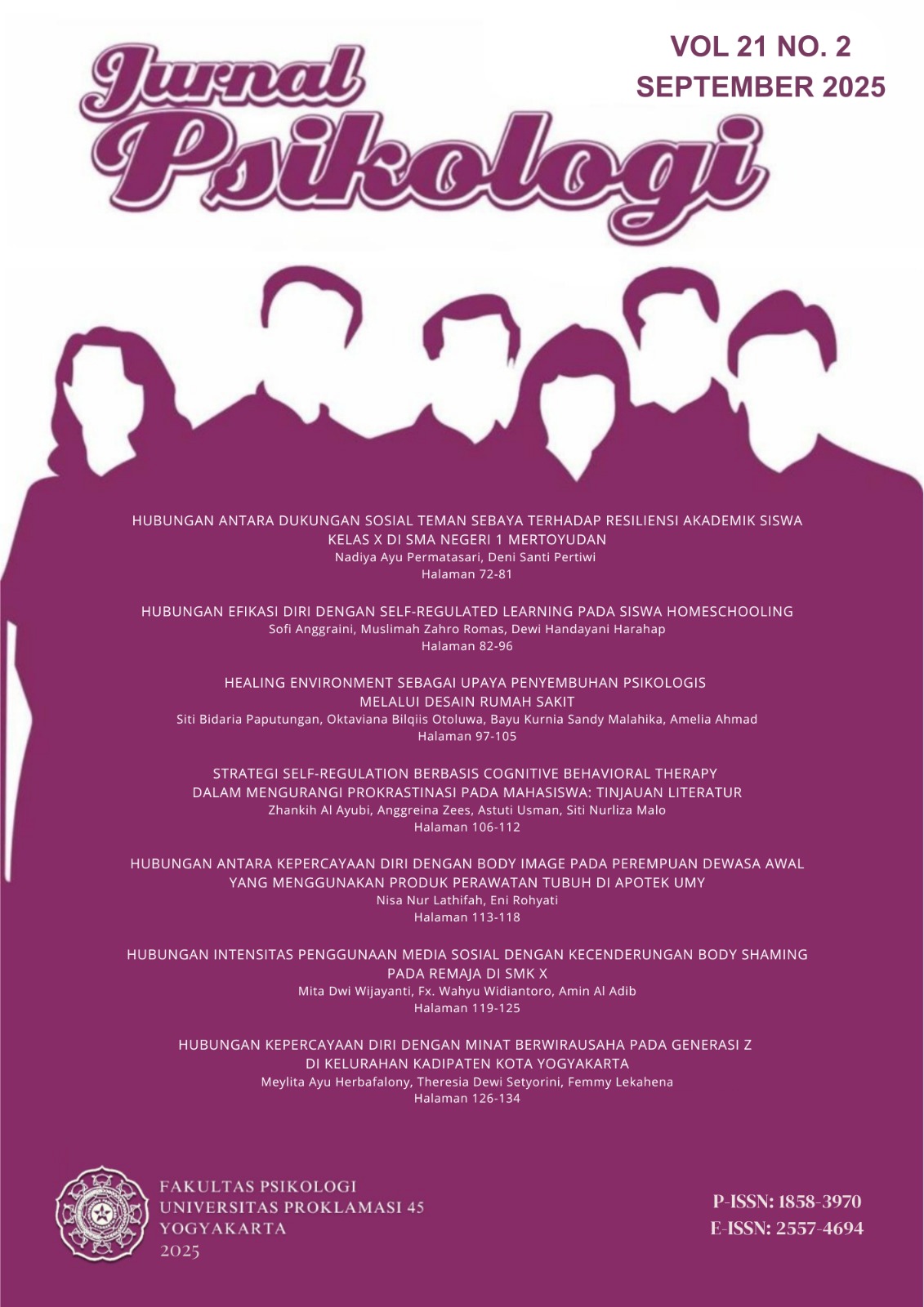
Hubungan Intensitas Penggunaan Media Sosial Dengan Kecenderungan Body Shaming Pada Remaja Di SMK X
DOI:
https://doi.org/10.30588/jpsi.v21i2.2512Keywords:
Intensity of Social Media Use, Body Shaming Tendencies, TeenagersAbstract
This study aims to examine the relationship between the intensity of social media use and the tendency for body shaming among teenagers at Vocational School physically yourself or others. This research uses a quantitative method with a purposive sampling technique. The sample for this research was 86 students of SMK X. The research instruments used were a social media usage intensity scale and a body shaming tendency scale which had been tested for validity and reliability. The results of data analysis show that there is a positive and significant relationship between the intensity of social media use and the tendency for body shaming among teenagers at SMK X (r= 0.446). This means that the higher the intensity of social media use, the higher the tendency for body shaming, and vice versa.
References
Ajzen, I. (2005). Attitudes, Personality and Behaviour. McGraw-hill education (UK).
Achmad D. (2021). Peningkatan Kesadaran Hukum Mahasiswa terhadap Kejahatan Body Shaming dan Cyber Bullying di Universitas Muhammadiyah Metro. Jurnal Sumbangsih, 2(1), 105-111.
Atsila, R. I., Satriani, I., & Adinugraha, Y. (2021). Perilaku Body Shaming dan dampak psikologis pada Mahasiswa kota Bogor. KOMUNIKATIF: Jurnal Ilmiah Komunikasi, 10(1), 84-101.
Damanik, M. J., Syafrudin Kalo, S. H., Ekaputra, M., SH, M., & Jelly Leviza, S. H. (2021). Problematika Body Shaming Pada Media Sosial Dikaitkan Dengan Undang Undang Nomor 11 Tahun 2008 Tentang Informasi dan Transaksi Elektronik Sebagaiman Diubah Dengan Undang Undang Nomor 19 Tahun 2016. Jurnal Justiqa, 3(2), 64-76.
Dolezal, L. (2015). The body and shame: Phenomenology, feminism, and the socially shaped body. Lexington Books.
Fauzia, T. F., & Rahmiaji, L.R. (2019). Memahami Pengalaman Body Shaming Pada Remaja Perempuan. Interaksi Online, 7(3), 238-248.
Geofani, D. (2019). Pengaruh cyberbullying body shaming pada media sosial instagram terhadap kepercayaan diri wanita karir di Pekanbaru. Jurnal Online Mahasiswa (JOM) Bidang Ilmu Sosial dan Ilmu Politik, 6(2), 1-15.
Hurlock, Elizabeth B. (2003). Psikologi Perkembangan. Jakarta: Erlangga.
Islamiyah, H. (2020). Pengaruh Intensitas Menggunakan Tik Tok terhadap Perilaku Body Shaming Anak. ORASI: Jurnal Dakwah dan Komunikasi, 11, 205.
Khairun, A. A., Equatora, M. A., Zulyadi, T., & Saputra, H. (2023). Penyuluhan Body Shaming di SMA Negeri 1 Darul Imarah Aceh Besar. Indonesian Journal of Community Services, 2(1), 5-8.
Libing, V., Lerik, M. D. C., & Kiling, I. Y. (2021). The Experience as a Victim of Bullying and Body Image Perception in Adolescents. Journal of Health and Behavioral Science, 3(1), 58-68.
Ramadhany, H. N. S., & Putri, K. Y. S. (2021). The Effect of Body Shaming on Instagram on Student's Confidence. HUMANISMA: Journal of Gender Studies, 5(2), 184-192.
Sakinah. (2018). Ini Bukan Lelucon "Body Shaming, Citra Tubuh, Dampak dan Cara Mengatasinya". eJurnal Emik Vol. 1, No. 12018, 60.
Sartika, Nyimas.Y. (2019). Pengaruh Efikasi Diri, Status Sosial Ekonomi Orang Tua, Dan Intensitas Penggunaan Media Sosial Terhadap Perilaku Konsumsi Mahasiswa Di Fakultas Ekonomi Universitas Negeri Yogyakarta.
Sayekti, E. K. (2022). MITOS MALE BEAUTY STANDRAD DALAM IKLAN MS GLOW MEN VERSI BABE CABITA DAN MARSHEL WIDIANTO DI INSTAGRAM. The Commercium, 5(02), 78-84.
Serni, S., Harmin, S., & Amin, H. (2020). Dampak body shaming siswa SMPN 17 Kendari terhadap perilaku komunikasi. Jurnal Ilmu Komunikasi UHO: Jurnal Penelitian Kajian Ilmu Komunikasi dan Informasi, 5(2), 132-140.
Supratiknya. (2014). Pengantar Psikologis. Yogyakarta: Universitas Sanata Dharma.
Udayana, J. P. (2015). Hubungan kebutuhan afiliasi dengan intensitas penggunaan jejaring sosial twitter pada remaja akhir. Jurnal Psikologi Udayana, 2(1), 48-58.
Widiastuti, N. L. R. (2016). Profil Citra Tubuh (Body Image) Pada Remaja dan Implikasinya Bagi Bimbingan Konseling: (Studi Deskriptif terhadap Peserta Didik Kelas XI SMA Negeri 1 Sukaresmi Kabupaten Cianjur Tahun Ajaran 2015-2016) (Doctoral dissertation, Universitas Pendidikan Indonesia).
Yuliana, Y., & Muslikah, M. (2021). Hubungan antara Empati dan Konformitas Teman Sebaya dengan Perundungan Verbal Siswa. ENLIGHTEN: Jurnal Bimbingan Konseling Islam, 4(1), 14-19.
Downloads
Published
How to Cite
Issue
Section
License
Copyright (c) 2025 Mita Wijayanti, Fx. Wahyu Widiantoro, Amin Al Adib

This work is licensed under a Creative Commons Attribution 4.0 International License.
Authors retain copyright and grant the Jurnal Psikologi right of first publication with the work simultaneously licensed under a Creative Commons Attribution 4.0 International License that allows others to share (copy and redistribute the material in any medium or format) and adapt (remix, transform, and build upon the material) the work for any purpose, even commercially with an acknowledgment of the work's authorship and initial publication in Jurnal Psikologi.
Authors are able to enter into separate, additional contractual arrangements for the non-exclusive distribution of the journal's published version of the work (e.g., post it to an institutional repository or publish it in a book), with an acknowledgment of its initial publication in Jurnal Psikologi. Authors are permitted and encouraged to post their work online (e.g., in institutional repositories or on their website) prior to and during the submission process, as it can lead to productive exchanges, as well as earlier and greater citation of published work (See The Effect of Open Access).