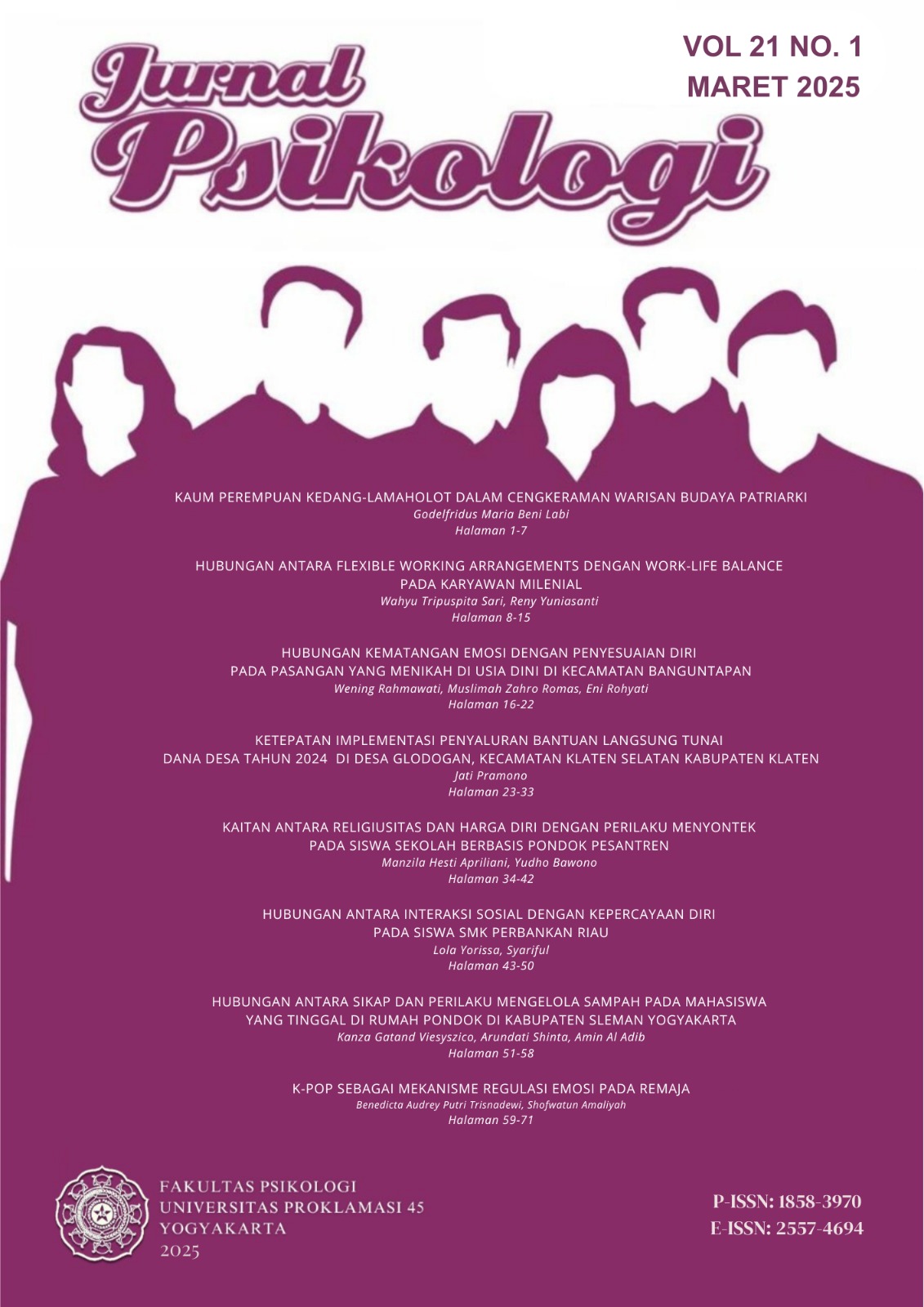
Kaum Perempuan Kedang-Lamaholot Dalam Cengkeraman Warisan Budaya Patriarki
DOI:
https://doi.org/10.30588/jpsi.v21i1.2167Keywords:
Patriarchal culture, gender stereotype, domestic violence, NTTAbstract
The implementation of rigid patriarchal culture will lead to the phenomenon of gender stereotypes in all aspects of life. Women are only allowed to operate within the feminine (domestic) sphere, while men are confined to the masculine (public) sphere. This situation is vulnerable to causing domestic violence, with women and children being the primary victims. This gender separation also occurs in the society of East Nusa Tenggara (NTT), Indonesia. A strategic approach to address this issue is through government intervention, such as affirmative policies in the fields of education, health, employment, and politics.
References
Ahmad, I., Alam, A., Khan, N. & Ullah, R. (2023). Inequality regimes, patriarchal connectivity, and women’s right to property inheritance in rural Pakistan. Journal of Positive School Psychology. 7(1), 1251-1267. http://journalppw.com
Ascandra, W., Bactiar, N. & Nazer, M. (2019). An economic analysis of women’s employment and divorce. Jurnal Perspektif Pembiayaan dan Pembangunan Daerah. 6(5), Maret – April, 535-544.
Atkinson, R. L., Atiknson, R. C. & Hilgard, E. R. (1983) Pengantar psikologi. Edisi ke-8. Jakarta: Erlangga.
Berry, J. W., Portinga, Y. H., Segall, M. H., & Dasen, P. R. (1999). Psikologi lintas budaya: Riset dan aplikasi. Jakarta: PT Gramedia Pustaka Utama.
Crespi, I. (2003). Gender socialization within the family: A study on adolescents and their parents in Great Britain. Paper prepared for BHPS.
DP2A. (2024). Data kasus kekerasan terhadap perempuan dan anak tahun 2023. Laporan tahunan. Jakarta: Dinas Pemberdayaan Perempuan dan Anak Kabupaten Lembata.
Franzoi, S. L. (2003), Social psychology. New York: McGraw Hill.
Canell, F. & Green, S. (2000). Patriarchy. In A. Kuper & J. Kuper (Eds.). Ensiklopedi ilmu-ilmu sosial. Edisi ke-2, 734-736. Jakarta: PT Raja Grafindo Persada.
Chen, L. C., Huq, E. & D’soura, S. (1989). Sex bias in the family allocation of food and health care in rural Bangladesh. In J. C. Caldwell & G. Santow (Eds.). Selected readings in the structural social and behavioral determinants of health, Canberra: Health Transition Centre, Australian National University, (pp. 147-163).
Khuza’i, M (2013). Problem definisi gender: Kajian atas konsep nature dan nurture. Kalimah: Jurnal Studi Agama dan Pemikiran Islam. 11(1), 101 – 118.
Kurniawan, N. (2014). Keterwakilan perempuan di Dewan Perwakilan Rakyat pasca putusan Mahkamah Konstitusi Nomor 22-24/PUU-VI/2008. Jurnal Konstitusi. 11(4), Desember, 714-736.
Lakamau, J.A. & Wibowo, D.H. (2021). Resiliensi dalam badai: Belis dan fenomena kekerasan dalam rumah tangga di Kabupaten Alor. JIBK Undiksha. 12(1), 39-48. DOI: http://dx.doi.org/10.23887/xxxx
Melalatoa, M. J. (1995). Lamaholot. Ensiklopedi suku bangsa di Indonesia, jilid l – z, 441-444. Jakarta: Departemen Pendidikan dan Kebudayaan.
Moore, H. L. (1998). Feminisme dan antropologi. Jakarta: Obor.
Ortner, S. (1974). Is female to male as nature to culture? In M. Rosaldo & L. Lamphere (Eds.). Women, culture and society. Stanford: Stanford University Press.
Poortman, A. & Kalmijn, M. (2002). Women’s labour market position and divorce in the Netherlands: Evaluating economic interpretations of the work effect. European Journal of Population. 18, 175-202.
Rao, N. (2011). Gender, land and resource rights in India. In C. Verschuur (Ed.). Du Grain à Moudre. Graduate Institute Publications, pp. 209-245. https://doi.org/10.4000/books.iheid.6757.
Sadker, D. & Zittleman, K. (2005). Gender bias lives, for both sexes. The Education Digest, Ann Arbor, April, 70 (8), 27.
Setiadi, O. (2023). Perceraian sebagai tren perempuan buruh pabrik garmen di Kabupaten Jepara. International Conference of Da’wa and Islamic Communication #3. 2, 71-81.
Widyawati, F. & Dianti, F.S. (2023). Fenomena KDRT dan praktik mahar di Kampung Ndilek Lamba Leda, NTT. Jurnal Inada: Kajian Perempuan Indonesia di Daerah-daerah Tertinggal, Terdepan, dan Terluar. 6(2), 150-172. https://doi.org/10.33541/ji.v3i1.1902
Wawo, R. (2024). Sengketa tanah di Lewoleba, Pengadilan Negeri Lembata kabulkan eksepsi Theresia Ina Erap. Tribunflires.com. 24 Juli. Retrieved on March 17, 2025 from: https://flores.tribunnews.com/2024/07/24/sengketa-tanah-di-lewoleba-pengadilan-negeri-lembata-kabulkan-eksepsi-theresia-ina-erap
Downloads
Published
How to Cite
Issue
Section
License
Copyright (c) 2025 Godelfridus Maria Beni Lagi

This work is licensed under a Creative Commons Attribution 4.0 International License.
Authors retain copyright and grant the Jurnal Psikologi right of first publication with the work simultaneously licensed under a Creative Commons Attribution 4.0 International License that allows others to share (copy and redistribute the material in any medium or format) and adapt (remix, transform, and build upon the material) the work for any purpose, even commercially with an acknowledgment of the work's authorship and initial publication in Jurnal Psikologi.
Authors are able to enter into separate, additional contractual arrangements for the non-exclusive distribution of the journal's published version of the work (e.g., post it to an institutional repository or publish it in a book), with an acknowledgment of its initial publication in Jurnal Psikologi. Authors are permitted and encouraged to post their work online (e.g., in institutional repositories or on their website) prior to and during the submission process, as it can lead to productive exchanges, as well as earlier and greater citation of published work (See The Effect of Open Access).