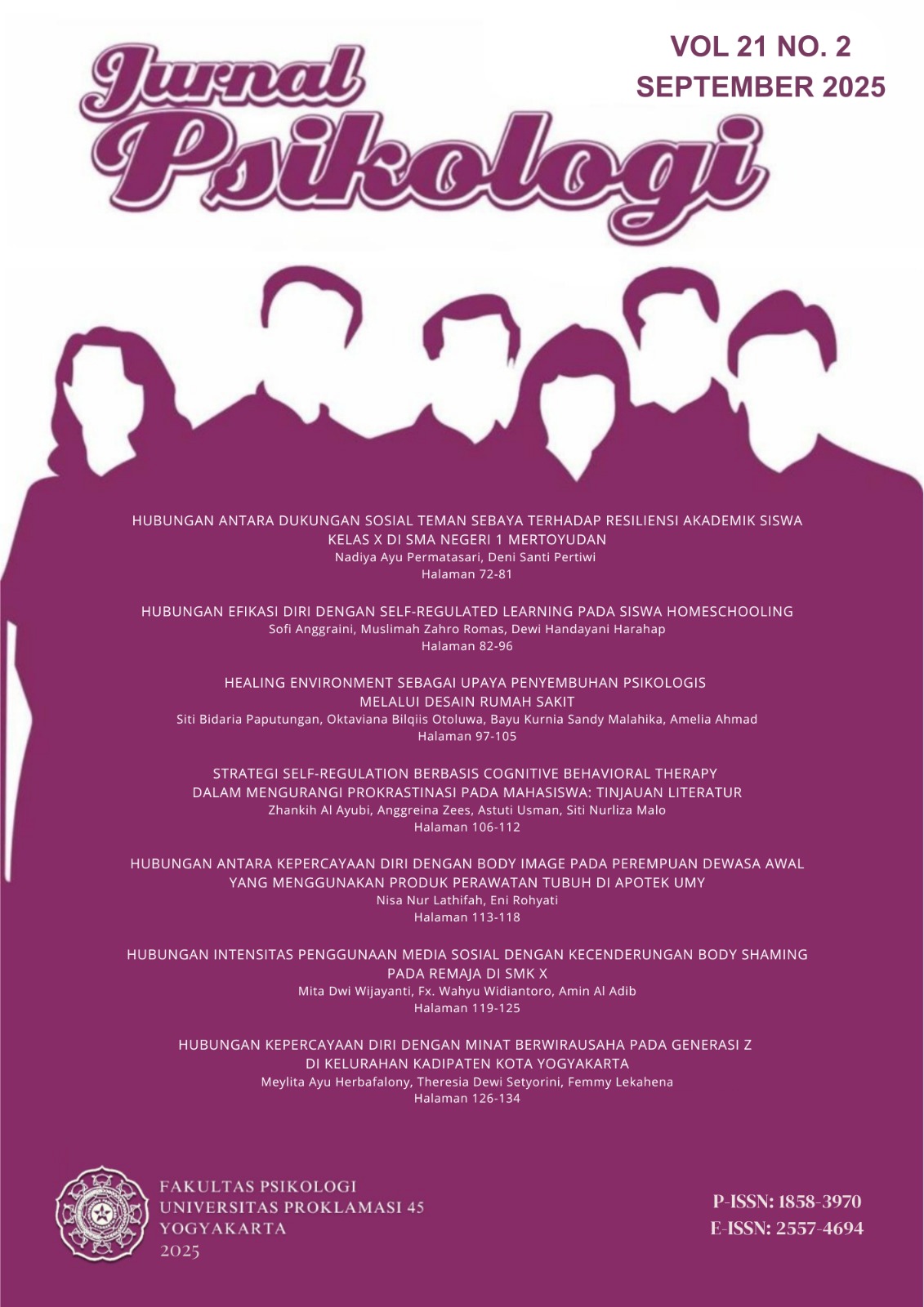
Hubungan Antara Dukungan Sosial Teman Sebaya Terhadap Resiliensi Akademik Siswa Kelas X di SMA Negeri 1 Mertoyudan
DOI:
https://doi.org/10.30588/jpsi.v21i2.2329Keywords:
Peer Social Support, Academic Resilience, StudentAbstract
Peer social support plays an important role in improving the academic resilience of grade X students at SMA Negeri 1 Mertoyudan. This support helps individuals cope with academic stress, increases self-confidence, and improves their ability to face challenges. With good social support, students tend to be better able to recover from difficulties and achieve better academic performance. The purpose of this study was to determine the relationship between peer social support and academic resilience of grade X students at SMA Negeri 1 Mertoyudan. The method in this study used a quantitative method with a correlational approach. The data collection tool used a peer social support scale based on aspects of Sarafino and Smith (2011) which was modified from the research of Ningsih and Astuti (2024) and an academic resilience scale based on aspects of Cassidy (2016) which was modified from the research of Afriyeni and Rahayunings. The sampling technique used purposive sampling. The subjects in this study were grade X high school students aged 15-18 years. The data analysis technique used in the hypothesis test used Pearson Product Moment. So that the results of the hypothesis test were obtained with a correlation value index of 0.393 with a significance level of 0.000 (p <0.01), so that the results of this study indicate that there is a positive relationship which means that the higher the level of peer social support received, the higher the level of academic resilience in high school students in grade X, conversely, the lower the peer social support, the lower the academic resilience of high school students in grade X.
References
Afriyeni, N., & Rahayuningsih , T. (2020). Konstruksi Alat Ukur Resiliensi Akademik untuk Kepuasan Belajar Online Mahasiswa pada Masa Pandemi Covid-19. PSISULA: Prosiding Berkala Psikologi, 2, 135-146. doi:http://dx.doi.org/10.30659/psisula.v2i0.13078
Amalia, Muna, Z., & Pratama, M. (20214). Hubungan Antara Dukungan Sosial Dengan Resiliensi Akademik Pada Santri Akhir Pesantren Modern Al-Zahrah. INSIGHT: Jurnal Penelitian Psikologi, 2(2), 303-314. doi:https://doi.org/10.2910/insight.v2i2.15210
Azwar, S. (2017). Metode Penelitian Psikologi. Yogyakarta: Pustaka Pelajar.
Azwar, S. (2019). Metode Penelitian Psikologi (2 ed.). Yogyakarta: Pustaka Belajar.
Azwar, S. (2020). Metode Penelitian Psikologi. Yogyakarta: Pustaka Pelajar.
Azwar, S. (2021). Penyusunan Skala Psikologi (3 ed.). Yogyakarta: Pustaka Pelajar.
Azwar, S. (2021). Reliabilitas dan Validitas (5 ed.). Yogyakarta: Pustaka Pelajar.
Cassidy, S. (2016). The academic resilience scale (ARS-30): A new multidimensional construct measure. Frontiers in Psychology, 7(18), 1-11. doi: https://doi.org/10.3389/fpsyg.2016.01787
Choi, S., Kim, D., Sung, Y., Yoo, I., An, S., & Kim, C. (2023). The moderating effect of resilience on the relationship between academic stress and school adjustment in Korean students. Frontiers in psychology(13). doi:https://doi.org/10.3389/fpsyg.2022.941129
Cohen , S., & Hoberman, H. (1983). Positive Events and Social Supports as Buffer of Life Change Stress. Journal of Applied Social Psychology, 13(2), 99-125. doi:https://doi.org/10.1111/j.1559-1816.1983.tb02325x
Dwiastuti, I., Hendriani, W., & Andriani, F. (2021). Perkembangan Penelitian Resiliensi Akademik Di Indonesia: Scoping Literatur Review. Talenta, 7(1), 24-35. doi:https://doi.org/10.26858/talenta.v7il.23748
Fitrito Yara, A., Yuliasari, H., & Sulistiono, A. (2023). HUBUNGAN DUKUNGAN SOSIAL TERHADAP KESEJAHTERAAN PSIKOLOGI PADA MASYARAKAT KELOMPOK TANI DI KAMPUNG BAHARI NUSANTARA TNI AL. Psikofusi: Jurnal Psikologi Integratif, 5(4), 19-25. doi:https://ojs.co.id/1/index.php/pjpi/article/view/358
Hardjana, A. (1994). Kiat Sukses Studi di Perguruan Tinggi. Yogyakarta: Kanisius.
Hart, A., & Heaver, B. (2015). Resilience Approaches to Supporting Young People's mental Health: Apprasing the Evidence Base for Schools and Communities.
Hendriani, W. (2018). Resiliensi psikologi sebuah pengantar. Prenadamedia Group.
Henriques, E., Laka, L., & Hatmoko, T. (2023). Resiliensi Akademik Siswa Sekolah Menengah Atas Ditinjau Dari Dukungan Teman Sebaya Dan Pembinaan Spiritualitas. Jurnal Review Pendidikan dan Pengajaran, 6(4), 3359-3371. Diambil kembali dari http://journal.universitaspahlawan.ac.id/index.php/jrpp
Jackson , R., & Watkin , C. (2004). the Resilience Inventory: Seven Essential Skills for Overcoming Lief's Obstacles and Determining Happines (Vol. 20). Selection Development Review.
Kesehatan RI, K. (2018). Laporan Nasional Riskesdas. Badan Penelitian dan Pengembangan Kesehatan.
Lubis, Z. (2012). Penggunaan Statistika Dalam Penelitian Sosial. Medan: Perdana Publishing.
Martin, A., & Marsh, H. (2003). Academic Resilience and The Four Cs: Confidence, Control, Compusure, and Commitment. Australian Association for Research in Education.
Meichenbaum, D. (2009). Blostering resilience: Benefiting from lesson learned in D. Brom, R Pat-Horenczyk & J. D. Ford.
Monks. (1996). Psikologi Perkembangan: Pengantar Dalam Berbagai Bagaiannya. Jakarta: Erlangga .
Mubayyinah, M., & Daslinda , D. (2023). Hubungan Antara Dukungan Sosial Teman Sebaya dengan Resiliensi Akademik. Jurnal Ilmiah Ilmu Pendidikan, 6(12), 9972-9977. doi:https://doi.org/10.54371/jiip.v6i12.3322
Nada Salsabila, C., & Fitriani, Y. (2023). Regulasi Emosi Ditinjau Dari Dukungan Sosial Teman Sebaya Pada Siswa SMP. Jurnal Bimbingan dan Konseling Ar-Rahman, 9(2), 144-153. doi:http://dx.doi.org/10.31602/jbkr.vr9i2.11604
Nurfadhila Surasa , I., & Murtiningsih. (2021). Hubungan Dukungan Sosial Teman Sebaya Terhadap Harga Diri Remaja di SMPN 258 Jakarta Timur. Borneo Nursing Journal (Bnj), 3(1), 14-22. doi:https://akperyarsismd.e-journal.id/BNJ
Papalia, D. (2008). Human Development (Psikologi Perkembangan). Jakarta: Kencana.
Perdana Putra, F., & Widyana, R. (2020). Peran Penting Dukungan Sosial OrangTua Terhadap Karakter Siswa Dalam Menghadapi Era 5.0. G-Couns: Jurnal Bimbingan Dan Konseling, 296-303. doi:https://doi.org/10.31316/g.couns.v4i2.816
Prawita, E., & Heryadi, A. (2021). Analisis Validitas Konstrak dan Analisis Konsistensi Internal pada Skala Resiliensi. PSIMPHONI, 4(1), 8-15. doi:https://doi.org/10.30595/psimphoni.v4i1.14477
Pusvitasari, P., & Yuliasari, H. (2021). STRATEGI REGULASI EMOSI DAN RESILIENSI PADA IBU YANG MENDAMPINGI ANAK STUDY FROM HOME (SFH) DI MASA PANDEMI COVID-19. Motiva: Jurnal Psikologi, 4(2), 109-118. doi:https://doi.org/10.3129/mv.v4i2.5844
Pusvitasari, P., & Yuliasari, H. (2024). PENINGKATAN ACADEMIC RESILIENCE MELALUI KONSELING KELOMPOK BERBASIS SOLUTION FOCUSED BRIEF COUNSELLING (SFBC) PADA SISWA SMA. MARTABE: Jurnal Pengabdian Masyarakat, 7(3), 1188-1196. doi:https://doi.org/10.31604/jpm.v7i3
Reivich, K., & Shatte, A. (2003). The Resilience Factor: 7 Keys to Finding Your Inner Strenght and Overcoming Life's Hurdles. New York: Broadway Books.
Rifqoh, F. (2022). Resiliensi Akademik Pada Siswa Kelas VII dalam Mengikuti Pendidikan di Pesantren Ditinjau Dari Dukungan Sosial Teman Sebaya. Proceeding Annual Conference on Madrasah Teacher, 51-56. Diambil kembali dari https://journalis.upi-yai.ac.id/index.php/jkraith-humaior/article/view/436
Rizka Ningsih , Y., & Astusti, K. (2024). Dukungan Sosial Teman Sebaya dan Resiliensi Akademik pada Mahasiswa Rantau di Yogyakarta yang Sedang Mengerjakan Skripsi. Prosiding Seminar Nasional, 347-355.
Said , A., Rahmawati, A., & Supraba , D. (2021). Hubungan antara dukungan sosial dengan resiliensi akademik pada mahasiswa rantau yang sedang mengerjakan skripsi. Jurnal Psikologi Tabularasa, 16(1), 32-44. doi:https://doi.org/10.26905/jpt.v16i1.7710
Santosa. (2004). Pendidikan Watak Utama Tugas Pendidikan. Jakarta: UI.
Santrock , J. (2003). Adolescence. Perkembangan Remaja (Keenam ed.). Jakarta: Erlangga.
Sarafino, E., & Smith, T. (2011). Health Psychology Biopsychosocial Interaction (7 ed.). (W. John, & I. Sons, Penyunt.) Canada.
Sarason, I., Levine, H., Basham, R., & Sarason, B. (1983). Assessing Social Support: TheSocial Support Questionnaire. Journal of Personality and Social Psychology, 44(1), 127-139. doi:https://doi.org/10.1037/0022-3514.44.1.127
Shilphy, & Octavia. (2020). Motivasi Belajar dalam Perkembangan Remaja. CV. Budi Utama.
Siebert, A. (2005). The Resiliency Advantage. San Fransisco, California: Berret-Koehler.
Smet, B. (1994). Psikologi kesehatan. Jakarta : PT. Grasindo.
Sugiyono . (2022). Metode Penelitian Kuantitatif, Kualitatif, dan R&D. Bandung: Alfabeta.
Sugiyono. (2015). Metode Penelitian Kuantitatif, Kualitatif, dan R&D. Bandung: Alfabeta.
Sugiyono. (2021). Metode Penelitian Kuantitatif, Kualitatif, dan R&D. Bandung: Alfabeta.
Taylor, S., Peplau , L., & David , O. (2009). Psikologi Sosial. Kencana Prenada Media Group.
Tracy, E., & Whittaker, J. (1990). The social network map: Assessing social support in clinical practice (Vol. 71). Families in Society.
Yuliasari, H., & Nirmalasari, N. (2024). Pelatihan Resiliensi untuk meningkatkan Kesejahteraan Psikologis Pada Remaja di Panti Asuhan. Jurnal Social Library, 4(1), 64-73. doi:https://doi.org/10.51849/sl.v4i1.208
Downloads
Published
How to Cite
Issue
Section
License
Copyright (c) 2025 Nadiya Permatasari, Deni Santi Pertiwi

This work is licensed under a Creative Commons Attribution 4.0 International License.
Authors retain copyright and grant the Jurnal Psikologi right of first publication with the work simultaneously licensed under a Creative Commons Attribution 4.0 International License that allows others to share (copy and redistribute the material in any medium or format) and adapt (remix, transform, and build upon the material) the work for any purpose, even commercially with an acknowledgment of the work's authorship and initial publication in Jurnal Psikologi.
Authors are able to enter into separate, additional contractual arrangements for the non-exclusive distribution of the journal's published version of the work (e.g., post it to an institutional repository or publish it in a book), with an acknowledgment of its initial publication in Jurnal Psikologi. Authors are permitted and encouraged to post their work online (e.g., in institutional repositories or on their website) prior to and during the submission process, as it can lead to productive exchanges, as well as earlier and greater citation of published work (See The Effect of Open Access).