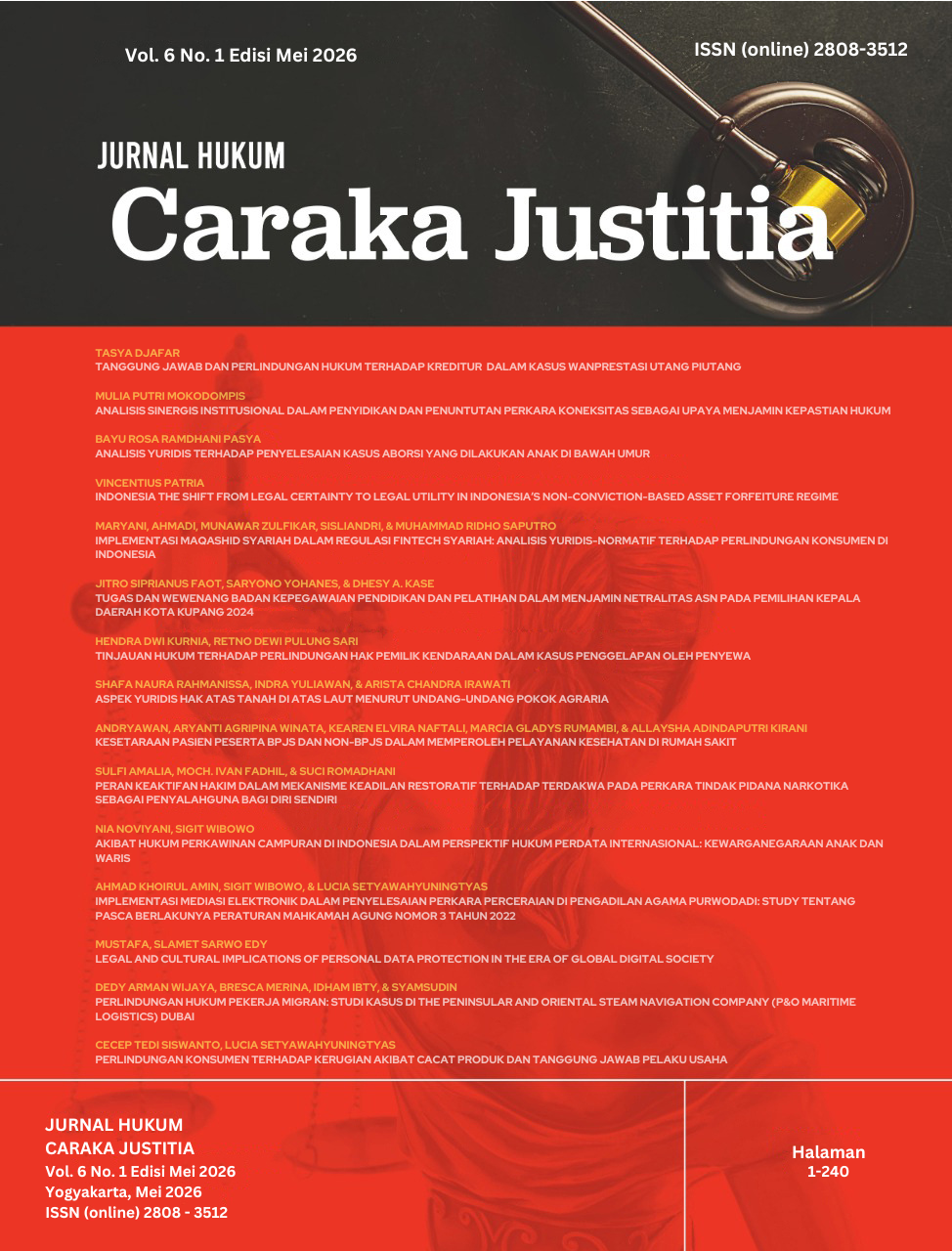
Implementasi Mediasi Elektronik dalam Penyelesaian Perkara Perceraian di Pengadilan Agama Purwodadi
Study tentang Pasca Berlakunya Peraturan Mahkamah Agung Nomor 3 Tahun 2022
DOI:
https://doi.org/10.30588/jhcj.v6i1.2649Keywords:
Divorce Case, Electronic Mediation, Supreme Court Regulation (PERMA) No. 3 of 2022Abstract
This research seeks to evaluate the application and identify the obstacles associated with electronic mediation (e-mediation) in handling divorce proceedings at the Purwodadi Religious Court. After the introduction of Supreme Court Regulation (PERMA) Number 3 of 2022 regarding Electronic Mediation in Courts, the Purwodadi Religious Court has started to apply e-mediation as a method for resolving disputes, which is viewed as more adaptable and effective. This research adopts a normative juridical framework utilizing a legal perspective and case analyses. Information was gathered via document analysis (including PERMA, court documentation, and case records), comprehensive interviews with judges, mediators, and parties involved, along with direct observation at the Purwodadi Religious Court. The findings from this analysis indicate that the execution of electronic mediation has been conducted in alignment with the guidelines set forth in PERMA No. 3 of 2022, with a success rate of reaching a peaceful agreement of 36.3% of 215 cases in the 2023-2025 period. E-mediation has been proven to increase efficiency by shortening the average settlement time to 25 days and expanding access for parties with distance constraints. However, this implementation faces technical obstacles (internet infrastructure, digital literacy), non-technical (difficulties in building rapport, face-to-face preferences), and administrative obstacles (lack of detailed internal SOPs).
References
Artikel Jurnal
Abduh, Muhammad. “Mediasi Elektronik Sebagai Sarana Penyelesaian Sengketa Di Era Digital (Tinjauan Atas Perma No. 3 Tahun 2022).” Jurnal Hukum Keluarga Islam 6, no. 1 (2025): 29. https://journal.iaitasik.ac.id/index.php/Ahwaluna/article/download/442/327.
E. L. Fakhriah. “Mediasi Elektronik sebagai Alternatif Penyelesaian Sengketa di Era Digital.” Jurnal Hukum dan Pembangunan 52, no. 3 (2022): 773-774.
Hartono, Christoper. “Mediasi Sebagai Alternatif Penyelesaian Sengketa Dalam Hukum Acara Perdata dan Agama di Indonesia.” JIHHP Jurnal Ilmu Hukum, Humaniora, dan Politik 5, no.6 (2025): 5. https://dinastirev.org/JIHHP/article/download/5110/3009/25412.
Ribi, Hikmawati Ribi. “Efektivitas Mediasi dalam Penyelesaian Perkara Perceraian di Pengadilan Agama.” Indonesian Journal of Intellectual Publication 5, no. 3 (2025): 304, http://journal.intelekmadani.org/index.php/ijipublication/article/view/730.
Buku
Arto, A. Mukti. Praktek Perkara Perdata pada Pengadilan Agama. Yogyakarta: Pustaka Pelajar, 2017.
Bisri, Cik Hasan. Peradilan Agama di Indonesia. Jakarta: Raja Grafindo Persada, 2010.
Friedman, M. Lawrence. “Legal Culture and the Modernization of Law,” dalam The Legal Culture and Systems of the World. New Haven: Yale University Press, 2002.
Mayer, Bernard. The Dynamics of Conflict: A Guide to Engagement and Intervention, ed. ke-2. San Francisco: Jossey-Bass, 2012.
Moore, Christopher W. The Mediation Process: Practical Strategies for Resolving Conflict, 4th ed. San Francisco: Jossey-Bass, 2014.
Nolan-Haley, Jacqueline M. Alternative Dispute Resolution in a Nutshell, 5th ed., St. Paul: West Academic Publishing, 2019.
Posner, Richard A. Economic Analysis of Law, 9th ed., New York: Aspen Publishers, 2014.
Sidharta, Bernard Arief. Metodologi Penelitian Hukum Normatif. Yogyakarta: Kanisius, 2019.
Soekanto, Soerjono. Faktor-Faktor yang Mempengaruhi Penegakan Hukum. Jakarta: Raja Grafindo Persada, 2008.
Soekanto, Soerjono, & Sri Mamudji. Penelitian Hukum Normatif: Suatu Tinjauan Singkat. Jakarta: Rajawali Pers, 2020.
Artikel Surat Kabar/Majalah
Mahkamah Agung Republik Indonesia Pedoman Pelaksanaan PERMA Nomor 3 Tahun 2022 tentang Mediasi di Pengadilan Secara Elektronik, Jakarta: Mahkamah Agung RI, 2023.
Internet
Kabupaten Grobogan, Badan Pusat Statistik. “Kabupaten Grobogan Dalam Angka 2024,” https://grobogankab.bps.go.id/id/publication/2024/02/28/5e859112e7e3f192da90ea48/kabupaten-grobogan-dalam-angka-2024.html (diakses 20 Maret 2026).
Mahkamah Agung Republik Indonesia. “Transformasi Digital Peradilan: Menuju Peradilan yang Responsif dan Inklusif, Laporan Tahunan 2023,” https://www.mahkamahagung.go.id (diakses 30 November 2025).
Pemerintah Kabupaten Grobogan, “Profil Kabupaten Grobogan,” https://grobogan.go.id/ (diakses 20 Maret 2026).
Pemerintah Kabupaten Grobogan, “Potensi Wisata Kabupaten Grobogan,” https://grobogan.go.id (diakses 20 Maret 2026).
Peraturan Perundang-Undangan
Undang-Undang Dasar Negara Republik Indonesia Tahun 1945.
Undang-Undang Nomor 1 Tahun 1974 tentang Perkawinan.
Undang-Undang Nomor 16 Tahun 2019 tentang Perubahan atas Undang-undang Nomor 1 Tahun 1974 tentang Perkawinan.
Undang-Undang Nomor 7 Tahun 1989 tentang Peradilan Agama.
Undang-Undang Nomor 3 Tahun 2006 tentang Perubahan atas Undang-Undang Nomor 7 Tahun 1989 tentang Peradilan Agama.
Undang-Undang Nomor 50 Tahun 2009 tentang Perubahan Kedua atas Undang-Undang Nomor 7 Tahun 1989 tentang Peradilan Agama.
Undang-Undang Nomor 48 Tahun 2009 tentang Kekuasaan Kehakiman.
Peraturan Mahkamah Agung Republik Indonesia Nomor 1 Tahun 2016 tentang Prosedur Mediasi di Pengadilan.
Peraturan Mahkamah Agung Republik Indonesia Nomor 3 Tahun 2022 tentang Mediasi di Pengadilan Secara Elektronik.
Downloads
Published
How to Cite
Issue
Section
License
Copyright (c) 2026 Ahmad Khoirul Amin, Sigit Wibowo, Lucia Setyawahyuningtyas

This work is licensed under a Creative Commons Attribution 4.0 International License.
Authors who publish with JHCJ agree to the following terms:
Authors retain copyright and grant the JHCJ right of first publication with the work simultaneously licensed under a Creative Commons Attribution 4.0 International License that allows others to share (copy and redistribute the material in any medium or format) and adapt (remix, transform, and build upon the material) the work for any purpose, even commercially with an acknowledgment of the work's authorship and initial publication in JHCJ.
Authors are able to enter into separate, additional contractual arrangements for the non-exclusive distribution of the journal's published version of the work (e.g., post it to an institutional repository or publish it in a book), with an acknowledgment of its initial publication in JHCJ. Authors are permitted and encouraged to post their work online (e.g., in institutional repositories or on their website) prior to and during the submission process, as it can lead to productive exchanges, as well as earlier and greater citation of published work (See The Effect of Open Access).