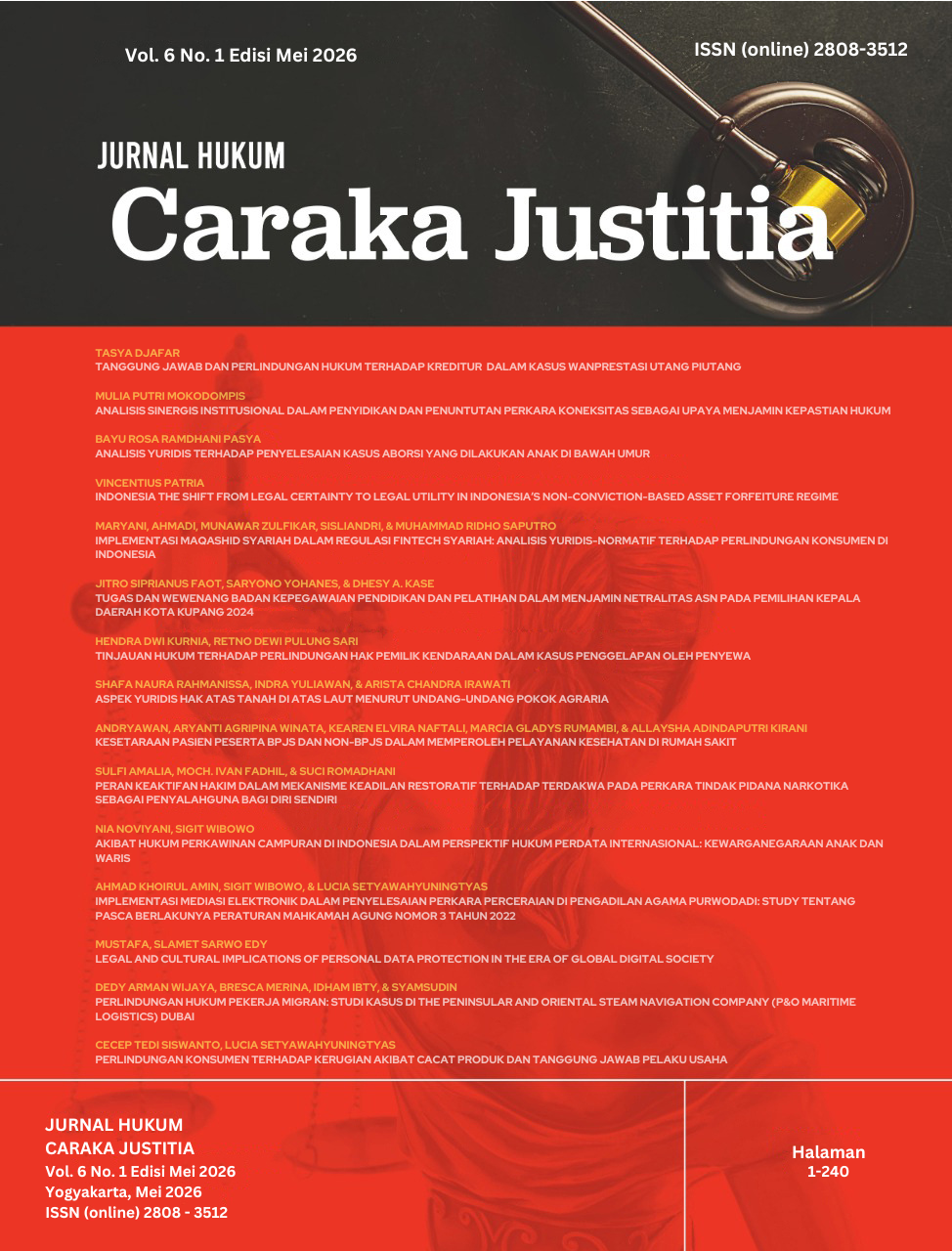
Implementasi Maqashid Syariah dalam Regulasi Fintech Syariah
Analisis Yuridis-Normatif Terhadap Perlindungan Konsumen di Indonesia
DOI:
https://doi.org/10.30588/jhcj.v6i1.2502Keywords:
Syariah Fintech, Maqashid Syariah, Consumer Protection, Syariah Compliance, Regulatory FrameworkAbstract
The rapid growth of Islamic financial technology (Syariah fintech) in Indonesia presents unique challenges in striking a balance between Sharia compliance and consumer protection mechanisms. Although regulatory frameworks from the OJK and DSN-MUI are in place, significant gaps remain in the implementation of maqashid Syariah principles within fintech operations. This study examines the extent to which Indonesia’s Syariah fintech regulations incorporate maqashid sharia principles for consumer protection, identifies regulatory gaps, and proposes a comprehensive framework for addressing these gaps. Using a juridical-normative approach, the research analyzes primary legal sources, including Law No. 21/2008, OJK Regulation No. 77/2016, and DSN-MUI Fatwas, as well as secondary sources from Scopus- and SINTA-indexed journals. The findings reveal three critical gaps: inadequate operationalization of the maslahah principle in algorithmic decision-making, limited protection against predatory lending practices, and insufficient Syariah-specific complaint mechanisms. Effective consumer protection in Syariah fintech requires regulatory reforms that embed maqashid sharia principles into licensing requirements, operational standards, and dispute resolution mechanisms through a three-tiered regulatory framework.
References
The rapid growth of Islamic financial technology (Syariah fintech) in Indonesia presents unique challenges in striking a balance between Sharia compliance and consumer protection mechanisms. Although regulatory frameworks from the OJK and DSN-MUI are in place, significant gaps remain in the implementation of maqashid Syariah principles within fintech operations. This study examines the extent to which Indonesia’s Syariah fintech regulations incorporate maqashid sharia principles for consumer protection, identifies regulatory gaps, and proposes a comprehensive framework for addressing these gaps. Using a juridical-normative approach, the research analyzes primary legal sources, including Law No. 21/2008, OJK Regulation No. 77/2016, and DSN-MUI Fatwas, as well as secondary sources from Scopus- and SINTA-indexed journals. The findings reveal three critical gaps: inadequate operationalization of the maslahah principle in algorithmic decision-making, limited protection against predatory lending practices, and insufficient Syariah-specific complaint mechanisms. Effective consumer protection in Syariah fintech requires regulatory reforms that embed maqashid sharia principles into licensing requirements, operational standards, and dispute resolution mechanisms through a three-tiered regulatory framework.
Downloads
Published
How to Cite
Issue
Section
License
Copyright (c) 2026 Maryani, Ahmadi, Munawar Zulfikar, Sisliandri, Muhammad Ridho Saputro

This work is licensed under a Creative Commons Attribution 4.0 International License.
Authors who publish with JHCJ agree to the following terms:
Authors retain copyright and grant the JHCJ right of first publication with the work simultaneously licensed under a Creative Commons Attribution 4.0 International License that allows others to share (copy and redistribute the material in any medium or format) and adapt (remix, transform, and build upon the material) the work for any purpose, even commercially with an acknowledgment of the work's authorship and initial publication in JHCJ.
Authors are able to enter into separate, additional contractual arrangements for the non-exclusive distribution of the journal's published version of the work (e.g., post it to an institutional repository or publish it in a book), with an acknowledgment of its initial publication in JHCJ. Authors are permitted and encouraged to post their work online (e.g., in institutional repositories or on their website) prior to and during the submission process, as it can lead to productive exchanges, as well as earlier and greater citation of published work (See The Effect of Open Access).