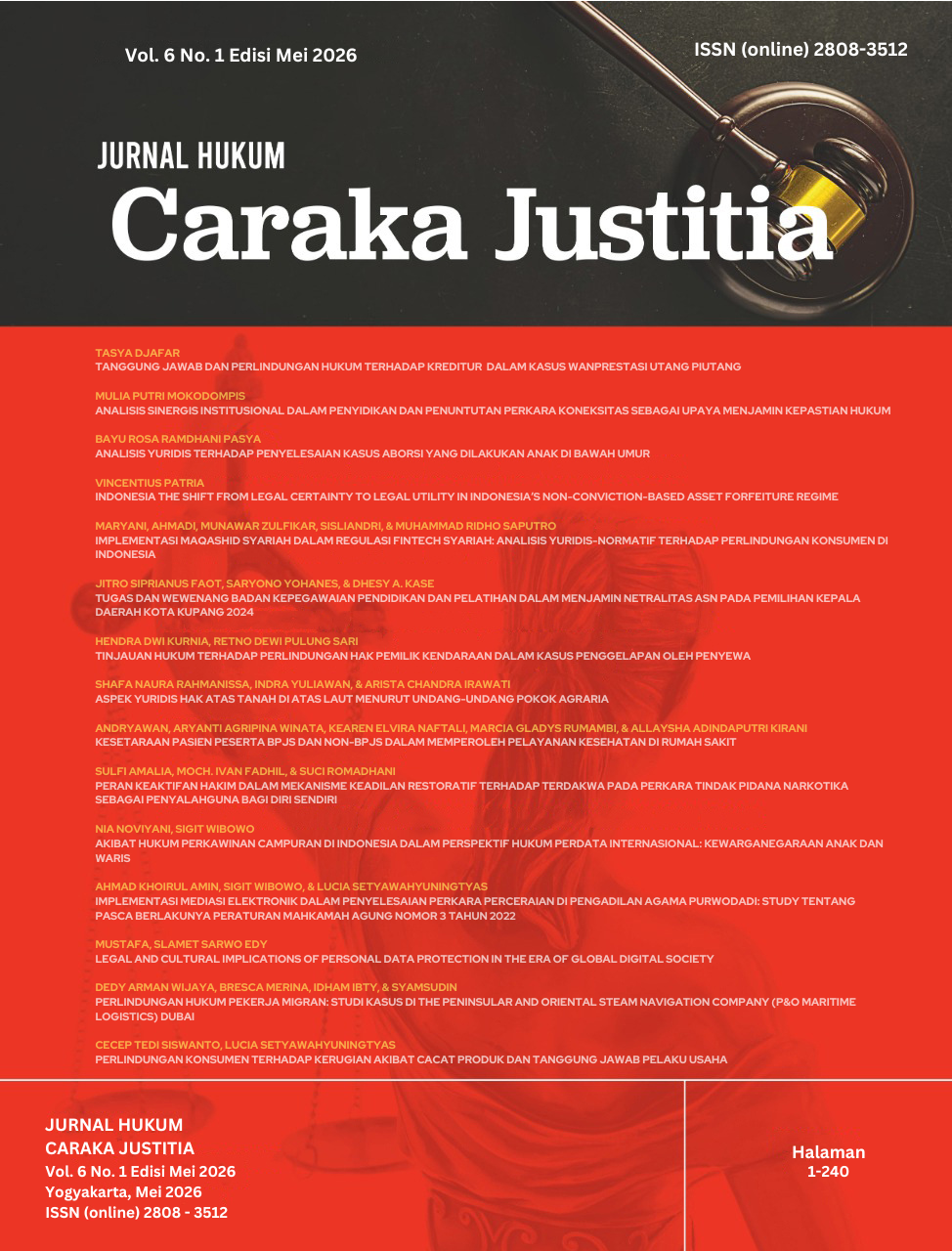
Analisis Yuridis Terhadap Penyelesaian Kasus Aborsi yang Dilakukan Anak di Bawah Umur
DOI:
https://doi.org/10.30588/jhcj.v6i1.2264Keywords:
Abortion, Minors, Criminal Law, Islamic LawAbstract
The phenomenon of abortion carried out by minors has become a crucial issue in the realm of law and child protection in Indonesia. This problem often arises due to unwanted pregnancies, frequently rooted in sexual violence or a lack of understanding regarding reproductive health. This study aims to analyze the legal resolution of abortion cases committed by minors from a juridical perspective, both in Indonesian positive criminal law and Islamic criminal law. The research uses a normative juridical approach by analyzing laws and regulations, jurisprudence, and relevant literature. The findings reveal that although Indonesian law criminalizes abortion, certain exceptions are allowed, such as in cases of rape that endanger the physical and mental health of the victim. On the other hand, Islamic criminal law provides sanctions based on the gestational age and the reason for the abortion. In practice, case resolution tends to consider the offender's age, psychological condition, and coercive elements. This study recommends the need for a restorative approach that prioritizes child protection, rehabilitation, and sexual education as preventive efforts.
References
Artikel Jurnal
Alifah, Anisa Putri, Nurliana Cipta Apsari, & Budi Muhammad Taftazani. “Faktor Yang Mempengaruhi Remaja Hamil di Luar Nikah.” Jurnal Penelitian dan Pengabdian Kepada Masyarakat (JPPM) 2, no. 3 (2021): 529-537. https://doi.org/10.24198/jppm.v2i3.38077.
Asmariah. “Dinamika Aborsi Remaja: Evaluasi Hukum dan Implikasi Sosial Dalam Konteks UU No. 1 Tahun 2023.” Causa: Jurnal Hukum dan Kewarganegaraan 10, no. 11 (2025): 1-17. https://doi.org/10.3783/causa.v10i11.11242.
Athaya, Dion Daffa. “Perlindungan Hukum Terhadap Anak Sebagai Korban Kekerasan Seksual Di Lingkungan Sekolah.” Jurnal Kertha Semaya 11, no. 4 (2023): 910-921. https://doi.org/10.24843/KS.2023.v11.i04.p17.
Damayanti, Elvira, et. al., “Mengkaji Praktik Aborsi di Indonesia: Penyebab, Dampak, dan Stigma Masyarakat.” Taruna Law: Journal of Law and Syariah 2, no. 2 (2024): 166-175. https://doi.org/10.54298/tarunalaw.v2i02.199.
Gibransyah, M., Dona Raisa Monica, & Maroni Maroni. “Upaya Penanggulangan Tindak Pidana Aborsi yang Dilakukan oleh Anak di bawah Umur.” Demokrasi: Jurnal Riset Ilmu Hukum, Sosial dan Politik 1, no. 4 (2024): 114-127. https://doi.org/10.62383/demokrasi.v1i4.459.
Noviariyani, Risa. “Tenaga Kesehatan yang Berwenang Melakukan Tindakan Aborsi Legal.” Jurist-Diction 3, no. 5 (2020): 1905-1920. https://doi.org/10.20473/jd.v3i5.21985.
Nuralisyah. “Tinjauan Yuridis Tindak Pidana Aborsi Yang Dilakukan Anak Dibawah Umur.” Journal Of Law: Jurnal Ilmu Hukum 7, no. 2 (2021): 1-15. http://ejurnal.untag-smd.ac.id/index.php/DD/article/view/5649/5311.
Widowati. “Tindakan Aborsi dalam Sudut Pandang Hukum dan Kesehatan di Indonesia.” Yustitiabelen 6, no. 2 (2020): 16-35. https://doi.org/10.36563/yustitiabelen.v6i2.243.
Zalbawi, Soenanti. “Masalah Aborsi di Kalangan Remaja.” Media Litbang Kesehatan 12, no. 3 (2002): 18-45. https://repository.badankebijakan.kemkes.go.id/id/eprint/5762.
Buku
Abdussalam. Hukum Perlindungan Anak. Jakarta: Restu Agung, 2007.
Arif, Barda Nawawi. Beberapa Aspek Kebijaksanaan Penegakan dan Pengembangan Hukum Pidana. Bandung: Citra Aditya Bagti, 1998.
Arliman S, Laurensius. Komnas HAM dan Perlindungan Anak Pelaku Tindak Pidana. Yogyakarta: Deep Publish, 2015.
Hadiwijoyo, Suryo Sakti. Pengarusutamaan Hak Anak dalam Anggaran Publik. Yogyakarta: Graha Ilmu, 2015.
Irfan, M. Nurul, & Masyrofah. Fiqh Jinayah. Jakarta: Amzah, 2013.
Mardiansyah, Helmi Zaki. Buku Ajar Hukum Pidana. Jember: Fakultas Syariah Universitas Islam Negeri KH Achmad Siddiq, 2021.
Marshall, Tony E. Restorative Justice: An Overview. London: Research Development and Statistics Directorate, 1999.
Moeljatno. Asas-Asas Hukum Pidana. Jakarta: Rineka Cipta, 2008.
Muslich, Ahmad Wardi. Hukum Pidana Islam. Jakarta: Sinar Grafika Offset, 2005.
Soekanto, Soerjono. Pengantar Penelitian Hukum. Jakarta: UI Press, 1986.
Disertasi/Tesis/ Paper Kerja
Muyassiroh, Helmy. “Pertanggungjawaban Pidana Terhadap Tindak Pidana Aborsi Yang Dilakukan Oleh Anak Di Bawah Umur Perspektif Hukum Pidana Islam Dan Hukum Positif.” Skripsi, Islam Negeri Kiai Haji Achmad Siddiq Jember, 2022.
Natasya, Diana. “Tindak Pidana Aborsi Yang Dilakukan Oleh Anak Di Bawah Umur Akibat Korban Pemerkosaan Perspektif Hukum Islam Dan Hukum Positif: Analisis Putusan Pengadilan Tinggi Jambi Nomor: 6/PID.SUS-ANAK/2018/PTJMB.” Skripsi, Universitas Islam Negeri Walisongo, 2023.
Santoso, Mohamad Aji. “Tinjauan Yuridis Terhadap Tindak Pidana Aborsi (Studi Komparatif Hukum Islam dan Hukum Positif).” Skripsi, Institut Agama Islam Negeri Jember, 2020.
Internet
Bimkemasditjenpas. “Modul I Gambaran Umum Penanganan Anak Yang Berhadapan Dengan Hukum.” https://bimkemasditjenpas.wordpress.com/wp-content/uploads/2015/05/modul-i-gambaran-umum_rev-1.pdf (diakses 4 Januari 2026).
Peraturan Perundang-undangan
Undang-Undang Dasar 1945.
Undang-Undang Nomor 11 tahun 2012 tentang Sistem Peradilan Pidana Anak, Lembaran Negara Republik Indonesia Tahun 2012 Nomor 153.
Undang-Undang Nomor 23 Tahun 2002 Tentang Perlindungan Anak, Lembaran Negara Republik Indonesia Nomor 109 Tahun 2002.
Peraturan Pemerintah Nomor 61 Tahun 2014 tentang Kesehatan Reproduksi.
Downloads
Published
How to Cite
Issue
Section
License
Copyright (c) 2026 Bayu Rosa Ramdhani Pasya

This work is licensed under a Creative Commons Attribution 4.0 International License.
Authors who publish with JHCJ agree to the following terms:
Authors retain copyright and grant the JHCJ right of first publication with the work simultaneously licensed under a Creative Commons Attribution 4.0 International License that allows others to share (copy and redistribute the material in any medium or format) and adapt (remix, transform, and build upon the material) the work for any purpose, even commercially with an acknowledgment of the work's authorship and initial publication in JHCJ.
Authors are able to enter into separate, additional contractual arrangements for the non-exclusive distribution of the journal's published version of the work (e.g., post it to an institutional repository or publish it in a book), with an acknowledgment of its initial publication in JHCJ. Authors are permitted and encouraged to post their work online (e.g., in institutional repositories or on their website) prior to and during the submission process, as it can lead to productive exchanges, as well as earlier and greater citation of published work (See The Effect of Open Access).