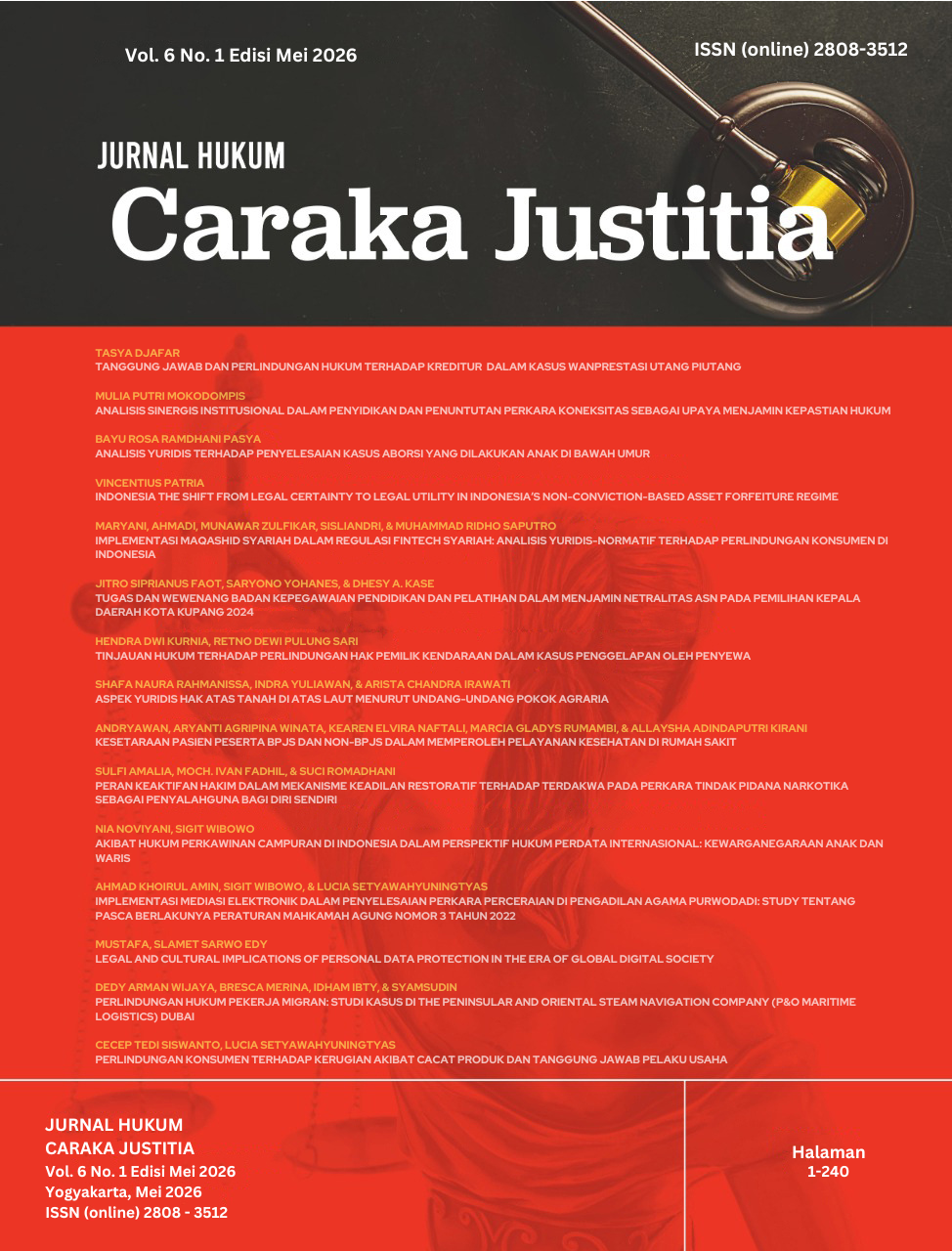
The Shift From Legal Certainty to Legal Utility in Indonesia’s Non-Conviction-Based Asset Forfeiture Regime
DOI:
https://doi.org/10.30588/jhcj.v6i1.2218Keywords:
Non-Conviction-Based Asset Forfeiture, Legal Utility, Corruption Asset RecoveryAbstract
This article analyzes the shift in legal approach to addressing assets derived from corruption in Indonesia, from an orientation toward legal certainty to an emphasis on legal utility through the mechanism of non-conviction-based asset forfeiture (NCB). The research employs a normative juridical method using statutory, conceptual, and comparative approaches, supported by a literature review of national regulations, court decisions, and international practices, particularly in the United States and Australia. The findings indicate that NCB serves as an effective alternative instrument for recovering corruption-related assets that cannot be reached through conventional criminal proceedings, especially in cases where the perpetrator has died, fled, or cannot be held criminally liable. Although its implementation raises debates concerning legal certainty and the protection of property rights, this utility-based approach is considered more adaptive in supporting anti-corruption efforts and the recovery of state losses. Therefore, this study concludes that strengthening the national regulatory framework is necessary to balance substantive justice with the protection of human rights.
References
Journal Articles
Amin, Subhan, & Satria, Wicaksana. “Perlindungan Hukum Bagi Whistleblower Dalam Tindak Pidana Korupsi Di Indonesia”. Media Of Law And Sharia 3, no. 3 (2022). https://Doi.Org/10.18196/Mls.V3i3.14468.
Abdullah, R., & Santoso, D. "International Cooperation on Asset Recovery: Indonesia’s Position." Asian Journal of International Law 12, no. 2 (2022): 210–229.
Aziz, R. "Ketidakjelasan Regulasi dalam Perampasan Aset Tanpa Pemidanaan di Indonesia." Jurnal Legislasi Indonesia 21, no. 1 (2024): 1–18.
Cole, Daniel H. “Legal Certainty and Legal Utility.” Harvard Law Review 125, no. 4 (2012): 859–864.
Doe, John. “Due Process Concerns in Civil Forfeiture.” Harvard Law Review 122, no. 6 (2009): 1450–1465.
Garnasih, Yenti. “Perampasan Aset Tanpa Pemidanaan dalam Tindak Pidana Pencucian Uang.” Jurnal Legislasi Indonesia 13, no. 3 (2016): 203–214.
González, C. "Asset Management in Latin America: Lessons for Southeast Asia." International Journal of Asset Recovery 4, no. 1 (2021): 59–77.
Hartono, A., & Wulandari, P. "Public Perception of Asset Forfeiture in Indonesia." Jurnal Sosiologi Hukum 15, no. 3 (2022): 150–166.
Hodge, Gareth. “Civil Forfeiture as a Tool Against Economic Crime.” International Journal of Law, Crime and Justice 50 (2017): 9–25.
Johnson, L., & Lee, P. "The Canadian Civil Forfeiture Regime: Balancing Rights and Recovery." Canadian Journal of Law & Society 33, no. 1 (2018): 89–104.
Kelly, R. "Proportionality and Human Rights in Civil Forfeiture." Journal of Financial Crime 29, no. 2 (2022): 289–305.
Mahendra, S. "Urgensi Undang-Undang Perampasan Aset: Tinjauan Perbandingan." Jurnal Hukum & Pembangunan 54, no. 1 (2024): 78–94.
Mahfud, A. "Perlu atau Tidaknya Pedoman MA tentang Perampasan Aset Tanpa Pemidanaan." Jurnal Hukum Nasional 54, no. 2 (2023): 101–117.
Mulya, A., & Harjono, B. "Keadilan dalam Proses Perampasan Aset: Studi Kasus Indonesia." Jurnal Konstitusi 20, no. 3 (2023): 224–240.
Nugraheni, L. "Peran Lembaga Keuangan dalam Pencegahan Pencucian Uang." Jurnal Keuangan dan Hukum 13, no. 2 (2023): 143–160.
Nugroho, B. "Institutional Challenges in Indonesia’s Asset Recovery System." Jurnal Hukum & Pembangunan 53, no. 2 (2023): 120–137.
Priyono, D. "Standar Pembuktian dalam Civil Forfeiture: Analisis Yuridis." Jurnal Hukum dan Peradilan 12, no. 1 (2023): 55–70.
Puspasari, N., and R. Dwiastuti. “Non-Conviction Based Asset Forfeiture dan Tantangannya di Indonesia.” Jurnal Antikorupsi Integritas 6, no. 1 (2020): 45–60. https://doi.org/10.32697/integritas.v6i1.474.
Putra, T. "Pancasila and Legal Reform: Social Justice in Indonesia." Jurnal Filsafat Hukum 10, no. 1 (2021): 35–52.
Putri, D. A., and M. Y. Sari. “Problematika Perampasan Aset dalam Kasus Korupsi di Indonesia.” Jurnal Hukum dan Pembangunan 51, no. 3 (2021): 403–420. https://doi.org/10.21143/jhp.vol51.no3.3134.
Putri, V. "Peran Masyarakat Sipil dalam Pengawasan Kasus Korupsi." Jurnal Demokrasi dan Hukum 9, no. 1 (2023): 91–108.
See, Benedictus Renny. “Tinjauan Yuridis tentang Penetapan sebagai Saksi Pelaku yang Bekerja Sama (Justice Collaborator) pada Kasus Tindak Pidana Korupsi di Indonesia.” Jurnal Hukum Caraka Justitia 4, no. 1 (2024): 70-89. https://doi.org/10.30588/jhcj.v4i1.1837.
Santosa, H. "Masalah dalam Pengelolaan Aset Sitaan dan Rampasan Negara." Jurnal Manajemen Publik 16, no. 2 (2022): 133–149.
Setiawan, M., & Kurnia, A. "Enhancing Financial Intelligence Capacity in Indonesia." Jurnal Keuangan Publik 21, no. 4 (2023): 212–230.
Smith, J. "Civil Recovery and Asset Forfeiture in the UK." British Journal of Criminology 59, no. 3 (2019): 547–565.
Suryadi, R., & Kurniawati, T. "Judicial Training and Asset Forfeiture: Addressing Evidentiary Standards." Jurnal Hukum Indonesia 17, no. 1 (2022): 54–70.
Susanto, H., & Indriani, D. "Institutional Reform for Asset Recovery in Indonesia." Jurnal Antikorupsi 8, no. 2 (2023): 77–95.
Tanjung, R., & Widjaja, L. "Korupsi dalam Proses Perampasan Aset: Kajian Institusional." Jurnal Antikorupsi Integritas 7, no. 2 (2023): 87–105.
Walker, J., and K. Broadhurst. “Transnational Corruption and Asset Recovery Challenges.” Journal of Financial Crime 20, no. 1 (2013): 50–65.
Zúñiga, N. "Asset Recovery and Transitional Justice: The Role of Reparation." International Journal of Transitional Justice 14, no. 2 (2020): 210–226.
Books
Amiruddin, & Zainal Asikin. Pengantar Metode Penelitian Hukum. Jakarta: Rajawali Pers, 2016.
Australian Government. Proceeds of Crime Act 2002. Commonwealth of Australia, 2002.
Cassella, Stefan D. Asset Forfeiture Law in the United States. 2nd ed. Huntington, NY: Juris Publishing, 2013.
Commonwealth of Australia. Proceeds of Crime Act 2002. Canberra: Federal Register of Legislation, 2002.
Fuller, Lon L. The Morality of Law. New Haven: Yale University Press, 1964.
Greenberg, Theodore S., Larissa Gray, Delphine Schantz, Carolin Gardner, and Michael Latham. Stolen Asset Recovery: Politically Exposed Persons—A Policy Paper on Strengthening Preventive Measures. Washington, DC: World Bank Publications, 2009.
Habermas, Jürgen. Between Facts and Norms: Contributions to a Discourse Theory of Law and Democracy. Cambridge, MA: MIT Press, 1996.
Ibrahim, Johnny. Teori dan Metodologi Penelitian Hukum Normatif. Malang: Bayumedia Publishing, 2007.
Lev, Daniel S. Hukum dan Politik di Indonesia: Kesinambungan dan Perubahan. Jakarta: LP3ES, 1990.
Marzuki, Peter Mahmud. Penelitian Hukum. Jakarta: Kencana, 2017.
Nonet, P., & Selznick, P. Law and Society in Transition: Toward Responsive Law. New Brunswick: Transaction Publishers, 2001.
Organisation for Economic Co-operation and Development (OECD). Asset Recovery: Risks, Challenges and Opportunities. Paris: OECD Publishing, 2021.
Rahardjo, S. Hukum Progresif: Hukum yang Membebaskan. Yogyakarta: Genta Publishing, 2021.
Rahardjo, Satjipto. Legal Studies. Yogyakarta: Genta Publishing, 2009.
Schott, Paul Allan. Reference Guide to Anti-Money Laundering and Combating the Financing of Terrorism. 2nd ed. Washington, DC: World Bank, 2006.
Soekanto, Soerjono, & Sri Mamudji. Penelitian Hukum Normatif: Suatu Tinjauan Singkat. Jakarta: Rajawali Pers, 2011.
StAR Initiative. International Cooperation in Asset Recovery. Washington, DC: World Bank and UNODC, 2010.
The World Bank. Going for Broke: Defining Fraud and Corruption to Trigger Action. Washington, DC: The World Bank, 2020.
United Kingdom Parliament. Proceeds of Crime Act 2002. London: HMSO, 2002.
United Nations Office on Drugs and Crime (UNODC). Implementation of UNCAC: Challenges and Progress. Vienna: UNODC, 2021.
United Nations Office on Drugs and Crime (UNODC). Stolen Asset Recovery: A Good Practices Guide for Non-Conviction Based Asset Forfeiture. Washington, DC: The World Bank, 2009.
UNODC. Stolen Asset Recovery (StAR) Initiative: Barriers to Asset Recovery. Vienna: United Nations Office on Drugs and Crime, 2011.
Reports
Della-Giacoma, Jim, and Paul Rule. “Asset Recovery in Indonesia: An Analysis of Legal and Institutional Challenges.” U4 Anti-Corruption Resource Centre Report, no. 7 (2021).
FATF. International Standards on Combating Money Laundering and the Financing of Terrorism & Proliferation. Paris: FATF/OECD, 2012.
Komisi Pemberantasan Korupsi (KPK). Laporan Tahunan KPK. Jakarta: KPK, 2022.
United States Congress. Civil Asset Forfeiture Reform Act of 2000, 18 U.S.C. § 983.
Regulations
Undang-Undang Republik Indonesia Nomor 8 Tahun 2010 tentang Pencegahan dan Pemberantasan Tindak Pidana Pencucian Uang.
Judicial Decision
Constitutional Court of the Republic of Indonesia. Decision No. 18/PUU-XVII/2019.
Constitutional Court of the Republic of Indonesia. Decision No. 21/PUU-XII/2014.
Downloads
Published
How to Cite
Issue
Section
License
Copyright (c) 2026 Vincentius Patria Setyawan

This work is licensed under a Creative Commons Attribution 4.0 International License.
Authors who publish with JHCJ agree to the following terms:
Authors retain copyright and grant the JHCJ right of first publication with the work simultaneously licensed under a Creative Commons Attribution 4.0 International License that allows others to share (copy and redistribute the material in any medium or format) and adapt (remix, transform, and build upon the material) the work for any purpose, even commercially with an acknowledgment of the work's authorship and initial publication in JHCJ.
Authors are able to enter into separate, additional contractual arrangements for the non-exclusive distribution of the journal's published version of the work (e.g., post it to an institutional repository or publish it in a book), with an acknowledgment of its initial publication in JHCJ. Authors are permitted and encouraged to post their work online (e.g., in institutional repositories or on their website) prior to and during the submission process, as it can lead to productive exchanges, as well as earlier and greater citation of published work (See The Effect of Open Access).