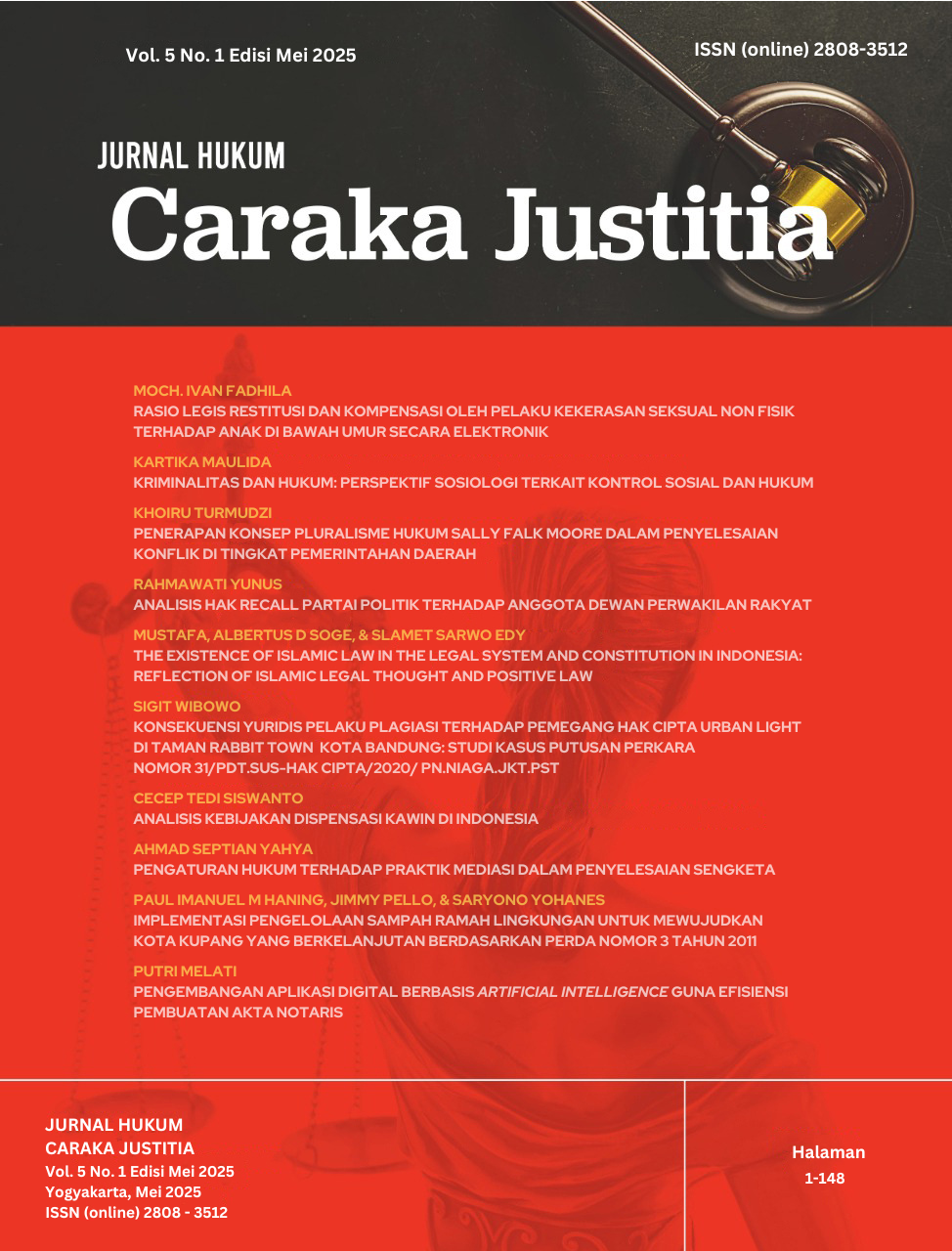
Konsekuensi Yuridis Pelaku Plagiasi Terhadap Pemegang Hak Cipta Urban Light di Taman Rabbit Town Kota Bandung
Studi Kasus Putusan Perkara Nomor 31/Pdt.Sus-Hak Cipta/2020/Pn.Niaga.Jkt.Pst
DOI:
https://doi.org/10.30588/jhcj.v5i1.2196Keywords:
Legal Consequences, Copyright Plagiarism, Decision on Case Number 31/Pdt.Sus-Copyright/2020/PN.Niaga.Jkt.PstAbstract
The purpose of this study is to determine and analyze the form of legal consequences for perpetrators of criminal plagiarism against the copyright holder “Urban Light” against the manager of Rabbit Town Park, who plagiarized his work. This research uses normative legal research methods that are prescriptive, which is a method by examining library materials shown in written regulations. The approach methods used in this legal writing are the case approach and the statutory approach.
The result of the study is the existence of legal consequences for the perpetrators of plagiarism of a work of authorship, which has legal consequences for them. The perpetrators of plagiarism in this case were imposed legal sanctions in the form of civil sanctions with the payment of compensation. This legal sanction was decided by the Judge, as a legal remedy taken by the other party harmed, namely the copyright holder Urban Light, because his work has been plagiarized by the management of Rabbit Town Park without permission for his copyright. The basis of the lawsuit brought by the copyright holder is the existence of moral rights and economic rights inherent in the copyright holder, which are normatively regulated in the Copyright Act. Manifestation of copyright is a creation that arises automatically based on the declarative principle after the creation is realized in a real creation without reducing restrictions according to the norms in the legislation.
References
Artikel Jurnal
Almaida, Zennia. “Perlindungan Hukum Preventif dan Represif Bagi Pengguna Uang Elektronik dalam Melakukan Transasksi Tol Non Tunai.” Privat Law 9, no. 1 (Januari-Juni 2021): 218-226. https://doi.org/10.20961/privat.v9i1.28858.
Hanum, Reza Fauzia, & Yudho Taruno Muryanto. “Kesesuaian Pertimbangan Hakim Terhadap Kriteria Plagiarisme Undang-Undang No 28 Tahun 2014 (Analisis Putusan Nomor 31/ Pdt.Sus-Hak Cipta/2020/ PN.JKT.PST).” Politika Progresif: Jurnal Hukum, Politik dan Humaniora 1, no. 1 (Maret 2024): 41-48. https://doi.org/10.62383/progres.v1i1.82.
Persada, N G E. “Seni Instalasi Utilitas Ekspos Pada Bangunan Bertema Industrial”. SENADA (Seminar Nasional Manajemen, Desain dan Aplikasi Bisnis Teknologi) 1 (November 2018): 456-463. https://eprosiding.idbbali.ac.id/index.php/senada/article/view/91/71.
Taupiqqurrahman, et. al. “Perlindungan Hak Cipta Terkait Pelanggaran Modifikasi Karya Ciptaan Asing yang Dilakukan Tanpa Izin di Indonesia.” Supremasi Jurnal Hukum 4, no. 1 (2021): 95-108. https://doi.org/10.36441/supremasi.v4i1.548.
Wardan, Made Kusuma, et. al. “Perlindungan Hukum terhadap Hak Kekayaan Intelektual di Lingkungan Provinsi Bali Khususnya Hak Cipta pada Motif Endek.” Jurnal Konstruksi Hukum 5, no. 1 (2024): 84-90. https://www.ejournal.warmadewa.ac.id/index.php/jukonhum.
Buku
Hariyani, Iswi. Prosedur Mengurus HAKI yang Benar. Yogyakarta: Pustaka Yustisia, 2010.
Hutahuruk, M. Peraturan Hak Cipta Nasional. Jakarta: Erlangga, 1982.
Mahmud, Peter Marzuki. Penelitian Hukum. Jakarta: Kencana, 2021.
Margono, Suyud. Hukum Hak Cipta Indonesia. Bogor: Ghalia Indonesia, 2010.
Roisah, Kholis. Konsep Hukum Hak Kekayaan Intelektual. Jakarta: Setara Press, 2015.
Soekanto, Soerjono. Pengantar Penelitian Hukum. Jakarta: UI-Press, 2007.
Supramono, Gatot. Hak Cipta dan Aspek-Aspek Hukumnya. Jakarta: Rineka Cipta, 2010.
Skripsi/Paper Kerja
Boer, Muhammad Riyan Kachfi. “Tinjauan Yuridis Tentang Tindak Pidana Terhadap Hak Cipta Atas Perangkat Lunak Komputer (Studi Kasus Putusan Nomor 2277 K/Pid/2006),” Skripsi Fakultas Hukum Universitas Hasanuddin, 2015.
Khotimah, C. A. “Perlindungan Hak Cipta atas Penggunaan Judul yang Sama pada Karya Cerpen dan Film,” Studi Cerpen Surat Dari Praha, 2017.
Downloads
Published
How to Cite
Issue
Section
License
Copyright (c) 2025 Sigit Wibowo

This work is licensed under a Creative Commons Attribution 4.0 International License.
Authors who publish with JHCJ agree to the following terms:
Authors retain copyright and grant the JHCJ right of first publication with the work simultaneously licensed under a Creative Commons Attribution 4.0 International License that allows others to share (copy and redistribute the material in any medium or format) and adapt (remix, transform, and build upon the material) the work for any purpose, even commercially with an acknowledgment of the work's authorship and initial publication in JHCJ.
Authors are able to enter into separate, additional contractual arrangements for the non-exclusive distribution of the journal's published version of the work (e.g., post it to an institutional repository or publish it in a book), with an acknowledgment of its initial publication in JHCJ. Authors are permitted and encouraged to post their work online (e.g., in institutional repositories or on their website) prior to and during the submission process, as it can lead to productive exchanges, as well as earlier and greater citation of published work (See The Effect of Open Access).