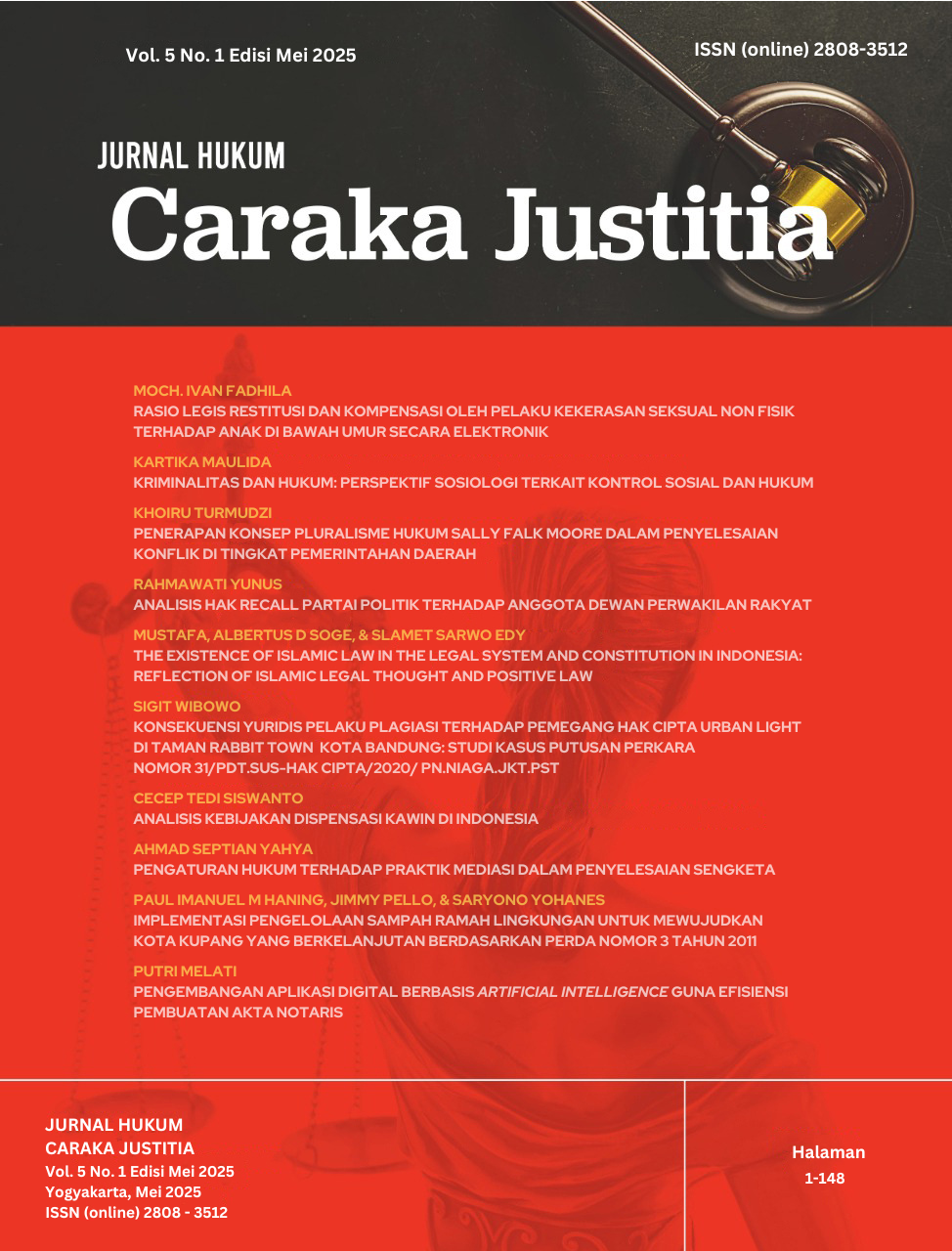
Analisis Hak Recall Partai Politik Terhadap Anggota Dewan Perwakilan Rakyat
DOI:
https://doi.org/10.30588/jhcj.v5i1.2192Keywords:
Popular Sovereignty, Right of Recall, Political Parties, House of RepresentativesAbstract
The recall right of political parties against members of the House of Representatives (DPR) in Indonesia is regulated in Article 239 paragraph (2) of Law Number 17/2014. The recall mechanism allows for the removal of members of the House of Representatives who are not in line with party policy, even though these members were directly elected by the people. This can shift popular sovereignty as it does not provide space for constituents to be involved in the recall process and can reduce the accountability of DPR members to their voters. The research focuses on the mechanism of recall rights of political parties against members of the House of Representatives based on the People's Sovereignty.
Through a normative inquiry, this research analyzes the provisions on the implementation of the recall right mechanism by political parties against members of the House of Representatives based on People's Sovereignty. The author finds that members of the House of Representatives can be dismissed intermittently if they are absent for three months without information, violate the oath/pledge or code of ethics, are sentenced to a minimum of five years in prison, are proposed by the party, no longer meet the candidate requirements, violate the provisions, lose party membership, or ally with alternative political groups. The mechanism goes through the stages of submitting proposals to the DPR leadership, the president, and the KPU. This research hopes to contribute understanding of the debate on the mechanism of recall rights of political parties without excluding popular sovereignty.
References
Artikel Jurnal
Hadan, Sulistiawati. “Analisis Yuridis terhadap Putusan Mahkamah Konstitusi Nomor 73/PUU-XX/2022 Terkait Ambang Batas Pencalonan Presiden dan Wakil Presiden.” Jurnal Ilmu Hukum Aktualita 1, no. 2 (2024): 86–100. http://jurnal.fakum.untad.ac.id/index.php/AKT/article/view/1088.
Nugroho, Helmy Nuky. “Strategi Peningkatan Kinerja Badan Kehormatan DPRD Dalam Penegakan Kode Etik Dewan.” Arena Hukum 9, no. 3 (2016): 307–27. https://arenahukum.ub.ac.id/index.php/arena/article/view/253.
Qoroni, Waisol, & Indien Winarwati. “Kedaulatan Rakyat Dalam Konteks Demokrasi Di Indonesia.” Inicio Legis 2, no. 1 (2021). https://journal.trunojoyo.ac.id/iniciolegis/article/view/11079.
Rikardo, Ofis. “Penerapan Kedaulatan Rakyat Di Dalam Pemilihan Umum Di Indonesia Berdasarkan Undang-Undang Dasar Negara Republik Indonesia Tahun 1945.” Jurnal Hukum Sasana 6, no. 1 (2020): 51–71. http://ejurnal.ubharajaya.ac.id/index.php/SASANA/article/view/228.
Sikumbang, Yudhia Perdana. “People’s Sovereignty in the Intertime Change of Members of The Indonesian Council of Representatives.” International Journal of Law Society Services 3, no. 2 (2023): 78–91. https://jurnal.unissula.ac.id/index.php/ijls/article/view/35232.
Syahrin, M Alpi. “Peran Partai Politik Dalam Demokrasi Perwakilan.” Eksekusi 2, no. 2 (2020): 146–65. https://ejournal.uinsuska.ac.id/index.php/eksekusi/article/view/10767.
Toloh, Pascal Wilmar Yehezkiel. “Politik Hukum Penguatan Partai Politik Untuk Mewujudkan Produk Hukum Yang Demokratis.” JAPHTN-HAN 2, no. 1 (2023): 141–68. http://japhtnhan.id/index.php/japhtnhan/article/view/60.
Buku
Farda, Nessa Fajriyana, et. al. Hukum Lembaga Negara. Padang: CV. Gita Lentera, 2024.
Kadi, Saurip, & Siok Lan Liem. Mengutamakan Rakyat: Wawancara Mayor Jenderal TNI Saurip Kadi. Jakarta: Yayasan Obor Indonesia, 2008.
M D, Mahfud. Perdebatan Hukum Tata Negara Pasca Amandemen Konstitusi, Cetakan Kedua. Depok: Raja Grafindo Persada, 2011.
Pandor, Pius C P. Pembusukan Demokrasi: Representasi Populis dan Implikasinya Bagi Demokrasi dalam Filsafat Politik Nadia Urbinati. Jakarta: Gramedia Pustaka Utama, 2024.
Saleh, S H. Hukum Acara Sidang Etik Penyelenggaraan Pemilu. Jakarta Timur: Sinar Grafika, 2022.
Disertasi/Tesis/Paper Kerja
Gunaryono, Nunung. “Kedudukan, Peran Dan Fungsi Tni Dalam Ketatanegaraan Ditinjau Dari UU No. 34 Tahun 2004 Tentang TNI.” Universitas Islam Indonesia, 2009.
Muhammad, Jaisy. “Pelembagaan Partai Demokrasi Indonesia Perjuangan (PDIP) Di Kabupaten Cirebon Tahun 2014-2019.” Skripsi, Universitas Islam Negeri Walisongo Semarang, 2023.
Perdana, Yudhia. “Politik Hukum Pemberhentian Anggota Dewan Perwakilan Rakyat Republik Indonesia Oleh Partai Politik Berdasarkan Ketentuan Pasal 16 ayat (1) Huruf D Undang-Undang Partai Politik.” Tesis, Universitas Islam Riau, 2022.
Subagja, Ari. “Hak Recall Oleh Partai Politik Terhadap Anggota Parlemen Berdasarkan Undang-Undang Nomor 17 Tahun 2014 Dalam Sistem Ketatanegaraan Indonesia.” Universitas Islam Indonesia, 2020.
Peraturan Perundang-undangan
UUD 1945.
UU Nomor 2 Tahun 2011 tentang Partai Politik.
Peraturan Komisi Pemilihan Umum Nomor 6 Tahun 2019 tentang Perubahan Atas Peraturan Komisi Pemilihan Umum Nomor 6 Tahun 2017 tentang Penggantian Antarwaktu Anggota Dewan Perwakilan Rakyat, Dewan Perwakilan Daerah, Dewan Perwakilan Rakyat.
UU Nomor 13 Tahun 2019 tentang Perubahan Ketiga atas UU Nomor 17 Tahun 2014 tentang Majelis Permusyawaratan Rakyat, Dewan Perwakilan Rakyat, Dewan Perwakilan Daerah, dan Dewan Perwakilan Rakyat Daerah.
Downloads
Published
How to Cite
Issue
Section
License
Copyright (c) 2025 Rahmawati Yunus

This work is licensed under a Creative Commons Attribution 4.0 International License.
Authors who publish with JHCJ agree to the following terms:
Authors retain copyright and grant the JHCJ right of first publication with the work simultaneously licensed under a Creative Commons Attribution 4.0 International License that allows others to share (copy and redistribute the material in any medium or format) and adapt (remix, transform, and build upon the material) the work for any purpose, even commercially with an acknowledgment of the work's authorship and initial publication in JHCJ.
Authors are able to enter into separate, additional contractual arrangements for the non-exclusive distribution of the journal's published version of the work (e.g., post it to an institutional repository or publish it in a book), with an acknowledgment of its initial publication in JHCJ. Authors are permitted and encouraged to post their work online (e.g., in institutional repositories or on their website) prior to and during the submission process, as it can lead to productive exchanges, as well as earlier and greater citation of published work (See The Effect of Open Access).