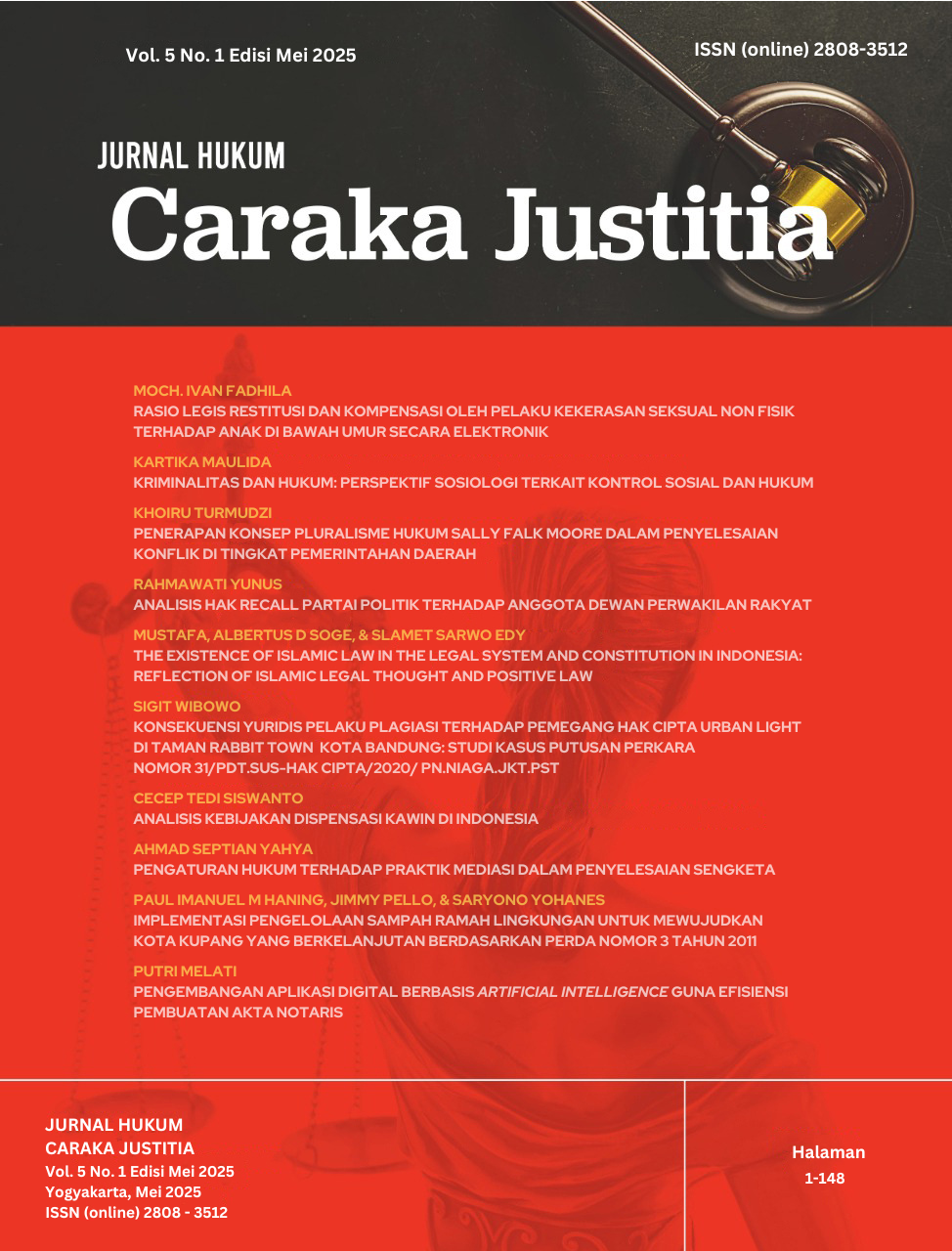
The Existence of Islamic Law in The Legal System And Constitution in Indonesia
Reflection of Islamic Legal Thought and Positive Law
DOI:
https://doi.org/10.30588/jhcj.v5i1.2146Keywords:
Transformation of Islamic Law into National LawAbstract
The legal position of Islam in the Republic of Indonesia cannot be separated from the influence of the entry of Islam throughout the archipelago around 16-17 Hijri, where at that time the spreaders of Islam throughout the archipelago came from various Middle Eastern countries, such as India, Pakistan, Arabia, Egypt, Jordan, and others, they traded to the archipelago while spreading Islam, and on average they brought the Shafi'i school of thought. The historical journey of the transformation of Islamic Law with various dimensions, namely; historical, philosophical, political, sociological, and legal. The presence of Islamic Law in Indonesia can be seen from two sides, namely: Islamic law applies legally formally or codified in the National legal structure, so the current compilation of Islamic Law was born which recorded the regulations of Islamic Law that have been enforced so far. And Islamic Law applies normatively, namely; having sanctions or legal equivalents for the Muslim community. The 1945 Constitution, Indonesia's constitution, also expresses the character and spirit of Islam, a constitution that is neither theocratic nor secular.
References
Journal Articles
Adillah, Fadlan Choirul. “Implementation of Living Values Education Pancasila Values In the Generation of Indonesians.” Jurnal Multidisiplin Indonesia 1, no. 1 (2022): 1-6. https://doi.org/10.57235/qistina.v1i1.15.
Books
Abdullah, Rozali. Pancasila as the State Philosophy and the Nation's Outlook on Life. Jakarta: Rajawali, 1989.
Ali, Ahmad. Revealing Legal Theory and Judicial Theory Including Interpretation of Legisprudence Laws. Jakarta: Kencana, 2009.
Azhary, Muhammad Thahir. Legal State: Aspect of Principles Viewed from the Perspective of Islamic Law, Its Implementation in the State of Medina and the Present. Jakarta: Kencana, 2007.
Baharudin. Islamic Educational Leadership. Yogyakarta: Ar-Ruz Media, 2012.
Bisri, Ilhami. Indonesian Legal System, Principles and Implementation of Indonesian Law. Jakarta: Grafindo Persada, 2005.
Hazairin. Islamic Legal Reform in Indonesia. Jakarta: UIP, 1976.
Kansil, Cristine. Indonesian Government System. Jakarta: Aksara Baru, 1985.
M S, Kaelan. Pancasila Education. Yogyakarta: Paradigma, 2008.
Mardani. Islamic Law, Collection of Regulations on Islamic Law in Indonesia, 2nd ed. Jakarta: Kencana, 2016.
Marzuki, Peter Mahmud. Legal Research. Jakarta: Prenada media Group, 2005.
Mudzhar, M. Atho. Approach to Islamic legal studies in Theory and Practice. Yogyakarta: Pustaka Pelajar, 1998.
Mustafa. Al-Mawardi's Thoughts on the Welfare State and Its Relevance in the Reform Era in Indonesia 1998-2018, First printing. Solok: Mitra Cendekia Media, 2021.
Mustafa. Human Essence and Existence: "Perspective of Islamic Legal Sources (Al-Qur'an and Sunnah), First printing. Purbalingga: CV. Eurengka Media Aksara, 2023.
Mustafa. Purification of Islamic Legal Philosophy: Wamallam yakum bima anzala Allah”. 1st ed. Purbalingga: CV. Eurengka Media Aksara, 2024.
Rahman, Fazlur. Islam and Political Action: Politics in the Religion,” in Nige Bigger, et al (ed.), Cities of God: Faith, Politics and Pluralism in Judaism, Christianity and Islam. New York: Greenwood Press, 1986.
Soekanto, Soerjono. Normative Legal Research. Jakarta: PT Raja Grafindo Persada, 2006.
Sukardja, Ahmad. Medina Charter and the 1945 Constitution. Jakarta: UI Press, 1995.
Suryadi, Budi. Political Sociology, History, Definition and Development of Concepts. Yogyakarta: IRCiSoD, 2007.
Suwarno, P J. Pancasila Budaya Bangsa Indonesia. Yogyakarta: Kanisius, 1993.
Proceeding/Paper
Arinanto, Satya. “Legal State in the Perspective of Pancasila,” Proceeding of the Pancasila Congress: Pancasila in Various Perspectives, Secretariat General and Registrar's Office of the Constitutional Court, 2009.
Muallim, Amir. “Islamic Legal Ijtihad Method in Indonesia: Efforts to Bring Text Messages Together with Social Reality,” Paper, in the inaugural speech of the professorship of Islamic jurisprudence, Islamic University of Indonesia, 2006.
Syaifuddin, Lukman Hakim. “Indonesia is a Religious Country: Formulating the Relationship between Religion and State in the Perspective of Pancasila,” Proceedings of the Pancasila Congress: Pancasila in Various Perspectives, Secretariat General and Registrar's Office of the Constitutional Court, 2009.
Statutory Regulations
The 1945 Constitution.
Tap MPR Number I/MPR/1983 on Peraturan Tata Tertib MPR.
Tap MPR Number IV/MPR/1983 on Referendum.
Downloads
Published
How to Cite
Issue
Section
License
Copyright (c) 2025 Mustafa, Albertus D Soge, Slamet Sarwo Edy

This work is licensed under a Creative Commons Attribution 4.0 International License.
Authors who publish with JHCJ agree to the following terms:
Authors retain copyright and grant the JHCJ right of first publication with the work simultaneously licensed under a Creative Commons Attribution 4.0 International License that allows others to share (copy and redistribute the material in any medium or format) and adapt (remix, transform, and build upon the material) the work for any purpose, even commercially with an acknowledgment of the work's authorship and initial publication in JHCJ.
Authors are able to enter into separate, additional contractual arrangements for the non-exclusive distribution of the journal's published version of the work (e.g., post it to an institutional repository or publish it in a book), with an acknowledgment of its initial publication in JHCJ. Authors are permitted and encouraged to post their work online (e.g., in institutional repositories or on their website) prior to and during the submission process, as it can lead to productive exchanges, as well as earlier and greater citation of published work (See The Effect of Open Access).