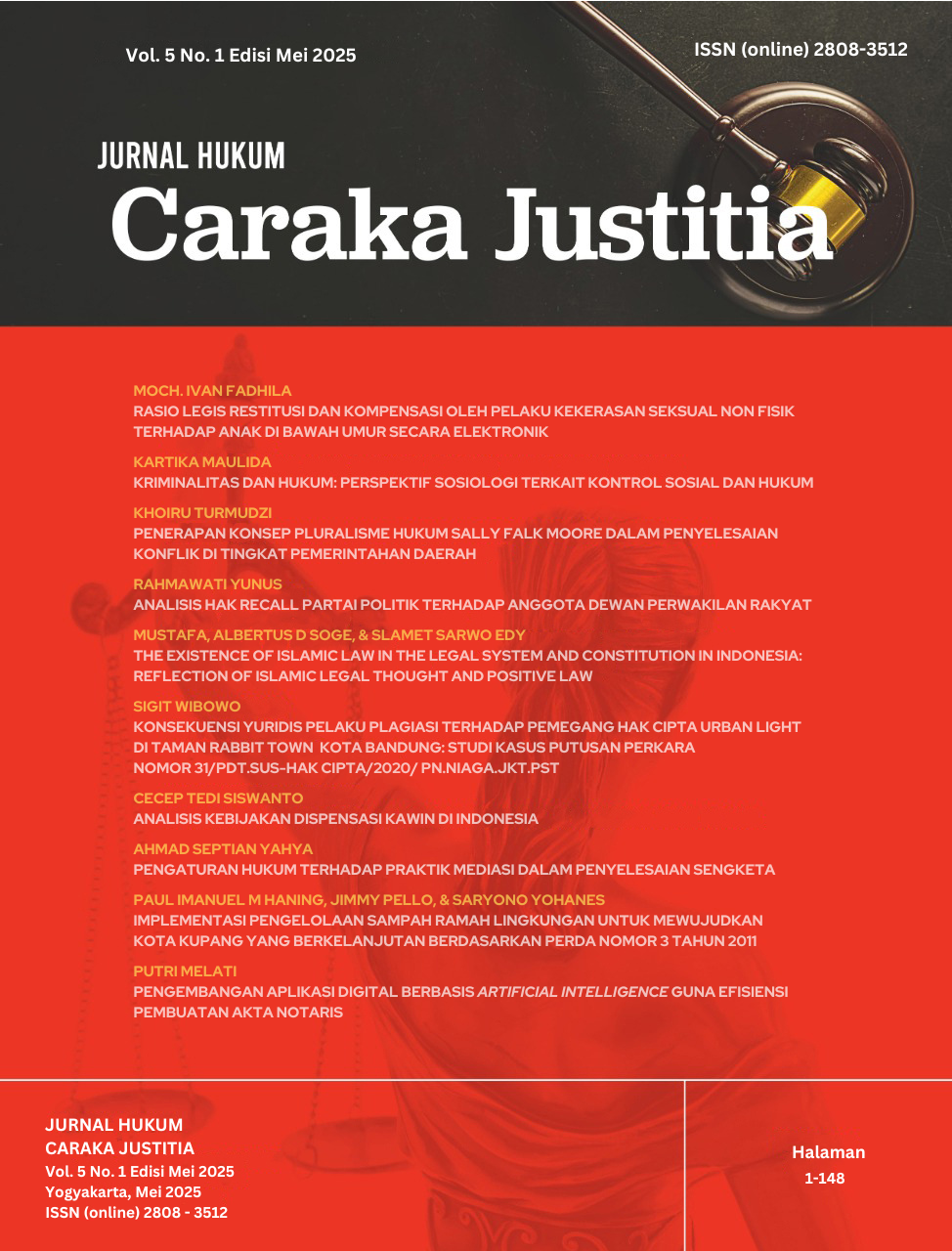
Penerapan Konsep Pluralisme Hukum Sally Falk Moore dalam Penyelesaian Konflik di Tingkat Pemerintahan Daerah
DOI:
https://doi.org/10.30588/jhcj.v5i1.2066Keywords:
Legal Pluralism, Sally Falk Moore, Conflict Resolution, Local GovernmentAbstract
This article discusses the application of Sally Falk Moore's concept of legal pluralism in conflict resolution at the local government level in Indonesia, known for its cultural diversity and complex normative systems. Legal pluralism refers to the coexistence of various legal systems, where customary law and state law interact and influence each other. In this context, the article explains how customary law is recognized within Indonesia's positive legal framework and its important role in resolving disputes arising from differences between the two legal systems.
Through an analysis of the interaction between state law and customary law, the article shows that applying legal pluralism can create balance and justice in conflict resolution, and strengthen the identity and rights of indigenous peoples. Using the concept of a semi-autonomous social environment, this article highlights the importance of recognizing the existence of customary law in improving social order and protecting community rights. In conclusion, applying legal pluralism not only provides solutions to conflicts but also contributes to developing a harmonious and equitable society.
References
Artikel Jurnal
Dewi, Anak Agung I A A. “Eksistensi Otonomi Desa Pakraman dalam Perspektif Pluralisme Hukum.” Jurnal Magister Hukum 3, no. 3 (November 2014). https://doi.org/10.24843/JMHU.2014.v03.i03.p13.
Fahmi, Erwin. “Pendekatan Semi-Autonomous Social Field dalam Studi dan Perencanaan Perkotaan: Telaah Metodologis.” Jurnal Muara Sains, Teknologi, Kedokteran, dan Ilmu Kesehatan 5, no. 2, (Oktober 2021).
Leatemia, Johanis. “Substansi Pengaturan Hukum Daerah Kepulauan.” Jurnal Hukum dan Pembangunan 41, no. 2 (2011): 108-241. https://doi.org/10.21143/jhp.vol41.no2.247.
Mashuri. “Konflik Batas Wilayah di Era Otonomi Menurut Undang-Undang 32 Tahun 2004.” Jurnal El-Riyasah 5, no. 2 (Desember 2014): 41. https://doi.org/10.24014/jel.v5i2.652.
Mulyono, Sutrisno Purwohadi. “Kebijakan Sinoptik Penerapan Hukum Adat dalam Penyelenggaraan Pemerintahan Desa.” Jurnal Yustisi 3, no. 2 (2014): 68-73. https://doi.org/10.20961/yustisia.v3i2.11096.
Pradhani, Sartika Intaning. “Pendekatan Pluralisme Hukum Dalam Studi Hukum Adat: Interaksi Hukum Adat Dengan Hukum Nasional Dan Internasional.” Undang: Jurnal Hukum 4, no. 1 (Juni 2021): 81–124. https://doi.org/10.22437/ujh.4.1.81-124.
Pramana, I Gede Pasek. “Hukum Adat dan Hukum Nasional: Elaborasi dalam Penyelenggaraan Pemerintah Daerah Mewujudkan Kesejahteraan Masyarakat.” Jurnal Majelis 2 (2020): 45-115.
Rahmasari, Betha, Ariza Umami, & Tirta Gautama. “Pengaruh Hukum Adat dalam Pengaturan Pemerintahan Desa: Perspektif Normatif.” Muhammadiyah Law Review 7, no. 2 (Agustus 2023): 60–77. https://doi.org/10.24127/mlr.v7i2.2770.
Sukmana, Sobar, Tuti Susilawati, et all. “Essensi Pluralisme Hukum Internasional dalam Perspektif Sistem Hukum Dunia.” PALAR (Pakuan Law Review) 10, no. 3 (Juli 2024): 40–55. https://doi.org/10.33751/palar.v10i3.10448.
Sulastriyono & Sandra Dini Febri Aristya. “Penerapan Norma dan Asas-Asas Hukum Adat dalam Praktik Peradilan Perdata.” Mimbar Hukum 24, no. 1 (2012): 25-40. https://doi.org/10.22146/jmh.16147.
Buku
Abubakar, Ali. Perempuan Gayo Pegawe: Nyaman Tapi Ingin Berubah. Banda Aceh: ICAIOS, 2022.
Aromatica, Desna, Aprih Santoso, & Yulia Ningsih, et all.. Membangun Desa dengan Revolusi Digital. Sumedang: Mega Press Nusantara, 2024.
Ingold, Tim. Companion Encyclopaedia of Anthropology. London: Routledge, 2021.
J.M., Otto, Stoter, et all. The Use of Lawmaking Theory for Improving Legal Quality in Development Projects. Netherlands: Leiden University, 2012.
Internet
Desembri. “Harmonisasi Hukum Adat Minangkabau di Era Milenium.” https://andaleh-limapuluhkotakab.desa.id/artikel/2021/11/18/harmonisasi-hukum-adat-minangkabau-di-era-milenium (diakses 16 Oktober 2024).
Forest Peoples Programme. “Divers Paths To Justice.” https://www.forestpeoples.org/sites/fpp/files/publication/2011/11/divers-paths-justice-cover.pdf (diakses 16 Oktober 2024).
MK RI. “Tak Bedakan Desa dan Desa Adat, UU Desa Diuji.” https://www.mkri.id/index.php?id=17936&menu=2&page=web.Berita (diakses 18 Oktober 2024).
Safa’At, Muchamad Ali. “Struktur Pemerintahan Daerah.” http://safaat.lecture.ub.ac.id/files/2011/11/Struktur-Pemerintahan-Daerah.pdf (diakses 18 Oktober 2024).
Downloads
Published
How to Cite
Issue
Section
License
Copyright (c) 2025 Khoiru Turmudzi

This work is licensed under a Creative Commons Attribution 4.0 International License.
Authors who publish with JHCJ agree to the following terms:
Authors retain copyright and grant the JHCJ right of first publication with the work simultaneously licensed under a Creative Commons Attribution 4.0 International License that allows others to share (copy and redistribute the material in any medium or format) and adapt (remix, transform, and build upon the material) the work for any purpose, even commercially with an acknowledgment of the work's authorship and initial publication in JHCJ.
Authors are able to enter into separate, additional contractual arrangements for the non-exclusive distribution of the journal's published version of the work (e.g., post it to an institutional repository or publish it in a book), with an acknowledgment of its initial publication in JHCJ. Authors are permitted and encouraged to post their work online (e.g., in institutional repositories or on their website) prior to and during the submission process, as it can lead to productive exchanges, as well as earlier and greater citation of published work (See The Effect of Open Access).