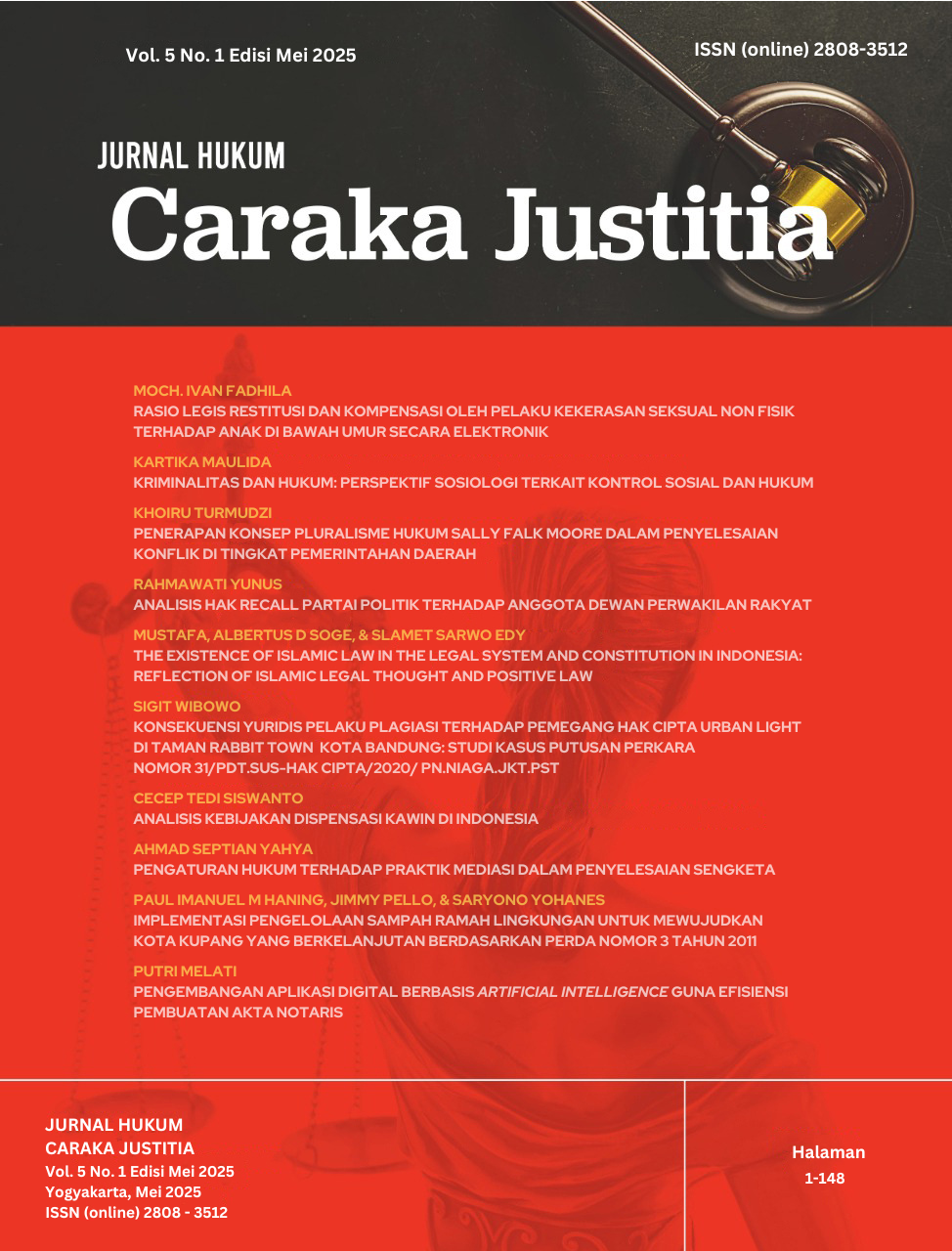
Kriminalitas dan Hukum
Perspektif Sosiologi Terkait Kontrol Sosial dan Hukum
DOI:
https://doi.org/10.30588/jhcj.v5i1.2054Keywords:
Criminality, Sosial Control, Sociology of LawAbstract
This article discusses the relationship between criminality and law from a sociological perspective, focusing on social control and the role of law in regulating societal behavior. Criminality is often understood as a violation of prevailing legal norms, but sociology views it as a social phenomenon influenced by various factors, including social, economic, and cultural structures. In this context, the law functions as a tool of social control aimed at maintaining order and stability. The article explores how social norms are codified into law and how the law interacts with power dynamics and group interests within society. This approach emphasizes the importance of understanding the social context in the application of law and the effectiveness of social control in addressing criminality. Through theoretical analysis and literature review, the article offers a more comprehensive understanding of the relationship between crime and law in modern social structures.
References
Artikel Jurnal
Gayatri, Ni Made Indah, & Gede Made Swardhana. “Teori Kriminologi dalam Memecahkan Kejahatan Pencurian Beserta Kekerasan yang Dilakukan Secara Berlanjut (Pasal 365 KUHP).” Jurnal Media Akademik 2, no. 10 (2024): 1-21. https://doi.org/10.62281/v2i10.859.
Iriani, Dewi. “Hukum Sebagai Alat Kontrol Sosial dan Sistem Supremasi Penegakan Hukum.” Justitia Islamica 8, no. 1 (2011): 139-159. https://doi.org/10.21154/ justicia.v8i1.527.
Buku
Dulkiah, Moh. Sosiologi Kriminal. Bandung: LP2M UIN SGD, 2020.
Muryanti. Sosiologi Hukum dan Kriminal. Bantul: Manggar Media, 2020.
Paikah, Nur. Sosiologi Hukum. Ternate: CV Cendekiawan Indonesia Timur, 2023.
Susanti, Emila & Eko Rahadjo. Hukum dan Kriminologi, edited by Heni Siswanto. Bojonegoro: CV Anugrah Utama Rahardja, 2015.
Skripsi/Makalah
Athifahputih, Putri Yaila Rahimah. “Kajian Teori Kriminal dari Perspektif Sosiologi,” Makalah, Universitas Sebelas Maret, 2022.
Merlinda, Vina. “Hubungan Kesadaran Hukum dengan Tindak Kriminalitas Masyarakat,” Skripsi, Universitas Negeri Jakarta, 2017.
Internet
Coleman, Katie. “Teori Sosiologi Kriminalitas.” Libertext, n.d. https://socialsci.libretexts.org/Bookshelves/Gender_Studies/Introduction_to_Gender_Studies_(Coleman)/10%3A_Gender_Deviance_Crime_and_Punishment/10.03%3A_Sociological_Theories_of_Criminality (diakses 15 Januari 2024).
Hashela, rizka noor. “Realitas Hukum Dalam Asas Kesetaraan di Depan Hukum.” https://jdih.tanahlautkab.go.id/artikel_hukum/detail/realitas-hukum-dalam-asas-equality-before-the-law (diakses 12 Januari 2024).
Nurkasihani, Iba. “Restorative Justice, Alternatif Baru dalam Sistem Pemidanaan.” https://jdih.tanahlautkab.go.id/artikel_hukum/detail/restorative-justice-alternatif-baru-dalam-sistem-pemidanaan (diakses 12 Januari 2024).
Oktavira, Barnadetha Aurelia, Hukum Online. “Makna Asas Equality Before The Law dan Contohnya.” https://www.hukumonline.com/klinik/a/makna-asas-iequality-before-the-law-i-dan-contohnya-lt6233304b6bfba/#_ftn1 (diakses 12 Januari 2024).
Setianingsih, Rofiqoh. “Analisis Ketimpangan Konsepsi Keadilan dalam Penerapan Hukum di Indonesi Berdasarkan Nilai Yang Tercermin pada Pancasila Sila Ke-5 ‘Keadilan Sosial Bagi Seluruh Rakyat Indonesia’.” https://iainutuban.ac.id/2022/06/28/analisis-ketimpangan-konsepsi-keadilan-dalam-penerapan-hukum-di-indonesia-berdasarkan-nilai-yang-tercermin-pada-pancasila-sila-ke-5-keadilan-sosial-bagi-seluruh-rakyat-indonesia/ (diakses 12 Januari 2024).
Thomas J, Bernad. “Sociological Theories.” https://www.britannica.com/science /criminology/Sociological-theories (diakses 12 Januari 2024).
Downloads
Published
How to Cite
Issue
Section
License
Copyright (c) 2025 Kartika Maulida

This work is licensed under a Creative Commons Attribution 4.0 International License.
Authors who publish with JHCJ agree to the following terms:
Authors retain copyright and grant the JHCJ right of first publication with the work simultaneously licensed under a Creative Commons Attribution 4.0 International License that allows others to share (copy and redistribute the material in any medium or format) and adapt (remix, transform, and build upon the material) the work for any purpose, even commercially with an acknowledgment of the work's authorship and initial publication in JHCJ.
Authors are able to enter into separate, additional contractual arrangements for the non-exclusive distribution of the journal's published version of the work (e.g., post it to an institutional repository or publish it in a book), with an acknowledgment of its initial publication in JHCJ. Authors are permitted and encouraged to post their work online (e.g., in institutional repositories or on their website) prior to and during the submission process, as it can lead to productive exchanges, as well as earlier and greater citation of published work (See The Effect of Open Access).